To save content items to your account,
please confirm that you agree to abide by our usage policies.
If this is the first time you use this feature, you will be asked to authorise Cambridge Core to connect with your account.
Find out more about saving content to .
To save content items to your Kindle, first ensure no-reply@cambridge.org
is added to your Approved Personal Document E-mail List under your Personal Document Settings
on the Manage Your Content and Devices page of your Amazon account. Then enter the ‘name’ part
of your Kindle email address below.
Find out more about saving to your Kindle.
Note you can select to save to either the @free.kindle.com or @kindle.com variations.
‘@free.kindle.com’ emails are free but can only be saved to your device when it is connected to wi-fi.
‘@kindle.com’ emails can be delivered even when you are not connected to wi-fi, but note that service fees apply.
Auditory verbal hallucinations (AVHs) in schizophrenia have been suggested to arise from failure of corollary discharge mechanisms to correctly predict and suppress self-initiated inner speech. However, it is unclear whether such dysfunction is related to motor preparation of inner speech during which sensorimotor predictions are formed. The contingent negative variation (CNV) is a slow-going negative event-related potential that occurs prior to executing an action. A recent meta-analysis has revealed a large effect for CNV blunting in schizophrenia. Given that inner speech, similar to overt speech, has been shown to be preceded by a CNV, the present study tested the notion that AVHs are associated with inner speech-specific motor preparation deficits.
Objectives
The present study aimed to provide a useful framework for directly testing the long-held idea that AVHs may be related to inner speech-specific CNV blunting in patients with schizophrenia. This may hold promise for a reliable biomarker of AVHs.
Methods
Hallucinating (n=52) and non-hallucinating (n=45) patients with schizophrenia, along with matched healthy controls (n=42), participated in a novel electroencephalographic (EEG) paradigm. In the Active condition, they were asked to imagine a single phoneme at a cue moment while, precisely at the same time, being presented with an auditory probe. In the Passive condition, they were asked to passively listen to the auditory probes. The amplitude of the CNV preceding the production of inner speech was examined.
Results
Healthy controls showed a larger CNV amplitude (p = .002, d = .50) in the Active compared to the Passive condition, replicating previous results of a CNV preceding inner speech. However, both patient groups did not show a difference between the two conditions (p > .05). Importantly, a repeated measure ANOVA revealed a significant interaction effect (p = .007, ηp2 = .05). Follow-up contrasts showed that healthy controls exhibited a larger CNV amplitude in the Active condition than both the hallucinating (p = .013, d = .52) and non-hallucinating patients (p < .001, d = .88). No difference was found between the two patient groups (p = .320, d = .20).
Conclusions
The results indicated that motor preparation of inner speech in schizophrenia was disrupted. While the production of inner speech resulted in a larger CNV than passive listening in healthy controls, which was indicative of the involvement of motor planning, patients exhibited markedly blunted motor preparatory activity to inner speech. This may reflect dysfunction in the formation of corollary discharges. Interestingly, the deficits did not differ between hallucinating and non-hallucinating patients. Future work is needed to elucidate the specificity of inner speech-specific motor preparation deficits with AVHs. Overall, this study provides evidence in support of atypical inner speech monitoring in schizophrenia.
Schizophrenia and other psychotic disorders are disorders in which the individual’s assessment of reality is impaired and which progress with exacerbations and become chronic, leading to disability, loss of function, social communication problems and frequent hospitalisations.
Objectives
The aim of our study was to evaluate the clinical and sociodemographic data of patients followed up in the outpatient clinic for psychotic disorders and hospitalized at least once in any time during their treatment.
Methods
The sample of the present study consisted of patients who were followed up in the psychotic disorders outpatient clinic of Selçuk University Faculty of Medicine Hospital and who were hospitalised at least once. Patients were identified by retrospective file search and those with sufficient information about their sociodemographic-clinical characteristics were included. The study approved by the ethics committee of Selçuk University Faculty of Medicine.
Results
Of the 130 patients, 52 (40%) were female and 78 (60%) were male; mean age was 40.8 ± 12.0 years. Almost half of the patients (n=53, 40.8%) had primary school education. 73 (59.2%) of 130 patients were receiving long-acting antipsychotic medication. 100 patients (76.9%) were using oral antipsychotics. 63 out of 100 patients were on clozapine. 22 of 63 patients used clozapine as monotherapy. The mean duration of untreated psychosis (n=90) was 15.8 ± 32.1 months. The mean number of hospitalisations was 3.4 ± 2.5. 15 patients (11.5%) were lived in a nursing home. The mean number of hospitalisations of patients receiving long-acting treatment (3.8±2.9) was significantly higher than that of patients receiving oral treatment only (2.7±1.6) (p=0.004). There was no significant difference in the mean number of hospitalisations when comparing according to the presence of clozapine in the treatment (p>0.05).
Conclusions
The primary goal in the treatment of patients with schizophrenia is to prevent relapses, hospital admissions and improve patients’ quality of life and functioning. Therefore, the variables related to hospitalisations, which are an indirect indicator of the frequency of psychotic episodes, should be well evaluated. Our study was mainly descriptive and evaluated the relationship between several parameters and hospitalisations. It was thought that the high number of hospitalisations in patients on long-acting treatment might be related to the fact that long-acting treatment in our country is mostly started in the late stages of the disease. Large-sample studies of predictive parameters are needed to prevent psychotic episodes and reduce the number of hospitalisations.
In large cities around the world, many sources of noise including traffic, domestic, construction, and industrial activities, contribute to urban noise pollution, which is now, a major concern in public health as declared by the WHO, for more than a decade (in 2011).
Objectives
The aim of this study was to try to find potential recommendations and references in terms of urban planning, particularly with the emergence of smart cities, to combat the problem of noise pollution and related mental health hazards.
Methods
We conducted a comprehensive review of the scientific literature using the following keywords: cities, smart cities, noise, pollution and mental health.
Results
Our research found that the continuous exposure to high noise levels could lead to psychological and physiological problems, such as hearing disorders, high blood pressure, heart disease, inconvenience and sleep disorders. While recent evidence indicates that road traffic noise has a negative impact on mental health and that aircraft noise significantly increases the risk of depression, there are not enough studies to date to properly assess the relationship between urban noise pollution and mental health hazards such as anxiety, mood disorders, sexual disturbance, cognitive impairment, learning disabilities, dementia, etc. In the field of urban planning, there is also a lack of reliable data on individual exposure to environmental noise in space and time, and on its effects on mental health.
Conclusions
Various noise mitigation strategies in urban renewal plans are proposed, such as the implementation of noise mapping to provide the detailed spatial distribution of noise levels in urban areas, their sources and time intervals, noise barriers along traffic arteries, vegetation and landscaping. New infrastructure projects involving new expressways and high-speed trains as well as the widening of major roads in their central areas are also suggested.
A 36-year-old man with a history of cannabis use disorder since age 16, consuming 8-10 units/day, experienced irritability and tremors upon reducing consumption. His psychiatric issues emerged in 2020, marked by anxiety, abdominal pain, and severe vomiting, leading to a dyspepsia diagnosis. Subsequently, he received psychiatric care at CAS Hospitalet, diagnosed with severe cannabis use disorder. No prior inpatient admissions occurred.
Objectives
Our project aims to show a case report and summarize the available evidence on cannabinoid hyperemesis syndrome (CHS).
Methods
In May 2023, he voluntarily sought admission to Barcelona’s “Hospital Sant Pau,” aiming for cannabis detox and treatment of cannabinoid hyperemesis. He’d endured years of intense abdominal pain, nausea, and vomiting, worsening over the last two years, with uncontrollable vomiting hindering daily life. Admission saw reduced cannabis use to 3-4 units/day. Inpatient care revealed anticipatory anxiety, rumination, and somatic anxiety, accompanied by distal tremors and internal restlessness due to abdominal discomfort, partially alleviated by 5-10 mg of diazepam.
Results
Treatment included domperidone 10mg/8h, haloperidol drops (5-10 drops/8h), capsaicin ointment, hot showers, and cryotherapy, resulting in gradual relief from abdominal pain. Moderate cravings for tobacco and cannabis led to acetylcysteine 600mg/12h and gabapentin up to 1200mg/8h. Gastric discomfort with SSRIs led to vortioxetine 10 mg/day, well-tolerated with a positive response. Consultation with the GI department confirmed the treatment’s efficacy, emphasizing cannabis abstinence. Upon discharge, cannabinoid hyperemesis symptoms markedly improved, and the patient was referred to “Hospital de Dia.”
Conclusions
CHS is a cyclic vomiting syndrome, preceded by daily to weekly chronic longstanding use of cannabis that can be difficult to diagnose and treat(1,3,4). It is unique in presentation, because of the cannabis’s biphasic effect as anti-emetic at low doses and pro-emetic at higher doses, and the association with pathological hot water bathing (2). The major characteristics are as follows: history of regular cannabis for any duration of time (100%), cyclic nausea and vomiting (100%), resolution of symptoms after stopping cannabis (96.8%), compulsive hot baths with symptom relief (92.3%), male predominance (72.9%), abdominal pain (85.1%), and at least weekly cannabis use (97.4%)(1). Treatments such as topical capsaicin, haloperidol, benzodiazepines, and propranolol have shown symptom relief (3) whereas opioids should be avoided (4). Cannabis cessation appears to be the best treatment (1,3).
References
1. Sorensen et al. Journal of Medical Toxicology 13 (2017):71-87.
2. Perisetti et al. Annals of gastroenterology 33.6 (2020):571.
3. Senderovich et al. Medical Principles and Practice 31.1 (2022):29-38.
4. Leu, et al. Journal of Emergency Nursing 47.3 (2021): 483-486
Infants born preterm usually show a Preterm Behavioural Phenotype, which includes mixed symptomatology characterized by lack of attention, anxiety and social difficulties, with a 3-4 times greater risk of disorders in further childhood. Critically, this behavioural pattern is also observed in infants born after a threated preterm labour (TPL), regardless of the presence of prematurity. It is known that the course of this Preterm Behavioural Phenotype shows high variability. Nevertheless, the predictors of this Preterm Behavioural Phenotype prognosis remain unknown.
Objectives
This study aimed to explore the predictors of change of Preterm Behavioural Phenotype symptomatology during preschool ages in order to improve prognosis.
Methods
In this prospective cohort study, 117 mother–child pairs who experienced TPL were recruited. Preterm Behavioural Phenotype symptoms were assessed at age 2 and 6 using Child Behaviour Checklist. Gestational age at birth, maternal anxiety trait, maternal history of psychological traumas, prenatal and postnatal maternal depression, anxiety, and cortisol as well as parenting stress were included as predictors in a regression model.
Results
Whereas increased internalizing problems were associated with a previous trauma history (p = .003), increased externalizing symptoms were linked to prenatal and postnatal maternal anxiety (p = .004 and p = .018, respectively).
Conclusions
Identifying modifiable risk factors, such as the history of maternal traumas and anxiety at TPL diagnosis and postpartum is recommendable to enhance better prognosis of Preterm Behavioural Phenotype in the offspring.
Public safety personnel (PSPs) often suffer from mental health issues due to the challenging and intricate nature of their work. Various barriers may prevent them from seeking necessary support and treatment. Therefore, implementing innovative and cost-effective interventions can potentially enhance the mental well-being of PSPs.
Objectives
The study sought to assess the influence of the Text4PTSI program on symptoms of depression, anxiety, trauma, and stress, as well as the resilience of public safety personnel after six months of receiving supportive text message intervention.
Methods
PSP subscribed to the Text4PTSI program and received daily supportive l SMS text messages for six months. Participants were invited to complete standardized self-rated web-based questionnaires to assess depression, anxiety, posttraumatic stress disorder (PTSD), and resilience symptoms measured on the Patient Health Questionnaire-9 (PHQ-9), Generalized Anxiety Disorder-7 scale (GAD-7), Posttraumatic Stress Disorder Checklist-Civilian Version (PCL-C), and the Brief Resilience Scale (BRS), respectively. The assessment of mental health conditions was conducted at enrolment, six weeks, three months, and six months after enrollment.
Results
One hundred and thirty-one subscribers participated in the Text4PTSI program. A total of 31 participants completed the baseline survey, and 107 total surveys were recorded at all follow-up time points. The baseline prevalence of likely major depressive disorder (MDD) was 47.1%, likely generalized anxiety disorder (GAD) was 37.5%, low resilience was 22.2%, and likely PTSD was 13.3%. At six months post-intervention, the prevalence of psychological conditions. There was a decrease in the mean scores on the PHQ-9, GAD-7, PCL-C, and the BRS from baseline to post-intervention by 25.8%, 24.7%, 9.5%, and 0.3%, respectively. However, the decrease was only statistically significant for the mean change in GAD-7 scores with a low effect size (t (15) = 2.73, p = 0.02).
Conclusions
The results of this study suggest a reduction in the prevalence of likely MDD as well as the severity of anxiety symptoms from baseline to post-intervention for subscribers of the Text4PTSI program. The program has the potential to complement existing services, aiding in mental health support for public safety personnel.
It is known that the formation of aggressive behavior is accompanied by neurodegenerative and neuroinflammatory changes. Immune cells have a regulatory effect on the central nervous system functions, including regulation of behavior.
Objectives
We first demonstrated that ex vivo chlorpromazine - modulated immune cells have a positive aggressive behavior editing effect. The aim of the study was to investigate the influence of the indicated cells on some central mechanisms underlying the development of aggressive reactions.
Methods
(CBAxC57Bl/6) F1 aggressive male mice, developed in conditions of chronic social stress, were undergoing the transplantation of syngeneic spleen lymphocytes with ex vivo chlorpromazine-modulated functional activity. In recipients the immunohistochemical analysis was performed assessing the expression of the microglial marker Iba1. The levels of brain-derived neurotrophic factor (Bdnf) and cytokines was assessed by ELISA. For histological examination Nissl staining was applied.
Results
Aggressive behavior editing after the chlorpromazine-modulated immune cells transplantation registered against the background of some structural and functional changes in the brain. It was found an increase in the density of pyramidal neurons in CA1 and CA3 hippocampal regions and augmented level of Bdnf. The decreased expression of microglial activation marker Iba1, accompanied with decreased levels of pro-inflammatory cytokines (IL-1β, IL-2, IL-6, INF-γ) and increased anti-inflammatory (IL-4) cytokine was found. Visualization of functionally active lymphocytes pre-treated with chlorpromazine in the brain parenchyma of aggressive recipients suggests a direct effect of injected lymphocytes on CNS.
Conclusions
The effect of chlorpromazine - modulated immune cells that edits aggressive behavior is realized by stimulating neurogenesis, neuroplasticity and reducing neuroinflammation.
To handle well clinical treatments, it is crucial to know the expectations of patients who seek help. We need to ask ourselves: how do patients interpret subjectively their diagnosis, treatments, and self-care? Medical Psychology brings us theories for this understanding. Grave’s Disease is an autoimmune disorder, a form of hyperthyroidism with a goitre, affecting also the eyes and the skin, as well as emotional manifestations. Weight loss, sometimes psychologically welcome, although due to a disease, can mean a psychoanalytic secondary gain. So, the medicine that leads to clinical improvement can be taken with ambivalence and bad adherence to treatment. It is important to differentiate between disease, a scientific entity explained by the clinical professional, and illness as a patient’s subjective perception of an un-health.
Objectives
To understand psychodynamically the fantasies, desires, and views related to Graves’ Disease as reported by patients in hyperthyroidism but without ophthalmopathy interviewed at an endocrinology-specialized outpatient clinic. (in the EPA-2023, it was presented the qualitative results of a sample in hyperthyroidism, with ophthalmopathy, studied at the same service).
Methods
Clinical-Qualitative Method designed by Turato. Data collected through Semi-Directed Interviews with Open-ended Questions in-Depth; and Field Notes, transcript fully. Treated by the Seven Steps of Clinical-Qualitative Content Analysis of Faria-Schützer, using psychodynamic concepts from Balintian Medical Psychology. Although we have extracted categories that permit us interesting discussions, we intend to close the sample (through the information saturation criterion by Fontanella) when we obtain other categories. The interviewer, a male psychologist, is the first author. The findings are validated by peer-reviewers of the Lab of Clinical Qualitative Research of the State University of Campinas.
Results
Three categories were chosen for this presentation: 1) “An atomic bomb in my life”: How drastic changes of a hormonal disease re-symbolize the patient’s life; 2) “I didn’t think the thyroid did that much”: the disease seen as a metaphor in a psychological blaming language to own disease and to himself as a sick person. 3) “I have so much medicine!”: a mode of referring to treatment that would justify an undisciplined use of medications.
Conclusions
Our findings can help clinical professionals to have a better understanding of some psychological meanings which have sense in the patients’ conscience, often not verbalized clearly in the conversation, and so to handle better the patients and relatives. In this way, it can reduce the patient’s resistance to recommended treatment, as well as encourage the clinical team to construct empathy with them.
Much has been made of the decline in population mental health over COVID but most studies show this just exacerabted a loing term trend This has predominnatly been attributed to changes in adolescent mental health over the past decade but there ahs been little evalaution of whether this post Millenium cohort was the first to demonstrate such a decline
Objectives
This study investigates to what extent mental differs in people born in different decades – i.e., possible birth cohort differences in the mental health of the popualtion over the past two decades To remove the linear dependency and identify any differences in trends between cohorts, we model mental health for each cohort as a nonlinear smooth function of age in an age-cohort model.
Methods
This analysis draws on 20 annual waves of the Household Income and Labour Dynamic in Australia (HILDA) survey.,is a nationally representative household panel that commenced in 2001 with 13,969 participants. The birth cohort of each person was defined by the decade of birth year(1940s, 1950s, etc). Mental ill health was assessed with the MHI5 from the SF36, in each wave and K10 from alternate waves. We estimate and compare penalized smooth trends in mental health for each cohort using restricted maximum likelihood (REML) using generalized additive mixed modelling (GAMM). Cohort effects are captured by directly estimating the differences between the smooth age trends of adjacent cohorts.
Results
Later cohorts were more likely to have poorer mental health, higher distress, more likely to be single and unemployed, and less likely to be chronically ill or disabled. Mental health was worse for younger age-groups in each survey year, and this discrepancy is much greater in more recent surveys - consistent with a birth cohort effect. Millennials (those born in the early 1990s) had a lower score at the same age as earlier generations, and the later cohorts do not show the age-related improvement seen in other earlier cohorts as they aged. At age 30 the average MHI-5 score of those born in the 1990s was 67, compared to 72.5 and 74 for people born in the 1980s and 1970s.
Conclusions
The deterioration in mental health over time which has been reported in large cross-sectional surveys, likely reflects cohort-specific effects related to the experiences of young people born in the Millennial generation and, to a lesser extent, those from the immediately prior cohort born in the1980s. We need to understand whether later cohorts are less resilient to similar risk factors experienced by earlier cohorts or whether they experience more and/or a greater severity of risks for mental ill-health. Such evidence is critical if the deteriorating pattern of mental health is to be arrested.
The journey for the electroconvulsive therapy began in 1938, when convulsive seizures induced by electrical stimulus were used, for the first time, in the therapy of patients diagnosed with Schizophrenia. Over the time, this therapy remains an important one, due to its applicability and necessity in the therapeutic management of patients with psychiatric pathology.
Objectives
Electroconvulsive therapy has evolved as a technique, nowadays being applied under induced intravenous anesthesia with the administration of oxygen on the mask, and from 2001, the sinus electrical stimulus has been replaced by the one in the form of a short pulse, upon the recommendation of professional organizations, in order to increase its therapeutic effectiveness. However, this form of therapy continues to be stigmatized, largely due to the way it is presented in the mass media. The objective of this work was to analyze how mental health professionals perceive electroconvulsive therapy.
Methods
We conducted a study in which we used a questionnaire applied to the Romanian professionals in the field of mental health.
Results
The results were analyzed in accordance with the objective of the study.
Conclusions
Through this analysis we wanted to understand how electroconvulsive therapy is seen through the eyes of mental health professionals and to identify those aspects that can help us in carrying out information programs, with a major impact on mental health, in order to reduce stigma forasmuch the therapeutic benefits of electroconvulsive therapy outweigh the possible risks.
Introduction: Affective patients, especially depressive, have an increased risk of suicidal behavior. Identifying individuals at increased risk remains a challenge. Among the correlates that may be crucial, the impact of personality is emphasized. Attention is paid to impulsivity, measured by subjective or objective tests.
Objectives
Objectives: Comparative analyses were carried out to capture the differences and relationship between personality dimensions, impulsivity, and the decision-making style and coping with stress strategies in suicide attempters and non-attempters in the course of an affective disorder.
Methods
Methods: Data were obtained from 276 individuals diagnosed with unipolar and bipolar affective disorder, both sexes. The study group was disaggregated into a subgroup of patients with (N=95) and without (N=181) suicide attempts in an individual’s history. The Temperament and Character Inventory (TCI) was used to assess personality dimensions. The Barratt Impulsiveness Scale version 11 (BIS-11) was used to measure impulsivity subjectively, and the Simple Reaction Time (SRT) test and the Continuous Performance Test (CPT) were objective assessment methods. The Coping Orientation to Problems Experienced (COPE) and Iowa Gambling Task (IGT) were applied to investigate coping and decision-making styles. Statistical analyses were performed in Statistica 13.3 StatSoft, Krakow, Poland.
Results
Results: In TCI, significant differences between suicide attempters and non-attempters concerned the following dimensions: harm avoidance (HA) (p=<0.0000), self-directedness (SD) (p=0.0001), and cooperativeness (C) (p=0.0186). In the CPT test, significant differences concerned correctly responded trials (p=0.0179) and Bias response (p=0.0230). In IGT, significant differences occurred in IGT block1_sum (p=0.0496) only (Table 1). We did not observe any significant differences in other tests applied. In the Spearman rank correlation analysis in the group of suicide attempters, the following correlations (p>0.05) with at least moderate strength rs>0.4 were revealed: Novelty seeking (NS), SD, and C correlated with several CPT parameters; Persistence (P) correlated with SRT variables; NS, HA and SD with BIS-11 variables.
Conclusions
Conclusions: Objective computerized tests (SRT; CPT; IGT) did not differentiate suicide attempters and non-attempters more clearly than self-reporting personality inventory TCI. Personality traits correlated with SRT and CPT variables. BIS-11 and COPE parameters did not enable to distinguish suicide attempters and non-attempters in the investigated group. This suggests that tests used complement each other, and using a single tool may be insufficient to indicate patients at increased risk of suicidal behavior.
In ESCAPE-TRD, esketamine nasal spray (ESK-NS) significantly increased the probability of remission at Week (Wk)8 and being relapse‑free through Wk32 after remission at Wk8 versus (vs) quetiapine extended-release (QTP-XR), in patients (pts) with treatment resistant depression (TRD). Safety data were consistent with established profiles of each treatment, with no new safety signals identified (Reif et al. DGPPN 2022; P-01-04).
Objectives
To explore weight changes and their impact on treatment discontinuation in ESCAPE-TRD.
Methods
ESCAPE‑TRD (NCT04338321) was a randomised, open-label, rater-blinded, phase IIIb trial comparing efficacy and safety of ESK-NS vs QTP-XR in pts with TRD. Safety analyses were conducted on pts who received ≥1 dose of study treatment. Treatment-emergent adverse events (TEAEs) were defined as occurring at or after the first dose of study treatment and within 14 days/30 days (non-serious/serious) of the last dose. A ≥7% increase/decrease in weight from screening was considered for evaluation as a TEAE. Weights were measured and are reported as observed, with no missing data imputation.
Results
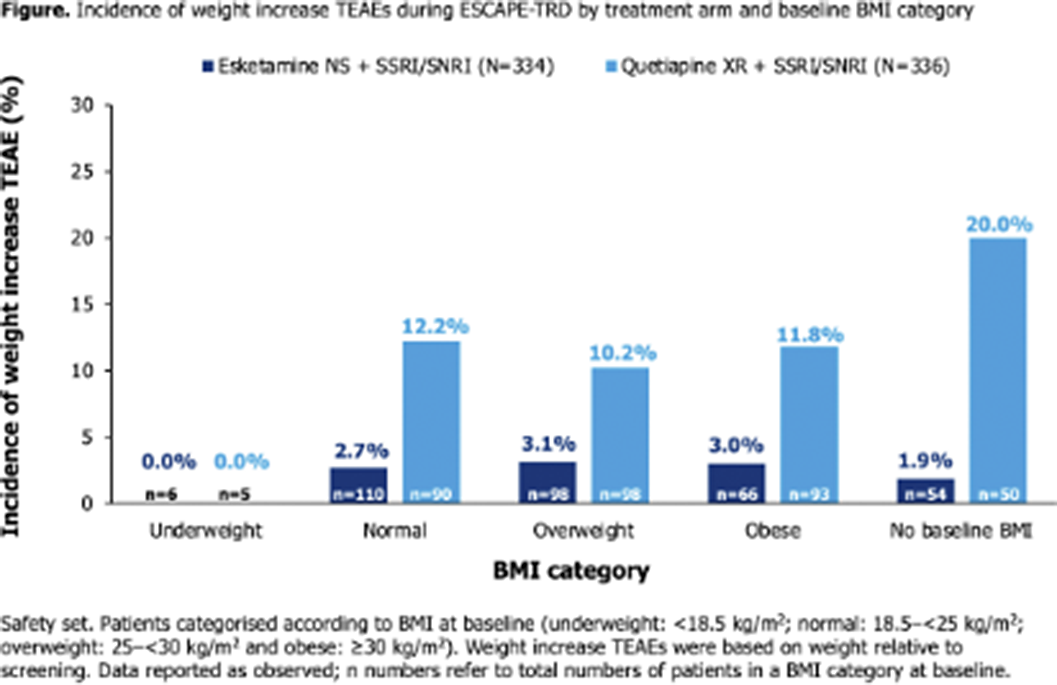
336 and 340 pts were randomised to ESK-NS and QTP-XR; 334 and 336 were included in the safety population. Over the 32-week study, a TEAE of weight increase was reported in fewer pts treated with ESK-NS than QTP-XR (9 [2.7%] vs 42 [12.5%]), leading to treatment discontinuation in 0 vs 6 (1.8%) pts, respectively. Incidences of weight increase TEAEs were balanced across pts categorised as normal, overweight or obsese by baseline body mass index (BMI; Figure). A weight decrease TEAE was reported in 7 pts (2.1%) in the ESK-NS arm vs 0 pts in the QTP-XR arm. Mean (standard deviation [SD]) weight at baseline was 76.4 (16.2) kg (ESK-NS; n=334) vs 79.1 (16.9) kg (QTP-XR; n=336). At Wk32, mean weight was maintained (76.5 [16.3] kg) in ESK-NS treated pts (n=249; mean [SD] change from baseline: 0.1 [4.0] kg) and increased (80.7 [15.6] kg) in QTP-XR treated pts (n=203; mean [SD] change from baseline: 2.5 [5.1] kg).
Image:
Conclusions
Increase in weight was uncommon with ESK-NS; weight increases were more common with QTP-XR and resulted in more treatment discontinuations. Weight increase was independent from baseline BMI.
Acknowledgements
We thank the patients who participated. Funding: Janssen, medical writing: Costello Medical, UK
Apathy in endogenous depressions is a complex mental phenomenon (it is characterized by indifference and loss of interests, reduced incentives and motivation, decreased mental and physical activity). Apathy becomes the cause of pronounced social maladaptation and untimely seeking medical help. Different depressions vary in psychopathological features of apathy, in addition, there are also different dimensions of the general dynamics of endogenous disease.
Objectives
Study of the features of the course of schizophrenia, in which apathetic depressions develop with episodic and persistent type of dynamics
Methods
The study included 36 patients (15 men, 21 women, average age 34.9 years) with schizophrenia. In 17 cases, apathetic depressions occurred as short-term episodes, in 19 cases, depression took a persistent (close to chronic) course.
Results
Schizophrenia with an episodic type of dynamics of apathetic depressions was characterized by: the predominance of cases with early onset of the disease; alternation of apathetic and other type depressions; equal occurrence of mono- and bipolar types of desease; low severity of negative symptoms and slight changes in social and labor functioning. Apathy has always been present during the whole lenght of depression, its picture was dominated by a motivational decline. The studied cases were prognostically favorable. The features of the course of schizophrenia with chronic apathetic depression were: hyperthymic (10 out of 19 observations) and sensitive schizoid (6 out of 19 observations) premorbid personality; bipolar forms of the disease (94.7%, p < 0.05); the predominance of apathetic depression over other depression types, atypical form of depression; short duration of remissions; frequent course of the disease with the presence of only apathetic depressions (12 out of 19, 63.1%, p < 0.05); significant severity of negative symptoms. Apathy occupied only as a part of the duration of the state, as a rule, after anxiety depression. The picture of apathy was dominated by a decrease in initiative or motivation. This clinical group is the most prognostically unfavorable.
Conclusions
Schizophrenia, occurring with the presence of persistent forms of apathetic depression, has a greater impact on the functioning of patients and has a less favorable prognosis.
Recurrent Depressive Disorder is a chronic condition that significantly impacts the quality of life. Despite various treatment options, some patients face severe and treatment-resistant relapses. This case is related to research on ketamine in Electroconvulsive Therapy (ECT) for RDD. One study highlighted the efficacy and safety of ketamine compared to other anaesthetic agents in ECT for major depression. Additionally, another study explored subanesthetic doses of ketamine before each ECT session to improve therapeutic outcomes and sleep quality in patients with major depressive disorder.
Objectives
To present a clinical case of a patient with Recurrent Depressive Disorder (RDD) who improved following a change in the Electroconvulsive Therapy (ECT) protocol using ketamine as an anaesthetic inducer.
Methods
We examined the patient’s medical records, including her medical history, previous treatments, and therapeutic responses.
Results
A 65-year-old childless woman with a history of stroke, bilateral carotid atheromatosis, and hypothyroidism suffered from RDD. Despite multiple prior treatments and ECT, she experienced a severe depressive relapse. Eight intensive ECT sessions were administered, with observed memory lapses. Due to the lack of response, the anaesthetic inducer etomidate was replaced with ketamine, resulting in a positive response. The patient continued pharmacological treatment with improved mood, but recent and evident memory alterations persisted, possibly related to anterograde amnesia.
Conclusions
This case highlights the complexity of RDD in patients with comorbidities and treatment-resistant relapses. The change in the ECT protocol using ketamine was effective, emphasizing the importance of alternative therapeutic approaches in refractory cases. The successful treatment of RDD in this patient using ketamine in ECT underscores the need for personalized therapeutic options in treatment-resistant patients. These scientific resources reinforce the relevance of exploring therapeutic alternatives in contemporary clinical practice. We need more research to understand the underlying mechanisms and how this approach could be enhanced in similar cases.
The European Alliance for Sport and Mental Health (EASMH) is a partnership of scientific institutions, charity associations and sport organizations, funded by EU-Erasmus+. It aimed at developing good clinical practice in psychiatric rehabilitation through sport-based interventions as an integration of pharmacological and psychological therapies. Within the framework of the EASMH projects, several actions have been promoted including an assessment of the dissemination of sport-based interventions, a training course for specialized coaches and the implementation of pilot actions in four European Countries.
Objectives
To briefly describe EASMH pilot actions performed in Finland, Italy, Romania and United Kingdom, where trained coaches delivered sport-based interventions to patients with severe mental disorders.
Methods
After completing pilot actions, charity associations and sport organizations belonging to EASMH network described general and specific aims, sport activities, composition of staff, timing and tools for assessing the outcomes.
Results
In Italy, “Crazy for Rugby”, including adolescents and young patients, and “Not only headshots”, a football project for adults with severe mental disorders were performed. In UK, a football-based activity called “Imagine Your Goal” and a walking-football program for participants aged more than 40 were delivered. In Romania, two courses including gymnastics, yoga and pilates called “Get fit!” were provided. Different team sport-based activities were implemented in Finland, where “Multiple Sport Group” and “Rehabilitating Sports” aimed at increasing patients’ autonomy. Assessment of psychopathological, social, cognitive and sport/fitness outcomes confirmed the overall beneficial effects of sport on mental health.
Conclusions
Pilot actions represent the final step of EASMH project, which showed improvement of mental health outcomes by also delivering sport-based rehabilitation to patients with severe mental disorders. Institutions and stakeholders are now called to promote the implementation of such initiatives on a broader scale.
Attachment styles is intrinsically related to the capacity for forming close social bonds, making it a vital lens through which to understand social functioning.
Objectives
This study investigates the link between attachment styles and social functioning among women diagnosed with schizophrenia.
Methods
We carried out a descriptive and analytical cross-sectional study from May to June 2023, focusing on stabilized female patients diagnosed with schizophrenia or schizoaffective disorder. The study took place in the ‘B’ psychiatry department of Hedi Chaker University Hospital in Sfax, Tunisia. Data on attachment styles and social functioning were collected using self-report questionnaires: the Revised Psychosis Attachment Measure (PAM_R) and the Social Functioning Scale (SFS). In our study, we employed both the Wilcoxon test for paired samples and the Spearman correlation test to assess the differences and correlations between attachment scores and social functioning scores, respectively.
Results
In the study, 41 female patients were included. The participants had a mean age of 49.19, ranging from 19 to 79 years old. Attachment styles were predominantly avoidant (60.97%), followed by anxious (24.39%) and disorganized (14.63%). A significant portion, 39%, exhibited low social functioning. The domains most affected were leisure (63.41%) and employment (60.97%). Our analysis revealed negative correlations between avoidant attachment and social functioning in leisure activities (Spearman’s ρ = -0.057, p < 0.05) as well as between avoidant attachment and independence performance (Spearman’s ρ = -0.040, p < 0.05). Also, the correlation coefficient for anxious attachment and leisure activities is 0.041, demonstrating a positive association (p < 0.005).
Conclusions
These initial findings may imply a potential association between attachment styles and social functioning in schizophrenia.
Antipsychotics are among the substances that are very frequently used for elderly people and dementia patients in particular. This is known from studies both in outpatient care and in nursing homes. They are often part of a polypharmacy. This group of substances is discussed in the context of the increased risk of falls, increased mortality and also - as here - in the context of the development of delirium.
On the other hand, antipsychotics are drugs for the treatment of delirium, whereby the question of their significance in modern delirium treatment is being asked anew. In the past, butyrophenones in particular have played a role here, partly because of their variable form of administration and also because of their low cardiac impact.
In the context of delirium prevention, the aim is to reduce the number of drugs on the one hand and the anticholinergic load of the drugs on the other. Algorithms and recommendations exist for this.
In the treatment of delirium, the focus is rightly placed primarily on non-pharmacological management. The use of antipsychotics should be reserved for severe states of agitation or agitation in the context of delirium. In other cases, careful judgement is required.
Lithium is a mood stabilizer often used as a first-line treatment for bipolar disorder. Its narrow therapeutic window and changes in the absorption, distribution, and elimination of the drug following bariatric surgery have important implications regarding patient safety.
Objectives
We present a 51-year-old female patient with bipolar disorder and a medical history of morbid obesity, type 2 diabetes mellitus, hypothyroidism, hyperlipidemia, and essential hypertension. She was mentally stable on lithium 1200 mg/day, valproate 500 mg/day, and quetiapine 400 mg/day. She had undergone laparoscopic sleeve gastrectomy. After a month, she showed up to the emergency room (ER) with nausea, vomiting, diarrhea, and fatigue. Gastroenteritis was suspected until the patient started showing neurological symptoms such as delirium, dysarthria, ataxia, chorea, and athetosis.
Methods
The patient was monitored and received aggressive intravenous hydration (3000 cc of 0.9% serum isotonic) in the intensive care unit (ICU). She was prescribed intramuscular biperiden injection of 5 mg/ml/day, pheniramine 45.5 mg/2 ml/day, and lorazepam 1 mg/day. Her lithium levels were checked every six hours. She was agitated and disoriented for the first five days despite lithium levels being in the therapeutic range. On day six, her blood lithium levels dropped to 0.399 mmol/L. Her psychiatric examination revealed that she resumed cooperation and orientation, her dysarthria subsided. However, her thought content and attitude were grandiose, and she had a labile affect. We prescribed 5 mg/day of olanzapine routinely and 1 mg/day of lorazepam on a needed basis. The next day, her labile affect became calmer, and her sleep improved so she was discharged from the ICU and admitted to general surgery inpatient service, and olanzapine was titrated to 10 mg per day since she had elevated mood symptoms.
Results
After 7 days of intravenous hydration and supportive treatment, her neurological symptoms completely subsided except for a fine tremor, which lasted for another 3 days and then ceased. She was clinically stabilized without further need for intervention. Her lithium level was 0.206 mmol/L before her discharge.
Conclusions
We believe it is of utmost importance to build a consensus in guidelines and inform physicians about lithium toxicity and its symptoms after bariatric surgeries. We recommend a careful follow-up of the patient pre-and postoperatively. Preoperative psychiatric intervention includes decreasing the lithium dose gradually and discontinuing it. After the operation, lithium can be started with a much lower dose and may be increased by checking lithium levels every week for at least 6 weeks after the operation until the patient can digest solid food again, and then every 2 weeks for 6 months, and thereafter every month for one year.
The Positive and Negative Syndrome Scale (PANSS) has been used as a universal instrument for clinical assessment of psychopathology in schizophrenia. Different studies have analyzed the factorial structure of this scale and have suggested a five-factor model: positive, negative, excited, depressive, and cognitive/disorganized factors. Two of the most used models are the Marder´s solution and the Wallwork´s one.
Objectives
The aim of this work was to study the correlations of the two cognitive factors (Marder and Wallwork) with a cognitive assessment performed with a standard cognitive battery, in a sample of patients with first psychotic episode of schizophrenia.
Methods
Seventy four patients with first psychotic episode of schizophrenia (26.9, SD:7.8 years old; 70.3% male) were included. The cognitive assessment was performed with the MATRICS Consensus Cognitive Battery (MCCB). The MCCB present seven cognitive domains: Speed of processing, Working memory, Attention/Vigilance, Verbal Learning, Visual Learning, Reasoning and Problem Solving, and Social cognition). Pearson correlations were performed between MCCB scores and Marder´s PANSS cognitive factor (P2, N5, G5, G10, G11, G13, G15) and Wallwork´s one (P2, N5, G11).
Results
Correlation between MCCB scores and cognitive factors of Marder and Wallwork can be seen in the table.
Marder´s cognitive factor
Wallwork´s cognitive factor
Speed of processing
r = -0.461; p<0.001
r = -0.455; p<0.001
Attention/Vigilance
r = -0.414; p<0.001
r = -0.415; p<0.001
Working memory
r = -0.449; p<0.001
r = -0.468; p<0.001
Verbal Learning
r = -0.511; p<0.001
r = -0.405; p<0.001
Visual Learning
r = -0.252; p=0.024
r = -0.254; p=0.029
Reasoning and Problem Solving
r = -0.244; p=0.036
r = -0.272; p=0.019
Social cognition
r = -0.268; p=0.024
r = -0.202; p=0.091
Conclusions
Both PANSS cognition factors show a moderate correlations with Speed of processing, Working memory, Attention/Vigilance and Verbal Learning assessed by MCCB. More discrete correlations were found with Visual Learning, Reasoning and Problem Solving, and with Social cognition (in fact, non-significant correlation with Wallwork´s cognitive factor was found).
Acknowledgements. This study has been funded by Instituto de Salud Carlos III (ISCIII) through the project PI19/00766 and co-funded by the European Union.
Consultation and liaison psychiatry (C-L psychiatry) in Switzerland can look back on a long tradition. It began in French-speaking Switzerland back in the 1960s and gradually spread throughout the country. Currently, C-L services are present throughout the country, although they differ greatly in terms of their services and dimensions. University hospitals and larger cantonal hospitals have extensive and differentiated services, while smaller hospitals in peripheral regions only offer basic services. There are also major differences in the financing models, which are decisive for the range of services offered. The question of funding, which has not yet been resolved satisfactorily despite various models and strategies, including at national level, is highly relevant for the further development and even the continued existence of C-L services. The introduction of the subspecialization in C-L psychiatry in 2010 and the lively training and CPD activities are of great importance for quality of the delivered services.
