To save content items to your account,
please confirm that you agree to abide by our usage policies.
If this is the first time you use this feature, you will be asked to authorise Cambridge Core to connect with your account.
Find out more about saving content to .
To save content items to your Kindle, first ensure no-reply@cambridge.org
is added to your Approved Personal Document E-mail List under your Personal Document Settings
on the Manage Your Content and Devices page of your Amazon account. Then enter the ‘name’ part
of your Kindle email address below.
Find out more about saving to your Kindle.
Note you can select to save to either the @free.kindle.com or @kindle.com variations.
‘@free.kindle.com’ emails are free but can only be saved to your device when it is connected to wi-fi.
‘@kindle.com’ emails can be delivered even when you are not connected to wi-fi, but note that service fees apply.
Psychedelics are substances consumed for recreational use, the majority of these psychoactive substances are illegal and hard to obtain. Therefore, there is a demand for psychedelics legal and easier to access, these types of drugs are called ‘legal highs’. LSA (lysergic acid amide) is one of these new psychoactive substances, this drug is searched because it is known to have an effect similar to LSD. LSA has negative effects on body functioning not fully understood by the medical field.
Objectives
This project aims to conduct a systematic review of the scientific health literature on LSA.
Methods
The following information was included in this review: articles reporting original data on physical effects, neurobiological effects, various bodily symptoms, social and cultural aspects in humans related to LSA, published in English, Portuguese, Spanish, Italian, and French. Studies involving animals, in vitro research, botanical studies, and non-original research were excluded. The following keywords were searched in the PubMed, Google Scholar, and Web of Science databases: (ergine or d-lysergic acid amide or LSA or d-lysergamide or lysergic acid amide). This study followed the PRISMA statement for systematic reviews and PRISMA checklist. The resulting data were tabulated and analyzed according to relevance.
Results
LSA, also known as ergine, is an ergot alkaloid with a chemical formula very similar to LSD. Ergine is found in plants of the Convolvulaceae family and is primarily consumed through chewing the seeds of these plants, soaking them in alcohol, or preparing an extract. The amount of LSA in each seed is inconsistent, making it unpredictable how much will be consumed, and these seeds may contain other harmful compounds.
LSA is a partial agonist and antagonist of serotonergic receptors, with a preference for 5-HT1A and 5-HT2, and stimulation of D2 is related to nausea. It can cause symptoms including euphoria, hallucinations, anxiety, nausea, weakness, fatigue, tremors, and elevated blood pressure. In some cases, the use of LSA is associated with the use of other drugs, and there are case reports of LSA-induced PRES (Posterior Reversible Encephalopathy Syndrome), post-use suicides and the need for hospitalization due to psychosis-like states.
Studies conducted on the quality of information about LSA on digital platforms indicate misinformation with incorrect data that can be harmful to those who ingest the drug. Additionally, there are studies suggesting that LSA may improve symptoms of cluster headaches.
Conclusions
LSA is a legal drug in most countries, with widespread misinformation on the internet and limited control over its use. There are potential serious adverse effects caused by the drug, and it is often associated with other psychoactive substances. Greater knowledge about the drug is needed for diagnosing its use and abuse, as well as for educating the public.
This article is a response to Christians in public and private life who favor policies, employ rhetoric, and view migrants in ways that contravene their faith traditions. Speaking primarily from the perspective of Christian migrant-serving, faith-based organizations in the United States, the author examines their challenges, sources of consolation, and understanding of migrants in light of their work and religious touchstones in an era of political polarization and unprecedented forced displacement. He outlines an inclusive path forward, rooted in a commitment to the common good, to solidarity with the displaced, and to a deeper understanding of the hopes, aspirations, and gifts of migrants.
Pregnant women are particularly vulnerable to a wide variety of psychiatric symptoms, including anxiety related to pregnancy and childbirth.
Objectives
The purpose of our study was to determine the sociodemographic characteristics of pregnant women and investigate their relationship with pregnancy-related anxiety.
Methods
The study was conducted from February to July 2023 among pregnant women in their 3rd-trimester consulting at the Gynecology-obstetrics department of the Hedi Chaker University Hospital of Sfax, Tunisia. Women with obstetric conditions favorable to vaginal delivery (cephalic presentation and eutrophic fetus) were interviewed using a questionnaire including their sociodemographic characteristics and the brief version of the pregnancy-related anxiety questionnaire PRAQ-R2.
Results
A total of 350 women were included in our study. The mean age of the participants was 28 years [16-41 years] with the majority being married (95.7%). One hundred and eighty-eight women (53.7%) did not graduate from high school and 213 (60.9%) were housewives. Half of the participants (52.9%) lived in the city, and 38.9% reported low income. Almost half of them (46.28%) were multiparous.
The mean score of the PRAQ-R2 was 31.24 ± 7.53.
We found a positive correlation between the PRAQ-R2 scale score and age younger than 30 years (p<0.001), low educational level (p=0.006), and low income (p=0.031).
Conclusions
Our findings suggest that demographic factors seem to predict anxiety related to pregnancy and are worth examining in future studies for a better understanding of this symptom in pregnant women.
There has been a 1000% increase in referrals for assessment of adult ADHD within Scotland over the past three years (The Scottish Government. 2023. NAIT adult Neurodevelopmental Pathways Report). These referrals are sent by general practitioners to the local community mental health team. The most junior clinicians (doctors who are pre-membership with the Royal College of Psychiatrists) in the team are often responsible for undertaking the initial assessment of these patients. Patients have on average waited almost a year to be seen and expectations are high.
Objectives
The diagnosis of ADHD can be challenging, and adult ADHD is still a relatively new and evolving diagnostic entity. We set out to explore how junior clinicians were coping with this in their daily practice.
Methods
We developed a questionnaire that was sent to all junior clinicians working within Argyll & Bute (n=8) via an anonymised email link. The link was open for 1 week and then results were analysed.
Results
The response rate to our survey was 87.5%. Prior to starting their current roles none of the respondents had ever undertaken an ADHD assessment before. All respondents answered “No” when asked if they felt they had adequate knowledge on ADHD in order to perform assessments. Only 14% (n=1) felt they had access to adequate resources about how to make an ADHD diagnosis. Participants were asked on a scale of 1-10 (1= not at all,10= very) to rate their confidence in conducting ADHD assessments. The average confidence score was 2.43. There was a space for free text feedback in which participants reported the following: “felt thoroughly out my depth”, “I felt chucked in the deep end”, “I felt very under qualified”
Image:

Conclusions
Our results showed that junior clinicians did not feel confident or knowledgeable about undertaking adult ADHD assessments. In response to this we have now produced, in association with the consultant psychiatrists within our health board, an informative and engaging quick reference poster which explains how to undertake an ADHD assessment (see QR code attached as Image 1). It contains useful pointers about diagnosis, and more importantly guidance on language/phrases to use when explaining to patients whether or not you feel a diagnosis of ADHD is appropriate. It then also explains next steps that can be offered i.e. psychological support/medication options and how to prescribe these. We plan to send out a repeat questionnaire to the next cohort of junior clinicians to assess if they have improved confidence in managing and diagnosing ADHD following this intervention.
There is a growing interest in understanding the impact of duty hours and resting times on training outcomes and the well-being of resident physicians. Psychiatry resident’s duty hours in Spain comprise a regular working schedule of 37.5h per week and a minimum of 4 mandatory on-call shifts. The most recent duty hours regulations in Spain were transposed from the European Working Time Directive (EWTD). According to Spanish Law, doctors cannot work for more than 48h per week and need to have resting times per day (at least 12h), per week (at least 36h) as well as annual leave (at least a month). However, there is practically no data on this situation in psychiatry resident physicians.
Objectives
Our aim is firstly, to describe the number of shifts performed by psychiatry resident physicians in Spain. Secondly, to describe compliance with the daily and weekly rests compared to those set in national and European law. Finally, to analyse the difference by demographic variables (gender and year of residency), in both the number of on-call duty shifts and compliance with rests.
Methods
A descriptive cross-sectional study was designed through an online survey adapted from the existing literature. The target population were Spanish psychiatry resident physicians undergoing PGT who started their specialist training during the years 2018–2021. The survey was disseminated through the Spanish regional medical councils to all active psychiatry resident physicians by mail as well as through informal communication channels. The study was authorised by the Spanish Medical Organization’s General Assembly which is the highest ethical and deontological body of physicians in Spain.
Results
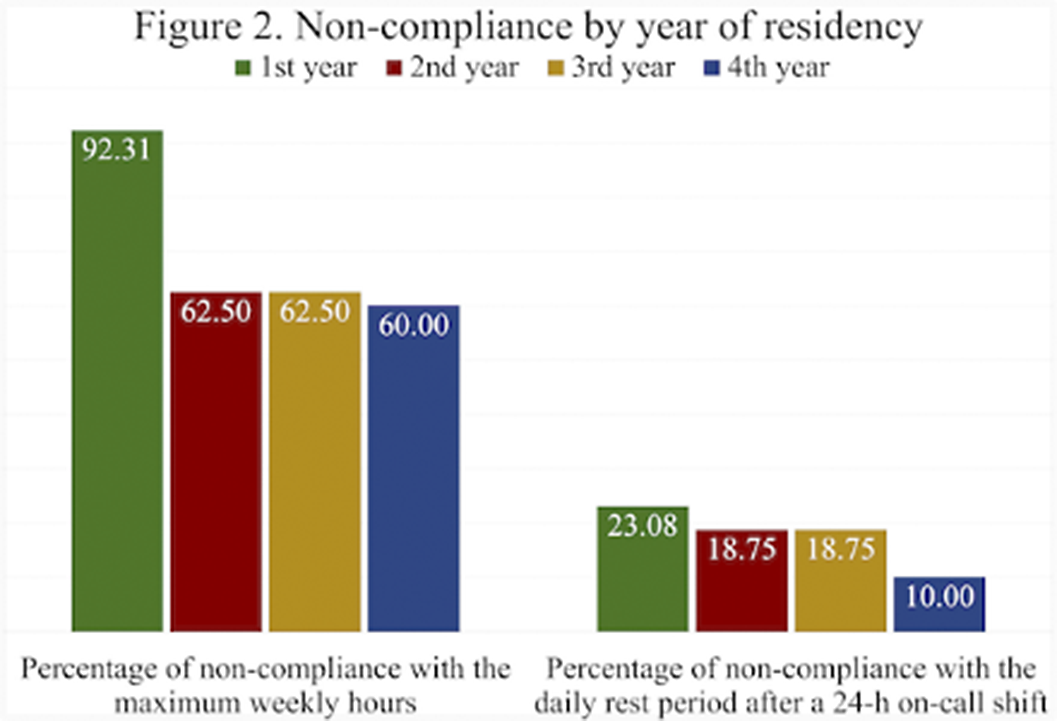
55 responses were obtained, of which 61.82% identified as females. The mean number of on-call shifts in the last 3 months was 14.05. This mean was highest in women 14,32 and in the cohort of 2020 15.46 (first year of residency). Among the resident physicians surveyed, 66.07% exceeded the 48h per week limit set by the EWTD and 7% of them did not rest after a 24-h on-call shift. Furthermore, 22% of respondents did not have a day-off after a Saturday on-call shift. The mean working hours when not resting after an on-call-shift were 7 hours. The comparison by gender and year of residency of the main variables can be seen in figures 1 and 2 respectively.
Image:
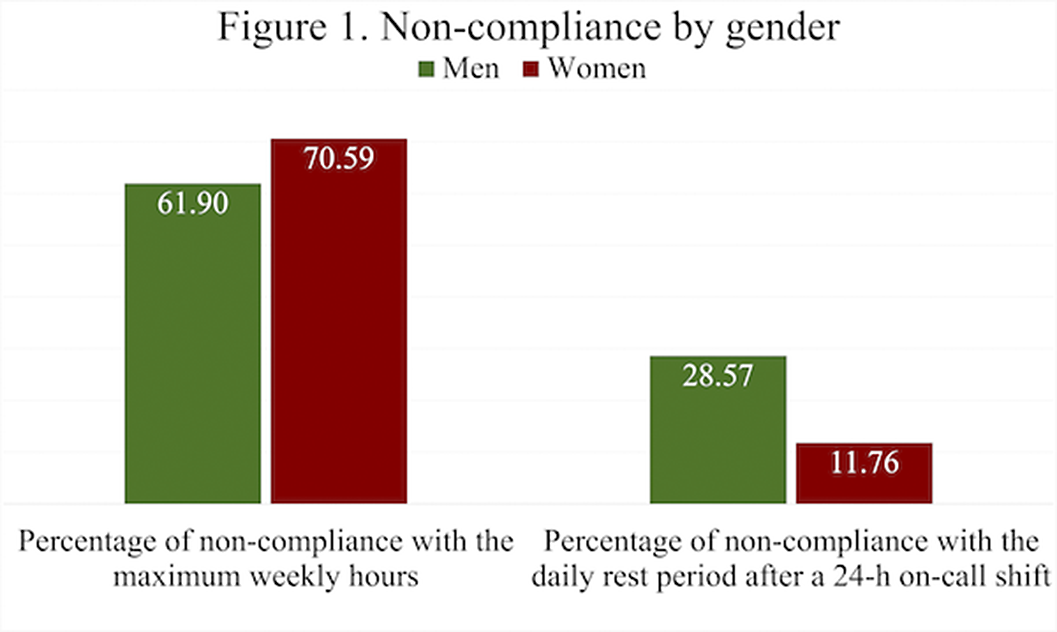
Image 2:
Conclusions
Psychiatry resident physicians in Spain greatly exceed the established 48 h/week EWTD limit. Likewise, non-compliance with labour regulations regarding mandatory rest after on-call duty and minimum weekly rest periods are observed. Differences can be seen by gender and year of residency. The situation described could potentially create a high-risk situation for the health and psychosocial well-being of resident physicians, hinder learning outcomes and could lead to suboptimal patient care.
Psychosis is a common clinical presentation of mental disorder in many psychiatric patients, however, an etiological diagnosis is important when it occurs for the first time in a patient. Regarding a case seen in the Emergency Department recently, with major depression and acute cocaine use, a differential diagnosis was made after adequate organic screening. When presenting delusion of infestation after the consumption of the substance, the main hypothesis was what we call Ekbom syndrome. However, among other possibilities we consider a toxic psychosis or a major depression with psychotic symptoms.
Objectives
Review the different causes of acute psychosis and the importance of a good clinical history to achieve a specific diagnosis. Perform a differential diagnosis between the main causes of psychosis in a patient with depression who has recently consumed cocaine.
Methods
Presentation of the case and review of the available literature on the risk of developing psychosis after cocaine use and depression concomitantly.
Results
There is a low number of reported cases of delusional infestation after acute cocaine use, being more likely toxic psychosis or major depression with psychotic symptoms. A good anamnesis, with systematic questions about toxic habits, can lead us to a more accurate main hypothesis.
Conclusions
We mark the importance of a systematic anamnesis to achieve a better diagnosis, as well as a correct study by the clinician of the specific syndromes described in phenomenology such as Ekbom syndrome, to make a correct association of ideas in the differential diagnosis.
Although birth is experienced, in most cultures, as a positive event, for a significant percentage of women, it is considered a traumatic event, which can be associated with the development of psychopathologies, with negative impacts for the mother and the baby .
Objectives
As part of a larger, multicenter study called Intersect, we aim to assess the prevalence of women who considered childbirth traumatic, in a cohort of women in southeastern Brazil, and the association with the outcome of post-traumatic stress disorder (PTSD).
Methods
A total of 427 women who gave birth in two hospitals in southeastern Brazil in the period from May to October 2022 were included in the study, who answered self-assessment instruments, through on a telephone interview, in the period from 6 to 12 postpartum weeks. For the purposes of this study, the City Birth Trauma Scale stands out.
Results
The participants had a mean age of 28.4 (± 6.4) years, 39.2% were primiparous and 76.1% had a partner. The results showed that 51.3% of them considered the birth moderately or extremely traumatic (N=218). Of these, 50.9% met criterion A for PTSD according to the DSM-5 (N=111) and among these, 20.7% had a PTSD profile (N=23; City-Birth >28 points). These mothers represent 5.4% of the total sample.
Conclusions
there is a high prevalence of traumatic experiences during childbirth, with high rates of PTSD associated with this condition, which requires attention from the medical community in order to track and treat PTSD associated with birth and, from the public authorities, in the institution of preventive measures, through public policies aimed at this population.
Consultation-Liaison (CL) psychiatry is the branch of psychiatric practice developed to offer support to patients with concomitant non-psychiatric diseases. In Portugal, most hospitals follow a model delivered by teams with Psychiatrists and Psychologists that support the medical team in wards. They act by advising directly other specialties’ colleagues after the observation of the patient and/or discussion of the case.
Bigger units, such as Santa Maria Hospital, in Lisbon, have tried a model of proximity to the community medical centers participating in local medical meetings, training of family doctors, discussing clinical situations directly and even doing psychiatric consultations, in community centers. This approach intends to extend primary mental health interventions and promote treatment in the community.
Substance use during pregnancy has become challenging clinical issue. Substance affects the brain, causing an addictive lifestyle. In pregnant women could lead more harm to neonatal life.
Objectives
This study investigates the neonatal outcome of substance use and associated factors.
Methods
A cross-sectional study was designed. Data were collected from pregnant women who used substance during labor and refer to rehabilitative consultation between 2017-2020. Neonate data were collected from perinatal care. Chi-square test and Fisher exact test were performed to analyze associated factors. A p-value less than 0.05 is considered significantly.
Results
162 participants were included in this study. Mean age was 27.37±6.46 years. Mean age at first substance used was 21.93±6.52years. No antenatal care was found 45.7%. Methamphetamine was the most used during the first use (67.9%) and latest used (72.2%). Average birth weight was 2,734.97±617.51 gram. Gestational age at birth was 36.75±2.83 week. Average head circumference was 32.81±1.39 centimeters. Average femur length was 47.77±2.17 centimeters. Apgar score > 7 at 1 minute and 5 minute was found 94.4% and 97.2% . Neonatal complications were preterm labor (34.6%), low birth weight (25.3%), small for gestational age (19.8%), premature rupture of membranes (4.9%), and stillbirth (3.7%). No antenatal care (p=0.048), no antenatal care and birth before admission (p=0.023), a cesarean delivery (p=0.024), and gestational age more than 37 weeks (p<0.001) were associated with neonatal outcome in maternal with substance used during labor. Using amphetamine as the first substance related to neonatal complication (p=0.028).
Conclusions
Preterm labor, low birth weight and small gestational age are the most found as neonatal complications in maternal substance used during labor. No antenatal care was related with neonatal complications in this group.
Therefore, an integrated system for the assessment of substances used in a pregnant woman and the system to reach out women who used substance and pregnant access to antenatal care should be established. Evaluation and rehabilitation are the interventions that should be done as soon as possible as primaray, secondary intervention.
In Our Lives in Their Portfolios, Brett Christophers provides an account of the rise of ‘asset manager society’ – a world in which the infrastructures of public life are converted from public to private ownership. Here I use Christophers’ analysis to comment on growing calls for asset manager investment in climate adaptation. The asset manager business model requires ever-escalating returns, a poor fit with the now unavoidable losses that climate change promises to bring.
Chronic fatigue and psychiatric manifestations (depression, anxiety and sleep disturbances) appear to be key features of post-COVID-19 syndrome and increase significantly in prevalence over time (Lavienraj et al. J Neurol Sci 2022;434:120162). Several studies have suggested an association between altered levels of arginine metabolites and depression, anxiety and stress severity (Arisoy et al. J Psychiatr Res 2020;120:21-28). L-arginine supplementation has also been shown to improve walking performance, muscle strength, endothelial function and fatigue in adults with Long COVID (Tosato et al. Nutrients 2022;14(23):4984).
Objectives
To study effects of L-arginine oral supplementation on chronic fatigue and depressive symptoms reported 3 months or more after acute COVID-19 onset in elderly outpatients without severe comorbid conditions.
Methods
This is a parallel-group, double-blind, randomized controlled trial conducted on 96 over 65 non-hospitalized patients suffering from Long Covid-related fatigue and depression. The first group included patients that received 1,66 g L-arginine twice a day in addition to a standard antidepressant therapy based on Selective Serotonin Reuptake Inhibitors (SSRIs), whereas the second group received antidepressant only. Severity of fatigue and depressive symptoms was evaluated at baseline and after 8 weeks of treatment using Fatigue Symptom Inventory (FSI) and Hamilton Rating Scale for Depression (HAM-D), respectively.
Results
At baseline, 64 patients (66,7%) reported moderate fatigue (4-6) and the remaining 32 (33,3%) reported severe fatigue (7-10). In this phase the average HAM-D score was 12,85 ± 5,97; among patients, 57,3% experienced mild symptoms of depression, 32,3% experienced moderate symptoms and 6,4% experienced severe symptoms. After two months, patients treated with L-arginine supplementation exhibited a 30% greater improvement in fatigue-related symptom severity (p=0.008) and a significantly decrease in average HAM-D score (p=0.002) compared to the group treated with SSRI only.
Conclusions
According to our results, adding oral L-arginine to standard antidepressant therapy in elders with Long Covid-related fatigue and depression significantly decreases severity of both physical and affective symptoms. Further studies are needed to clarify the intriguing role of L-arginine in the treatment of Post Covid-19 syndrome and its potential effects in promoting geriatric patients’ health, wellbeing and quality of life.
Gender identity may be experienced within a broad spectrum beyond the binary understanding of sex concerning genital characteristics. In people with gender identities not congruent with the gender culturally associated with the sex assigned at birth, distress related to biopsychosocial correlates of this condition may arise. In current diagnostic systems, this is considered within the framework of “Gender Incongruence” (ICD-11) and “Gender Dysphoria” (DSM 5). Although this diversity is known to be present throughout the ages, the terms related to gender identity were introduced to medical literature a hundred years ago. They were popularized with the advances in medical procedures that assist individuals in acquiring physical features aligning with their gender identity and expression. There has been an increase in research interest with increasing numbers in medical centers working on gender-affirmative medical procedures. Starting from the 1970s, international organizations prepared guidelines on the standards of care for trans and gender diverse (TGD) individuals. Despite all the progress in the gender-affirming medical care provided to TGD individuals and the changes in the legal recognition of gender, health inequalities persist globally. The discrepancy in mental and physical health conditions has long been shown to be associated with “minority stress.” The minority stress perspective suggests that distal and proximal chronic stressors arising from society are associated with adverse health outcomes for TGD individuals. Resilience against these stressors is more robust with better coping styles and social support. Lately, structural stigma and discrimination have been shown to be an important source of inequality. Therefore, much more progress is still required with respect to societal inequalities, human rights, and structural transphobia for the improvements in medical care to impact the global health condition of TGD people. However, lately, there have been attempts to restrict TGD individuals’ access to medical care and their legal rights, even if they were not close to the level they ought to be. This backlash mostly sits on the discussion on the management of TGD adolescents and children. Models of care for these age groups have been developed for decades, and despite evidence of the protective and beneficial effects on health and development, in many countries, there are attempts to block their access to medical care. Growing debate on TGD care turned into a political combat, where scientific evidence and human rights perspectives are often ignored. These tendencies present a strong challenge for public health and the professional identity and practice of healthcare professionals.
During the last two years, many young people and adolescents in the Kyrgyz Republic started to visit specialists due to Non-suicidal self-harm. A significant rise in the amount of such cases allowed specialists from the Republican Center of Psychiatry in Bishkek to think about an “epidemic “of self-harming behavior. Non-suicidal self-harm (NSSH) is defined as repeated, deliberate, direct injury to the body without suicidal intent that is not socially acceptable (Nixon et al., 2002) to reduce psychological discomfort in the absence of a conscious intention to take one’s life (ICD-10 codes X60-X84, and ICD-11 codes PB80-PD3Z).
Objectives
To determine the causes of NSSH among adolescents and young adults who approached specialists in mental health sphere at Institute of Behavioral Health at the American University of Central Asia.
Methods
Over two years, forty-five adolescents and young adults under twenty-five who had committed self-harm visited specialists from the Behavioral Health Institute at the American University of Central Asia.
All the patients received either dialectical behavioral treatment or cognitive processing treatment, medication (paroxetine) was used in three cases.
Results
Thirty patients were girls under twenty-one, and fifteen were boys and young male adults. The overwhelming majority (40 people) had self-inflicted cuts, two had imposed burns with matches and cigarettes, and one had used self-suffocation without a bond. Reasons for self-harm were the following: releasing internal tension and anxiety, getting some rest from intrusive thoughts, relieving the inner pain, and a desire to “feel as a whole person.” All the patients underlined that they did not want to attract attention from their family members; moreover, they tried to hide the consequences of self-harm.
Teens and young adults (twelve patients) from Kyrgyz traditional families visited a consultant or psychiatrist after a long drive through conventional or religious healers. All of the patients knew that they were addicted to self-harm, wanted to stop a problematic behavior, and could not stop it on their own. Ten patients have been diagnosed with borderline personality disorder. Two of them also had eating disorders. Five patients had PTSD, and five had social phobia. The others had recognizable anxiety symptoms.
Conclusions
The enormous rise of non-suicidal self-harm is a phenomenon that needs further research. Those cases often resist treatment due to the “addictive” component in the pathogenesis.
Insufficient knowledge about the pathophysiological processes in bipolar disorder (BD) leads to difficulties in differentiating this disorder from other affective disorders. Quantitative analysis of serum protein profiles in BD expands our understanding of the pathophysiology of the disease and may aid in subsequent diagnosis. As a result of a previously conducted comparative mass spectrometric study of serum proteins in patients with depression, bipolar disorder and healthy donors, increased expression of Heat Shock 70kDa Protein1A (HSPA1A) and transthyretin was identified.
Objectives
Determination of HSPA1A and transthyretin concentrations in the blood serum of patients with mental disorders.
Methods
Blood serum of 28 patients with bipolar disorder aged 49 years [33;52], 30 patients with recurrent depressive disorder aged 40 years [31; 51] and 130 patients with schizophrenia aged 38 years [31;49], as well as 20 mentally and somatically healthy individuals aged 35 years [31;40] was studied. The amount of Heat shock protein 1A (HSPA1A) and Transthyretin (thyroxine and retinol transport protein) was determined using a Enzyme-linked Immunosorbent Assay Kit from Homo sapiens (Cloud-Clone Corp). Statistical data processing was carried out in the Statistica 12.0 program.
Results
A statistically significant (p = 0.016) increase in the level of HSPA1A was found in patients with BD (0.84 [0.59; 1.09] ng/ml), compared with healthy individuals (0.61 [0.51; 0.77] ng/ml). HSPA1A plays a pivotal role in the protein quality control system, ensuring the correct folding of proteins. It is known that this protein is involved in the embryonic development of the central nervous system, as well as in neuroprotection by preventing the death of neurons due to its anti-apoptotic properties. A statistically significant (p = 0.047) increase in the level of transthyretin was found in patients with BD 21.8 рg/ml, compared with healthy individuals 19.4 pg/ml. Transthyretin plays an important role in ensuring the normal state of the central nervous system and is involved in cognitive processes.
Conclusions
Thus, the HSPA1A and transthyretin are probably involved in the pathogenesis of BD and can be proposed as be proposed as an additional paraclinical criterion for differential diagnosis.
According to the latest Intergovernmental Panel on Climate Change (IPCC) Report (2022), climate changes (e.g. rising sea levels and temperatures and) are noticeable and intensifying on the entire planet. Extreme weather events or ecological disasters are occurring with increased frequency and intensity. Anthropogenic climate change has been called “the defining issue of our time” (United Nations, 2022) and “the greatest threat to global health in the 21st century” (World Health Organization, 2015). Health impacts from climate change may include increased morbidity and mortality from worsening cardiopulmonary health, and greater risk of infectious diseases and mental illness. During this lecture, we will discuss environmental aspects that clearly have a negative impact on the mental well-being of the general population and, more specifically, the psychiatric population. The focus will primarily delve deeper into climate anxiety.
The results of the study of psychological factors of hostility in depression are presented. The topicality of the study is due to hostility considered, on the one hand, as a property of depression, and on the other hand, as a risk factor, associated with the likelihood of auto-aggressive behavior.
Objectives
The aim of the study was to analyze the relationship between hostility and attachment disorders in endogenous depression.
Methods
The study involved 49 patients with depressive disorder (mean age 19,8±4,5). All patients were assessed using the Hamilton Depression Rating Scale (HDRS-17 mean 21,03±6,02). All completed the following methods: Revised Experiences in Close Relationships (ECR-R); Symptom Check List-90-Revised (SCL-90R); Aggression Questionnaire by Buss and Perry (BPAQ); I-structural test by G. Ammon (ISTA). According to the “depression” parameter of the SCL-90R, the group was divided into subgroups with high and medium severity of depression. Analysis of variance (ANOVA) or Mann-Whitney test were. Correlation analysis (Spearman) and stepwise multiple regression analysis were also used.
Results
At high levels of depression, the indicators of “hostility”, “destructive” and “deficit aggression” are statistically significantly higher. The severity of depression significantly correlates with the severity of “anxiety” in attachment (close relationships), as well as with pathological “narcissism”, “destructive external self-delimitation”, “deficient internal self-delimitation”.
For the measure of depression, regression analysis showed that the regression model explained more than 76% of the variance, with the measures of “interpersonal sensitivity”, “deficit narcissism”, and “avoidance” in attachment making significant contributions. For the “hostility” the regression model explains about 62% of the variance, while a significant contribution is made, as in the analysis of “depression”, by the indicators of “interpersonal sensitivity” and “avoidance”, however, unlike “depression”, the contribution of the “destructive narcissism” is noted in contrast to the “deficit narcissism”.
Conclusions
With severe depressive symptoms, indicators of hostility are increased. Hostility in depression is associated with factors caused by a violation of early interpersonal relationships (anxious attachment), which causes increased sensitivity in relations with others, “building a barrier” between oneself and the external environment perceived as hostile in the narcissistic pathology, problems in emotional regulation. One of the targets of psychotherapeutic work may be the ambivalence between desire for symbiotic dependence and the experienced hostility.
Use of psychoactive substances is a risk factor for mental health. Studying the peculiarities of using psychoactive substances by university students is extremely important for organizing preventive health care
Objectives
To specify the frequency of smoking and alcohol drinking, as well as the peculiarities of the correlational interconnections, in domestic and foreign university students
Methods
The survey covered 546 undergraduate domestic and foreign university students of both genders and different religious backgrounds. As a tool, we used the Sociocultural Health Questionnaire (E. Nikolaev)
Results
It has been revealed that domestic students smoke cigarettes and hookahs surely more often (p=.01) than foreign students (30.49% vs 19.08%). It is obvious that they also more often (p=.01) use electronic cigarettes or vaping drugs (25.24% vs 12.86%) and alcohol (54.42% vs 9.96%). Students in both groups denied using other psychoactive substances. Foreign students reveal positive correlational interconnections between smoking and alcohol drinking (r=.44), while there is no evidence of such interconnections in domestic students. Both groups show valid interconnections between the frequency of smoking and the level of stress (r=.15 и r=.17 correspondingly), the frequency of smoking and monthly financial expenses (r=.21 и r=.22 correspondingly). With domestic students, vaping negatively correlates with exercising in gyms (r=-.12), with foreign students it directly correlates with bodybuilding supplements consumption (r=.15). Those foreign students who drink alcohol more often point to the necessity of having a psychologist in the university (r=.13).
Conclusions
The revealed general and specific factors associated with domestic and foreign students’ use of psychoactive substances call for the necessity of developing culturally differentiated preventive programs
An undeniably significant amount of psychotropic medication can evidently affect the corrected QT (QTc) interval, which puts patients’ lives at risk. More specifically, certain anti-psychotic medication can increase the risk of QTc prolongation and by extension the risk of a potentially fatal arrhythmia or sudden cardiac death.
Objectives
Electrocardiograms (ECG) were contacted in one hundred and four (104) chronic patients, with psychosis, through out their hospitalization in several enclosed psychiatric facilities in Corfu. Almost the entirety of the patients along side their anti-psychotic medication were also taking various other medication for their individual pathological issues. We observed any changes that might have occurred on the ECG in comparison with each patient’s medication and it’s potential effect on the QTc.
Methods
The measurements of the QT interval were made manually in lead V5 and the mathematical conversion was contacted using the Hodges correction formula.
Results
At least one ECG (n = 104) was performed. Among them 29,8% (n=31) had ECG abnormalities, including 13,5% (n=13) with a prolonged Qtc (481.2 ± 26,8 ms). Covariates significantly associated with the QTc were gender (+17.2 ms if female, p < 0.0001) and age (+0.4 ms/year, p = 0.0001).
Conclusions
The QTc prolongation that was evident in a notable number of patients, emphasizes the importance of QTc monitoring in patients who are taking anti-psychotic medication. QTc prolongation risk factors should be assessed before the administration or prescription of any anti-psychotic medication.
The time period between the onset of a mental disorder and its first adequate treatment (duration of untreated illness - DUI) influence long-term prognosis and outcome in patients with severe mental disorders. The relationship between DUI and outcome was originally found in people affected by schizophrenia spectrum disorders, however in patients with Obsessive-Compulsive Disorder (OCD) DUI is significantly longer compared with that of patients with other severe mental disorders, such as schizophrenia and bipolar disorder.
Objectives
Aims of the present study is to assess the impact of DUI on long-term outcomes in OCD patients across published studies.
Methods
A systematic review was carried out by selecting relevant articles on the topic present in three common on-line databases, such as PubMed, APA PsycInfo, and Scopus, up to June 2023.
Results
Among included studies, DUI ranged from 7,0±8,5 to 20,9±11,2 years. Patients reporting a longer DUI have a poor long-term outcome, in terms of greater symptom severity and lower level of treatment response, whether pharmacological treatment or psychotherapy or a combination of these two. This is particularly true when the onset of the disease is insidious and subthreshold. However, there are severe early-onset forms of OCD in which the request for help is anticipated due to the severity of the symptoms, the DUI is shorter, but the prognosis is still negative.
Conclusions
The present review confirms that longer DUI has a negative impact on the long-term outcome of patients with OCD. Furthermore, it is reasonable to hypothesize that cultural factors, such as the perception of the disease and the ability to access treatment, may result in a prolongation of the DUI. All these elements cannot be evaluated in our review due to the paucity of studies on the topic. Future studies could be useful to better understand the causes of a longer DUI, to guide and to promote the dissemination of early interventions with a specific focus on OCD symptoms.
The research was conducted to explore the mental health issues, including anxiety, depression, low mood, emotional irrationality, and stressors related to pregnancy in the tertiary care hospital, in Karachi, after getting diagnosed with a life-threatening virus of hepatitis C and to determine the factors associated with depression among HCV-infected pregnant women. There appears to be a dearth of literature on this particular topic, and depression in HCV-infected pregnant women might not be dealt with effectively till this gap in the literature is addressed. The findings are to aid counselors in the formulation of treatment plans to help the patients during pregnancy and it helped to address the gaps in the antenatal care plans and support provided to the vulnerable population like HCV-Infected pregnant women.
Objectives
To explore what are the anxieties, stressors, and fears of HCV-infected young mothers.To explore the experiences of infected young mothers with HCV.
Methods
We have used a qualitative design of the study and a convenient, purposeful sampling technique to acquire the data. In Karachi, Pakistan, a tertiary care hospital will host this trial. Young moms who registered HCV+ infections between January 2022 and June 2022 were included in the study. The tertiary healthcare setting was used for the investigation. The suggested number of 10 young moms with HCV who had been detected during pregnancy and came to the clinic for treatment were selected, those who provided consent and who were neither pregnant nor extremely unwell at the time of the study were eligible. The average age of the inhabitants was 26. There were 42.85% undergraduate mothers, 28.57% mothers with graduate degrees, and 28.57% mothers with postgraduate degrees in the population. Thematic analysis was utilized to evaluate the data, and the themes were generated by looking at the data and creating codes to look into the transcription’s content.
Results
According to the findings, the referral system appeared to place a significant burden on individuals who were already dealing with the potentially fatal hepatitis C infection and were pregnant. In the antenatal period, when there should have been two different doctors’ visits, they were compelled to go to the same clinic.
Conclusions
The finding addressed the importance of specialized care setting in the tertiary care hospital in Karachi, Pakistan. There is a requirement of training programs for the development of soft skills of health care professionals and there must be awareness sessions to promote and mobilize the understanding of the spread of this disease.
To this research finding the importance of comprehensive health care support was identified. And it also depicts the importance of inclusive antenatal program design.
