To save content items to your account,
please confirm that you agree to abide by our usage policies.
If this is the first time you use this feature, you will be asked to authorise Cambridge Core to connect with your account.
Find out more about saving content to .
To save content items to your Kindle, first ensure no-reply@cambridge.org
is added to your Approved Personal Document E-mail List under your Personal Document Settings
on the Manage Your Content and Devices page of your Amazon account. Then enter the ‘name’ part
of your Kindle email address below.
Find out more about saving to your Kindle.
Note you can select to save to either the @free.kindle.com or @kindle.com variations.
‘@free.kindle.com’ emails are free but can only be saved to your device when it is connected to wi-fi.
‘@kindle.com’ emails can be delivered even when you are not connected to wi-fi, but note that service fees apply.
Psychotic disorders are significant comorbidities in young people with Autistic Spectrum Disorder (ASD). Evidence suggests that ASD & psychosis present with overlapping clinical features & cognitive symptoms leading to misdiagnosis (Trevisan et al. Front.Psych 2020;11:548). Clinicians encounter diagnostic dilemma during assessment of psychosis in adolescents with ASD.
Objectives
To discuss the clinical challenges in the assessment & treatment of young people with ASD & comorbid psychosis.
Methods
A case report of a young girl with ASD & comorbid psychotic illness.
Results
A young girl with ASD was admitted to CAMHS inpatient Unit with unusual beliefs & perceptual disturbances. She reported hearing the voice of ‘Hydrogis’ who was talking to her about his girlfriend. She made a voodoo doll & tried to set it on fire, as she believed that this would kill the girlfriend. She also heard voices of characters from a TV show, discussing her in third person. She absconded from home due to the distress associated. She attempted suicide by tying a ligature. She was seen responding to external stimuli, laughing incongruously & was thought disordered. Despite never being to USA, she spoke in American accent. She lacked insight & struggled to differentiate reality from fantasy. The aim of admission was to determine if the symptoms were part of ASD or a psychotic disorder. She had medication free assessment but continued to be very distressed. We commenced Aripiprazole which was optimised. She responded well to the treatment & was discharged to the care of Early Intervention in Psychosis team with partial remission of symptoms.
Conclusions
Historically psychotic illnesses & ASD were thought to be closely linked. Research suggest that they are two separate disorders with specific onset, progress, signs & symptoms. ASD might be misdiagnosed as psychosis as difficulties in communication may resemble thought disorder, ‘melt down’ may mimic catatonia & difficulties in recognising others’ intentions may mimic paranoia. Our patient was experiencing first episode psychosis in late adolescence. This age of onset is consistent with research findings. A study to differentiate between ASD & psychosis found that positive symptoms like hallucinations & delusions were suggestive of psychosis while odd emotional gestures, stereotyped speech & restricted interests indicated ASD. Our patient predominantly had positive symptoms of delusions, hallucinations & thought disorder, hence our diagnosis of psychotic episode. In some cases, it is difficult to differentiate childhood fantasies from delusional beliefs (Ribolsi et al. Front.Psych 2022;13:768586). Bleuler explains that children with ASD replace imperfect realities with imaginations & hallucinations but Michael Rutter claims that autistic children lack fantasy. There are varying views on this subject & this is the challenge we faced when treating this young person.
Many mental health conditions, including anxiety, mood disorders, and depression, can be effectively treated at a relatively low cost. Exercise interventions can be a therapeutic strategy, but even though exercise has consistently been shown to improve physical health, cognitive function, and psychological well-being, as well as reduce depression and anxiety symptoms, this intervention is often neglected in mental health care services.
Objectives
The study aims to assess the feasibility of incorporating an Exercise Intervention Program (EIP) as a therapeutic pathway within the Mental Health and Addictions Program (MHAP) in Nova Scotia, as well as to evaluate the effectiveness of the program on mental health outcomes and incremental costs, and the patient acceptability and satisfaction with the program.
Methods
This proof-of-concept study has a pragmatic, prospective, controlled observational design with an embedded one-phase qualitative component. Patients with a primary diagnosis of depression or anxiety attending the Rapid Assessment and Stabilization Program (RASP, Halifax, Nova Scotia, Canada) will be offered to receive 60-minute exercise sessions three times per week, per 12 weeks. Patients with similar mental health conditions that have opted to wait for Cognitive Behavioral Therapy (CBT) with the community provider and declined from the EIP will be part of the control group. A certified recreational therapist will conduct the EIP. Participants of both groups (EIP and control condition) will be assessed at baseline and then weekly for four weeks, six weeks and then at 12 weeks post-enrollment. Primary outcomes include differences in the mean change in functional (well-being, resilience, and recovery) and symptom variables (depression, anxiety, and suicidal risk), which will be assessed through online validated scales/questionnaires. Service variables (patient acceptance and satisfaction) and health care utilization (crisis calls, emergency department visits, hospital admissions and readmissions, length of stay for each admission) will comprise the secondary outcomes.
Results
The results of the study will provide information about the effectiveness of EIP in the treatment of anxiety and depression compared to those only wait-listed to receive CBT or counselling from a CMHA provider. The study will also inform about the acceptability and satisfaction of the EIP, as well as the incremental cost-effectiveness of the intervention compared to the control condition.
Conclusions
This proof-of-concept study will demonstrate the effectiveness of EIP as an adjunctive or alternative therapeutic option for the treatment of anxiety and depression in patients seeking mental health support from the MHAP in Nova Scotia.
The person is constantly exposed to various types of psychosocial stress, and what will be the course and outcome of the reaction, in addition to other factors, primarily depends on the structure of the person (cognitive, conative, affective and somatic characteristics).
Objectives
Presentation of a case of an inadequately structured person (a 29-year-old girl) who experiences an emotional loss, thus reactivating a trauma experienced many years ago (content-like emotional loss). The activation of traumatic memory as a center for generating a complex of pathological symptoms is provoked due to the personal structural inability of a person to legally reorganize, reintegrate and absorb stress.
Methods
For a complete psychological exploration of an organization, personality dynamics, symptoms, defenses, motives, goals, values, interpersonal relationships, etc. I have applied: MMPI-202, NEO PI-R, Millon’s test, PIE, ZS and Azinger aggression scale.
Results
The result is an inadequately structured person of the avoidant type: introverted, vulnerable, disturbingly self-centered, constantly alert to prevent his impulses and affectional compunctions from leading to a repetition of pain and suffering experienced in the past, denying his feelings to maintain interpersonal distance, sensitive, helpless in an aggressive environment, low self-esteem and self-confidence, with weak capacities to overcome stress, etc. Anxiety and depressive symptoms are dominant. Manifest symptomatology is elaborated.
Conclusions
In a person with an inadequate structure, there is an increased vulnerability, therefore applying an exploratory approach to people with a stressful condition in daily professional practice is a necessary need in order to more effectively, comprehensively treat the current and previously memorized stressful reactions with an emphasis on the highly personalized response to stress.
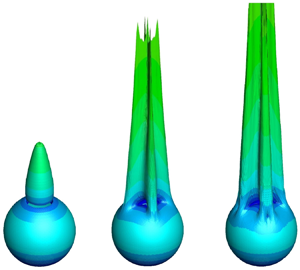
The motion of rigid particles in complex fluids is ubiquitous in natural and industrial processes. The most popular toy model for understanding the physics of such systems is the settling of a solid sphere in a viscoelastic fluid. There is general agreement that an elastic wake develops downstream of the sphere, causing the breakage of fore-and-aft symmetry, while the flow remains axisymmetric, independent of fluid viscoelasticity and flow conditions. Using a continuum mechanics model, we reveal that axisymmetry holds only for weak viscoelastic flows. Beyond a critical value of the settling velocity, steady, non-axisymmetric disturbances develop peripherally of the rear pole of the sphere, giving rise to a four-lobed fingering instability. The transition from axisymmetric to non-axisymmetric flow fields is characterized by a regular bifurcation and depends solely on the interplay between shear and extensional properties of the viscoelastic fluid under different flow regimes. At higher settling velocities, each lobe tip is split into two new lobes, resembling fractal fingering in interfacial flows. For the first time, we capture an elastic fingering instability under steady-state conditions, and provide the missing information for understanding and predicting such instabilities in the response of viscoelastic fluids and soft media.
Schizophrenia is a complex psychiatric disorder that changes the patient’s life by influencing how they think, behave, express emotions, percept reality and their interpersonal relationships.
Objectives
The aim of this study was to evaluate sociodemographic and therapeutic factors that act as risk and protective factors in the clinical outcomes of patients diagnosed with schizophrenia.
Methods
This was an observational retrospective study including patients diagnosed with schizophrenia, treated at the “Xhavit Gjata” Psychiatric Hospital, Tirane, Albania, who were discharged between May 1- October 30, 2022. The follow-up period was six months. Data on further hospitalizations during the follow-up were obtained from the Department of Statistics, QSUT, and confirmed by family members for hospitalizations in other psychiatric hospitals in the country. Univariate and multivariate analyses were conducted to identify potential factors associated with emergency room stays, length of stay, and time until the next admission.
Results
A total of 158 patients were included in the study, 63 women and 95 men (p=0.03). The average age of the patients was 42.9 years, with women averaging 45.3 years and men 40.6 years (p=0.01). 43.7% of them had elementary education. The average age of disorder onset was 24.7 years. Haloperidol was the ambulatory therapy used in 54.3% of patients, while atypical antipsychotics were used in 75.1% of patients. The most commonly used atypical antipsychotic was Risperidone in 34.1% of patients, followed by Olanzapine in 17% of cases. Depo antipsychotics were used in 35.1% of patients. Clozapine was administered to 29.3% of patients, where 12.8% for the first time. 54.2% of patients starting Clozapine for the first time had three or more admissions. Clozapine was more frequently used in men, showing a significant difference from women (p=0.05). In 44.7% of cases, monotherapy was prescribed. The average hospital stay was 21.9 days, ranging from 2-68 days. Living with a family member, male gender, and being “married” helped reduce the length of hospital stay. In the 6-month follow-up period, 31.4% were re-hospitalized. Significant factors affecting the reduction of time spent outside the hospital until the next hospitalization were social problems, the number of previous hospitalizations, civil status “not married,” living arrangements, negative symptoms, and alcohol use (nearly significant). Protective factors included Clozapine, which reduced the prevalence of hospitalization by 57% compared to patients not taking it. Additionally, the use of Clozapine and Haloperidol increased the time spent outside the hospital.
Conclusions
Social and family support, positive compliance, and antipsychotic therapy such as Clozapine serve as protective factors for patients diagnosed with schizophrenia.
This article examines the Committee for Constitutional Government, a conservative organization that spearheaded a novel form of mass-based mobilization and direct-mail propaganda to counter New Deal reforms from 1937 to the late 1950s. I argue that the members of the committee offered a supple and variegated response to New Deal liberalism, one with deep roots in the American past. Organizationally, the committee differed from other conservative groups of the period in the vastly greater reach of its propaganda, the small-donor financial base of its operations, and its extensive cultivation of a grassroots movement committed to right-wing reform. The committee was a critical political actor from 1937 to 1955, systematically shaping legislation and countering the trend toward social democracy in America. The ultimate result of its campaigns was to retard the growth of the administrative state and help formulate a cogent conservative critique of reformist liberalism.
Generalized anxiety disorder (GAD) is one of the most common mental disorders in adults. Psychotherapies are among the most recommended treatment choices for GAD, but which should be considered as first-line treatment still needs to be clarified.
Objectives
To examine the most effective and accepted psychotherapy for GAD both in the short and long-term, via a network meta-analysis.
Methods
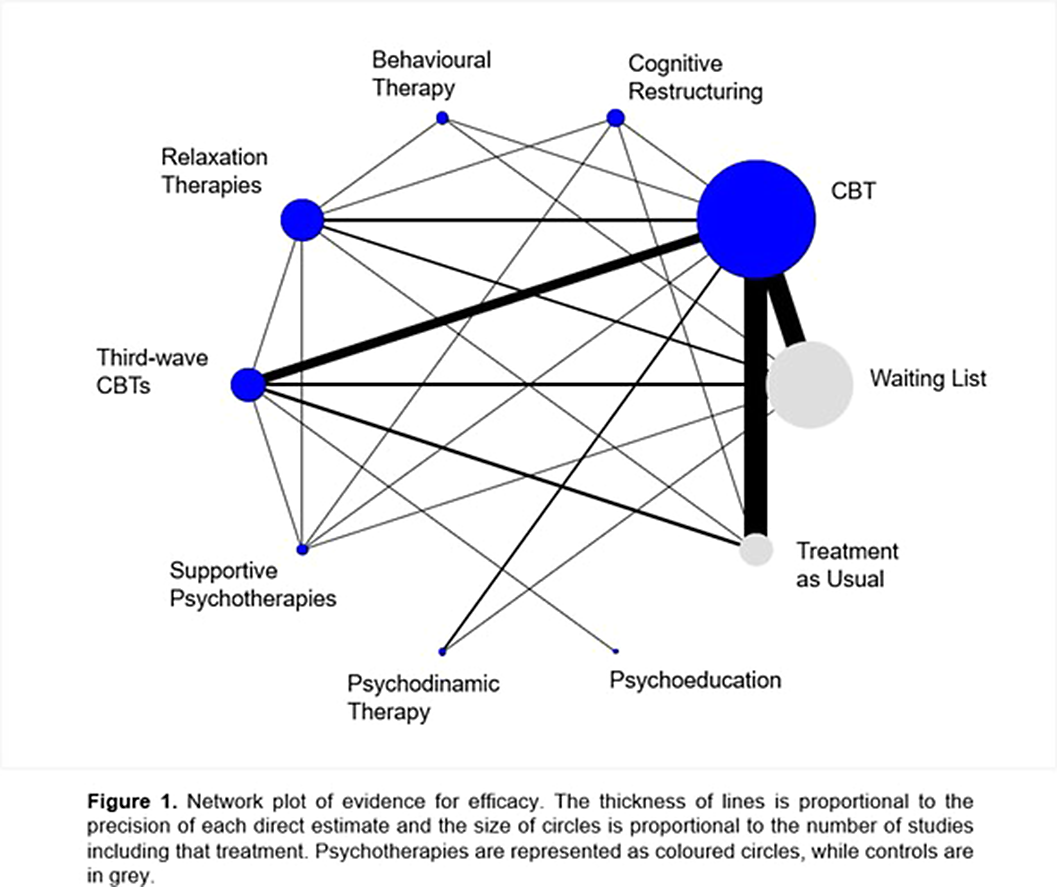
We searched MEDLINE, Embase, PsycINFO, and the Cochrane Register of Controlled Trials – CENTRAL, from database inception to January 1st, 2023, to find randomized controlled trials (RCTs) of psychotherapies for GAD. Eight psychotherapies (behaviour therapy, cognitive-behaviour therapy, cognitive restructuring, psychoeducation, psychodynamic therapy, relaxation therapy, supportive psychotherapy, and third-wave CBTs) were compared with each other and two control conditions (treatment as usual, waiting list). We followed Cochrane standards when extracting data and assessing data quality and used PRISMA guidelines for the reporting. We conducted random-effects model pairwise and network meta-analyses. We assessed risk of bias of individual studies through the second version of the Cochrane’s Risk of Bias tool and used the Confidence in Network Meta-Analysis (CINeMA) to rate certainty of evidence for meta-analytical results. Severity of GAD symptoms and acceptability of the psychotherapies were our outcomes of interest.
Results
We analysed data from 66 RCTs. Effect size estimates on data from 5,597 participants suggest third wave cognitive-behavioural therapies (standardized mean differences [SMDs] =-0.78; 95%CI=-1.19 to -0.37; certainty=moderate), cognitive-behavioural therapy (CBT) (SMD=-0.68; 95%CI=-1.05 to -0.32 certainty=moderate), and relaxation therapy (SMD=-0.54; 95%CI=-1.04 to -0.05; certainty=low) reduced generalized anxiety symptoms more than treatment as usual (TAU). Relative risks for all-cause discontinuation signalled no differences compared with TAU for all psychotherapies. When excluding studies at high risk of bias, relaxation therapy lost its superiority over TAU. When considering anxiety severity at three to twelve months after completion of the intervention only CBT remained significantly more efficacious than TAU (SMD=-0.58; 95%CI=-0.93 to -0.23).
Image:
Conclusions
Given the evidence for both acute and long-term efficacy, CBT may represent the reasonable first-line psychological treatment for GAD. Third-wave CBT and relaxation therapy have short-term efficacy and may also be offered. Results from this investigation should inform patients, clinicians, and guidelines. This project is funded by the European Union’s HORIZON EUROPE research programme under grant agreement No 101061648.
Cannabis use has been reported to cause a myriad of acute adverse reactions, including those linked to anxiety disorders, such as panic attacks and derealization. Notably, in the emergency department, anxiety makes up a significant proportion of the complaints related to cannabinoid consumption. Several reports show these symptoms can persist after the cessation of cannabis consumption. Consequently, some questions have arisen regarding the role of cannabinoids as precipitators for anxiety disorders in vulnerable individuals. Alternatively, it has been hypothesized that patients with anxiety disorders are more prone to using cannabis.
Objectives
We aim to understand whether there is an established relationship between anxiety disorders and cannabis use. Moreover, we intend to identify what are the factors which make an individual more likely to experience anxiety following cannabis consumption.
Methods
A search was conducted in the PubMed database using the MeSH terms “cannabis”, “panic disorder”, “anxiety”, “panic” and “generalized anxiety disorder”. Articles published in the last ten years were considered. Publications were selected after careful reading of their abstract. A non-systematic review of the selected articles was performed.
Results
Eight articles were included in this review. While a majority of these publications did not find a significant association between cannabis use and anxiety disorders, a small subset of analyzed articles found that cannabis use may increase anxiety severity in general, devoid of specific diagnostic association. Individuals who presented to the emergency department with anxiety complaints after cannabis use were likely to be young and to have ingested edible cannabis. History of psychiatric disease, especially substance use disorder, was common in this population.
Conclusions
Most available data suggest cannabis use is not clearly linked to anxiety disorders. However, information around this topic is scarce and heterogenous. Further research is needed focusing on the natural evolution of acute anxiety after cannabis use. Factors such as young age, presence of psychiatric comorbidities and consumption of edible cannabis appear to contribute to a significantly increased risk of experiencing acute anxiety after cannabis use.
Cariprazine is one of the most recent innovations in neuropsychopharmacology, with evidence for its efficacy in affective and psychotic spectrum disorders.
Objectives
To present a case that highlights cariprazine’s potential use outside the regulatory approved indications.
Methods
Case report using CARE guidelines and a narrative review.
Results
We present the case of a 41-year-old male readmitted to a psychiatric inpatient unit due to three months of mutism and withdrawal. At admission, the patient did not communicate verbally or in writing, but he complied with simple orders, and his consciousness remained unimpaired. He scored 11 points on the Bush-Francis Catatonia Rating Scale (BFCRS), indicating immobility, mutism, staring, withdrawal, ambitendency, and automatic obedience. We observed psychomotor retardation and indirect signs of a depressive mood, including the omega sign. His medical history included ongoing psychiatric treatment since the age of 30, with two prior admissions to an acute inpatient unit. At the time of admission, he was treated with olanzapine 20 mg/day, lorazepam 2 mg/day (recently downtitrated), venlafaxine 150 mg/day, and bupropion 150 mg/day. At the start of the current episode, the patient’s diagnosis was uncertain, with previous descriptions of psychotic, affective, and catatonic features. Due to suspicion of catatonia, we administered a high dose of lorazepam (8 mg/day), resulting in a partial response with a 4-point reduction in the BFCRS. We discontinued bupropion, increased venlafaxine to 225 mg, and switched from olanzapine to cariprazine using a taper, washout, and switch strategy. Psychotic symptoms briefly appeared when the patient was not taking a dopamine D2-receptor modulatory drug. We identified mild possible adverse drug reactions, including akathisia, transient insomnia, and daytime sleepiness. At a dose of 6 mg/day of cariprazine, we observed complete remission of catatonia (BFCRS=0) and significant improvement in affective and psychotic symptoms. The patient was discharged home with diagnoses of catatonia and schizoaffective disorder, prescribed 6mg/day of cariprazine, 225mg/day of venlafaxine, and 2,5mg/day of lorazepam. At the 6-month follow-up, the patient continues to exhibit clinical stability.
Conclusions
This case emphasizes the safety and potential effectiveness of cariprazine in treating catatonia within the context of schizoaffective disorder. We consider that the partial agonist properties of cariprazine could theoretically reduce the risk of exacerbating catatonia, a risk typically associated with full D2-receptor antagonists. Other mechanisms of action, such as D3 partial agonism, may also contribute to the improvement or at least the non-aggravation of catatonic symptoms. Cariprazine’s mood-stabilizing properties make it a promising off-label choice for treating schizoaffective disorder, especially when catatonic features are present.
Major Depressive Disorder (MDD) stands as a prevalent psychiatric condition within the general population. Despite extensive research efforts, the identification of definitive diagnostic biomarkers for depressive disorders remains elusive. Currently, machine learning methods are gaining prominence in the diagnosis of medical illnesses.
Objectives
This study aims to construct a machine learning-based prediction model for Major Depressive Disorder (MDD) by harnessing diffusion tensor imaging (DTI) data.
Methods
The DTI datasets comprising MDD (N=83) and Healthy Control (N=70) groups were procured from the cohort study of Anxiety and Depression conducted at the National Center for Mental Health in South Korea. A machine learning method using a decision tree algorithm was employed to select relevant brain regions and establish a robust diagnostic model. Features associated with white matter (WM) tracts were chosen through recursive feature elimination.
Results
Demographic characteristics, including age, sex, and handedness, displayed no significant differences between the MDD and Healthy Control groups. However, the total score of the Beck Depression Inventory was notably higher in individuals with MDD compared to Healthy Controls. A diagnostic model was crafted using the decision tree algorithms to distinguish between the two groups. The model demonstrated the following classification performance metrics: accuracy (65.6% ± 8.5), sensitivity (66.6% ± 12.5), and specificity (64.7% ± 13.6). Furthermore, through recursive feature elimination, specific neuroanatomical features tied to brain structures such as the inferior cerebellar peduncle, posterior thalamic radiation, cingulum (hippocampus), uncinate fasciculus, and tapetum were identified.
Conclusions
Despite of limited performance of classification, a machine learning-based approach could provide insights into the development of a diagnostic model for MDD using neuroimaging data. Furthermore, these features, derived from DTI-derived data, may have implications for understanding the neural underpinnings of major depressive disorder.
Sexual and gender minority (SGM) people are often found to have lower levels of body appreciation than do cis-heteronormative people.
Objectives
The current study utilizes the social cure model and the intragroup status and health model to investigate whether identification with a SGM social group and identity centrality (i.e., the degree to which a specific social identity is important to an individual) is linked to experiences of hostile behaviors because of a person’s looks or body and consequently, to body appreciation.
Methods
A cross-sectional online-questionnaire study was conducted with 1,680 German-speaking participants (49.2% cisgender women, 37.7% cisgender men, 9.0% non-binary, 4.1% transgender; Mage = 32.7, SD = 12.5). The Multidimensional and Multicomponent Measure of Social Identification, the Body Appreciation Scale-2, the Perceived Stigmatization Questionnaire and the Sociocultural Attitudes Towards Appearance Questionnaire-4, revised were used. A manifest path model was calculated.
Results
People who identified as gender minority (GM) people and LGBTQ* people reported lower levels of body appreciation. Sexual minority (SM) individuals who identified with a social group other than LGBTQ* people reported levels of body appreciation similar to those of individuals who identified as women. Individuals who identified as GM people experienced fewer instances of hostile behaviors because of their looks or body the higher their level of identity centrality was. On the other hand, individuals who identified as LGBTQ* people more frequently encountered hostile behaviors because of their looks or body when their identity centrality was strong. Frequent experiences of hostile behaviors because of a person’s looks or body was linked to poor body appreciation in all social groups.
Conclusions
Identity centrality might help alleviate experiences of discrimination, especially in people who identify as GM people, as the social cure model suggests. In line with the intragroup status and health model, individuals who strongly identify as LGBTQ* people might be more visible as SM people and experience more discrimination than do SM people who identify with another social group.
The burnout syndrome is a blend of physical exhaustion and emotional fatigue that impairs an individual’s performance at work. In Tunisia, factors like working hours, the frequency of monthly shifts, and the physical and emotional abuse that physicians face from patients have collectively led to a significant incidence of burnout among medical professionals.
Objectives
To evaluate the prevalence of burnout syndrome among medical residents working in healthcare facilities in Tunisia and to pinpoint the contributing factors.
Methods
This study is a descriptive cross-sectional survey conducted among medical residents completing their training in various healthcare facilities in Tunisia. The study employed an online self-administered questionnaire and assessed burnout across three dimensions: personal burnout, professional burnout, and relational burnout, using the Copenhagen Burnout Inventory (CBI).
Results
A total of 50 physicians took part in the survey. Among them, 72% were female, 80% were single, and the average age at the time of the study was 27.72 years. Concerning their professional status, 84% worked in university hospitals, 16% specialized in surgery, 40% specialized in medicine, and 44% were family physicians. The majority were students from the Faculty of Medicine in Sfax (56%), with 30% in Monastir, 8% in Tunis, and 6% in Sousse. Regarding their work hours, more than 40 hours per week were reported by 32% of participants. According to the CBI scale, 12% of participants had scores indicating severe personal burnout, while 20% had scores indicating moderate personal burnout. Additionally,16% reported severe professional burnout, and 12% had scores suggesting severe relational burnout. In contrast, only 8% had scores indicating moderate relational burnout. The sociodemographic and professional factors that were studied, such as weekly working hours, monthly shifts, specialty, and workplace, did not show a significant correlation with the presence of burnout syndrome.
Conclusions
Burnout syndrome among medical resident physicians not only impacts their physical and mental well-being but also reduces their effectiveness and motivation at work. It is essential to introduce stress management strategies within hospitals to foster a healthier work-life balance.
Tourette syndrome (TS) is a neurodevelopmental disorder characterized by the development of persistent and changing motor and phonic tics over time. The presence of at least two motor tics and one vocal tic that have persisted for at least a period of 1 year is required, and which developed before the age of 18. The most commonly used pharmacological treatment are antipsychotics, with a preference for atypical antipsychotics such as aripiprazole or risperidone. Clonidine and guanfacine have shown effectiveness in suppressing tics, and although generally less effective than antipsychotics, some authors are considering them as first-line treatments. The treatment is also influenced by any comorbidities the patient may present.
Objectives
To enumerate in a clinical case the pharmacological alternatives for TS, which vary according to the patient’s comorbidities and the intensity of the tic symptoms.
Methods
Case study. Anamnesis of the patient and their family.
Results
A 12-year-old boy presenting simple motor and vocal tics for over a year. At the same time that a valuation is requested by child psychiatry, the mother also requests follow-up by neuropediatrics. Other causes are ruled out, an EEG is performed, and a TS diagnosis is made. The initial treatment was low-dose aripiprazole with partial effectiveness. After 3 months, he presents an exacerbation of the tics, interfering with his social and academic life, making it impossible to attend classes. The mother takes him to emergency services, and he is admitted to pediatrics. During the stay in pediatrics, he is diagnosed with Attention Deficit Hyperactivity Disorder, in addition to confirming the TS diagnosis. Extended-release methylphenidate is initiated (neuropediatrics). After starting methylphenidate, the patient’s tics worsen, also presenting insomnia and hyporexia. Due to the diagnosis of ADHD, school failure, and affective symptoms (hypothymia), atomoxetine is initiated. The tics become constant and incapacitating. As the dose of aripiprazole is increased, the child presents extrapyramidal effects. As a therapeutic alternative, guanfacine is initiated, progressively discontinuing aripiprazole. Currently, the child is stable from motor and vocal tics, allowing him to lead a normalized life.
Conclusions
Although guanfacine is not as effective in reducing tics as antipsychotics, since the latter produce more side effects, it is justifiable to use it. This drug is capable of enhancing the therapeutic effect and reducing the adverse effects that antipsychotics could produce. Guanfacine may be a good alternative as a first line in the treatment of Tourette Syndrome with or without attention deficit disorder and hyperactivity .
Adolescents and young adults have particularly been impacted by the COVID-19 pandemic, leading to a rise in the incidence of mental health issues. Increased exposure to traumatic events may lead to decreased resilience and subsequently increased likely PTSD.
Objectives
This study sets out to examine the predictors and prevalence of likely PTSD and determine the level of resilience among adolescents and young adults.
Methods
A cross-sectional study using an online survey questionnaire was adopted to collect sociodemographic and clinical information from the subscribers of MoreGoodDays. The PTSD Checklist Civilian (PCL-C) and the Brief Resilience Scale (BRS was respectively used to assess likely PTSD and resilience Data was analyzed with SPSS version 25 using chi-squared tests and multivariate logistic regression analysis.
Results
343 of MoreGoodDays subscribers who participated in the survey were about 343. Most were female (79.0%), and 13.7% were male. Overall, 95 (45.7%) of respondents had likely PTSD and 109 (51.7%) had likely low resilience. Approximately 176 (51.3%) respondents had received mental health counselling, and 64 (35.4%) expressed the desire to receive mental health counselling. When all other variables are controlled in the regression model, respondents who have received mental health counselling in the past year were 13.7 times more likely to experience likely PTSD (OR = 13.70; 95% CI: 1.23- 142.86) and 15.15 times more likely to experience low resilience than those who did not (OR = 15.15; 95% CI: 1.46- 166.67). Again, those who would like to receive mental health counselling were 20.8 times more likely to experience PTSD than those who did not (OR = 20.76; 95% CI: 2.61- 165.401) and 29.4 times more likely to experience low resilience than those who did not (OR = 29.42; 95% CI: 3.31- 261.445). Finally, those with four or more ACE scores were 6.2 times more likely to experience likely PTSD than those who had zero scores (OR = 6.24; 95% CI: 1.46- 26.67).
Conclusions
MoreGoodDays subscribers were disproportionally affected by likely PTSD and low resilience, reflecting the devastating effect of the COVID-19 pandemic. Increased ACE has been linked to low resilience, which may also lead to a rise in mental health issues. Strategies to promote resilience may reduce the incidence of likely PTSD. Educational institutions may adopt innovative mental health interventions, including psychological interventions such as mobile text technology, to support the mental health of this cohort. Policymakers and government agencies are encouraged to give the mental health of young adults and youth more prominence on their agenda.
Dissociative Identity Disorder (DID) is the presence of two or more distinct personality states within an individual. It is a rare dissociative disorder where usually self-non-integration arises as a response to significant stress. As is the case for many other psychiatric disorders, the diagnosis and management of DID is highly dependent on cultural variables and contexts.
Objectives
To present a case of DID in Palestine in which the diagnosis was dependent on noticing minor changes in the patient’s dialect at different times. To highlight the importance of understanding each patient’s environment, values, and culture when assessing DID to avoid under- or over-diagnoses.
Methods
A case report in which we present a case of a 17-year-old Palestinian girl who suffered from three months of general fatigue, restlessness, poor coordination, and peripheral numbness. She was seen by several doctors who excluded organic causes and several spiritual healers without benefit. This caused severe deterioration of social and academic functioning. The family noticed a change in her articulation and memory issues, so they presented her to a psychiatrist. Data was collected by interviewing the patient and her family weekly for a month. The psychiatrist noted that the patient has subtle differences in accent, and directed the family to record any change in tone of voice or articulation. The patient was found to have three different accents on top of her native one, representing a total of four personalities with no memory integrity among them. She was started on Escitalopram (gradually increased) and Alprazolam (gradually decreased).
Results
The psychiatrist detected the theme of being “stuck” throughout the personalities, each in its own way, according to the context of their roots. It was revealed that the patient is engaged to a man she doesn’t approve of and has “no way out” due to the social and familial significance of this relationship. Family counseling and trauma-informed psychoeducation were done, where the patient’s choice was reaffirmed. This led to significant improvement in terms of mood, identity integration, and social functioning with complete resolution of split personalities in just short of one-and-a-half months.
Conclusions
This case report asserts the importance of cultural understanding and sensitivity when assessing psychiatric patients. Symptoms, triggers, psychotherapy, and psychoeducation have a universal baseline, yet are highly culturally-dependent. Through this case study, we emphasize the importance of translating universal criteria into context-specific practices.
According to the two-factor theory of delusional belief (Coltheart. Ann N Y Acad Sci 2010; 1191 16-26), explaining the presence of a delusion requires a combination of two neuropsychological impairments. The first deficit initially prompts the delusional belief and defines its content, whereas the second deficit – aberrant belief evaluation – interrupts the rejection of a delusional belief and is common for different types of delusions. The second deficit is associated with compromised functioning of the right ventral frontal/anterior insular cortex (r-VF/AI; Darby et al. Brain 2017; 140 497-507). However, neural correlates of the first deficit in different types of delusions remain obscure.
Objectives
The aim of the study was to search for regions whose functional connectivity with r-VF/AI is different between patients with somatic delusions (SD) and persecutory delusions (PD) and to further clarify the results by comparing clinical groups with healthy controls. We hypothesized that each clinical group is characterized by aberrant functional connectivity between a region, associated with poor belief evaluation (r-VF/AI), and a region, presumably associated with a neuropsychological impairment specific to the corresponding type of delusions.
Methods
Patients with delusional disorder or paranoid schizophrenia (n = 23) and healthy controls (n = 9; 5 females; mean age 36.2 ± 1.3) underwent resting-state fMRI (Philips Ingenia 3T). Nine patients had SD (5 females; mean age 40.3 ± 7.9) and fourteen patients had PD (3 females; mean age 35.6 ± 10.2). The clinical groups were compared in terms of whole-brain functional connectivity of r-VF/AI (ROI-to-voxel analysis in CONN; RRID:SCR_009550; www.nitrc.org/projects/conn). Statistical thresholds were p < .005 voxelwise, p[FDR] < .05 clusterwise. Each clinical group was compared with controls in terms of functional connectivity between r-VF/AI and previously identified regions with between-group differences in connectivity (ROI-to-ROI analysis). Age was a covariate of no interest in all analyses.
Results
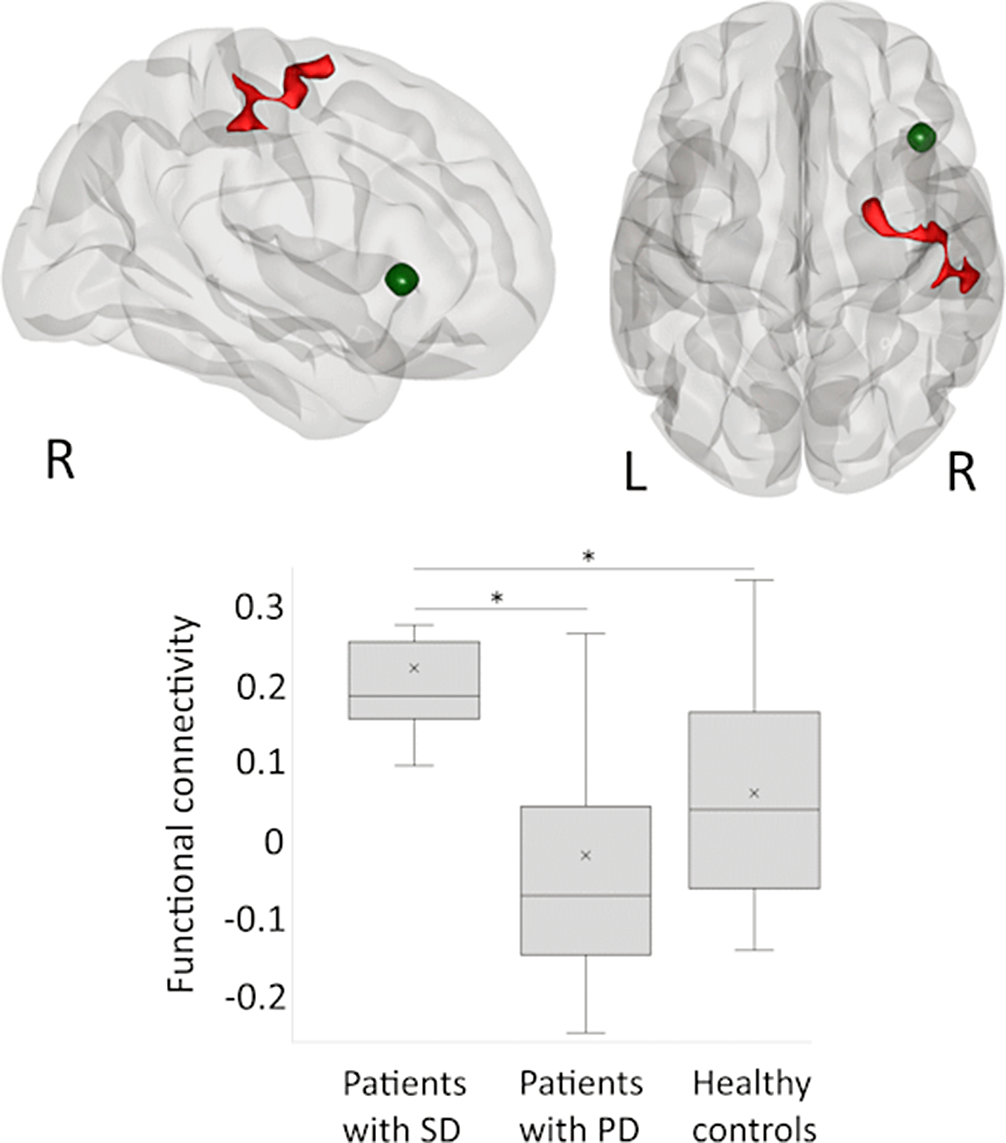
Patients with SD compared to patients with PD and healthy individuals had higher functional connectivity between the r-VF/AI and a cluster in the right precentral and postcentral gyri extending to supramarginal and superior frontal gyri (Figure 1).
Image:
Conclusions
The regions whose functional connectivity with r-VF/AI was aberrant in patients with SD are involved in the processing of tactile, proprioceptive, and visceral information. Our results coincide with a suggestion that the evaluation of beliefs related to bodily sensations is disturbed in patients with SD.
Research was supported by RFBR grant project 21-515-12007.
In recent years, there has been renewed interest in lithium therapy due to emerging evidence of the protective effects of lithium against neuronal death caused by a wide range of neurotoxic effects. Oxidative stress is a common pathway that is involved in various pathologies. In this regard, the development and study of new lithium compounds with combined antioxidant effects becomes relevant. Pyruvate has many potential benefits due to its positive effects on cellular metabolism.
Objectives
The purpose of this study was to study lithium pyruvate on blood cells of healthy donors under conditions of induced oxidative stress.
Methods
The study used blood from 20 healthy control group volunteers, aged 25 to 54 years. Venous blood was taken at baseline and then used for PBMCs extraction. After that cells were incubated during 24 hours in RPMI 1640 medium at 37°С and 5% carbon dioxide concentration. For oxidative stress induction hydroperoxide of trisubstituted butyl (HTB) was used in concentration of 50 μM. Cells were also incubated with lithium pyruvate in final concentration of lithium ions of 1.2 mM with or without HTB. Level of oxidative stress in culture was assessed by flow cytometer «Muse Cell Analyzer» (Merck Millipore, Germany) using «Oxidative stress» reagents kit (Merck Millipore, Germany). Statistical analysis was performed using the SPSS software, release 20.0 for Windows.
Results
Percentage of cells with reactive oxygen species (ROS) cultivated with HTB (65,33 (41,95-79,30) %) was statistically significant higher compared to intact cells (11,03 (7,93-15,53) %) (p=0.001). After addition of lithium pyruvate in culture statistically significant antioxidant effects were observed. In PBMCs incubated with HTB and lithium pyruvate statistically significant decreased percentage of cells with ROS (42,70 (16,73-58,70) %) (p=0.001)
Conclusions
A pronounced antioxidant effect of lithium pyruvate under induced oxidative stress on human peripheral blood mononuclear cells has been established. Lithium pyruvate can be considered as a promising psychotropic antioxidant for further experiments.
The symptoms of depression and anxiety, which are frequently comorbid, may be significantly impacted by the individual’s personality, even considering the complex etiology of depression. Several studies have shown that while certain personality traits may act as protective factors, others may increase vulnerability to depression and anxiety. Understanding these relationships may be important since personality traits have gained attention as potential determinants of symptom severity and treatment outcomes.
Objectives
To identify and evaluate the association of personality traits with symptoms of depression and anxiety in patients with depression.
Methods
The study involved 80 inpatients (≥ 18 years), hospitalised in University psychiatry department with depression diagnosis based on the ICD-10-AM classification. Subjects were asked to fill the Overall Anxiety Severity and Impairment Scale (“OASIS”), the Big Five Personality Dimensions scale and the Patient Health Questionnaire-9 (PHQ-9). Data analysis included descriptive data, Shapiro-Wilk test, Spearman correlation, Kruskal–Wallis test and Chi-Square test, with a significance threshold of p<0.05.
Results
Severe (26.3%) and very severe (41.3%) depressive symptoms were the most prevalent. Extraversion was associated with minimal (p=0.002), conscientiousness with mild (p<0.001), neuroticism with very severe depressive symptoms (p=0.003). The majority of depressed patients had severe (33,75 %) or very severe (32,5 %) anxiety symptoms. Anxiety symptoms were associated with more severe depressive symptoms (r=0.704, p<0.001). The association of conscientiousness and moderate anxiety symptoms was found (p=0.004). In the presence of expressed neuroticism, most of the respondents showed very severe anxiety symptoms, in the absence of neuroticism – moderate anxiety symptoms (p<0.001).
Conclusions
The results showed that personality traits were associated with severity of depression and anxiety symptoms in psychiatry inpatient with depression. Therefore, recognition of predominant personality traits in patients with depression may be helpful in selecting treatment and predicting treatment outcomes.
Obsessive-compulsive disorder (OCD) is a chronic condition characterized by time-consuming and distressing obsessions and/or compulsions, often accompanied by avoidance behaviours. It is a highly prevalent and incident disorder that results in considerable disability and quality of life reduction.
Current pharmacological treatments are hindered by their delayed onset and the limited evidence on how to approach first and second line treatment-resistant patients.
Recent research showcased the involvement of glutamatergic pathways in the pathophysiology of OCD prompting research into the potential therapeutic use of ketamine, which binds to the N-methyl-D-aspartic acid receptor and acts as a non-competitive antagonist of glutamate.
Objectives
The aim of this study is to conduct a literature review on the use of ketamine and its enantiomers as a treatment for OCD and report a clinical case involving an OCD patient who experienced significant improvement following ketamine use.
Methods
A search was performed on PubMed using a combination of keywords and Medical Subject Headings terms, including “Ketamine”, “Esketamine” and “Obsessive-Compulsive Disorder”. Only studies that involved patients with OCD aged ≥18 years who had received ketamine or its enantiomers as an intervention and that reported treatment response using a validated scale were included.
Results
Nine studies were included, 4 case reports, 3 open-label trials and 2 randomized controlled trials, totalling 71 patients. Ketamine was administered intravenously in 7 studies and intranasally in the remaining 2. The results were heterogeneous, with some studies reporting no effect on obsessive-compulsive (OC) symptoms and others demonstrating significant and rapid improvement, albeit some only transitorily.
We present the case of a 42-year-old man who experienced OC symptoms since the age of 20 but was only formally diagnosed with OCD 3 years ago. During his first consultation, the patient described obsessive thoughts related to contamination and dirtiness, accompanied by handwashing rituals and avoidance behaviours (e.g., avoiding touching handles and switches). His Yale-Brown Obsessive Compulsive Scale (Y-BOCS) score was 29. Escitalopram was initiated with a progressive dose titration, resulting in partial improvement (Y-BOCS 23). In a follow-up appointment, the patient disclosed that he had purchased and self-administered a single intravenous dose of 2g of ketamine 2 months earlier for recreational use. This led to an immediate and significant improvement of his OC symptoms. Subsequent re-evaluation 4 months later confirmed that he remained asymptomatic (Y-BOCS 2).
Conclusions
Ketamine may be a therapeutic alternative for OCD patients who are treatment resistant due to its rapid anti-obsessional effect. Further studies with improved designs and larger sample sizes are warranted to better assess the efficacy of ketamine in OCD treatment.
The COVID-19 global crisis has resulted in significant disruptions in the lives of students in higher education, leading to negative consequences for their academic achievements and general psychological well-being.
Objectives
In this study, we sought to examine the psychometric properties of the Depression Anxiety Stress Scale-21 (DASS-21) among students in Portuguese higher education institutions during the initial phase of the COVID-19 pandemic and its efficacy in capturing mental health symptoms due to a global health crisis.
Methods
In this cross-sectional study, a convenience sampling method was used to enlist a total of 1522 participants. The sample consisted of 75.1% women and 79.2% undergraduate students. Participants completed an electronic survey that was designed using the Depression Anxiety Stress Scale-21 (DASS-21) — a self-report instrument measuring anxiety, depression, and stress.
Results
The findings of the study indicated a significant occurrence of depressive symptoms [≥10] (N = 434, 28.5%), anxiety symptoms [≥7] (N = 551, 36.2%), and stress symptoms [≥11] (N = 544, 35.7%). Based on the collected data, a Confirmatory Factor Analysis (CFA) was conducted in order to examine the factor structure of the scale. The analysis revealed a three-factor solution that corresponded to the three subscales of the DASS-21. The Heterotrait-Monotrait (HTMT) correlation ratio was then used to assess the discriminant validity, with good results. Results showed that the DASS21 has satisfactory reliability indexes (Cronbach’s α > 0.90).
Conclusions
In light of the notable changes in living conditions brought by the COVID-19 pandemic, the present study has shown that the DASS-21 instrument has maintained its reliability and validity. Consequently, this finding supports the appropriateness of using the DASS-21 as a screening tool for assessing mental health among students in Portugal. Moreover, it is recommended that academics and healthcare practitioners use the DASS-21 as a tool for assessing the levels of psychological distress experienced by students. Additional validation studies of this scale are required, using bigger and more representative populations.