To save content items to your account,
please confirm that you agree to abide by our usage policies.
If this is the first time you use this feature, you will be asked to authorise Cambridge Core to connect with your account.
Find out more about saving content to .
To save content items to your Kindle, first ensure no-reply@cambridge.org
is added to your Approved Personal Document E-mail List under your Personal Document Settings
on the Manage Your Content and Devices page of your Amazon account. Then enter the ‘name’ part
of your Kindle email address below.
Find out more about saving to your Kindle.
Note you can select to save to either the @free.kindle.com or @kindle.com variations.
‘@free.kindle.com’ emails are free but can only be saved to your device when it is connected to wi-fi.
‘@kindle.com’ emails can be delivered even when you are not connected to wi-fi, but note that service fees apply.
This textbook provides an introduction to general relativity for mathematics undergraduates or graduate physicists. After a review of Cartesian tensor notation and special relativity the concepts of Riemannian differential geometry are introducted. More emphasis is placed on an intuitive grasp of the subject and a calculational facility than on a rigorous mathematical exposition. General relativity is then presented as a relativistic theory of gravity reducing in the appropriate limits to Newtonian gravity or special relativity. The Schwarzchild solution is derived and the gravitational red-shift, time dilation and classic tests of general relativity are discussed. There is a brief account of gravitational collapse and black holes based on the extended Schwarzchild solution. Other vacuum solutions are described, motivated by their counterparts in linearised general relativity. The book ends with chapters on cosmological solutions to the field equations. There are exercises attached to each chapter, some of which extend the development given in the text.
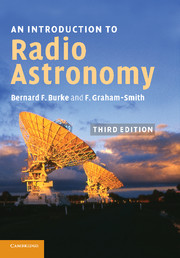
Written by two prominent figures in radio astronomy, this well-established, graduate-level textbook is a thorough introduction to radio telescopes and techniques. It is an invaluable overview for students and researchers turning to radio astronomy for the first time. The first half of the book describes how radio telescopes work - from basic antennas and single aperture dishes through to full aperture-synthesis arrays. It includes reference material on the fundamentals of astrophysics and observing techniques. The second half of the book reviews radio observations of our galaxy, stars, pulsars, radio galaxies, quasars, and the cosmic microwave background. This third edition describes the applications of fundamental techniques to newly developing radio telescopes, including ATA, LOFAR, MWA, SKA, and ALMA, which all require an understanding of aspects specific to radio astronomy. Two entirely new chapters now cover cosmology, from the fundamental concepts to the most recent results of WMAP.
Volumes I and II provide a completely new translation of the philosophical works of Descartes, based on the best available Latin and French texts. Volume III contains 207 of Descartes' letters, over half of which have not been translated into English before. It incorporates, in its entirety, Anthony Kenny's celebrated translation of selected philosophical letters, first published in 1970. In conjunction with Volumes I and II it is designed to meet the widespread demand for a comprehensive, accurate and authoritative edition of Descartes' philosophical writings in clear and readable modern English.
This textbook covers the classification, causes, treatment and prevention of psychological disorders in the infant through the adolescent years. Chapters balance the social and historical context of psychopathology with the physiological roots of abnormal behavior, leading students to a comprehensive understanding of child psychopathology. The book is totally up-to-date, including coverage of the DSM-5 and criticisms of it. In four parts, this textbook describes the empirical bases of child psychopathology as well as the practice of child psychologists, outlining the classification and causes of disorders in addition to methods of assessment, intervention and treatment. Students will be able to evaluate the treatments used by professionals and debunk popular myths about atypical behavior and its treatment. Complementing the lively writing style, text boxes, clinical case studies and numerous examples from international cultures and countries add context to chapter material. Study questions, diagrams and a glossary offer further learning support.
Plutarch's essay 'How to Study Poetry' offers a set of reading practices intended to remove the potential damage that poetry can do to the moral health of young readers. It opens a window on to a world of ancient education and scholarship which can seem rather alien to those brought up in the highly sophisticated world of modern literary theory and criticism. The full Introduction and Commentary, by two of the world's leading scholars in the field, trace the origins and intellectual affiliations of Plutarch's method and fully illustrate the background to each of his examples. As such this book may serve as an introduction to the whole subject of ancient reading practices and literary criticism. The Commentary also pays particular attention to grammar, syntax and style, and sets this essay within the context of Plutarch's thought and writing more generally.
Exploring Language and Linguistics considers the key concepts of linguistics and the application of these concepts to real-world settings. The first eight chapters cover the standard topics of introduction to linguistics courses, while subsequent chapters introduce students to applied topics such as media discourse, literary linguistics and psycholinguistics. Each chapter has been written by a subject expert and experienced teacher, ensuring that the text is both up-to-date and clearly presented. Numerous learning features provide extensive student support: exercises allow students to review their understanding of key topics; summaries encourage students to reflect on the main points of each chapter; figures, photos, tables and charts clarify complex topics; and annotated suggestions for further reading point students to resources for self-study. A companion website, with 170 self-test questions, suggested group exercises, audio files and links to additional web resources, completes the learning package.
This reader remains the only major new reader of Old English prose and verse in the past forty years. The second edition is extensively revised throughout, with the addition of a new 'Beginning Old English' section for newcomers to the Old English language, along with a new extract from Beowulf. The fifty-seven individual texts include established favourites such as The Battle of Maldon and Wulfstan's Sermon of the Wolf, as well as others not otherwise readily available, such as an extract from Apollonius of Tyre. Modern English glosses for every prose-passage and poem are provided on the same page as the text, along with extensive notes. A succinct reference grammar is appended, along with guides to pronunciation and to grammatical terminology. A comprehensive glossary lists and analyses all the Old English words that occur in the book. Headnotes to each of the six text sections, and to every individual text, establish their literary and historical contexts, and illustrate the rich cultural variety of Anglo-Saxon England. This second edition is an accessible and scholarly introduction to Old English.
As the number of universities offering entrepreneurial programs continues to increase, there is a growing need for a suitable framework for the teaching of entrepreneurship beyond the operational side of the business and the preparation of a business plan. This book offers a fresh approach to entrepreneurship by teaching readers how to discover and create a new firm, or grow an existing one, starting from a firm's or team's capabilities. The core methodology is based on the 'entrepreneurial arch' which provides a more holistic view of entrepreneurship by dividing the business development process into six distinct segments. An important feature of this model is the inclusion of learning units focusing on opportunity identification, business design and risk reduction before the business planning stage is attempted. Illustrated with various real-world examples, this structured and concise book will appeal to students, as well as to practitioners looking to develop their entrepreneurial skills.
Providing chemical engineering undergraduate and graduate students with a basic understanding of how separation of a mixture of molecules, macromolecules or particles is achieved, this textbook is a comprehensive introduction to the engineering science of separation.Students learn how to apply their knowledge to determine the separation achieved in a given device or processReal-world examples are taken from biotechnology, chemical, food, petrochemical, pharmaceutical and pollution control industriesWorked examples, elementary separator designs and chapter-end problems are provided, giving students a practical understanding of separation.The textbook systematically develops different separation processes by considering the forces causing the separation and how this separation is influenced by the patterns of bulk flow in the separation device. Readers will be able to take this knowledge and apply it to their own future studies and research in separation and purification. Online resources include solutions to the exercises and guidance for computer simulations.
This comprehensive and engaging textbook introduces the basic principles and techniques of signal processing, from the fundamental ideas of signals and systems theory to real-world applications. Students are introduced to the powerful foundations of modern signal processing, including the basic geometry of Hilbert space, the mathematics of Fourier transforms, and essentials of sampling, interpolation, approximation and compression The authors discuss real-world issues and hurdles to using these tools, and ways of adapting them to overcome problems of finiteness and localization, the limitations of uncertainty, and computational costs. It includes over 160 homework problems and over 220 worked examples, specifically designed to test and expand students' understanding of the fundamentals of signal processing, and is accompanied by extensive online materials designed to aid learning, including Mathematica® resources and interactive demonstrations.
This concise yet comprehensive overview of the political and economic development of the world's cities offers a unique emphasis on its cultural impacts. The book emphasizes the transition from modern (industrial) to post-modern (post-industrial) eras and its effect on established and developing global cities, and arguments are supported with case studies for each of the main concepts of urban theory and research. Mark Abrahamson analyzes contemporary global cities - ranging from Lagos to Los Angeles, Paris to Beijing - helping students relate concepts to concrete places and understand the global nature of contemporary urban development. Rigorous yet accessible, this textbook includes key learning features designed to enrich student understanding and engagement, including chapter-by-chapter glossaries, summaries, and suggestions for further reading.
Written for advanced undergraduate and graduate students, this is the first textbook on international relations theory to take a specifically game-theoretic approach to the subject, and provide the material needed for students to understand the subject thoroughly, from its basic foundations to more complex models. International relations theory is presented and analysed using simple games, which allow students to grasp the concepts and mechanisms involved with the rationalist approach without the distraction of complicated mathematics. Chapter exercises reinforce key concepts and guide students to extend the models discussed. Drawing examples from international security, international political economy, and environmental negotiations, this introductory textbook examines a broad array of topics in international relations courses, including state preferences, normal form games, bargaining, uncertainty and communication, multilateral cooperation, and the impact of domestic politics.
Unique in its coverage of all aspects of modern particle physics, this textbook provides a clear connection between the theory and recent experimental results, including the discovery of the Higgs boson at CERN. It provides a comprehensive and self-contained description of the Standard Model of particle physics suitable for upper-level undergraduate students and graduate students studying experimental particle physics. Physical theory is introduced in a straightforward manner with full mathematical derivations throughout. Fully-worked examples enable students to link the mathematical theory to results from modern particle physics experiments. End-of-chapter exercises, graded by difficulty, provide students with a deeper understanding of the subject. Online resources available at www.cambridge.org/MPP feature password-protected fully-worked solutions to problems for instructors, numerical solutions and hints to the problems for students and PowerPoint slides and JPEGs of figures from the book.
Psychology aims to give us a scientific account of how the mind works. But what does it mean to have a science of the mental, and what sort of picture of the mind emerges from our best psychological theories? This book addresses these philosophical puzzles in a way that is accessible to readers with little or no background in psychology or neuroscience. Using clear and detailed case studies and drawing on up-to-date empirical research, it examines perception and action, the link between attention and consciousness, the modularity of mind, how we understand other minds, and the influence of language on thought, as well as the relationship between mind, brain, body, and world. The result is an integrated and comprehensive overview of much of the architecture of the mind, which will be valuable for both students and specialists in philosophy, psychology, and cognitive science.
With a new author team contributing decades of practical experience, this fully updated and thoroughly classroom-tested second edition textbook prepares students and practitioners to create effective forecasting models and master the techniques of time series analysis. Taking a practical and example-driven approach, this textbook summarises the most critical decisions, techniques and steps involved in creating forecasting models for business and economics. Students are led through the process with an entirely new set of carefully developed theoretical and practical exercises. Chapters examine the key features of economic time series, univariate time series analysis, trends, seasonality, aberrant observations, conditional heteroskedasticity and ARCH models, non-linearity and multivariate time series, making this a complete practical guide. Downloadable datasets are available online.
This groundbreaking single-authored textbook equips students with everything they need to know to truly understand the hugely topical field of biomaterials science, including essential background on the clinical necessity of biomaterials, relevant concepts in biology and materials science, comprehensive and up-to-date coverage of all existing clinical and experimental biomaterials, and the fundamental principles of biocompatibility. It features extensive case studies interweaved with theory, from a wide range of clinical disciplines, equipping students with a practical understanding of the phenomena and mechanisms of biomaterials performance; a whole chapter dedicated to the biomaterials industry itself, including guidance on regulations, standards and guidelines, litigation, and ethical issues to prepare students for industry; informative glossaries of key terms, engaging end-of-chapter exercises and up-to-date lists of recommended reading. Drawing on the author's forty years' experience in biomaterials, this is an indispensable resource for students studying these lifesaving technological advances.
As consul in 63 BC Cicero faced a conspiracy to overthrow the Roman state launched by the frustrated consular candidate Lucius Sergius Catilina. Cicero's handling of this crisis would shape foreverafter the way he defined himself and his statesmanship. The four speeches he delivered during the crisis show him at the height of his oratorical powers and political influence. Divided between deliberative speeches given in the senate (1 and 4) and informational speeches delivered before the general public (2 and 3), the Catilinarians illustrate Cicero's adroit handling of several distinct types of rhetoric. Beginning in antiquity, this corpus served as a basic text for generations of students but fell into neglect during the past half-century. This edition, which is aimed primarily at advanced undergraduates and graduate students, takes account of recently discovered papyrus evidence, recent studies of Cicero's language, style and rhetorical techniques, and the relevant historical background.
Pliny the Younger's nine-book Epistles is a masterpiece of Roman prose. Often mined as a historical and pedagogical sourcebook, this collection of 'private' letters is now finding recognition as a rich and rewarding work in its own right. The second book is a typically varied yet taut suite of miniatures, including among its twenty letters the trial of Marius Priscus and Pliny's famous portrait of his Laurentine villa. This edition, the first to address a complete book of Epistles in over a century, presents a Latin text together with an introduction and commentary intended for students, teachers and scholars. With clear linguistic explanations and full literary analysis, it invites readers to a fresh appreciation of Pliny's lettered art.
How can the drag coefficient of a car be reduced? What factors govern the variation in the shape of the Earth's magnetosphere? What is the basis of weather prediction? These are examples of problems that can only be tackled with a sound knowledge of the principles and methods of fluid dynamics. This important discipline has applications which range from the study of the large-scale properties of the galaxies to the design of high precision engineering components. This book introduces the subject of fluid dynamics from the first principles. The first eleven chapters cover all the basic ideas of fluid mechanics, explaining carefully the modelling and mathematics needed. The last six chapters illustrate applications of this material to linearised sound and water waves, to high speed flow of air, to non-linear water waves on channels, and to aerofoil theory. Over 350 diagrams have been used to illustrate key points. Exercises are included to help develop and reinforce the reader's understanding of the material presented. References at the ends of each chapter serve not only to guide readers to more detailed texts, but also list where alternative descriptions of the salient points in the chapter may be found. This book is an undergraduate text for second or third year students of mathematics or mathematical physics, who are taking a first course in fluid dynamics.
This 1981 book is a general introduction to linguistics and the study of language, intended particularly for beginning students and readers with no previous knowledge or training in the subject. There is first a general account of the nature of language and of the aims, methods and basic principles of linguistic theory. John Lyons then introduces in turn each of the main sub-fields of linguistics: the sounds of language, grammar, semantics, language change, psycholinguistics: the sounds of language, grammar, semantics, language change, psycholinguistics, language and culture. Throughout the book he emphasizes particularly those aspects of the discipline that seem fundamental and most likely to remain important. He stresses throughout the cultural at least as much as the biological context of human language, and shows how the linguist's concerns connect productively with those of the traditional humanities and the social sciences. Each chapter has a wide-ranging set of discussion questions and revision exercises, and extensive suggestions for further reading. The exposition is marked throughout by the author's characteristic clarity, balance and authority.