Refine search
Actions for selected content:
46 results
Weak cluster points of maximizing sequences on Banach spaces satisfying $\boldsymbol {(M_p)}$
- Part of
-
- Journal:
- Canadian Mathematical Bulletin , First View
- Published online by Cambridge University Press:
- 23 February 2026, pp. 1-8
-
- Article
-
- You have access
- Open access
- HTML
- Export citation
-
Let T be a bounded linear operator on a separable Banach space that satisfies geometric properties similar to those of $\ell ^p,\, p>1$. We prove that the smallest and the largest norm of weak cluster points of all maximizing sequences for T can only take the values $0$ or $1$. The three classes of bounded linear operators emerging from the dichotomy of these extremal norm values coincide with the partition, created by considering the norm-attaining property and if the essential norm equals the norm.


Inequalities of the ℓp-operator norm for block matrices
- Part of
-
- Journal:
- Canadian Mathematical Bulletin , First View
- Published online by Cambridge University Press:
- 26 January 2026, pp. 1-12
-
- Article
- Export citation
-
We develop several $\ell ^p$-operator norm inequalities for $k\times k$ block matrices defined on the $\ell ^p$-sum of Banach spaces. Using these inequalities, we obtain p-numerical radius and spectral radius bounds for $k\times k$ block matrices. We deduce a p-numerical radius bound for the Kronecker product $A\otimes B$, where $A\in {M}_k(\mathbb {C})$ is a $k\times k$ complex matrix and $B\in \mathcal {L}(\mathbb {H})$ is a bounded linear operator on a complex Hilbert space $\mathbb {H}$. This improves and extends Holbrook’s bound $w(A\otimes B)\leq w(A)\|B\|.$ If $\|A\|_{\ell ^p}$ and $w_p(A)$ denote the $\ell ^p$-operator norm and p-numerical radius of $A\in {M}_k(\mathbb {C})$, respectively, then it is shown that where
 $$ \begin{align*} \frac{1}{2}\|A\|_p+\mu_p(A) \leq w_p(A), \end{align*} $$ $\mu _p(A)$ is a positive real number that involves the $\ell ^p$-operator norms of the Cartesian decomposition of A. In addition, a complete characterization of the equality case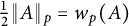 $\frac {1}{2}\|A\|_p= w_p(A)$ is given.


The norms for symmetric and antisymmetric tensor products of the weighted shift operators
- Part of
-
- Journal:
- Canadian Journal of Mathematics , First View
- Published online by Cambridge University Press:
- 26 January 2026, pp. 1-27
-
- Article
- Export citation
-
In the present article, we study the norms for symmetric and antisymmetric tensor products of weighted shift operators. By proving that for $n\geq 2$, if and only if the weight satisfies the regularity condition, we partially solve [see Problems 6 and 7 in Garcia et al. (2025, Canad. J. Math., 77, 324–346)]. It will be seen that most weighted shift operators on function spaces, including weighted Bergman shift, Hardy shift, etc., satisfy the regularity condition. Moreover, at the end of the article, we solve [see Problems 1 and 2 in Garcia et al. (2025)].
 $$ \begin{align*}\|S_{\alpha}^{l_1}\odot\cdots \odot S_{\alpha}^{l_k}\odot S_{\alpha}^{*l_{k+1}}\odot\cdots \odot S_{\alpha}^{*l_{n}}\| =\mathop{\prod}_{i=1}^n\left \| S_{\alpha}^{{l_{i}}}\right\|, \text{ for any} \ (l_1,l_2\ldots l_n)\in\mathbb N^n\end{align*} $$

Parabolic Muckenhoupt weights characterized by parabolic fractional maximal and integral operators with time lag
- Part of
-
- Journal:
- Canadian Journal of Mathematics , First View
- Published online by Cambridge University Press:
- 17 March 2025, pp. 1-54
-
- Article
- Export citation
Symmetric and antisymmetric tensor products for the function-theoretic operator theorist
- Part of
-
- Journal:
- Canadian Journal of Mathematics / Volume 77 / Issue 1 / February 2025
- Published online by Cambridge University Press:
- 22 December 2023, pp. 324-346
- Print publication:
- February 2025
-
- Article
-
- You have access
- Open access
- HTML
- Export citation
Norms on complex matrices induced by random vectors II: extension of weakly unitarily invariant norms
- Part of
-
- Journal:
- Canadian Mathematical Bulletin / Volume 67 / Issue 2 / June 2024
- Published online by Cambridge University Press:
- 06 November 2023, pp. 447-457
- Print publication:
- June 2024
-
- Article
- Export citation
-
We improve and expand in two directions the theory of norms on complex matrices induced by random vectors. We first provide a simple proof of the classification of weakly unitarily invariant norms on the Hermitian matrices. We use this to extend the main theorem in Chávez, Garcia, and Hurley (2023, Canadian Mathematical Bulletin 66, 808–826) from exponent $d\geq 2$ to $d \geq 1$. Our proofs are much simpler than the originals: they do not require Lewis’ framework for group invariance in convex matrix analysis. This clarification puts the entire theory on simpler foundations while extending its range of applicability.


Remarks on countable subadditivity
- Part of
-
- Journal:
- Proceedings of the Royal Society of Edinburgh. Section A: Mathematics / Volume 154 / Issue 5 / October 2024
- Published online by Cambridge University Press:
- 23 August 2023, pp. 1504-1517
- Print publication:
- October 2024
-
- Article
- Export citation
Norms on complex matrices induced by random vectors
- Part of
-
- Journal:
- Canadian Mathematical Bulletin / Volume 66 / Issue 3 / September 2023
- Published online by Cambridge University Press:
- 23 December 2022, pp. 808-826
- Print publication:
- September 2023
-
- Article
- Export citation
-
We introduce a family of norms on the $n \times n$ complex matrices. These norms arise from a probabilistic framework, and their construction and validation involve probability theory, partition combinatorics, and trace polynomials in noncommuting variables. As a consequence, we obtain a generalization of Hunter’s positivity theorem for the complete homogeneous symmetric polynomials.

Matrix inequalities and majorizations around Hermite–Hadamard’s inequality
- Part of
-
- Journal:
- Canadian Mathematical Bulletin / Volume 65 / Issue 4 / December 2022
- Published online by Cambridge University Press:
- 10 January 2022, pp. 943-952
- Print publication:
- December 2022
-
- Article
- Export citation
-
We study the classical Hermite–Hadamard inequality in the matrix setting. This leads to a number of interesting matrix inequalities such as the Schatten p-norm estimates
for all positive (semidefinite) $$ \begin{align*}\left(\|A^q\|_p^p + \|B^q\|_p^p\right)^{1/p} \le \|(xA+(1-x)B)^q\|_p+ \|((1-x)A+xB)^q\|_p, \end{align*} $$ $n\times n$ matrices $A,B$ and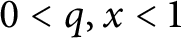 $0<q,x<1$. A related decomposition, with the assumption $X^*X+Y^*Y=XX^*+YY^*=I$, is for some family of
 $$ \begin{align*}(X^*AX+Y^*BY)\oplus (Y^*AY+X^*BX) =\frac{1}{2n}\sum_{k=1}^{2n} U_k (A\oplus B)U_k^*, \end{align*} $$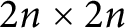 $2n\times 2n$ unitary matrices $U_k$. This is a majorization which is obtained by using the Hansen–Pedersen trace inequality.


EQUIVALENCE OF SEMI-NORMS RELATED TO SUPER WEAKLY COMPACT OPERATORS
- Part of
-
- Journal:
- Bulletin of the Australian Mathematical Society / Volume 104 / Issue 3 / December 2021
- Published online by Cambridge University Press:
- 22 June 2021, pp. 506-518
- Print publication:
- December 2021
-
- Article
- Export citation
-
We study super weakly compact operators through a quantitative method. We introduce a semi-norm $\sigma (T)$ of an operator $T:X\to Y$, where X, Y are Banach spaces, the so-called measure of super weak noncompactness, which measures how far T is from the family of super weakly compact operators. We study the equivalence of the measure $\sigma (T)$ and the super weak essential norm of T. We prove that Y has the super weakly compact approximation property if and and only if these two semi-norms are equivalent. As an application, we construct an example to show that the measures of T and its dual $T^*$ are not always equivalent. In addition we give some sequence spaces as examples of Banach spaces having the super weakly compact approximation property.


NUMERICAL RANGE AND POSITIVE BLOCK MATRICES
- Part of
-
- Journal:
- Bulletin of the Australian Mathematical Society / Volume 103 / Issue 1 / February 2021
- Published online by Cambridge University Press:
- 11 June 2020, pp. 69-77
- Print publication:
- February 2021
-
- Article
-
- You have access
- Export citation
-
We obtain several norm and eigenvalue inequalities for positive matrices partitioned into four blocks. The results involve the numerical range $W(X)$ of the off-diagonal block $X$, especially the distance $d$ from $0$ to $W(X)$. A special consequence is an estimate, between the diameters of the numerical ranges for the full matrix and its partial trace.
 $$\begin{eqnarray}\text{diam}\,W\left(\left[\begin{array}{@{}cc@{}}A & X\\ X^{\ast } & B\end{array}\right]\right)-\text{diam}\,W\biggl(\frac{A+B}{2}\biggr)\geq 2d,\end{eqnarray}$$


INEQUALITIES OF JENSEN’S TYPE FOR POSITIVE LINEAR FUNCTIONALS ON HERMITIAN UNITAL BANACH $\ast$-ALGEBRAS
- Part of
-
- Journal:
- Bulletin of the Australian Mathematical Society / Volume 102 / Issue 2 / October 2020
- Published online by Cambridge University Press:
- 08 January 2020, pp. 308-318
- Print publication:
- October 2020
-
- Article
-
- You have access
- Export citation
-
We establish inequalities of Jensen’s and Slater’s type in the general setting of a Hermitian unital Banach $\ast$-algebra, analytic convex functions and positive normalised linear functionals.


IMPROVED INEQUALITIES FOR THE NUMERICAL RADIUS: WHEN INVERSE COMMUTES WITH THE NORM
- Part of
-
- Journal:
- Bulletin of the Australian Mathematical Society / Volume 97 / Issue 2 / April 2018
- Published online by Cambridge University Press:
- 02 February 2018, pp. 293-296
- Print publication:
- April 2018
-
- Article
-
- You have access
- Export citation
-
New inequalities relating the norm $n(X)$ and the numerical radius $w(X)$ of invertible bounded linear Hilbert space operators were announced by Hosseini and Omidvar [‘Some inequalities for the numerical radius for Hilbert space operators’, Bull. Aust. Math. Soc.94 (2016), 489–496]. For example, they asserted that $w(AB)\leq$ $2w(A)w(B)$ for invertible bounded linear Hilbert space operators $A$ and $B$ . We identify implicit hypotheses used in their discovery. The inequalities and their proofs can be made good by adding the extra hypotheses which take the form $n(X^{-1})=n(X)^{-1}$ . We give counterexamples in the absence of such additional hypotheses. Finally, we show that these hypotheses yield even stronger conclusions, for example, $w(AB)=w(A)w(B)$ .


SOME INEQUALITIES FOR THE NUMERICAL RADIUS FOR HILBERT SPACE OPERATORS
- Part of
-
- Journal:
- Bulletin of the Australian Mathematical Society / Volume 94 / Issue 3 / December 2016
- Published online by Cambridge University Press:
- 26 September 2016, pp. 489-496
- Print publication:
- December 2016
-
- Article
-
- You have access
- Export citation
-
We introduce some new refinements of numerical radius inequalities for Hilbert space invertible operators. More precisely, we prove that if $T\in {\mathcal{B}}({\mathcal{H}})$ is an invertible operator, then $\Vert T\Vert \leq \sqrt{2}\unicode[STIX]{x1D714}(T)$ .


Corrections to “On the commutators of singular integrals related to Bloch spaces, Nagoya Math. J., 173 (2004), 205–223”
-
- Journal:
- Nagoya Mathematical Journal / Volume 175 / 2004
- Published online by Cambridge University Press:
- 22 January 2016, pp. 223-224
-
- Article
-
- You have access
- Export citation
On the commutators of singular integrals related to block spaces
-
- Journal:
- Nagoya Mathematical Journal / Volume 173 / 2004
- Published online by Cambridge University Press:
- 22 January 2016, pp. 205-223
-
- Article
-
- You have access
- Export citation
SPECTRUM AND COMPACTNESS OF THE CESÀRO OPERATOR ON WEIGHTED $\ell _{p}$ SPACES
- Part of
-
- Journal:
- Journal of the Australian Mathematical Society / Volume 99 / Issue 3 / December 2015
- Published online by Cambridge University Press:
- 19 August 2015, pp. 287-314
-
- Article
-
- You have access
- Export citation
-
An investigation is made of the continuity, the compactness and the spectrum of the Cesàro operator $\mathsf{C}$ when acting on the weighted Banach sequence spaces $\ell _{p}(w)$, $1<p<\infty$, for a positive decreasing weight $w$, thereby extending known results for $\mathsf{C}$ when acting on the classical spaces $\ell _{p}$. New features arise in the weighted setting (for example, existence of eigenvalues, compactness) which are not present in $\ell _{p}$.


Boundedness of integral operators on decreasing functions
- Part of
-
- Journal:
- Proceedings of the Royal Society of Edinburgh. Section A: Mathematics / Volume 145 / Issue 4 / August 2015
- Published online by Cambridge University Press:
- 30 June 2015, pp. 725-744
- Print publication:
- August 2015
-
- Article
- Export citation
-
We continue the study of the boundedness of the operator

on the set of decreasing functions in Lp(w). This operator was first introduced by Braverman and Lai and also studied by Andersen, and although the weighted weak-type estimate
 was completely solved, the characterization of the weights w such that
  is bounded is still open for the case in which p > 1. The solution of this problem will have applications in the study of the boundedness on weighted Lorentz spaces of important operators in harmonic analysis.
 was completely solved, the characterization of the weights
  is bounded is still open for the case in which
 HYPERPLANES OF FINITE-DIMENSIONAL NORMED SPACES WITH THE MAXIMAL RELATIVE PROJECTION CONSTANT
- Part of
-
- Journal:
- Bulletin of the Australian Mathematical Society / Volume 91 / Issue 3 / June 2015
- Published online by Cambridge University Press:
- 02 March 2015, pp. 447-463
- Print publication:
- June 2015
-
- Article
-
- You have access
- Export citation
-
The relative projection constant ${\it\lambda}(Y,X)$ of normed spaces $Y\subset X$ is ${\it\lambda}(Y,X)=\inf \{\Vert P\Vert :P\in {\mathcal{P}}(X,Y)\}$, where ${\mathcal{P}}(X,Y)$ denotes the set of all continuous projections from $X$ onto $Y$. By the well-known result of Bohnenblust, for every $n$-dimensional normed space $X$ and a subspace $Y\subset X$ of codimension one, ${\it\lambda}(Y,X)\leq 2-2/n$. The main goal of the paper is to study the equality case in the theorem of Bohnenblust. We establish an equivalent condition for the equality ${\it\lambda}(Y,X)=2-2/n$ and present several applications. We prove that every three-dimensional space has a subspace with the projection constant less than $\frac{4}{3}-0.0007$. This gives a nontrivial upper bound in the problem posed by Bosznay and Garay. In the general case, we give an upper bound for the number of ( $n-1$)-dimensional subspaces with the maximal relative projection constant in terms of the facets of the unit ball of $X$. As a consequence, every $n$-dimensional normed space $X$ has an ( $n-1$)-dimensional subspace $Y$ with ${\it\lambda}(Y,X)<2-2/n$. This contrasts with the separable case in which it is possible that every hyperplane has a maximal possible projection constant.


Exact and Approximate Operator Parallelism
-
- Journal:
- Canadian Mathematical Bulletin / Volume 58 / Issue 1 / 01 March 2015
- Published online by Cambridge University Press:
- 20 November 2018, pp. 207-224
- Print publication:
- 01 March 2015
-
- Article
-
- You have access
- Export citation
-
Extending the notion of parallelism we introduce the concept of approximate parallelism in normed spaces and then substantially restrict ourselves to the setting of Hilbert space operators endowed with the operator norm. We present several characterizations of the exact and approximate operator parallelism in the algebra $\mathbb{B}\left( H \right)$ of bounded linear operators acting on a Hilbert space $H$ . Among other things, we investigate the relationship between the approximate parallelism and norm of inner derivations on $\mathbb{B}\left( H \right)$ . We also characterize the parallel elements of a ${{C}^{*}}$ -algebra by using states. Finally we utilize the linking algebra to give some equivalent assertions regarding parallel elements in a Hilbert ${{C}^{*}}$ -module.


