To save content items to your account,
please confirm that you agree to abide by our usage policies.
If this is the first time you use this feature, you will be asked to authorise Cambridge Core to connect with your account.
Find out more about saving content to .
To save content items to your Kindle, first ensure no-reply@cambridge.org
is added to your Approved Personal Document E-mail List under your Personal Document Settings
on the Manage Your Content and Devices page of your Amazon account. Then enter the ‘name’ part
of your Kindle email address below.
Find out more about saving to your Kindle.
Note you can select to save to either the @free.kindle.com or @kindle.com variations.
‘@free.kindle.com’ emails are free but can only be saved to your device when it is connected to wi-fi.
‘@kindle.com’ emails can be delivered even when you are not connected to wi-fi, but note that service fees apply.
The organisation and financing of services dominate long-term care policy and research. This article argues for reorientation towards the social determinants of long-term care and the inequalities they generate. Building on Dahlgren and Whitehead’s influential equivalent for health, the article offers a framework for understanding how inequalities in long-term care need, access and experience are shaped by social networks, living and working conditions, services and policies, social norms, and political, economic and environmental conditions. International evidence on inequalities in need, access and experience is reviewed, and new analysis is presented for England, based on analysis of the Health Survey for England and the Adult Social Care Survey. Socio-economic inequalities are associated with steep gradients in need. Combined with unequal access to formal services, this results in more unmet need among disadvantaged people and a greater weight of responsibility on their family and friends. The final section explores the implications of a social determinants’ perspective for long-term care: addressing ‘upstream’ drivers of need (including social protection, housing and neighbourhood regeneration); inclusion and empowerment agendas; and ensuring that services effectively compensate for, rather than re-enforce, inequalities.
Childlessness in late male adulthood is increasingly prevalent in rural China, indicating a need to understand the factors contributing to it. This group is often overlooked in gerontological and childlessness research. While existing studies have explored individual-level predictors of childlessness over the lifecourse and implications of broader societal conditions at the population level, little is known about how lifecourse and structural factors interact to shape pathways to childlessness. This study aims to investigate structural factors contributing to childlessness among older men in a rural area of northern China. It focuses on the life stories of 13 childless older men and the effects of history, timing and life-domain interdependencies, finding that some participants experienced intense disruptive life events or critical turning points – early-life care-giving responsibilities, disability or withdrawal from school – that altered their life trajectories. These events often intersected with structural factors, including unstable and low-paid employment, lack of social protection and prevailing social norms, which reinforced one another and jointly constrained prospects for marriage and parenthood. These trajectories unfolded within shifting policy contexts; institutional arrangements across different historical periods shaped and often produced disadvantages in the marriage market. This study advances theoretical understanding of the structural factors contributing to male childlessness by recognizing life trajectories, structural shifts and social relations as linked factors shaping cumulative disadvantage in union formation and childbearing. Its policy implications surround supporting individuals who intend to form families during critical life transitions and addressing the broader structural barriers that shape male childlessness in rural areas.
It is becoming increasingly evident that women are affected differently from men before, during, and after disasters. This study aims to evaluate the safety, health, and privacy concerns associated with earthquakes in Kahramanmaraş, focusing on the impact on women.
Methods
The study is a case study design within a qualitative research approach. The data obtained were evaluated using the thematic analysis method. In the study, semi-structured interviews were conducted with 24 survivors of the earthquake. The data were analyzed with MAXQDA analysis software.
Results
The study revealed that women have various health and safety risks. The main themes include experiences related to health, safety and privacy issues, hygiene, and other problems. Lack of adequate privacy, security problems, lack of appropriate resources and specialized facilities, women’s menstrual difficulties, exposure to or witnessing violence, and issues related to being alone were found to be important themes.
Conclusions
The root causes of women’s vulnerability during disasters should be identified, and programs should be designed to reduce this vulnerability. Strategies and policies based on the needs of women should be developed to reduce their future vulnerability. Inclusion of women in decision-making processes will be effective in the development of gender strategies.
Equality law has developed into a mature and sophisticated field of law across jurisdictions. At the same time, inequality too has bourgeoned. This Article explores this paradox. It argues that the widening gulf between equality law and persisting inequalities can be addressed through a ‘structural turn’ in equality law. The structural turn is imagined in contrast with the liberal view which sees the harm of inequality/discrimination as something inflicted by and against individuals or collectivities through specific acts or omissions. The structural view places individual victims and perpetrators within the broader dimensions of the social, economic, legal, political, psychic and cultural contexts in which they exist and the power relations within them. The way these dimensions interact with each other and against the relationships of power within them, reveals how structural harm is occasioned. This Article argues that structural harm need not only be treated as a product of structures, including a structure such as equality law, but as the target of equality law which is open to not only enacting structural harm but also structural change.
Deaths from suicides, drug poisonings, and alcohol-related diseases (‘deaths of despair’) are well-documented among working-age Americans, and have been hypothesized to be largely specific to the U.S. However, support for this assertion–and associated policies to reduce premature mortality–requires tests concerning these deaths in other industrialized countries, with different institutional contexts. We tested whether the concentration and accumulation of health and social disadvantage forecasts deaths of despair, in New Zealand and Denmark.
Methods
We used nationwide administrative data. Our observation period was 10 years (NZ = July 2006–June 2016, Denmark = January 2007–December 2016). We identified all NZ-born and Danish-born individuals aged 25–64 in the last observation year (NZ = 1 555 902, Denmark = 2 541 758). We ascertained measures of disadvantage (public-hospital stays for physical- and mental-health difficulties, social-welfare benefit-use, and criminal convictions) across the first nine years. We ascertained deaths from suicide, drugs, alcohol, and all other causes in the last year.
Results
Deaths of despair clustered within a population segment that disproportionately experienced multiple disadvantages. In both countries, individuals in the top 5% of the population in multiple health- and social-service sectors were at elevated risk for deaths from suicide, drugs, and alcohol, and deaths from other causes. Associations were evident across sex and age.
Conclusions
Deaths of despair are a marker of inequalities in countries beyond the U.S. with robust social-safety nets, nationwide healthcare, and strong pharmaceutical regulations. These deaths cluster within a highly disadvantaged population segment identifiable within health- and social-service systems.
Chapter 3 explains the principle of the indivisibility and interdependence of human rights (‘the principle of indivisibility) as recognising: (a) the equal importance of economic, social and cultural rights with civil and political rights, and (b) the interdependence of rights within and across categories. It explains how the privileging of civil and political rights, including the right to legal capacity, erroneously frames state restraint as always rights-affirming; such framing, in turn, demands the abolition of decision-making by substitutes. It argues that depending on how an adult with cognitive disability is contingently situated even after all supports are provided, they may require a decision to be made by a substitute to fulfil an immediate socio-economic need and to claim their human rights. It argues that Article 12, in requiring supports for legal capacity, is a ‘hybrid’ civil and political and socio-economic right, illustrating and driving the principle of indivisibility in the CRPD.
Publications on citizenship, democracy, and disability tend to focus almost exclusively on the labor market, the political system, as well as assistance and support, and not on education. The same holds true in reverse. Democracy in relation to education and schooling is often discussed in a restricted manner. Disability is not treated with specific interest in this context. This chapter addresses this gap with a specific focus on John Dewey’s theoretical considerations. It first outline key aspects of Dewey’s theoretical framework before turning to the issue of disability and the specific risks it entails for democratic life in general and democratic participation in particular. It then explores the question of whether Dewey’s pragmatist approach can be used to make progress for disabled people’s education. It particularly discusses tensions and dilemmas that disability poses for democratic and inclusive education.
This introductory chapter outlines the structure of the book and some of the themes that appear throughout the book. The themes include intersectionality, the role of social factors in causing and maintaining mental ill-health, the need for a public mental health approach, and the role of mental health professionals and services in facilitating social inclusion. We discuss why social exclusion violates social justice and social solidarity, and put forward ten reasons why mental health professionals should be concerned with social exclusion.
Health inequities such as chronic disease are significantly higher among individuals living with disadvantage compared with the general population and many are reported to be attributable to preventable dietary risk factors. This study provides an overview of the current nutrition interventions for individuals living with extreme disadvantage, in supported residential settings, to develop insights into the development and implementation of policies and practices to promote long-term nutritional health and well-being.
Design:
A scoping review searched Scopus, ProQuest, CINAHL Plus, MEDLINE, and Web of Science databases using the terms ‘resident’, ‘nutrition’, ‘disadvantage’, ‘intervention’ and their synonyms, with particular emphasis on interventions in residential settings.
Setting:
Residential services providing nutrition provision and support.
Participants:
People experiencing extreme disadvantage.
Results:
From 5262 articles, seven were included in final synthesis. Most interventions focused on building food literacy knowledge and skills. Study designs and outcome measures varied; however, all reported descriptive improvements in behaviour and motivation. In addition to food literacy, it was suggested that interventions need to address behaviour and motivations, programme sustainability, long-term social, physical and economic barriers and provide support for participants during transition into independent living. Socio-economic issues remain key barriers to long-term health and well-being.
Conclusions:
In addition to food literacy education, future research and interventions should consider utilising an academic-community partnership, addressing nutrition-related mental health challenges, motivation and behaviour change and a phased approach to improve support for individuals transitioning into independent living.
“Decades ago, the rehabilitation model emerged as an innovative tool for planning services and clarifying clients’ goals. Central to the model are disadvantages. Yoman and Edelstein (1994) defined disadvantages in terms of the relationship between clients’ performance and environmental demands. This definition of disadvantage incorporates social constraints such as discrimination and is consistent with the biopsychosocial model of disability. Defining disadvantage this way is also highly compatible with behavioral assessment, and readily yields skills training and advocacy/support goals to improve the client’s quality of life. Viewed from a present day perspective, the rehabilitation model played an important historical role, in part as a transition from the medical model to the recovery model. It continues to be relevant today. As alluded to above, many of the disadvantages people with serious mental illnesses face are systemic, and held in common across many individuals. This chapter will describe the implications of the rehabilitation model for addressing both individual and systemic disadvantages. With a view toward the future, the chapter will show how the rehabilitation model can be reconciled with the recovery model, and how it can be used to continue to improve services for those with serious mental illnesses.”
In 1942, Shaw and McKay reported that disadvantaged neighborhoods predict youth psychopathology (Shaw & McKay, 1942). In the decades since, dozens of papers have confirmed and extended these early results, convincingly demonstrating that disadvantaged neighborhood contexts predict elevated rates of both internalizing and externalizing disorders across childhood and adolescence. It is unclear, however, how neighborhood disadvantage increases psychopathology.
Methods
Our study sought to fill this gap in the literature by examining the Area Deprivation Index (ADI), a composite measure of Census tract disadvantage, as an etiologic moderator of several common forms of psychopathology in two samples of school-aged twins from the Michigan State University Twin Registry (N = 4815 and 1030 twin pairs, respectively), the latter of which was enriched for neighborhood disadvantage.
Results
Across both samples, genetic influences on attention-deficit hyperactivity problems were accentuated in the presence of marked disadvantage, while nonshared environmental contributions to callous-unemotional traits increased with increasing disadvantage. However, neighborhood disadvantage had little moderating effect on the etiology of depression, anxiety, or somatic symptoms.
Conclusions
Such findings suggest that, although neighborhood disadvantage does appear to serve as a general etiologic moderator of many (but not all) forms of psychopathology, this etiologic moderation is phenotype-specific.
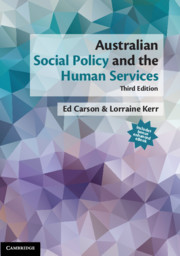
Social policy encompasses the study of social needs, policy development and administrative arrangements aimed at improving citizen wellbeing and redressing disadvantage. Australian Social Policy and the Human Services introduces readers to the mechanisms of policy development, implementation and evaluation. This third edition emphasises the complexity of practice, examining the links and gaps between policy development and implementation and encouraging readers to develop a critical approach to practice. The text now includes an overview of Australia's political system and has been expanded significantly to cover contemporary issues across several policy domains, including changes in labour market structure, homelessness, mental health and disability, child protection and family violence, education policy, Indigenous initiatives, conceptualisations of citizenship, and the rights of diverse groups and populations. Written in an engaging and accessible style, Australian Social Policy and the Human Services is an indispensable resource for students and practitioners alike.
The capability approach provides three important insights to the debate on disability and justice. First, the approach helps resolve some of the tensions in current views of disability, which either emphasize disability as a natural suboptimal trait, or as prevalently socially determined. The approach suggests instead an interactional understanding of disability, where impairment relates to restrictions in functionings, and disability to the consequent limitations in real opportunities. Second, the approach provides a metric of justice which, unlike other metrics such as the Rawlsian social primary goods, is sensitive to the demands of people with disabilities. The potential lower opportunity for well-being of a person with disabilities can only be evaluated in relation to the absence of a certain functioning, and the related inequality in her real opportunities to lead her life fully. Finally, the capability approach, specifically in Nussbaum’s work, advances the discussion on the equal moral and political status of people with disabilities, and cognitive disabilities in particular, by suggesting that their full citizenship is enacted through forms of surrogacy and guardianship when needed, and by defending their human dignity as participants in the human community.
This chapter explores vulnerability, courage, and grit in turn, considering their relationship to one another and to the task of educating for emotional virtues and for social justice. Resilience and mindfulness in education are often recommended to make vulnerable or at-risk youth less vulnerable, to mental or emotional disturbance, poor academic achievement, drop out, and related concerns. Yet this chapter argues that there is a bright side to vulnerability, and good reason to question common conflations of it with entirely negative experiences and feelings. There can be a positive role for particular kinds of experiences of vulnerability, generally within communities, and particularly in education. On the other hand, courage is normally prized in society, and has been promoted in education. However, to be understood as a virtue, courage must be tempered, so that it is not reckless, careless, or brash. Grit is a combination of passion and perseverance.
Human services practitioners who are entering the field in the early twenty-first century, or who have worked in the field for some time and have seen wide-ranging changes in the ways human services are conceived, funded and delivered, face the same task of making sense of complexity at the government, organisational and grassroots levels. In analysing current social policy, it is appropriate to ask not only what is expected to be the impact of any proposed policy change on affected individuals and groups but also how the particular issue being addressed has come to be nominated as a social problem and which ideological forces are proposing change or opposing it. Social policy in Australia since white settlement has been shaped by dominant white, Judaeo-Christian values. Beyond that, any classification of Australian political dynamics and debates concerning social policy in terms of competing ideologies risks over-simplification. A distinguishing feature of successive Australian governments in the twentieth century was their respective approaches to social change being shaped by fundamentally different commitments to and strategies of social welfare provision.
This chapter focuses on how early years’ educators can foster wellbeing through learning in health and physical education. This chapter is organised into sections that provide the background knowledge that is relevant to the health promotion and wellbeing of all early years learners, paying particular attention to students with backgrounds that for many reasons can be described as educationally disadvantaged. Recent policies that should guide educator decision-making across the dimensions of health and physical education and wellbeing will be canvassed. Insights are given into the relationship between recognition of culture and identity and educational rights, building resilience, safety and pride in the early years and the educator’s role in fostering their development. While this discussion does canvass some social and contextual factors underpinning healthy development for children who experience disadvantage, the focus is more on what you can do as a teacher to promote these dimensions from a strengths-based or salutogenic approach (Antonovsky, 1996; Quennerstedt, 2008; 2019). The chapter concludes with a case study of how teachers can act locally and in partnership with national and community-level organisations to facilitate wellbeing in early years learners via the health and physical education learning area.
Inequities in children’s health and wellbeing represent a ‘wicked problem’ that is the focus of much international attention. These inequities are a ‘wicked problem’ because of the complexity of underlying causes and contributing factors identified in this chapter as the social determinants of health. Social determinants arise not only out of individual neurobiology/physiology differences, but from the world around children impacting not only directly on them, but on their parents (and even their grandparents). Attempts to address these issues to create a more socially just society need to be complex and sophisticated. Early childhood educators play a significant role in contributing to these initiatives.
This chapter focuses on how early years’ educators can foster wellbeing through learning in health and physical education. This chapter is organised into sections that provide the background knowledge that is relevant to the health promotion and wellbeing of all early years learners, paying particular attention to students with backgrounds that for many reasons can be described as educationally disadvantaged. Recent policies that should guide educator decision-making across the dimensions of health and physical education and wellbeing will be canvassed. Insights are given into the relationship between recognition of culture and identity and educational rights, building resilience, safety and pride in the early years and the educator’s role in fostering their development. While this discussion does canvass some social and contextual factors underpinning healthy development for children who experience disadvantage, the focus is more on what you can do as a teacher to promote these dimensions from a strengths-based or salutogenic approach (Antonovsky, 1996; Quennerstedt, 2008; 2019). The chapter concludes with a case study of how teachers can act locally and in partnership with national and community-level organisations to facilitate wellbeing in early years learners via the health and physical education learning area.