To save content items to your account,
please confirm that you agree to abide by our usage policies.
If this is the first time you use this feature, you will be asked to authorise Cambridge Core to connect with your account.
Find out more about saving content to .
To save content items to your Kindle, first ensure no-reply@cambridge.org
is added to your Approved Personal Document E-mail List under your Personal Document Settings
on the Manage Your Content and Devices page of your Amazon account. Then enter the ‘name’ part
of your Kindle email address below.
Find out more about saving to your Kindle.
Note you can select to save to either the @free.kindle.com or @kindle.com variations.
‘@free.kindle.com’ emails are free but can only be saved to your device when it is connected to wi-fi.
‘@kindle.com’ emails can be delivered even when you are not connected to wi-fi, but note that service fees apply.
This chapter theorizes and puts into practice the use of fashion in feminist historiography. It does so by charting two histories of the modernist poet and artist Mina Loy. One is narrated via Loy’s 1940s designs for a “corselet,” intended to correct curvature of the spine in a woman’s middle age. The other is via the poetic series Loy wrote at the same time, “Compensations of Poverty,” in which she identifies with a group of outcast people in fashion contexts. These histories augur different versions of Loy, with different temporalities: one capitalist, teleological and individualist, based on the opportunities offered by new plastic materials; the other intersubjective, cyclical and, this chapter argues, sustainable. Ultimately the chapter asks: which of these Loys do we want, now, in the context of climate catastrophe and persistent sexism? How can fashion help us write the feminist history we need?
Neruda’s poetry and political activism have been naturally inscribed in the geopolitical and hermeneutical framework of the Cold War, the struggle between capitalism and communism, and the national liberation processes of the Global South. His international recognition coincides with his political radicalization: from his exile at the end of 1940 to his presidential candidacy in 1969, promoted by the Communist Party of Chile. His poetry, on the other hand, from Residencia en la tierra and El canto general, and to his later Incitación al Nixonicidio y alabanza de la Revolución Cubana, can be understood as an expression of partisan literature. It is clear that Neruda is not only a well-known writer, but also an important witness of the twentieth century. In this context, this chapter begins with the question: Is a new reading of Neruda possible, a reading beyond the historical framework that has informed his usual reception?
Nineteenth-century history paintings were as formative as the historical novel for fixing our cultural image of the national past. Their style was conformist and even kitschy; but their visual evocation of bygone ages provided Romantic narratives of the national past with a visual, spectacular and, what is more, enduring iconography. Painting operated in tandem with the historical novel and with history writing. It helped translate historians’ knowledge production into cultural production, into a cultural repertoire and a visual iconography. And as the study of history evolved from Romantic nationalism towards a more factualist, archive-driven academic specialism, that Romantic iconography continued to dominate the popular imagination of what the national past had been like. History painting shaped, lastingly, how the nation’s past was envisaged, even as its status declined to that of a largely decorative art.
This chapter discusses the discovery, in the modernizing of libraries and archives around 1800, of many medieval texts and literary remains. It traces how these discoveries triggered an interest in the medieval period and the rise of historicism: the cultivation of the past and the desire to turn it, and the nation’s ancient roots, into an inspiring contemporary presence. The impact of medievalism and historicism on the culture of nationalism, mainly in literature and in literary history, is surveyed across the nineteenth century. Paradoxically, the scholarly expertise of the philologists was a Europe-wide field, but their commitment was in most cases to their own countries, for which they claimed and appropriated literary heirlooms. The relations between philologists were sometimes collaborative, sometimes competitive, and competition often took the form of international rivalry.
Romantic historicism expressed itself in the narrative representations of the national past, both in fiction (the historical novel) and in nonfiction (Romantic history writing). The rise and decline of the Romantic historical novel is discussed, with its characteristic combination of the past’s exotic allure and its moral relatability, and with special reference to the Scottish tales and the Europe-wide influence of Sir Walter Scott. The techniques of the historical novel in the style of Scott also inspired historians such as Jules Michelet, who began to see history as the collective experiences of national communities and adopted literary techniques of empathy and evocation. From the mid-century the historical novel began its long decline, addressing an increasingly downmarket readership, while historical fields went through a factualist and source-critical turn, away from the Romantic narrativity of the earlier practitioners. However, the Romantic imagination of the past as brought to life by the Scott/Michelet generation remained lastingly dominant outside the historical profession and in the various popular media of cultural memory.
This chapter explores how a group of North African thinkers rethought the meaning of the Arab revolution in the 1970s. Departing from anti-colonial nationalism and Marxist orthodoxy, Abdallah Laroui and Hichem Dja?t called for a deeper cultural and intellectual transformation grounded in historicist thinking. Their seminal books—La Crise des intellectuels arabes (1974) and La Personnalité et le devenir arabo-islamique (1974)—articulated visions of a new Arab future that rejected both Salafism and westernization in favor of a rational and historicized approach to Arab modernity and the future. Though published in Paris and shaped by networks in Beirut and the Arab Left, their ideas were targeted at audiences back home in Morocco and Tunisia. The chapter situates their work by tracing the complex reception of these essays across North African intellectual publics. Ultimately, it argues that the effectiveness of revolutionary thought was not determined solely by publication or prestige, but by the ability to engage meaningfully with local contexts and contested ideas of tradition and modernity. As as their reception reveals, audiences were not passive: they questioned, resisted, and sometimes rejected these “prophets”— because they insisted on situating theory within lived political constraints.
At the core of nationalism, the nation has always been defined and celebrated as a fundamentally cultural community. This pioneering cultural history shows how artists and intellectuals since the days of Napoleon have celebrated and taken inspiration from an idealized nationality, and how this in turn has informed and influenced social and political nationalism. The book brings together tell-tale examples from across the entire European continent, from Dublin and Barcelona to Istanbul and Helsinki, and from cultural fields that include literature, painting, music, sports, world fairs and cinema as well as intellectual history. Charismatic Nations offers unique insights into how the unobtrusive soft power of nationally-inspired culture interacts with nationalism as a hard-edged political agenda. It demonstrates how, thanks to its pervasive cultural and 'unpolitical' presence, nationalism can shape-shift between romantic insurgency and nativist populism. This title is also available as Open Access on Cambridge Core.
This article examines the ways in which explanation has been achieved in scientific work on language change over the last two hundred years. Explanations have come in many forms and at many levels and are greatly influenced by what are taken as the leading questions, which themselves have varied significantly since the early nineteenth century.
Chapter 5 excavates the debates leftist and socialist thinkers in Ghana had about the brand of socialism they were building and its relationship to religion, morality, Black freedom, and precolonial African history. The chapter argues that debates surrounding how to define and historicize socialism in the African context were not simply intellectual exercises and disputes over labeling rights but central to reclaiming Africans and African history within global history. It was a deliberate critique of white supremacist paradigms that situated ideas, histories, and societies emanating from Africa as operating outside the continuum and space of human history. By rethinking and (re)historicizing histories of exploitation and violence in Africa, socialists in Ghana were simultaneously decolonizing and rescuing socialism from itself. The chapter demonstrates that socialism then was more than a fashionable lexicon or moniker to curry favor with certain geopolitical groups. Instead, it also offered a tangible way, a theoretical analytic, for Africans to revisit, debate, and offer a critical appraisal of African historiography and societies and Africa’s place in world history. Not only were the socialist theorists in Ghana domesticating socialism, they were remaking it globally. They were Marxist-Socialist worldmakers.
This chapter is a description and analysis of the modern and postmodern periods and how they influenced theologians from a variety of traditions as they wrestled anew with the doctrine of Christ. In characterizing modernity as an era which celebrates universal reason and human progress, the author examines the ways in which modern theologians both chafed against and conformed to these insights as they developed their ideas about the person and work of Christ. Likewise, the author engages postmodernity as a disavowal of universal reason and progress, and thereby examines the manner in which these concepts were both rejected and embraced by various theologians as they sought to answer Christ’s question: “Who do you say I am?” within a postmodern era.
This chapter makes a case for a historical materialism in the study of Ulysses. The historical materialism in question is conditioned by Joyce’s work. The historical contexts it considers as most relevant are those indicated by Ulysses itself, not ours nor continental European ones. They are, firstly, Irish and, secondly, British. A Joycean historical materialism seeks to deepen and complicate our knowledge of those contexts in all their myriad detail, and to read Ulysses accordingly. Assuming the historical priority of Irish and British preoccupations, what is it likely Joyce cared about, in any given episode, passage, or detail? The chapter contrasts a historically materialist method with others relying on a more idealist historicism. In line with this case, the chapter moves from concrete detail – a lengthy, highly particularized discussion of ‘Sirens’ – to a more theoretical conclusion whilst seeking to avoid the limitations of an unreflective empiricism.
Mutual estrangement characterised the relationship between the popes and the Protestant Churches for centuries after the Reformation. Despite occasional ecumenical stirrings, the creation of Protestant state Churches removed formal contact between popes and Protestants from a theological to a diplomatic plane. The concurrent development of Protestant ideas of history, which styled the pope as the Antichrist of prophecy and the consolidation of the Catholic understanding of him as the steward of an exclusive tradition, further eroded the space for dialogue. Only from the nineteenth century onwards did significant changes alter these patterns of understanding. The growth of developmental historicism began to relativise doctrinal differences; whilst the retreat of the confessional state created renewed possibilities for papal–Protestant contact. These shifts prepared the way for the twentieth-century ecumenical movement, which since the 1960s has transformed relations for the better. Whether formal reconciliation can proceed any further, however, remains to be seen.
This chapter defines the field of history by examining both the topics it investigates and some of its long-standing and unique epistemological and methodological assumptions. It points out the unique breadth of the discipline, which has always taken the whole of human experience as its object of study. It emphasizes the holism of the discipline – that is, History’s consistent interest not in particular parts or aspects of that experience, but in the interactions between different aspects of human societies. It examines the historicist tradition within the discipline – the fundamental assumption that every aspect of human life is conditioned by its broad historical context. And it explores the way in which that fundamental assumption has contributed to a primarily idiographic epistemological position – an interest in the analysis of the particular and specific, rather than the general or universal.
This chapter reviews the literature on the teaching of history, and defines the purpose of this book: to offer a clearer definition of the aims and benefits of the study of History at the college and university level. Two principles are at the heart of that conception. One is that long-standing methodological and epistemological divisions within the discipline are a source of its unique pedagogical value. The other is that History assumes a particular ethical posture relative to its subjects – the people it studies – and that this too is a source of its unique pedagogical value.
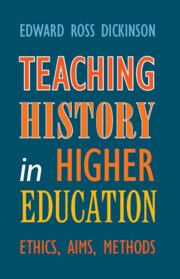
What are the distinctive characteristics of the discipline of history? How do we teach those characteristics effectively, and what benefits do they offer students? How can history instructors engage an increasingly diverse student body? Teaching History in Higher Education offers instructors an innovative and coherent approach to their discipline, addressing the specific advantages that studying history can bring. Edward Ross Dickinson examines the evolution of methods and concepts in the discipline over the past two hundred years, showing how instructors can harness its complexity to aid the intellectual engagement of their students. This book explores the potential of history to teach us how to ask questions in unique and powerful ways, and how to pursue answers that are open and generative. Building on a coherent ethical foundation for the discipline, Teaching History in Higher Education presents a range of concrete techniques for making history instruction fruitful for students and teachers alike.
The last major chapter of the book reflects on the question of ‘happiness’ as discussed by Popper, Hayek, and Neurath, but also presents a case study of how Neurath not only theorized on such matters but also sought to make a practical difference by collaboration in planning projects. He became a consultant for the redevelopment of Bilston, a small town blighted by the legacy of the Industrial Revolution. In discussion with town councillors and architects, he steered plans by taking into account the needs of residents, seeking to represent those whose voice was generally not heard. This finally led to Neurath being interviewed in the mainstream media, marking acceptance and respect for Neurath in British culture. He did not want to use his broad learning to set himself apart as an intellectual but instead to articulate the needs of ordinary people.
The timeless and unchanging nature of God was defended by Dr. Eric Mascall throughout his books. He argued against process theology, and in particular the works of mathematician and philosopher Alfred North Whitehead, who was one of its foremost exponents. In his books, Mascall defended the distinction between our temporal and created nature and God’s divine and uncreated nature as found in historic theology. In a manner suited to his learning, he discussed the implications of modern physics for theology.
This chapter examines the aversion to theories and programs of natural rights in much mainstream nineteenth-century British political discourse. Following on the heels of their Enlightenment and revolutionary efflorescence, writers in Great Britain articulated various critiques of natural rights philosophies and declarations. Moving from early critics such as Burke and Bentham to later Victorian writers and statesmen – most importantly, J. S. Mill – the chapter traces several threads of skepticism toward natural rights. British writers, it argues, were preoccupied less with the unsound conceptual foundations of natural rights theories than with the perceived consequences of belief in natural rights, which was seen as leading in anarchic, destabilizing, and antinomian directions. Natural rights platforms, it was contended, appealed to passion, ignored context and the weighing of costs and benefits, and undermined both the rule of law and state authority. In addition, natural rights theories were perceived by critics to be connected to a range of worrying trends (democratization and the rise of socialism, among others). Natural rights theories, furthermore, stood in stark contrast to the utilitarian and historicist attitudes towards law and government which prevailed in Britain during these decades. Finally, the conclusion offers a glance at nineteenth-century France, contrasting the loyalty toward natural rights across the Channel with British hostility, and revealing that many of the fears that Britons articulated about the dissemination of natural rights ideas were harbored by the French with regard to the spread of consequentialism.
Edited by
Randall Lesaffer, KU Leuven & Tilburg University,Anne Peters, Max Planck Institute for Comparative Public Law and International Law, Heidelberg
This chapter periodises the British historiography of international law in five parts. Its first period extends from Robert Ward’s Enquiry into the Foundation and History of the Law of Nations in Europe (1795) to Thomas Erskine Holland’s Oxford inaugural lecture on Alberico Gentili (1874), and traces the gradual professionalisation of the discipline and its historical strain. The second part examines the entanglement of empire and historicism in British international legal historiography from around 1870 to roughly 1920. The third part treats the symbolic coming of age of British international legal historiography, between the founding of the British Yearbook of International Law in 1920, and Hersch Lauterpacht’s pivotal enunciation of the so-called ‘Grotian’ tradition of international law after the Second World War. The fourth part explores the history of international law in the succeeding ‘age of Lauterpacht’ up to c. 1960, when historiographical advances came increasingly from the semi-periphery rather than the centre and from disciplines other than international law. The fifth part takes stock of the transdisciplinary ‘turn’ to the history of international law in the British world and the chapter concludes with reflections on the nascent field of comparative international legal history in the light of British developments over the longue durée.
Edited by
Randall Lesaffer, KU Leuven & Tilburg University,Anne Peters, Max Planck Institute for Comparative Public Law and International Law, Heidelberg
This chapter narrates a history of the history of international law as a species of European historical jurisprudence born of the nineteenth century. It connects this historical jurisprudence with a wider atmosphere of historicism and its intellectual antecedents and descendents, including (but not limited to) so-called ‘progress narratives’. It argues that the history of international law in this specific sense largely vanished after the Second World War, and the history of international law underwent two distinct rebirths: as part of the anti-colonial legal arguments repudiating the colonial structures and presuppositions of international legal thought, and as part of a critique of a renewed historicism and civilisational progressivism between 1989 and the present. But the second revival of the history of international law coincided with emergent histories of empire, international history, histories of international political thought and global history. The result is an exploding field of scholarship with objects and subjects of many kinds connected to the international and the global and their laws, institutions and practices.