To save content items to your account,
please confirm that you agree to abide by our usage policies.
If this is the first time you use this feature, you will be asked to authorise Cambridge Core to connect with your account.
Find out more about saving content to .
To save content items to your Kindle, first ensure no-reply@cambridge.org
is added to your Approved Personal Document E-mail List under your Personal Document Settings
on the Manage Your Content and Devices page of your Amazon account. Then enter the ‘name’ part
of your Kindle email address below.
Find out more about saving to your Kindle.
Note you can select to save to either the @free.kindle.com or @kindle.com variations.
‘@free.kindle.com’ emails are free but can only be saved to your device when it is connected to wi-fi.
‘@kindle.com’ emails can be delivered even when you are not connected to wi-fi, but note that service fees apply.
The democratic backsliding literature sees reactionary shifts among the electorates of mature democracies as a reason for the rise of right-wing populism (RWP)—shifts that supposedly fuel citizens’ distrust in democratic institutions and their readiness to support RWP in its efforts to cut back on democracy’s liberal principles. However, the assumptions underlying this democracy falling narrative are more often stated than tested. Filling this void, we analyze data from the European Values Study/World Values Surveys in a cross-national longitudinal design amended by multilevel evidence, covering all EU countries surveyed at two distant timepoints over the past twenty to twenty-five years. We test whether reactionary shifts among socio-economically vulnerable electoral segments increased polarization over four ideological cleavages: right-vs-left on economic issues, nativism-vs-cosmopolitanism on immigration issues, patriarchy-vs-emancipation on sexuality issues, and economy-vs-environment on sustainability issues. Specifically, we examine whether those population segments at the reactionary end of these cleavages lost trust in democracies’ political institutions and their liberal principles in ways that increase voters’ readiness to support RWP parties. Our results provide no confirmation that polarizing shifts in the population account for RWP’s electoral rise. We conclude that the problems explaining RWP success do not originate in reactionary public opinion shifts. Instead, we propose further research into potential representation gaps with respect to nonvoter camps that grew larger during the pre-RWP era and are now mobilized by RWP parties—a game change presumably triggered by the rise of social media.
The police killing of George Floyd, an unarmed Black American, prompted massive protests across the USA and around the globe in the spring and summer of 2020. Like those south of their border, Canadian protesters gathered to bring renewed attention to a longstanding problem: systemic racism and police impunity. While race and dissatisfaction with the police have received a great deal of attention in popular media, surprisingly little political science research considers the relationship between race, attitudes towards the police and protest. Do attitudes towards police differ across racial groups in Canada? Are attitudes towards the police related to protest activity? We answer these questions using data from Statistics Canada’s General Social Survey (GSS) Cycle 34, GSS Cycle 35 and Statistics Canada’s Impacts of COVID-19 on Canadians’ Experiences of Discrimination. We find that Black and Indigenous Canadians express the lowest confidence in police relative to other People of Colour (POC) and compared with White Canadians. We also find more confidence in the police is associated with lower probability of protest (in general).
What is the relationship between social media use and trust in civil society and governance institutions? In many parts of Asia, trust in government remains high despite limited political accountability and civil liberties. This study examines whether online political expression reshapes institutional trust in governance institutions and civil society organizations. The analysis considers the dual role of social media as a site for civic engagement and a channel for disaffection with formal authority. Using data from the Asian Barometer, the findings show that political expression on social media is associated with lower trust in governance institutions and higher trust in nongovernmental organizations (NGOs), a fundamental part of civil society. These effects vary across regimes and survey waves. The results suggest that online expression may erode legitimacy of formal authority while enhancing trust in civil society, thus shaping the political role of NGOs and social media platforms in restrictive political settings.
Longstanding public support for the Supreme Court of Canada is well-documented and contributes to its public legitimacy. However, the sources of this support and how vulnerable it may be to political factors or negative coverage of events are not well understood. In February of 2023, Justice Russell Brown took a leave of absence from the Supreme Court following a conduct complaint under review by the Canadian Judicial Council. Justice Brown retired from the bench in June of that year, before the CJC concluded its investigation. In the intervening period, media coverage of the events that prompted the attention from the CJC thrust the Court into the spotlight. Using data from an original two-wave survey experiment (n = 1,222) from May and November of 2023, we investigate whether perspectives toward the circumstances surrounding Brown’s retirement hurt perceptions of the Court’s legitimacy. We find that the event did not disrupt support for the Court over time but also point to the ways in which opinion toward the Court changed pre- and post-resignation. These findings suggest that support toward Canada’s high court is at present largely stable even in the case of negative coverage of a high-profile event. However, we also acknowledge the potential vulnerabilities that negative coverage of the Court may present.
In the study of politics, many theoretical accounts assume that we are experiencing a ‘crisis of democracy’, with declining levels of political trust. While some empirical studies support this account, others disagree and report ‘trendless fluctuations’. We argue that these empirical ambiguities are based on analytical confusion: whether trust is declining depends on the institution, country, and period in question. We clarify these issues and apply our framework to an empirical analysis that is unprecedented in geographic and temporal scope: we apply Bayesian dynamic latent trait models to uncover underlying trends in data on trust in six institutions collated from 3,377 surveys conducted by 50 projects in 143 countries between 1958 and 2019. We identify important differences between countries and regions, but globally we find that trust in representative institutions has generally been declining in recent decades, whereas trust in ‘implementing’ institutions has been stable or rising.
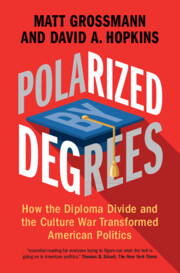
Over the past several decades, American society has experienced fundamental changes – from shifting relations between social groups and evolving language and behavior norms to the increasing value of a college degree. These transformations have polarized the nation's political climate and ignited a perpetual culture war. In a sequel to their award-winning collaboration Asymmetric Politics, Grossmann and Hopkins draw on an extensive variety of evidence to explore how these changes have affected both major parties. They show that the Democrats have become the home of highly-educated citizens with progressive social views who prefer credentialed experts to make policy decisions, while Republicans have become the populist champions of white voters without college degrees who increasingly distrust teachers, scientists, journalists, universities, non-profit organizations, and even corporations. The result of this new “diploma divide” between the parties is an increasingly complex world in which everything is about politics – and politics is about everything.
Anticorruption audits may deter corruption and signal to citizens that institutions are proactively combating it. However, by detecting and reporting corruption, audits might also unintentionally erode trust in institutions. Therefore, the impact of audits potentially hinges on whether they uncover corruption. Audit institutions, not implicated in the corruption they uncover, might be less likely to experience a decline in trust compared to auditee institutions. This study uses survey and administrative data from Brazil, leveraging a federal anti-corruption program that randomly selects municipalities for auditing. Results do not support the claim that audits boost institutional trust. Individuals in audited municipalities show no different levels of trust in local government or the audit institution than those in non-audited municipalities, and the coefficients may even indicate a negative effect. Additionally, audit institutions may not be better insulated from the corrosive effects of uncovering corruption than the institutions they audit.
This essay documents growing partisan social uprootedness across Latin America over time, manifested in diminishing social trust toward parties, debilitation of links between parties and social collectivities, lowering levels of partisanship, and rising incidence of personalism in the electorate. It focuses on some unrecognized and undertheorized causal factors behind partisan involution in the region, putting emphasis on mutually reinforcing processes. First, it identifies forces endogenous to the traits of origin of diminished parties that foster their uprootedness and decay; second, it lays out some of the manifold ways that the weakening of political parties fuels regime malperformance, in a mutually reinforcing vicious circle; third, it outlines the existence of mutual feedback loops between political agency and structure; fourth, it identifies various agential sources of party decay. There are strong theoretical and empirical reasons to expect continued party deinstitutionalization across Latin America going forward.
This article discusses the results and prospects of the market reform in Dutch health care which came into force in 2006. Attention is paid to the results of the health insurance reform, the experience with the shift from passive to active purchasing and the impact of the reform on healthcare provision and cost control respectively. Other topics discussed are the consequences of the reform for administrative costs, institutional trust in health insurance, and the power balance in health care after reform. The central message is that the high expectations of the market reform have not come true. Dutch health care features a high degree of hybridity and there are indications that the system is becoming ever more hybrid: the system operates much less market-like than the market frame suggests. Currently, the policy narrative on the reform is changing. Policymakers and policy documents underscore the need for cooperation in provider networks and more state direction. The Dutch experience with health care reform illustrates the pendulum theory. After a period of a belief in competition and less state direction the pendulum in policymaking swings back to a belief in cooperation and a pro-active role of the state.
This paper draws on macroeconomics, the economics of institutions and the economics of trust to explain private savings at the national level for 33 OECD (mostly European) countries from 2002 to 2012. More specifically, it raises two questions: (i) is it the quality of institutions or trust in institutions that drives private savings? (ii) if trust matters, what is the appropriate institutional level at which it operates? To answer these questions, we add to the usual explanatory variables of private savings three measures of institutional quality and six measures of institutional trust, distributed between the following institutional levels, presented in assumed hierarchical order: political, legal, financial and social. We find that trust in political institutions is the most significant driver of private savings. This contributes to the literature underlining the importance of subjectivity in social and economic phenomena and suggests, for private bank savings in countries having highly regulated banking systems, the existence of a hierarchy of trust in which trust in the highest-ranking institutions (political – and to a lesser extent legal – institutions) acts as a substitute for trust in every lower-ranking institution (financial institutions and social trust).
The three-child policy constitutes a hotly debated socio-political issue in China. Upon its announcement, many Chinese citizens have ridiculed the move on social media. Adopting the cognitive mediation model and the influence of presumed influence theory, this study examines how social media exposure to three-child policy-related news and discussions could affect the Chinese public’s attitudes toward the policy. The online survey results show that social media exposure negatively predicts supportive opinion via cognitive elaboration and three types of perceived negative effects of the policy (i.e., perceived negative effects on self, on the public, and on females) in serial. It also finds that institutional trust moderates the relationship between cognitive elaboration and policy support. Only among people with high institutional trust, there is a positive effect of social media exposure on supportive opinion through cognitive elaboration.
Vaccine hesitancy impacts the ability to cope with coronavirus disease 2019 (COVID-19) effectively in the United States. It is important for health organizations to increase vaccine acceptance. Addressing this issue, this study aimed to predict citizens’ acceptance of the COVID-19 vaccine through a synthetic approach of public segmentation including cross-situational and situational variables. Controlling for demographics, we examined institutional trust, negative attitudes toward, and low levels of knowledge about vaccines (ie, lacuna public characteristics), and fear of COVID-19 during the pandemic. Our study provides a useful framework for public segmentation and contributes to risk and health campaigns by identifying significant predictors of COVID-19 vaccine acceptance.
Method:
We conducted an online survey on October 10, 2020 (N = 499), and performed hierarchical regression analyses to predict citizens’ COVID-19 vaccine acceptance.
Results:
This study demonstrated that trust in the Centers for Disease Control and Prevention (CDC) and federal government, vaccine attitude, problem recognition, constraint recognition, involvement recognition, and fear positively predicted COVID-19 vaccine acceptance.
Conclusions:
This study outlines a useful synthetic public segmentation framework and extends the concept of lacuna public to the pandemic context, helping to predict vaccine acceptance. Importantly, the findings could be useful in designing health campaign messages.
In this study, we conceptualize the thus far little explored relationship between expatriate and host country as a form of social exchange governed by the norm of reciprocity. Drawing from social exchange theory and our analysis of 451 self-initiated expatriates (SIEs) living and working in the United Arab Emirates, we examine whether the degree of SIEs’ career and community embeddedness explains their host country withdrawal intention via enhanced perceived institutional trust and a more tolerant attitude toward workplace discrimination. Our results provide general support for our theoretical model and most of our hypotheses. In this way, our article makes three contributions. First, it suggests a novel way to conceptualize the relationship between SIEs and host country as a form of social exchange. Second, it differentiates between two dimensions of embeddedness and explicates how the two contribute to SIEs’ intentions to stay in the host country. Finally, the analysis theorizes and empirically tests two previously little explored mechanisms of enhanced institutional trust and a more tolerant attitude toward workplace discrimination through which SIEs’ host country embeddedness influences their host country withdrawal intentions.
How does repression on opposition protests affect citizens' institutional trust under dictatorships? There has been a burgeoning literature investigating empirically both long- and short-term impacts of protests and their repression on citizens' political preferences in both democratic and nondemocratic contexts. Yet, the literature tells us relatively little about how the above question could be answered. This paper tries to answer this question by taking advantage of a recent natural experiment in Hong Kong when Beijing suddenly adopted the National Security Law (NSL) in June 2020 to repress dissidents' protest mobilization. Our findings are twofold. First of all, the NSL drove a wedge in the Hong Kong society by making the pro-establishment camp more satisfied with the post-NSL institutions on the one hand, while alienating the pro-democracy camp who lost tremendous trust in them on the other. Second, our study also reveals that one's trust in institutions is significantly associated with the regimes' ability to curb protesters' contentious mobilization. The Hong Kongers who had higher confidence in the NSL to rein in protests would also have a greater level of trust than those who didn't. The effect, however, is substantially smaller among pro-democracy Hong Kongers except for their trust in monitoring institutions. As Beijing is transforming Hong Kong's current institutions from within hopes of bringing about a new political equilibrium, our study helps provide a timely assessment of Hong Kong's institutional landscape and sheds light on how likely this strategy can work.
Desiring vengeance against those that hurt us is deeply human; justice systems are one means by which those desires can be contained and addressed in ways that avoid cycles of revenge. However, such systems require that people have trust in them. We begin with the relationship between institutional trust and the reduction of vengefulness. We then consider how youth develop their sense of institutional trust, with a particular emphasis on school justice systems in the K-12 context. We propose that a narrative approach to institutional trust might complement existing work, and outline strengths of that approach. We contrast retributive disciplinary and restorative justice systems in schools and consider how each of these systems looks from a narrative lens. Finally, we make recommendations for future research and practice based on ways that institutional trust, narrative, and school-based approaches to justice and discipline may reduce vengeful behavior and promote youths’ development.
While official science has given its answer to the question on the origin of the Coronavirus (animal to human transmission), alternative theories on human creation of the virus – purposely or inadvertently – have flourished. Those alternative theories can be easily located among the family of conspiracy theories, as they always assume some secretive activity of some groups acting on their self-interest and against the good of the many. The article assesses the prevalence of these beliefs during the COVID-19 pandemic in Italy, studies its development during the pandemic, and investigates its potential determinants. In particular, it analyses the relationship between beliefs in alternative theories on the origin of the virus and political orientation, by arguing that the association cannot be attributed to (politically) motivated reasoning, as the issue has not been highly politicized in the Italian context. Alternatively, the article suggests that the main factor driving beliefs in alternative accounts on the origins of the virus is institutional trust. Political orientation moderates its effects, depending on specific conditions (e.g. cue taking, position of the supported party either in government or opposition), and eventually reinforcing scepticism towards epistemic authorities for those with low trust in institutions. Data come from the ResPOnsE COVID-19 survey, carried out with daily samples from April to July 2020 (N > 15.000) to monitor the development of the Italian public opinion during the Coronavirus pandemic.
Here, I give an account of what it means for an institution to be trusted and be trustworthy in the context of global health research. I employ the example of data sharing to illustrate the importance and value of trustworthiness as an institutional moral characteristic. I use the term ‘institution’ to refer to groups or collectives that actively undertake research, such as universities and research centres. I conclude that trust is important in global health research collaboration because of the power imbalance between partners that often characterises such collaborations. In order to promote trust, institutions need to focus on being trustworthy by developing a behaviour that corresponds to the aims, principles and values they profess to uphold, and by demonstrating that they have incorporated into their functions, rules and regulations the particular needs of their partners and collaborators.
We examine the cultural context for individual's trust in public institutions. To shed some light on possible cultural explanations from a more comparative perspective and cover a wider set of cultural aspects, we use indicators of cultural dimensions by Kaasa et al. (2014) based on Hofstede's (1980) approach. Multilevel regression analysis is conducted with individual-level data from two waves of the European Social Survey (2008, 2010) and regional-level data from multiple sources. Confirmatory factor analysis is used to construct the indicators of social and institutional trust and corruption. Our results suggest that individuals tend to trust institutions less in regions with large power distance. Hence, an important key for governments being more successful in achieving their aims seems to be related to improving the sense of participation and civic responsibility.
This study examined if and for whom prosecution of politicians for hate speech undermines support for the legal system and democracy. Three research designs were combined to investigate the case of Dutch politician Geert Wilders, who was convicted for hate speech against minorities in 2016. First, an experiment showed that observing a guilty verdict decreased support among ‘assimilationists’ who oppose the multicultural society. This deterioration of support was found among the entire group of assimilationists, regardless of whether they voted for Wilders. Secondly, a quasi-experiment demonstrated that assimilationists who were interviewed after Wilders' conviction indicated less support than those who were interviewed before the verdict and compared to a pre-test. Thirdly, a nine-year panel study suggested that these effects accumulate into long-term discontent. This case therefore demonstrates that hate speech prosecution can damage the democratic system it is intended to defend.
Individualistic values are often presented as promoting economic development; however, their links to relevant behaviour and preferences at the micro-level remain under-explored. Here we investigate the relationship between individualistic values and personal attitudes towards reporting corruption. Unlike much of the previous research which focuses on attitudes towards corruption, we analyse the micro-level mechanisms relating to one's willingness to escape the status quo and act against corruption. We also focus on a region associated with persistently high levels of perceived corruption. Our findings indicate that individualism is associated with a greater likelihood to act against corruption. The effect estimated is small but highly significant and robust to changes in estimators and specifications. We also find evidence that institutional trust and individualism strengthen each other to generate greater willingness to report corruption.