To save content items to your account,
please confirm that you agree to abide by our usage policies.
If this is the first time you use this feature, you will be asked to authorise Cambridge Core to connect with your account.
Find out more about saving content to .
To save content items to your Kindle, first ensure no-reply@cambridge.org
is added to your Approved Personal Document E-mail List under your Personal Document Settings
on the Manage Your Content and Devices page of your Amazon account. Then enter the ‘name’ part
of your Kindle email address below.
Find out more about saving to your Kindle.
Note you can select to save to either the @free.kindle.com or @kindle.com variations.
‘@free.kindle.com’ emails are free but can only be saved to your device when it is connected to wi-fi.
‘@kindle.com’ emails can be delivered even when you are not connected to wi-fi, but note that service fees apply.
This article uses digital Geographic Information Systems (GIS) to visualize changing crop choice over time in nineteenth-century equatorial eastern Africa. It maps the locations of crops mentioned in early imperial sources, using contemporary cartographic representations of the region as a base. This enables a novel visualization of changing agricultural potential and vulnerability to climate variability over time. The maps contextualize the growth of commercial and political centers, a series of famines during years and seasons of below average rainfall, and the well-known environmental challenges of the early colonial period.
By reconstructing the boundaries of a ‘community’ that shared the same emotional horizon when it came to love, this article explores the role that concepts of romantic love played in the development of modern ideas of sexuality, with a specific focus on the relationship between women, sexual desire and pleasure. After a brief description of the Italian historical and cultural context in which Paolo Mantegazza developed his sexual science and the role that romantic love played within it, I analyse his Fisiologia dell’amore to show how, even without explicit references to sexual acts, the book clearly alludes to sexual desire and pleasure. I then examine a selection of letters from Mantegazza’s female readers to demonstrate their enthusiasm for the book. Finally, I show how ideas of romantic love and the introspective enquiry prompted by reading Mantegazza also affected women’s awareness of themselves as sexed beings capable of and entitled to experiences of pleasure.
In the mid-nineteenth century, opéra de salon dominated residential entertainment in Parisian salons. As these short, comedic operas were adapted for household receptions, librettists and composers faced a choice: adhere to staging conventions or adapt their works to fit the idiosyncrasies of residential space. Focusing on the salon of Anne Gabrielle Orfila, who was a proponent of opéra de salon and who hosted at least ten unique productions, this study examines how opera was adapted to salon space. It shows how stage action was not always contained by a single room, with scenes often spanning adjacent rooms. This affected audience seating and shaped the dramatic experience. The study also considers the significance of salon décor as it harmonized with or competed with the opera scenery. At a time when spectacle and elaborate designs prevailed at the Paris Opéra, opéra de salon presented a contrasting model that challenged theatrical conventions.
The conclusion ends the book by bringing together the themes and questions it has explored but also looks to the ways in which questions of property, possession and keeping hold are very much eighteenth-century questions. The conclusion looks to how ‘lost property’ was dealt with in the nineteenth century and sees a different set of practices and institutions at play.
This article examines the institutional evolution and professionalization of the state police in Prague during the final decades of the Habsburg monarchy, arguing that the transformation of the Prague State Police between 1893 and 1910 represents a proactive effort in modern state-building. Drawing on reports from the Prague Police Directorate and the Bohemian Governor’s Office, it analyzes how recurring episodes of mass violence—specifically the unrest of the early 1890s, the riots of December 1897, and the nationalist disturbances of 1908—exposed the structural vulnerabilities of a security apparatus designed for routine policing rather than mass politics.
The article highlights a significant shift in administrative strategy: the movement away from a reliance on military intervention, which was increasingly viewed by civil authorities as a “double defeat” that undermined the legitimacy of the constitutional state. Instead, police directors such as Georg Dörfl and Karel Křikava successfully advocated for a robust, civilian-controlled force characterized by increased manpower, modernized equipment, and the establishment of a dedicated reserve for professional training. By 1910, the Prague Guard had largely expanded, reflecting a fundamental reconceptualization of urban order where protest was accepted as an unavoidable feature of political life to be contained by professional civilian forces rather than crushed by the army.
This study proposes a new qualitative method in historical pragmatics to extract politeness formulae for master-servant directives from nineteenth-century French advice literature. Whereas traditional politeness models study strategic face-saving, this study investigates non-strategic, routinized or conventionalized politeness by mapping explicit linguistic instructions in historical prescriptive metasources. Because etiquette and conduct books targeted middle-class households – typically defined as having at least one live-in servant – they routinely discussed interactions with servants. The self-built corpus comprises 43 sources: etiquette and conduct manuals, alongside servant manuals. Through close reading I manually extract politeness formulae, which are compiled into a formulary. Historians underline servants’ harsh conditions and social erasure, typically mirrored by bare imperatives. Advice on a kind prosody is widespread, but politeness formulae (e.g. voulez-vous? – je vous prie) only emerge in the 1870s, when the crisis of domestic service begins. This shift suggests that domestic service was increasingly viewed in transactional rather than purely hierarchical terms. Despite these changes, master-servant, servant-master and peer directives remain rigidly compartmentalized. The article addresses a notable gap in French historical im/politeness studies by showing how politeness formulae in prescriptive discourse reveal the persistence of caste-like social structures in nineteenth-century French domestic service.
This article examines how Miskitu King Robert Charles Frederic (1824–42) used colonial contracts with foreign merchants to advance his political agenda in Moskitia, on Central America’s Caribbean coast. Drawing on European and Central American archives, this study challenges narratives that portray Indigenous leaders as passive actors in colonial expansion, highlighting how the king strategically wielded contracts to facilitate the import of foreign capital through concessions and loans. His mastery of international finance enabled resistance to imperial domination while allowing him to consolidate power, maintain independence, and participate in nineteenth-century Atlantic political transformations. However, this strategy compelled him to facilitate the entry of financial capitalism into Moskitia, subsequently defining his kingdom’s fiscal governance and external relations. By examining Robert Charles Frederic’s learning process in navigating Caribbean political and Atlantic financial systems, this article contributes to scholarship on Indigenous agency in colonial encounters and reveals how peripheral actors mediated the global spread of economic institutions.
This article explores the nineteenth-century history of ship’s ballast to study global maritime mobility ‘from below’, both socially and materially. Though mostly overlooked by contemporaries and historians alike, ballast was both a necessary resource for and a constraint on sea travel. This article examines ballast in four steps. First, it defines ballast in terms of its function, materiality, and value. Second, it studies ballast in the littoral zone, where specialized ballasting organizations depended on precarious labour and where both its production and disposal became entangled with environmental agendas and concerns. In a third step, the article focuses on ballast at sea, where it materially and sometimes detrimentally impacted the experience of ‘being in transit’. Finally, the article considers the transition to water ballast as an example for the persistence and staying-power of seemingly obsolete technologies and associated labour regimes. Ballast was an obscure but powerful enabler of sea travel. Maintaining this connectivity rested both on the widespread mobilization of labour for ballast practices and on the global movement of vast amounts of otherwise useless weight.
This article proposes a mixed-method approach to examine historical censuses with regard to race. It does so by exploring various kinds of demographic records from nineteenth-century Buenos Aires in order to test the conventional hypothesis of a significant census underenumeration of the city’s population of African descent. Starting from the overall progression of census results, the article is divided into three parts. The first of these deals with potential under-coverage, the second with the possibility of classificatory changes, and the third with vital statistics, largely derived from parish books. With special attention to two censuses of the 1850s, it concludes that Buenos Aires’s Afro-descendant population likely did suffer serious demographic decline between 1840 and 1890.
This research examines migration in Linares during the third quarter of the nineteenth century, focusing on migration chains. The city experienced a significant increase in population due to the mining boom, which led to an almost sixfold increase in the population over a period of 30 years. Using data from the 1873 population register, which includes more than 22,500 individuals, this study confirms the effectiveness of the migration chain framework in analyzing internal migration during the preindustrial and early industrialization periods. This approach has revealed the significant influence of this form of social capital in determining migratory flows to Linares, highlighting the importance of places of origin in the spatial distribution of the city and in the occupational specialization of the migrant population. The findings suggest that migratory chains played a key role in providing information about opportunities at the destination, as well as in reducing the costs associated with the search for employment and housing.
The first ever field mission of the International Committee of the Red Cross (ICRC) took place in Montenegro in the winter of 1875–76. Although the expedition was little documented by what was then a new organization, a rediscovered trove of private archives has shed light on how it was carried out. Three delegates were sent to Montenegro with the aim of supporting the creation of a new relief society, aiding wounded soldiers and spreading awareness of the original Geneva Convention of 1864. Although the delegates were forced to adjust their ambitions, the Montenegro mission marked an important milestone in the burgeoning International Red Cross and Red Crescent Movement and sparked debate over the recognition of new National Red Cross and Red Crescent Societies by their sister Societies. This article outlines the ICRC’s first experience in the field and examines the mission’s legacy.
Beginning with an analysis of William Prinsep’s watercolour of nautch dancers (circa 1840), this chapter discusses the figure of the Indian nautch dancer as ‘homo sacer’, the killable target of anti-nautch dance bans introduced in British colonial India. It focuses on the British-controlled colonial city of Calcutta, a dynamic and experimental hub in nineteenth-century undivided Bengal, where the management of native populations, including sex workers and dancers, were led by colonial-era scientific and commercial agendas, and which resulted in an intersectional race-gender-caste-based violence against professional nautch women. Examining a series of newspaper reports from the colonial archive that prominently feature nautch events, the chapter tracks changing British attitudes towards nautch dancing, ranging from mild tolerance to total denouncement. A ‘corpo-active’ method of re-animating nautch archives through the body is introduced as a framework for the book, which resurfaces nautch subjects from visual and material archives as active agents rather than passive victims of tragedy. Overall, the chapter provides an overview of three broad tendencies against or with which the whole book moves: nautch as contagion, nautch as disappearance and nautch as ‘survivance’.
The chapter begins with a survey of literature on nineteenth-century colonial exhibitions and world’s fairs as a cultural practice and the complicity of academic disciplines such as anthropology and ethnology in promoting violent forms of pedagogy. It provides a brief overview of the ‘nasty’ Indian nautch, a racially charged practice framed simultaneously by colonial desire and abhorrence, which moved between the Empire’s exhibitions and theatres as disturbances. It then examines one particular colonial exhibition, the failed Liberty of London’s 1885 exhibition, and specifically analyses the work of nautch dancers whose moving bodies both engaged and disrupted the scopophilia framing live human exhibits. The chapter then listens to the dissenting voices of Liberty’s performers and delves into the legal proceedings they set in motion against their producers. In the final section, the chapter examines how re-imagining the Liberty’s nautch experience by embodying archival silences and slippages might be a usefully anarchic ‘corpo-active’ method that animates the memories of subaltern dancers forgotten by both British and Indian nationalist history.
This chapter examines the fictions of nautch dancers painted by local artists (patuas) in nineteenth-century Kalighat paintings from Bengal. Part I, ‘Bazaar Art, Bazaari Women’, highlights key features and techniques of Kalighat paintings in representing the female/courtesan figure (or Bibi). Part II, ‘Patuas and Performance’, discusses the intimacy between visual and performance worlds in Kalighat paintings, noticing how patuas borrowed gestures and bodies from Bengal’s performance forms such as jatra and khemta. Through contemporary social satires and reviews produced by caste-privileged, Bengali male authors, the chapter tracks a growing anti-nautch narrative targeting the baiji and khemta dancers of Bengal whilst popular circulation of their imagery through Kalighat paintings flourished. Part III, ‘Murdering Dance’, examines two real murders: the 1873 Tarakeshwar case, a sensational event that rocked Calcutta and was captured in several notable Kalighat paintings, and the 1875 Sonagachi murder case of Golap, a sex worker in Calcutta. Visual traces of these two murders are read as part of an anti-nautch discourse in which colonial law and native patriarchy centred violence against a dancer’s body within debates on female sexual desire and deviance, and against which subaltern women performed their insurgent gestures of refusal.
This chapter maps the prolific appearance of nautch sundaris (beauties) and jans (beloveds) in South Asian popular visual culture in a period of growing anti-colonial nationalism and anti-nautch regulation in India. Visual traces of dancer-actresses are studied alongside established theatre history primary texts to re-presence the overlooked labour of dancing, a fundamental part of innovative and seditious vernacular dramaturgies that inaugurated modern Bengali drama. Part I, ‘The Age of Mechanical Reprodarshan’, narrates the intimacy of the red-light district and the popular printing presses of Kansaripara Art Studio and Chorebagan Art Studio in Calcutta. It argues that actress-dancers proliferated in print in the unique visual participatory space of darshan. Part II, ‘The Sundaris (Beauties)’ traces the many sundaris – real and fictional – appearing in popular visual prints and in Calcutta’s theatres. Part III, ‘The Jans (Beloveds)’ examines nautch on the humble and ubiquitous matchbox label. A reading of the real and fictional beloveds – Khorshed Jan, Pokhraj Jan, Sanichar Jan, Bani Jan and the celebrated Gauhar Jan (1873 –1930) – explores how the circulation of the Jan series on matchboxes brought about a change in modes of patronage and spectatorship for nautch in the subcontinent in the early twentieth century.
As well as being a virtuoso pianist, Louise Farrenc became the first woman to hold a permanent position as Professor at the Paris Conservatoire while continuing to compose symphonic and chamber music. This handbook introduces readers to Farrenc and her contemporaries with a focus on professional women musicians in nineteenth-century Paris. Farrenc's music was much admired by her contemporaries including Robert Schumann and Hector Berlioz. The acclaimed Nonet (1849) incorporated playful dialogue within the ensemble, virtuosic display, and an artful balance of newer and older compositional methods, garnering critical and artistic success and official recognition for the composer. Its performance history shows how musicians managed the logistics of professional life: forming and sustaining relationships, organizing concerts and tours, and promoting their work in the musical press. The book's nuanced analytical approach and historical insights will allow students, performers and listeners a fresh appreciation of Farrenc's work.
The final chapter discusses the opera’s initial reception by nineteenth-century audiences and its future legacy. As many scholars have shown, regardless of its popularity today, the ‘mad scene’ in Act III was not popular in the years following the premiere in 1835. In fact, it was the character Edgardo and his music that received the most praise from audiences and critics alike. Chapter 7 sets out to answer why this was the case by presenting key critical reviews of the work, including those in Naples and Paris. Paris is a rather telling example, for Lucia appeared in three different versions: the original Italian work at the Théâtre-Italien (1837), a French-language version at the Théâtre de la Renaissance (1839) and a French grand opéra version with ballet at the Paris Opéra (1846). In addition to its reception in the press, Chapter 7 also discusses Lucia’s popularity with publishers of opera selections for the salon and the opera’s auspicious appearance in Gustave Flaubert’s Madame Bovary (1857). Such reception points to the extent of the opera’s success outside the opera hall and serves as further evidence of Lucia in the everyday consciousness of European audiences.
Edited by
Martin Nedbal, University of Kansas,Kelly St. Pierre, Wichita State University and Institute for Theoretical Studies, Prague,,Hana Vlhová-Wörner, University of Basel and Masaryk Institute, Prague
This chapter focuses on the history of the Prague Conservatory from its inception to the end of the Austro-Hungarian monarchy. Founded in 1811, the Prague Conservatory is the second oldest institution of its kind in Europe outside of Italy, following the Paris Conservatory established in 1795. The first part of the chapter explores the development of the institution’s curriculum under the director Friedrich Dionys Weber. Subsequently, the chapter explores how the conservatory achieved international prestige in the second half of the nineteenth century. The last part of the chapter discusses how the rising nationalistic tensions in Prague during the late Habsburg period influenced the conservatory’s operations.
Between 1847 and 1876, the textile factory Todos os Santos operated in Bahia. During these almost three decades, it was the largest textile factory in Brazil and came to employ more than four hundred workers. Until recently, many aspects of the factory’s labour force were hidden. There was a hegemonic narrative that all of these workers were free and waged individuals and that their living and working conditions were extremely progressive for the period. Meanwhile, there was a silence about the employment of enslaved people in the institution as well as a lack of in-depth analysis concerning the legally free workers. This article analyses labour at the Todos os Santos factory. On the one hand, it provides evidence on why the myth about the exclusive use of free and waged workers in the factory was formulated and the interests behind this narrative. On the other, through analysis of data from newspapers, philanthropic institutions, and legal and government documents, it reveals the profiles of the supposedly different classes of free and enslaved workers employed at Todos os Santos—men, women, and children of different colours—showing how complex, and often how similar, their living and working conditions were.
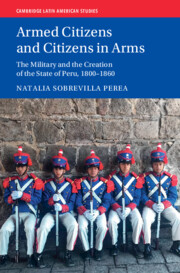
In this book, Natalia Sobrevilla Perea reconstructs the history of the armed forces in nineteenth-century Peru and reveals what it meant to be a member. By centering the experiences of individuals, it demonstrates how the armed forces were an institution that created social provision, including social care for surviving family members, pensions for the elderly, and assistance for the infirm. Colonial militias transitioned into professional armies during the wars of independence to become the institution underpinning and sustaining the organization of the republic. To understand the emergence and weaknesses of nineteenth-century Peru, it is imperative to interrogate how men of the sword dominated post-independence politics.