To save content items to your account,
please confirm that you agree to abide by our usage policies.
If this is the first time you use this feature, you will be asked to authorise Cambridge Core to connect with your account.
Find out more about saving content to .
To save content items to your Kindle, first ensure no-reply@cambridge.org
is added to your Approved Personal Document E-mail List under your Personal Document Settings
on the Manage Your Content and Devices page of your Amazon account. Then enter the ‘name’ part
of your Kindle email address below.
Find out more about saving to your Kindle.
Note you can select to save to either the @free.kindle.com or @kindle.com variations.
‘@free.kindle.com’ emails are free but can only be saved to your device when it is connected to wi-fi.
‘@kindle.com’ emails can be delivered even when you are not connected to wi-fi, but note that service fees apply.
This study examines the antecedents of political trust and its association with the likelihood of charitable giving in China using the path analysis model. The results show that morality and competence matter for political trust. Unlike most existing studies that separately test the impact of political trust and general social trust on charitable giving, this research pays attention to the significant association between political trust and general social trust in the Chinese state-centered environment and explores the role of general social trust in bridging political trust and charitable giving. Using a nationally representative sample, this research finds that political trust indirectly shapes charitable giving through the effect of general social trust in China. Individuals with a higher level of political trust also show more trust in society and have a higher probability of donating.
Political participation can take shape in many types of participation, between which the overlap is low. However, the similarities and differences between various types of participants are surprisingly understudied. In this article, I propose to differentiate between four types of participants: institutional political participants, non-institutional political participants, civic participants, and political consumers. These types differ from each other on two dimensions: whether they are political or publicly oriented and whether they are formally or informally organized. Building on the matching hypothesis, I argue that we should differentiate those four types of participants by their outlook on society (societal pessimism, political trust, and social trust). Using data from the European Social Survey 2006, including participants from 19 countries, logistic regressions show that institutional political participants trust politics rather than people, non-institutional political participants are societal pessimists who trust other people, civic participants are societal optimists who trust other people, and political consumers are pessimists who do not trust politics.
We study how Swedish citizens updated their institutional and interpersonal trust as the corona crisis evolved from an initial phase to an acute phase in the spring of 2020. The study is based on a large web‐survey panel with adult Swedes (n = 11,406) in which the same individuals were asked the same set of questions at two different time points during the coronavirus pandemic (t0 and t1). The sample was self‐selected but diverse (a smaller subsample, n = 1,464, was pre‐stratified to be representative of the Swedish population on key demographics). We find support for the view that the corona crisis led to higher levels of institutional and interpersonal trust. Moreover, reactions were largely homogeneous across those groups that could potentially relate distantly to government authorities.
This paper analyzes the role of social connectedness in motivating citizens to take an active interest in society and to engage in communal activities. Japan is used as an example of a society which has been diagnosed with a weakening of social bonds, as well as with an increase in social inequality and precarity in recent years. Structural equation modeling was applied to data of a nationwide survey from 2009, to test the assumption that feelings of disconnectedness from society exert a negative effect on civic engagement that needs to be differentiated from effects of general social trust. Results support this hypothesis and further indicate that it is not socioeconomic precarity per se that lowers chances for civic engagement, but its negative impact on the subjective evaluation of both the quality of social networks and one’s belonging to and value for society. As precarity, however, enforces the negative effects of low social capital, this implies that specially the socially disadvantaged are less likely to participate.
This study is part of the growing literature on the effects on civic engagement of attitudinal predictors, such as trust, along with structural predictors. Drawing data from the 2005 Japanese General Social Survey, it examines the association between trust and the probabilities of formal volunteering and charitable giving. A bivariate probit analysis of the data suggests that trust, institutional trust in particular, matters more to predict giving than volunteering. Although the number of membership affiliations is positively and significantly associated with both types of civic engagement, the association between membership affiliations and formal volunteering is significantly greater. Implications of these and other findings are discussed for future studies linking trust to civic engagement in group-collectivist societies such as Japan.
Arguments that corruption is “grease for the wheels,” benefiting economic growth, are difficult to sustain. State-level findings show that extensive corruption tends to leave a state poorer, and more economically unequal, than states where the problem is less significant. Citizens’ ability to respond to those difficulties by political means is in turn influenced by corruption itself, general levels of political participation, the strength or weakness of trust in officials and fellow citizens, the amount and quality of political news coverage in the mass media, and a state’s social composition. Problems of low trust could conceivably be addressed via effective universally applied public policies, but those in turn can challenge, and be challenged by, key aspects of America’s long-term bargain between government and citizens and by citizens’ expectations of each other. Corruption often undermines trust, and trust can underwrite effective reforms, but the relationships are complex and contingent upon levels of trust that are neither too low nor too high.
Chapter 7 examines how secondary school action groups, established by students in their respective schools, played a crucial role in mobilizing teenagers against the extradition bill by tapping into and leveraging their latent social capital. Utilizing Instagram as a platform, these groups facilitated connections among students within and across schools, often by capitalizing on their schools’ identities and leveraging various sources of social capital tied to those identities. This enabled loose and fragmented social networks can be mobilized in social movements, provided that they can activate their latent social capital.
The neologism “mansplaining” captures an insidious dynamic in which men explain things to women that women already understand, assuming that, by virtue of being a woman, she lacks the man’s knowledge. Mansplaining has started to receive some attention in contemporary scholarship, conceptualizing the phenomenon and identifying its epistemic harm. My purpose is to consider mansplaining and its harms from the perspective of democratic theory. Setting the problem of mansplaining against the norms we expect of democracy—equality, inclusion, and recognition—I argue that mansplaining poses harms that are not only individual and epistemic but also collective and relational. I distinguish two types of mansplaining based on women’s expertise and experience to elaborate on its collective epistemic harms to decision making and its relational harm of political exclusion. Mansplaining poses further relational harms of inequality and misrecognition, undermining the equal social relations and social trust required for deliberation.
This paper draws on macroeconomics, the economics of institutions and the economics of trust to explain private savings at the national level for 33 OECD (mostly European) countries from 2002 to 2012. More specifically, it raises two questions: (i) is it the quality of institutions or trust in institutions that drives private savings? (ii) if trust matters, what is the appropriate institutional level at which it operates? To answer these questions, we add to the usual explanatory variables of private savings three measures of institutional quality and six measures of institutional trust, distributed between the following institutional levels, presented in assumed hierarchical order: political, legal, financial and social. We find that trust in political institutions is the most significant driver of private savings. This contributes to the literature underlining the importance of subjectivity in social and economic phenomena and suggests, for private bank savings in countries having highly regulated banking systems, the existence of a hierarchy of trust in which trust in the highest-ranking institutions (political – and to a lesser extent legal – institutions) acts as a substitute for trust in every lower-ranking institution (financial institutions and social trust).
Liberal political institutions have been an enormous boon for humanity. The free market aspect of liberalism has led to an explosion of innovation, ranging from new kinds of technology and novel forms of entertainment to advances in science and medicine. The emphasis on individual rights at the core of liberalism has increased our ability to explore new ways of living and to construct an identity of our own choosing. But liberal political institutions around the world are facing two crises: low fertility and declining social trust. In particular, liberalism’s focus on individual liberty rather than group cohesion can increase economic productivity by encouraging the free movement of people and capital, but this movement is associated with declines in social cohesion and fertility. In this essay, we highlight some challenges to the long-term evolutionary stability of liberalism. In other words, we raise the question: Can liberalism last?
Involvement in sports is considered a powerful way to generate social capital. However, the role of sport engagement in the development of social relationships of older adults has not received much attention. Remarkably, there is a lack of empirical evidence on the quality and diversity of social relations built through active sport participation and spectatorship. This paper attempts to assess the relationship between sport engagement and various measures of network social capital, including the extension and quality of social networks and the heterogeneity of personal relationships. Also, it proposes new and more informative measurements of an individual's quantity and quality of social ties. By analysing data from a survey in Spain (N = 600) and applying logistic regressions, the results show that sport participation and attendance at sporting events are closely related to different dimensions of network social capital. Concerning people who are not actively engaged in sports, more extensive social networks characterise those who frequently attend sporting events. In contrast, active sport participation is associated with the extensity and quality measures of social connectedness, the level of satisfaction with friends and the opportunity to enjoy close relationships. Therefore, this paper provides new evidence on how sport engagement may result in tighter and extensive networks for older adults and serve as support for emphasising sports, physical activity and leisure as strategies for maintaining and boosting older people's social and psychological health.
Trust is critical to the economic, political, and social coordination and cooperation underpinning society, yet we find ourselves in a perceived “crisis of trust,” particularly in institutions such as government, business, the media, and NGOs. But what is trust, and why is it thought to have declined in recent years? This chapter considers the problem and the nature of trust in both an interpersonal and an institutional (collective) form, asserting that trust involves a three-part relationship between a trustor, a trustee, and some domain of behavior wherein the trustee’s behavior is perceived to encapsulate the interests of the trusting party. Choosing to trust is not a risk-free endeavor for the trusting party, as it involves the acquisition of (usually imperfect) information about the trustworthiness of a trustee that is then used to form a justified true belief about the trustee’s trustworthiness as a basis of a trustor’s decision about whether to act in a given situation. By clarifying the notion of trust in its interpersonal and institutional forms, this chapter lays the foundation for considering the relationship between trust and distributed ledgers, including blockchains, in the following chapter.
Recent studies in collaborative management identify social and communal trust as a key determinant of positive socio-ecological outcomes. Social trust in turn derives from fair and equitable forms of representation, participation, and revenue distribution. While many recent studies have provided in-depth cases on how formally constituted rules and procedures mediate social trust in the governance of natural resources, there is a need for more research on the role of informal institutions – social norms that are enforceable but not fully codified – in enhancing or derailing inter-communal trust, thereby crucially determining ecological and social outcomes. In this chapter, we examine – based on comparative analysis of co-management schemes from Eastern and Southern Africa – how informal institutions (mainly customary authorities) contribute to intra-communal trust. Specifically, we are interested in how the integration of informal institutions in the form of customary authorities—de facto institutions governing among others historical claims to collective rights to, and adjudicating “tradeoff conflicts” over wildlife – is crucial to success of collaborative management. The chapter potentially contributes to enhancing our theoretical understanding of how intra-communal trust along with institutional integration co-determines resource and ecological outcomes, and it does so with “empirical evidence” drawn from “multiple cases from multiple countries.”
Chapter 8 summarizes key findings of the book and explores the feedback loops between legitimacy, institutional design, social trust, and effective governance. We also discuss various implications of our findings. First, we turn to the ambivalent role of the state in areas of limited statehood. Effective governance in most issue-areas is not possible without some degree of security and without some basic infrastructure. Yet, the residual state often behaves as a governance spoiler rather than an active supporter. It needs to be tamed by the rule of law and participatory institutions. Second, we discuss the implications for international affairs. The international system shares the “anarchy problematique” with areas of limited statehood. Many IR theories are highly relevant for explaining effective governance in areas of limited statehood – and vice versa. The global governance system and areas of limited statehood are also firmly intertwined in a multi-level governance system. Third, we discuss the political implications of our findings. Most analysts and policy-makers alike agree that comprehensive state-building efforts in ALS have largely failed. Rather than lowering our normative standards, we suggest a paradigm shift from state-building to governance promotion.
Chapter 3 elaborates our theory of governance in areas of limited statehood. While existing approaches address certain pieces of our “governance puzzle,” none of them offers a satisfying answer. We develop a theoretical explanation for when and how actors are motivated to engage in governance. As to the role of (state) institutions, we argue that the shadow of hierarchy and the shadow of anarchy go a long way to incentivize actors to become governors. The same holds true for the quest for (international as well as domestic) legitimacy and social acceptance. Personalized trust relations within and among local communities not only helps overcoming collective action problems, but also leads to the demand for governance contributions. Next, we introduce our theory of effective and legitimate governance in areas of limited statehood. First, institutional conditions fostering effective governance consist of institutional design, inclusiveness and fairness, and residual statehood. Second, empirical legitimacy and social acceptance of the governors and the governance institutions matter for effectiveness. Last not least, personalized, group-based, and generalized trust constitutes a further enabling condition for effective governance.
Wildlife reintroduction projects often face resistance from local residents who see potential conflicts with the species or lack trust or confidence in the agencies and professionals involved in reintroduction. Yet the linkages between trust, confidence, risk perceptions, attitudes towards the species and local support for its reintroduction are not well known. The Dual-Mode Model of Cooperation and Cognitive Hierarchy Model were theoretical frameworks used to shed light on these linkages by exploring the potential roles trust and confidence play as mediators between risk perceptions and attitudes towards, and support for, reintroduced elk in Tennessee (USA). A mail survey of 1005 residents living in the five-county area surrounding the North Cumberland Elk Restoration Zone assessed resident attitudes and risk perceptions towards the reintroduced elk, trust towards the managing wildlife agency and support for continued conservation efforts. A structural equation model revealed that trust and confidence play positive roles in mitigating risk perceptions and improving support for the reintroduction of elk. The findings confirm the roles public trust and confidence play in wildlife reintroductions and should help agencies work towards building local trust and confidence, minimizing risks, improving attitudes and increasing the chances for successful outcomes for the species and people.
This chapter examines the importance that social trust and deep cultural roots have for current productivity and the impact immigration has on each. Ultimately, we find that there isn't strong evidence that immigration could impact productivity through either of these channels.
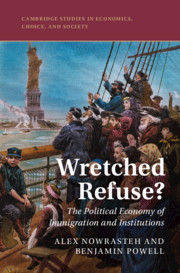
Economic arguments favoring increased immigration restrictions suggest that immigrants undermine the culture, institutions, and productivity of destination countries. But is this actually true? Nowrasteh and Powell systematically analyze cross-country evidence of potential negative effects caused by immigration relating to economic freedom, corruption, culture, and terrorism. They analyze case studies of mass immigration to the United States, Israel, and Jordan. Their evidence does not support the idea that immigration destroys the institutions responsible for prosperity in the modern world. This nonideological volume makes a qualified case for free immigration and the accompanying prosperity.
This chapter challenges the concept of school–home communication by offering a transactional notion of the home–school–home communication model (drawn from communication theory). We review the classic and more recent international literature on school–home communication in relation to newly arrived migrant children and the need to consider whether the presence of such children challenges the ‘one size fits all’ model. We use the dynamic notion of transactional communication to consider the empirical findings of the three-year research programme, covering secondary and primary schooling, and recommend alternative and more empowering constructions of school communication systems (its modes, processes, content and operationalisation). Our conclusions are of direct relevance to education practitioners, school community liaison officers and migrant communities themselves.