To save content items to your account,
please confirm that you agree to abide by our usage policies.
If this is the first time you use this feature, you will be asked to authorise Cambridge Core to connect with your account.
Find out more about saving content to .
To save content items to your Kindle, first ensure no-reply@cambridge.org
is added to your Approved Personal Document E-mail List under your Personal Document Settings
on the Manage Your Content and Devices page of your Amazon account. Then enter the ‘name’ part
of your Kindle email address below.
Find out more about saving to your Kindle.
Note you can select to save to either the @free.kindle.com or @kindle.com variations.
‘@free.kindle.com’ emails are free but can only be saved to your device when it is connected to wi-fi.
‘@kindle.com’ emails can be delivered even when you are not connected to wi-fi, but note that service fees apply.
This chapter discusses the circumstances of Ginsberg’s arrival and deportation from Czechoslovakia in 1965. Although it is often thought otherwise, Ginsberg did in fact have long-formed plans to travel behind the Iron Curtain, and his expulsion from Cuba only expedited, rather than facilitated, his arrival to Europe. During his stay in Czechoslovakia, Ginsberg had the opportunity to look behind the façade of the Communist Party and observed firsthand that Czechoslovaks lived in an oppressive regime they increasingly tried to challenge through various means, one of them being the publication and performance of Beat poetry. However, he underestimated the surveillance practices of the regime, which only intensified after Ginsberg was elected the King of May in front of a 100,000-strong crowd during May Day celebrations. Ultimately, his often frank discussion of his views and experiences not only placed several of his associates in danger, but also led to his deportation from the country.
The contribution that coal miners made to the reconstruction of Europe is hard-wired into popular memory, with widespread tales of the selfless sacrifice that saw miners conduct extra shifts and work longer hours for the nation. This article compares three conflicts that arose when miners were ordered to go the extra mile: the campaign to have miners in the Nord-Pas-de-Calais basin (France) make up public holidays in early 1945, the extension of the Saturday shift in the coal mines of the Ostrava-Karviná basin (Czechoslovakia) in late 1946, and the calls on miners in the Ruhr basin (Germany) to conduct extra shifts to provide the population with coal for the winter of 1946/47. Where trade unionists invoked patriotic sentiments and, when that failed, ethnic resentments to motivate miners to go the extra mile, this article shows that generational conflict between old and young miners was the driving force behind these disputes.
The Munich conference notoriously symbolizes appeasement and its failure. The issue under dispute concerns territory – specifically, the Sudetenland. This territorial dispute was initially internal to Czechoslovakia, a disagreement between the Sudetenland Germans and the central government of Czechoslovakia. Eventually, however, the nationalistic element to the dispute brought in the German government. The major powers avoided war because the French and British prime ministers – Daladier and Chamberlain, respectively – forced the Czechoslovakian president, Benes, to accept the peaceful transfer of the Sudetenland to Germany, based on the norm of nationalism (or self-determination). As this case shows, when actors widely agree on the norms through which territory can change hands, the probability of war declines. Nevertheless, this peace was short-lived. Indeed, the afterword to the chapter describes how Hitler invaded Prague shortly thereafter. The Danzig–Poland crises then followed. By that point, Britain and France had abandoned appeasement and shifted to balancing against Hitler; they allied with Poland and gave Hitler an ultimatum to try to stop his invasion. This conventional deterrence failed, and the Second World War began in Europe.
Edited by
Martin Nedbal, University of Kansas,Kelly St. Pierre, Wichita State University and Institute for Theoretical Studies, Prague,,Hana Vlhová-Wörner, University of Basel and Masaryk Institute, Prague
This chapter situates itself between the untheorizable singularities of specific case studies and the unsustainable generalities that usually result from attempts at broad historical characterization. By looking at everything from a late fifteenth-century image of Jews making music in a Prague synagogue to armies of wooden klezmer musicians in a twenty-first-century store window, and from a nineteenth-century Jewish musical caricature to a bit of concentration-camp ephemera involving Hebrew words spelled with musical notes, this chapter endeavors to give some of the flavor of the Czech Jewish musical experience.
Edited by
Martin Nedbal, University of Kansas,Kelly St. Pierre, Wichita State University and Institute for Theoretical Studies, Prague,,Hana Vlhová-Wörner, University of Basel and Masaryk Institute, Prague
This chapter begins by exploring the professionalization of Czech rock under the influence of The Beatles in the 1960s, exemplified by the group Olympic. The second part of the chapter focuses on the distinction between official and unofficial types of popular music that emerged in the 1970s and 1980s. An examination of the output and reception of the groups Blue Effect and The Plastic People of the Universe during this period illustrates how rock music became politicized during normalization and how this politicization influenced later Czech historiographies of rock.
This chapter treats the daily life experiences of Jews who survived the Second World War in the interior regions of the Soviet Union. Included among this group were Soviet citizens who evacuated eastward ahead of invading German armies as well as refugees from Poland, the Baltic states, Romania, and Czechoslovakia.
This article explores the specifics of night work under Communist rule and within the state-socialist economy that the Communist Party of Czechoslovakia (KSČ) established after they seized power in 1948. Although the Czechoslovak communists sought to minimise night work, they achieved the opposite effect. One reason for this was the absence of economic reforms. At the turn of the 1950s and 1960s, they were compelled to introduce uniform bonuses for night shifts, leading to their standardisation. However, those targeted by the incentives showed little interest in night shifts; consequently, night shift workers were often drawn from marginalised groups, such as prisoners and women facing financial difficulties. The article delves into their potential motivations for accepting night shifts. Furthermore, despite the Czechoslovak communists’ efforts to differentiate their night shift policy from that of the ‘capitalist’ approach (as embodied by interwar Czechoslovakia), numerous continuities were evident. This article investigates these aspects and seeks to uncover their potential causes.
On 23 September 1920, when the Inter-Allied boundary commission arrived in the town of Gmünd (Cmunt), residents participated in a large demonstration about the small border change set to take place along the Lower Austrian-Bohemian border. While boundary commissions in Europe have historically acted as intermediaries between local and state interests, this article argues that the Inter-Allied commission members departed from this role when they refused to undergo any public consultation or meet with any demonstrators about the border change. Examining the (in)actions of the postwar Inter-Allied and state boundary commission representatives alongside the concerns of the local population in Gmünd reflects how international, state, and local actors all perceived Europe’s boundaries as malleable and negotiable over a year after the signing of the post-World War I (WWI) treaties. The lead-up to and demonstration in Gmünd in September 1920 further nuances the relationships between the Allied Powers, postwar states, and local populations during the boundary-making process in the wake of WWI, illuminating both successful and unsuccessful claim making strategies pursued by state and local actors.
In the first months of the Spanish Civil War, the Spanish doctor Frederic Duran Jordà developed a new method of blood transfusion which overcame the era of direct arm-to-arm transfusions. While Duran was experimenting in Barcelona and the Aragon front, hundreds of foreign doctors came to Spain with the help of internationalist associations and offered their services to the Republican government. The Czechoslovak Dr Karel Holubec entered Spain in May 1937 and practiced in a mobile hospital funded by the Czechoslovak Committee to Aid Democratic Spain, receiving blood from Duran’s laboratory. This article aims to study how Duran and Holubec transferred the method of blood transfusion to Czechoslovakia through interpersonal contact, conferences, and performances. This paper argues that while individual actors played a crucial role in the diffusion of medical practices, this circulation was determined by a unique historical and socio-political framework. The Spanish Civil War, the International Brigades, and the invasion of Czechoslovakia by Nazi Germany were not only the historical context of medical innovation but an integral part of it.
A recurring issue of debate for scholars of Central Europe has been the extent to which analyses of European colonialism apply to Austria-Hungary and its successor states. This article considers this issue in relation to the theologian, archeologist, and scholar of Arabic culture, Alois Musil (1868–1940). Long celebrated in Austria and Czechoslovakia, he has seldom been subject to critical analysis. A loyal Habsburg subject—and confessor to the Empress Zita until 1918—then an enthusiastic promoter of Czechoslovakia and co-founder of the Institute of Oriental Studies in Prague, Musil was a striking example of how individuals in Central Europe adapted to changing political realities. The article focuses in particular on his attitudes to European colonialism. On the one hand, he was critical of British and Italian colonialism, but he worked to further Habsburg imperial interests in the Middle East. When discussing Japanese ambitions in the 1930s, he emphasized the superiority of European colonial rule. He illustrates the complex stance of many Czechs (and other Central Europeans) toward colonialism. They imagined they were innocent of its taint but were in fact enmeshed in it, often endorsing it or acting as agents of the schemes of the European powers.
Recent historical studies on the origins of the postsocialist order in eastern and central Europe have adopted a “long transformation” perspective. They emphasize the importance of state socialist economic and political experts who, as early as the 1970s, began to think in ways that would prove compatible with neoliberal governance after 1989/91. Sharing this interest in longer genealogies of the postsocialist transformation, the present article shifts the focus of attention from the history of expertise to the everyday practices and “work on the self” of members of the urban and educated classes. It presents a microhistorical study of courses for students and white-collar workers that were offered by psychology coach David Gruber from the 1980s in Czechoslovakia and focused on intellectual productivity skills such as speed reading. These courses provide a unique insight into how people worked on themselves to become more effective in order to adapt to the newly emerging postsocialist world. The present article points to hitherto understudied continuities in the understandings and practices of productivity between the socialist and postsocialist periods.
This article deals with the confiscation of property from the German-speaking inhabitants of Czechoslovakia and its redistribution to the new settlers of the Czech borderlands. It shows how the social revolution—that is, the emergence of an egalitarian postwar society—was made possible by the national revolution—that is, the expulsion of the German-speaking inhabitants of Central Europe. Using the example of the industrial center of Liberec in northern Bohemia, the author shows how the Czech administration that was established after the Second World War applied the dichotomy of the Czech–German conflict to an ethnically complex postwar society and how, despite the ideology of distributing property to the “Slavs,” non-Czech minorities were discriminated against with respect to redistribution. Eventually, she analyzes how postwar Czechoslovak society was shaped, with an emphasis on the material demands of workers and collectives, even as individuals sought to achieve a middle-class lifestyle through participation in property distribution.
In the 1960s, Indian governments were embroiled in a succession of diplomatic disputes involving defections from East to West. In March 1967, Svetlana Iosigovna Alliluyeva, the only daughter of Joseph Stalin, defected through the US embassy in New Delhi. Further back, in 1962, Vladislaw Stepanovich Tarasov, a Soviet merchant seaman, jumped ship in the eastern Indian port of Calcutta. After a legal wrangle in the Indian courts the Russian sailor left the subcontinent to begin a new life in the West. The Tarasov episode came at a point when India was reeling from a military defeat inflicted by China, and the national government was actively courting American and Soviet assistance to stave off what, at one point, appeared a threat to the India Republic’s survival. More broadly, defections staged in India served as an unwelcome irritant in relations between the Soviet Union, the United States and Great Britain, when these countries were attempting to forge more productive ties in the wake of the Cuban Missile Crisis. This chapter focuses attention on the role played by Western intelligence services in the story of Cold War defection.
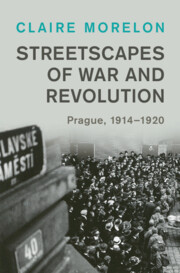
Prague entered the First World War as the third city of the Habsburg empire, but emerged in 1918 as the capital of a brand new nation-state, Czechoslovakia. Claire Morelon explores what this transition looked, sounded and felt like at street level. Through deep archival research, she has carefully reconstructed the sensorial texture of the city, from the posters plastered on walls, to the shop windows' displays, the badges worn by passers-by, and the crowds gathering for protest or celebration. The result is both an atmospheric account of life amid war and regime change, and a fresh interpretation of imperial collapse from below, in which the experience of life on the Habsburg home-front is essential to understanding the post-Versailles world order that followed. Prague is the perfect case study for examining the transition from empire to nation-statehood, hinging on revolutionary dreams of fairer distribution and new forms of political participation.
As a part of the conversation in the forum “Austria and the Czech Republic as Immigration Countries: Transnational Labor Migration in Historical Comparison” this article revisits the history of refugees in the Bohemian Lands and Czechoslovakia, from World War I until the occupation by Nazi Germany in 1939. Taking stock of existing research, it suggests alternative lines of thinking about the management of migrants' labor and contributes to the wider discussion about how to conceptually combine refugee studies and research on labor migration. For analytical purposes, it focuses on three distinct state approaches to managing refugee labor that often existed in parallel: mobilization of refugee labor in a crisis situation, the support of labor as a pathway to future citizenship, and the denial of work as a sign of statelessness. These three approaches show how refugees' work impacted their status, communicated ideas about the future, and reproduced hierarchies defined by ethnicity, class, or political persuasion.
This article introduces the forum on food shortages during the post-Habsburg transition in the Bohemian Lands and Slovenia. Using examples from these regions, it first outlines the food crisis that developed during World War I and contributed to the internal disintegration of the Habsburg Empire. The article then turns to Czechoslovakia and Yugoslavia, successor states which, despite their victorious status and optimistic prospects for the future, had to contend with food shortages that lasted well beyond 1918. Shortages remained one of the main challenges to the consolidation of these newly formed states. Finally, and most importantly, the article provides an overview of the state of the art in Czech, Slovene, and international historiography, identifies gaps in knowledge, and presents our approach to the topic.
The article deals with food profiteering in the Bohemian Lands after the declaration of Czechoslovakia in 1918. The new state faced a disintegrated society in which various units continued to fight each other for an advantage in the food market. While food shortages persisted, the Czechoslovak authorities had to deal with a situation in which food rationing laws had lost some of their power to distinguish between the legal and the criminal. Moreover, collective ideas about what was right and wrong, about the victims and perpetrators of food profiteering, and of whom to punish and how, varied according to the different social and ethnic affiliations of the population. Political instrumentalization of such ideas jeopardized the postwar consolidation based on the promise of a better future. Thus, the introduction of food profiteering courts with lay judges was an attempt to institutionalize conflicts over food profiteering and to reduce the impacts of the atomization of society until the economic situation improved.
This chapter seeks to illustrate from the bottom up the role that social justice played in establishing and maintaining authoritarian rule in Czechoslovakia under National Socialism and state socialism. The author investigates how notions of social justice were included in the social practice of both regimes and how the working population responded to these policies. By analysing legal disputes, this chapter explores the critical space between rulers and ruled to assess when and how notions of social justice were articulated in Czechoslovakia. In their opposition to the ‘injustices’ of past governments, such as those wrought by social inequality and economic suffering, both National Socialists and Communists drew on a language of social justice to articulate their own visions of a new order. However, their respective notions of social justice differed radically: from social justice defined in racial terms, typical for New Order movements, to social justice delimited by social class and attained for all members of the ‘socialist working society’. The main difference that emerged from the transition from the Nazi to the post-war Communist regime was a shift from the language of individual rights to a language related to the collective, to society, and to the state.
This article develops a praxeological perspective on the history of partisanship in Central and Eastern Europe. The author proposes to examine partisanship not as an idea or a concept but as a virtue that was supposed to be forcibly cultivated and practiced in science and scholarship under Soviet domination. The article focuses on the cases of two prominent Marxist philosophers, Arnošt Kolman and Adam Schaff, who became devoted teachers of partisanship in the Soviet Union as well as in their “native” Czechoslovakia and Poland. Later, both were publicly accused of “non-partisanship.” Based on these examples, the author argues that, with the establishment of the socialist regimes, partisanship became a tool of maintaining stability. This implied more autonomy for the scholars and scientists who learned how to use the quasi-moral authority of partisanship to exclude from the “moral consensus” those who, due to their “excessive diligence,” threatened the internal norms and conventions.