To save content items to your account,
please confirm that you agree to abide by our usage policies.
If this is the first time you use this feature, you will be asked to authorise Cambridge Core to connect with your account.
Find out more about saving content to .
To save content items to your Kindle, first ensure no-reply@cambridge.org
is added to your Approved Personal Document E-mail List under your Personal Document Settings
on the Manage Your Content and Devices page of your Amazon account. Then enter the ‘name’ part
of your Kindle email address below.
Find out more about saving to your Kindle.
Note you can select to save to either the @free.kindle.com or @kindle.com variations.
‘@free.kindle.com’ emails are free but can only be saved to your device when it is connected to wi-fi.
‘@kindle.com’ emails can be delivered even when you are not connected to wi-fi, but note that service fees apply.
The concept of social inclusion meets the criteria of a “magic concept” because it is broadly stretched, normatively attractive, and denies the possibility of conflicting interests and logics. However, when this broad concept is operationalized in policies targeting specific groups it is often reduced in scope by narrowly defined policy designs. This paper asks how do disability policies define and operationalize social inclusion? Drawing from a critical frame analysis of all disability policies at Canada’s provincial and federal levels, six policy frames are identified that encapsulate different meanings of social inclusion for people with intellectual and developmental disabilities in Canadian policy design. Comparison is facilitated by engaging critiques of inclusion policy from the disability politics literature to help explain emergent trends and areas of divergence in social inclusion framing. This facilitates a discussion of policy design characteristics during the “inclusion era” of Canadian disability policy.
This study examines the ramifications engendered by the personalisation welfare initiative, denominated as ‘Individualised Budgeting’, upon the welfare service framework in Israel. Adopting a supply-side perspective, the study employed qualitative, in-depth interviews with service providers to scrutinise potential successes and failures in service systems. The study’s methodology employed a multi-criteria policy analysis based upon the analytical theoretical framework of Gilbert and Terrell’s welfare service delivery system analysis. Results revealed that while service integration and systematic function distribution align well with the programme, accessibility and accountability only partially fit, suggesting a need for improved regulatory frameworks. New criteria, including economic viability for private suppliers and investment in innovative services, also emerged. Addressing these market inadequacies requires State investment in technological innovations to ensure an effective service delivery system.
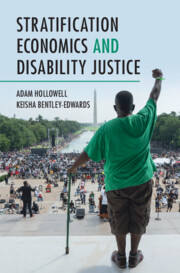
In Stratification Economics and Disability Justice, Adam Hollowell and Keisha Bentley-Edwards explore how the work of Black disabled activists can and should inform economic analysis of inequality in the United States. Presenting evidence of disability-based inequality from economics, sociology, disability studies, and beyond, they make a case for the inclusion of ableism alongside racism and misogyny in stratification economics' analysis of intergroup disparity. The book highlights the limitations of traditional economic analyses and elevates quantitative and qualitative intersectional research methods across four key areas in stratification economics: employment, health, wealth, and education. Chapters also recommend public policies to advance fair employment, healthcare access, and equal education for Black disabled people in the US Incisive and compelling, Stratification Economics and Disability Justice follows the lead of Black disabled activists pursuing intersectional advancement of economic justice.
Despite over 50 years of advocacy and policymaking toward deinstitutionalization, residential institutions for people labelled with intellectual and developmental disabilities (IDD) remain operational in six Canadian provinces. In addition, the lack of public, community-based housing has led to contemporary housing models that represent the re- or trans-institutionalization of labelled people. This article asks: why does the institutionalization of people labelled with IDD still occur in Canada? We argue that institutionalization is propelled by a policy legacy of systemic ableism that is manifested in three pervasive logics, which “haunt” the public provision of IDD housing: exclusion, elimination, and extraction. Empirical support is drawn from textual analysis and interviews with policymakers, advocates and people labelled with IDD in two Canadian provinces (Ontario and Nova Scotia). We conclude by discussing the interrelation of institutionalization and systemic ableism and presenting implications for counteracting ableism in Canadian IDD housing policy.
The degree to which disability benefit programs provide an adequate standard of living to those with work-limiting disabilities has long been overlooked in social policy research. This paper presents a framework for assessing disability-related decommodification and then applies that framework to an analysis of the Social Security Disability (SSD) programs in the United States. The paper draws on survey data from the Health and Retirement Study linked to administrative records from the Social Security Administration, and further compares the U.S. estimates to those from 27 other countries. The results indicate that more than 50 percent of older adults of working-age with work-disabilities in the U.S. do not receive SSD benefits, though rates of benefit receipt are higher than the average across other high-income countries. Those that receive SSD benefits, moreover, experience greater difficulty achieving an adequate standard of living, as measured by an index of financial security, than those with similar characteristics in the U.S. who do not receive disability benefits. The paper thus provides a framework for future policy research on benefit adequacy, while evaluating the availability and generosity of disability benefits in the U.S.
Studies on the development of social policies have provided us with a rich body of knowledge. However, being based mostly on class, gender or racial analysis, this body of work has seldom used disability as an analytical framework. This article proposes a systematic research agenda for addressing this lacuna. Drawing on the political and institutional approaches, this article illustrates how mainstream theories on social policy development cannot be assumed applicable to disability policies ‘as is’. To apply them effectively, we argue, students of social policy need to rework them in light of the insights of disability studies. Such conceptual work would involve closer attention to the uniqueness of disability as a socio-political category. Integrating these social policy theories with disability studies will allow us to better identify the unique political and institutional factors behind the trajectories of disability related policy. We conclude this discussion with suggestions for future research.
This introductory article offers an analytical framework to understand the limits of approaches that stress the diffusion and transfers of international norms within the field of disability policy over the last three decades. It also aims to provide alternative ways to frame some of the important changes that have occurred through the concept of layering, in order to better account for the intricate processes of national translation but also for the contradictions, conflicts, and obstacles that the promotion of disability rights have faced in different countries. Finally, this article serves to introduce the contributions that make up the themed section in this issue of Social Policy and Society.
This essay criticizes recent trends in disability policy as restrictive of individual liberty and informed by too narrow a definition of what constitutes human flourishing. I defend the value of intentional community settings as one legitimate residential option for people with intellectual and developmental disabilities. Recent federal regulations (HCBS Final Rule) define intentional communities or disability-specific housing as presumptively institutional in nature, misunderstanding the positive, noninstitutional features of intentional, integrated communities created by and for people with developmental disabilities. In addition, current disability policy, despite its stated concern for the autonomy of people with intellectual and developmental disabilities, limits individual liberty by strictly defining the types of settings eligible for Medicaid waiver funding, expressly excluding agricultural communities, disability-specific residential settings, and intentional communities. A robust commitment to the autonomy of people receiving Medicaid waiver services would allow them to choose to direct their program dollars, recognizing that some individuals may choose a life in intentional community or with others facing similar challenges to themselves over an illusory “integration” into a wider society that remains too often unwelcoming and difficult to navigate.
Applying a political economy lens, this article examines the impact of the Convention on the Rights of Persons with Disabilities (CRPD), within a political context marked by crisis and austerity. Taking the case of Portugal, a country that faced a financial crisis and underwent an austerity plan, the article seeks to understand the impact of the CRPD at domestic level. What has changed, what has remained the same and what has deteriorated? And how has the disability movement responded and resisted to the crisis? This article addresses these questions and discusses the challenges of implementing disability rights in times of ‘enduring’ austerity.
This article explicates two approaches to the basis of moral worth and status: Eva Kittay’s relational view and Jeff McMahan’s psychological personhood view. It is argued that these theories alone do not provide adequate support for the conclusions Kittay and McMahan want to draw concerning individuals whose entitlement to fundamental protections can be challenged—infants with severe cognitive disabilities and infants without the support of their families and social environments. The real justification can in each case be found in deeply held convictions regarding entities that must and entities that must not be included in the core community of moral equals. Philosophical discussions about these convictions would be more useful for the advancement of our moral thinking than vain attempts to show that the absolute truth lies on either side of the ongoing debate.
The purpose of this study was to assess the extent to which vulnerability was present or heightened as a result of either disability or end-of-life policies, or both, when people with disabilities face end of life.
Method:
People with disabilities and policy makers from four Canadian provinces and at the federal level were interviewed or participated in focus groups to identify interactions between disability policies and end-of-life policies. Relevant policy documents in each jurisdiction were also analyzed. Key theme analysis was used on transcripts and policy documents. Fact sheets identifying five key issues were developed and shared in the four provinces with policy makers and people with disabilities.
Results:
Examples of heightened vulnerability are evident in discontinuity from formal healthcare providers with knowledge of conditions and impairments, separation from informal care providers and support systems, and lack of coordination with and gaps in disability-related supports. When policies seek to increase the dignity, autonomy, and capacity of all individuals, including those who experience heightened vulnerability, they can mitigate or lessen some of the vulnerability.
Significance of results:
Specific policies addressing access to community-based palliative care, coordination between long-standing formal care providers and new care providers, and support and respect for informal care providers, can redress these heightened vulnerabilities. The interactions between disability and end-of-life policies can be used to create inclusive end-of-life policies, resulting in better end-of-life care for all people, including people with disabilities.
Recommend this
Email your librarian or administrator to recommend adding this to your organisation's collection.