To save content items to your account,
please confirm that you agree to abide by our usage policies.
If this is the first time you use this feature, you will be asked to authorise Cambridge Core to connect with your account.
Find out more about saving content to .
To save content items to your Kindle, first ensure no-reply@cambridge.org
is added to your Approved Personal Document E-mail List under your Personal Document Settings
on the Manage Your Content and Devices page of your Amazon account. Then enter the ‘name’ part
of your Kindle email address below.
Find out more about saving to your Kindle.
Note you can select to save to either the @free.kindle.com or @kindle.com variations.
‘@free.kindle.com’ emails are free but can only be saved to your device when it is connected to wi-fi.
‘@kindle.com’ emails can be delivered even when you are not connected to wi-fi, but note that service fees apply.
This article describes a series of steps to integrate multiple modes of archaeological mapping in arid and agricultural settings. We use the coastal region of Peru as a case study and share our recent field experience at Cerro San Isidro, a multicomponent hill site located in the agriculture-intensive and mid-elevation (about 500 m asl) Moro region of the Nepeña Valley. In June and July 2022, we spent eight weeks deploying a combination of drone aerial imagery, pedestrian GPS reconnaissance, and GPR survey to map the surface and subsurface features at the site and in the adjacent agricultural fields. Our efforts suggest that the ancient settlement extended over an area of at least 50 ha, well beyond the visible surface architecture. Using a multimodal approach to confirming the partial destruction of archaeological vestiges by modern agricultural encroachment is both time-effective and noninvasive. The article offers insights from our experience, including the sequence of field operations, technical troubleshooting, and the collection and integration of datasets. We discuss the methodological potential and implications of this combination of multimodal mapping and its deployment in coastal Peru, a region that, like many others in the world, is increasingly subject to rapid agricultural expansion and other anthropogenic developments.
Cathodes with recessed sample surfaces have several benefits in cesium sputter ion sources, including higher output, more efficient use of sample material, and improved focusing of the extracted ion beam. However, the Ionplus MICADAS uses cathodes with a graphite surface that is essentially flush with the sample holder. To evaluate the performance of recessed graphite with the MICADAS and determine the optimal surface depth, we tested four different depths, including the standard (flush) pressing method, 0.5 mm, 1.0 mm, and 1.5 mm. We found that recessed depths of 1.0 and 1.5 mm resulted in 20% higher ion beam current compared to the standard method under the same source conditions. The results are consistent with the beam produced from the recessed targets being more narrowly focused with a lower emittance, resulting in better transmission through the accelerator. Small graphite samples (200 µg C) with recessed surfaces produced higher currents for longer, leading to a 2–3× increase in sample ionization efficiency. Additionally, there was some evidence that isotopic ratio measurements of recessed samples were more stable over time. Overall, samples recessed to 1 mm depth offered numerous advantages over the standard pressing method and we have subsequently started pressing all MICADAS graphite using this approach.
Radiocarbon and uranium-thorium dating of microbialites and penecontemporaneous cements in a microbialite mound at Death Point at Lakeside, Utah, on the shore of Great Salt Lake, Utah, call for a revision of the Lake Bonneville hydrograph. At about 30,000 cal yr BP, the lake experienced an abrupt rise of about 20 m, then dropped back down to levels near or slightly higher than the modern average elevation of Great Salt Lake. Over the ensuing ~6000 yr the lake experienced a series of fluctuations, up to levels a few tens of meters higher than the modern average Great Salt Lake, then down again. The exact timing and amplitudes of those fluctuations are not known, but importantly, the lake did not rise to levels near the Stansbury shoreline (~80 m higher than Great Salt Lake) until after about 24,000 cal yr BP. After the Stansbury shoreline, the lake rose almost 200 m to its highest level at the Bonneville shoreline by about 17,500 cal yr BP. This interpretation is different from previously published hydrographs, many of which show a relatively steady rise to near the Stansbury shoreline between 30,000 and 25,000 cal yr BP.
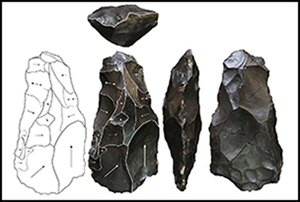
Prior to this work, no Palaeolithic field survey had been conducted in the central region of the northern Iranian Central Desert. This article is the first account of the presence of Pleistocene hominins in Eyvanekey, Semnan Province, and reports the recovery of lithics that date to at least the Middle Palaeolithic.
Obtaining accurate radiocarbon (14C) results from wood samples requires the extraction of cellulose. In the past, this has been done using different combinations of methods including acidified bleaching, acid-base-acid, and strong bases. This often becomes a time-consuming task in most analyses, especially when single ring isotope chronologies are needed from wood samples. Using 14C and Fourier-transform infrared spectroscopy (FTIR), we tested four different pretreatment methods to determine their ability to produce high quality cellulose. We then adjusted the best methods to determine a method for pretreating wood laths of multiple rings. A sequence of base-acid-base-acid-bleach + strong base (BABAB+) and BABAB produced the most accurate results when compared to the Bomb20 Northern Hemisphere Zone 1 curve with an average difference in Δ14C of 1.3‰ and 5.8‰ respectively. These methods were adjusted to pretreat an entire wood lath and a comparison of the FTIR results suggest that our adjusted BABAB+ and BABAB produced high quality cellulose comparable to that of an individually pretreated ring. The possibility to pretreat wood lath samples has the potential to more than double the number of tree rings which can be pretreated in a week. This is a significant reduction in time when creating long tree ring chronologies.
Massive ground ice found in the Barrow Permafrost Tunnel at 3–7 m depths from the surface has been interpreted as an ice wedge and used to reconstruct early Holocene environmental changes. To better understand the development of this ground ice, we conducted radiocarbon dating for 34 samples of plant remains from the massive ground ice and underlying sediment layer. A significantly large gap in the measured radiocarbon ages (more than 24 ka) between massive ice and the underlying sediment layer throughout the tunnel profile suggested at least two possibilities. One is that the lower and older sediment layer had thrust upwards at the boundary between intruding ice wedge and adjacent sediment, and the growing ice had pushed the sediment sideways. Another is that erosional events had removed surface materials at about 12–36 ka BP (14–41 cal ka BP) before the overlaying sediment layer with massive ground ice developed. The overall distribution of radiocarbon ages from the massive ice supported the ice-wedge hypothesis as a formation mechanism, although our results showed several age inversions and large fluctuations. Dating of densely spaced samples revealed two ground-ice regions with similar ages around 11–11.5 and 10–10.5 ka BP divided by a relatively narrow region of transitional ages along the tunnel long-axis. This distribution may be explained by a possible misalignment between the sampling direction and the ice-wedge growth line or by intermittent ice growth with repeated cracking at more random locations than the classic ice-wedge growth model suggested.
The immense outpouring of archaeological discoveries this past century has shed new light on ancient East Asia, and China in particular. Yet in concert with this development another, more troubling, trend has likewise gained momentum: the looting of cultural heritage and the sale of unprovenienced antiquities. Scholars face difficult questions, from the ethics of working with objects of unknown provenance, to the methodological problems inherent in their research. The goal of this Element is to encourage scholars to critically examine their relationships to their sources and reflect upon the impact of their research. The three essays in this Element present a range of disciplinary perspectives, focusing on systemic issues and the nuances of method versus ethics, with a case study of the so-called 'Han board' MSS given as a specific illustration. This title is also available as open access on Cambridge Core.
Southern Peru is home to one of the richest sites with rock art in South America—Toro Muerto. A unique aspect of the iconography of the petroglyphs of the site is the figures of dancing humans, the so-called danzantes, which are additionally frequently associated with geometric motifs, mostly variants of zigzag lines. Drawing upon intriguing data recorded during Reichel-Dolmatoff's research in Colombia related to the meaning of analogous motifs in Tukano art, as well as broader exploration of the sonic sphere in South American cultures and the thesis that Amazonian animism was a more archaic ontology over a broader area of South America, this paper suggests that the geometric patterns at Toro Muerto, with which the figures of danzantes are juxtaposed, may have been representations of songs. An extension of this hypothesis is the suggestion that some of the more complex compositions consisting of danzantes and linear geometric motifs were graphic metaphors of transfer to the other world.
Ancient Southeast Mesoamerica explores the distinctive development and political history of the region from its earliest inhabitants up to the Spanish conquest. It was composed of a matrix of social networks rather than divided by distinct cultures and domains. Making use of the area's rich archaeological data, Edward Schortman and Patricia Urban provide a social network analysis of southeast Mesoamerica. They demonstrate how inhabitants from different locales were organized within such networks, and how they mobilized the assets that they needed to define and achieve their own goals. The also provide evidence for the actions of other groups, who sought to promote their importance at local and regional scales, and often opposed those efforts. Schortman and Urban's study demonstrates the fresh insights gained from study of socio-political structures via a social network perspective. It also challenges models that privilege the influence of powerful leaders in shaping those structures.
This Element describes and synthesizes archaeological knowledge of humankind's first cities for the purpose of strengthening a comparative understanding of urbanism across space and time. Case studies are drawn from ancient Mesopotamia, Europe, Asia, Africa, and the Americas. They cover over 9000 years of city building. Cases exemplify the 'deep history' of urbanism in the classic heartlands of civilization, as well as lesser-known urban phenomena in other areas and time periods. The Element discusses the relevance of this knowledge to a number of contemporary urban challenges around food security, service provision, housing, ethnic co-existence, governance, and sustainability. This study seeks to enrich scholarly debates about the urban condition, and inspire new ideas for urban policy, planning, and placemaking in the twenty first century.
Even though lithics in the Maya region have traditionally been relegated to appendices and tool-type lists, much has been done to move beyond this descriptive approach in the last decade. In this article we highlight general themes of lithic studies in the Maya region since 2011, including economic production and exchange, the role of lithics in ritual practice, and the use of previously understudied raw materials and lithic forms, such as ground stone. Employing a temporal scope that encompasses the Maya and their preceramic predecessors, we explore gendered patterns of research within lithic studies from a feminist perspective and discuss the impacts that gender disparities have on academic thought.
The morphological characteristics of starch granules preserved on ancient ground stone tools can reveal which plant species were processed and consumed and even infer tool function. Bedrock metates are commonly associated with the processing of localized seasonal resources, providing potential evidence for past human lifeways, including foods collected and processed, social gatherings, settlement patterns, land investment, and territorial behavior. In contrast to ground stone artifacts preserved in a buried context that have been studied extensively, limited starch research has been conducted on the potential for environmental contamination of open-air bedrock mortars and metates exposed to natural erosional elements. This project examines the residue samples of bedrock metates from three archaeological sites in southern Oregon in the United States to compare the starch yields of extraneous material cleaned from the grinding surface to those extracted from interstitial matrices deeper within the bedrock. Significantly greater number of starch granules were recovered from deep within the cracks and crevices than from the surface. Our study suggests that environmental contamination can be managed if separate surface and control samples are collected and analyzed in conjunction with the interstitial samples. Examining the potential for environmental contamination on exposed grinding surfaces is crucial for confidence in starch granule results and improving our understanding of human dietary behavior.
En este trabajo se presenta el estudio de los sitios con arte rupestre del faldeo oriental de la Sierra de Velasco y occidental de la Sierra de La Punta (norte de la provincia de La Rioja, Argentina). Los objetivos son definir la diversidad de representaciones a nivel local, evaluar la circulación de información a escala regional y examinar su rol en la conformación de paisajes sociales, durante los últimos 2.000 años. Para ello se realiza un análisis de los repertorios iconográficos y de los vínculos entre imágenes y contextos de emplazamiento. Los resultados sugieren que los sitios rupestres distribuidos en altitudes contrastantes implicaron diferentes prácticas sociales. Los emplazamientos pedemontanos, integrados a los espacios residenciales y productivos, se habrían conformado en torno a prácticas domésticas y simbólicas recurrentes, mientras que aquellos situados en las serranías de La Punta estarían vinculados con el uso de vías naturales de circulación. Esta segregación espacial involucra, a su vez, distintas temporalidades para la producción y el consumo de arte rupestre.
The aim of the article is to reframe speculation from being seen as synonymous with unacademic conjecture, or as a means for questioning consensus and established narratives, to becoming a productive practical engagement with the archaeological and responding to its intrinsic uncertainties. In the first part of the article, we offer a review of speculation in the history of archaeological reasoning. In the second part, we proceed to discussing ways of embracing the speculative mandate, referring back to our engagements with the art/archaeology project Ineligible and reflections on how to work with the unknowns and uncertainties of archaeology. In the third and last part, we conclude by making the case for fertilizing the archaeological potential nested in the empirical encounter, creating more inceptions than conclusions, fostering ambiguities, contradictions and new spaces of experiential inquiry. This leads us to suggest that—when working with the archaeological—speculation should be seen not only as a privilege, but also as an obligation, due to the inherent and inescapable uncertainties of the discipline. In other words, archaeology has been given a mandate for speculation through its material engagements.
In the Salish Sea region, labret adornment with lip plugs signify particular identities, and they are interpreted as emblematic of both membership in horizontal relationships and achieved status for traditional cultures associated with labret wearing on the Northwest Coast (NWC) of North America. Labrets are part of a shared symbolic language in the region, one that we argue facilitated access to beneficial horizontal relationships (e.g., Angelbeck and Grier 2012; Rorabaugh and Shantry 2017). We employ social network analysis (SNA) to examine labrets from 31 dated site components in the Salish Sea region spanning between 3500 and 1500 cal BP. Following this period, the more widely distributed practice of cranial modification as a social marker of status developed in the region. The SNA of labret data shows an elaboration and expansion of antecedent social networks prior to the practice of cranial modification. Understandings of status on the NWC work backward from direct contact with Indigenous societies. Labret wearing begins at the Middle-Late Holocene transition, setting an earlier stage for the horizontal social relationships seen in the ethnohistoric period. These findings are consistent with the practice as signifying restricted group membership based on affinal ties and achieved social status.