To save content items to your account,
please confirm that you agree to abide by our usage policies.
If this is the first time you use this feature, you will be asked to authorise Cambridge Core to connect with your account.
Find out more about saving content to .
To save content items to your Kindle, first ensure no-reply@cambridge.org
is added to your Approved Personal Document E-mail List under your Personal Document Settings
on the Manage Your Content and Devices page of your Amazon account. Then enter the ‘name’ part
of your Kindle email address below.
Find out more about saving to your Kindle.
Note you can select to save to either the @free.kindle.com or @kindle.com variations.
‘@free.kindle.com’ emails are free but can only be saved to your device when it is connected to wi-fi.
‘@kindle.com’ emails can be delivered even when you are not connected to wi-fi, but note that service fees apply.
Health benefits among the members of state-level societies may vary depending on sex, social privilege, and whether the individual resides in an urban or rural setting. Human skeletal remains are prone to express individual life experiences and, ultimately, well-being. This research elaborates on these correlates by contextualizing the physiological stresses among Classic Maya hinterland populations in comparison to their urban peers. Comparisons are made using the frequencies and expression of enamel hypoplasia, caries, porotic hyperostosis, infectious osteomyelitis/subperiosteal reaction and osteoporosis in 842 adult skeletons of both sexes from 63 peripheral and centric, inland, lowland settlements. The results suggest problematic inland weaning diets and higher infectious load among rural populations. While comparisons between urban and rural lifeways show inconsistent load differences, our results indicate repeated distinctions between the sexes. We cautiously interpret this pattern as an indication of a physically demanding regime of rural life compared to a more sedentary routine among urban peers and gendered lifestyles in general. We conclude that apart from these distinctions (and potential sample biases), the health costs versus benefits impacted rural lifestyles in a complex and non-uniform fashion during the first millennium a.d., rejecting clear-cut hierarchical conceptualizations while inviting more nuanced causal explorations.
The northwest region of Belize, known as the Rio Bravo Conservation and Management Area (RBCMA), is a research set-aside of interest for investigating hinterland communities of the prehistoric Maya. The hinterland or rural communities of the RBCMA are as diverse and complex as any across the Maya lowlands. The Programme for Belize Archaeological Project (PfBAP), of northwest Belize, provides various data for identifying and interpreting ancient Maya interactions in the region. With more than 25 seasons of Maya archaeological research in the region, PfBAP researchers are well placed to present aspects of nonurban life that helped make Maya civilization possible. The PfBAP utilizes survey and mapping strategies, material culture analyses, Light Detection and Ranging, and theoretical interests for evaluating ancient Maya life in the region's rural areas. There are four essential components herein contained for the PfBAP investigations of ancient Maya rural settlements in northwest Belize: (1) hinterland study strategies, (2) rural settlements, (3) rural diversity, and (4) nonurban life and rural elites. Sociopolitical systems (and/or interactions) are also posited for the prehistoric rural Maya. Where possible, suggested relationships between communities of varying size and complexity are discussed. The manifestations of production, identity, and equality are also defined as appropriate and integrated into the discussion of function(s) associated with rurality.
This Special Section provides a glimpse into the vitality of rural investigations in the Maya area by presenting recent archaeological research and interpretive perspectives on the ancient rural Maya. This introduction serves to contextualize the articles of this Special Section within and outside of academic discourse and practice. I start by reviewing the common ways in which rural people and places are essentialized, to underscore that these now unpopular ideas continue to implicitly pervade research priorities, definitions, and interpretations. I then provide a brief historical summary of rural research in the Maya area and some of its significant contributions to our current understandings of ancient rural Maya peoples. Finally, drawing from rural studies, I argue for greater theorization of rurality—including how it was constituted, experienced, perhaps even perceived in the past, and its relationship to periurban, conurban, and urban life, and the continued existence and transformation of rural spaces and lifeways within increasingly urbanized societies. This introduction aims to invigorate further theoretical elaboration with regard to ancient Maya rurality and elicit archaeologists to place themselves and their work within the broader historical and cultural trends of how the rural is perceived and addressed.
New excavations at the Jebel Moya cemetery in Sudan reveal previously unknown, continuous burial activity from the third millennium BC to c. 2000 years ago. Radiometric dates, archaeobotanical analyses and new approaches to the pottery sequence reveal a long-lasting and vibrant community in what was previously dismissed as a marginal environment in south-central Sudan.
This article examines rural social differentiation in Chunhuayum, Yucatan, a rural village continuously occupied from approximately 800 b.c.–a.d. 1000. Focusing on the late Early Classic (a.d. 400/500–600/630), a time when other settlements of the Uci polity experienced political and population disruptions, I examine how households shaped and expressed local social differentiation, particularly wealth, occupation, and social connectivity. Residential architecture provides the most salient marker of wealth differences at Chunhuayum, while ceramic, shell, and obsidian assemblages indicate that households also varied in terms of their occupations and external social networks. Within this predominantly agrarian village, two households attempted to improve their economic and immaterial well-being through locally innovative strategies—shell crafting and group-oriented ritual orchestration. Such strategies ultimately had different outcomes both for the household and community. These points underscore the heterogeneity of the rural ancient rural Maya, and that social differentiation was actively constructed by rural people rather than a trickling-down of the normative hierarchical social order. Through habituated practice and innovative action, Chunhuayum's Early Classic residents continued participating in external networks while shaping locally meaningful relations of differences.
Public structures in the Maya region materialize ideologies and define centers of power as they create politically charged sacred landscapes. These locations are focal nodes for community and polity making processes, embedding social hierarchies, ideologies, and social memories into the physical landscape. Archaeologists, however, have historically focused little attention on small-scale focal nodes within rural communities. To explore the ways hinterland or rural communities may integrate and articulate with larger heartland seats of power, this article examines one such public group at the hinterland site of San Lorenzo, Belize. Drawing from studies of integrative features, we explore practices of affiliation from the Late Preclassic through the Terminal Classic periods and the ways they are expressed at a civic-ceremonial community space through ritual economy. Focal nodes facilitated the face-to-face interactions that were necessary for community integration and the practices enacted within such spaces allow associated groups to negotiate and display their status within the community and to larger regional polities.
Considering the Classic Maya lowlands as an intricate landscape of nested settlements with cities, villages, and farmsteads in the middle of agricultural land, the rural/urban conceptual contrast would apparently apply, yet, is still debated. By combining detailed studies of the relationships between populations of both categories, one can better understand what rurality and urbanity meant in ancient Maya societies, and evaluate the dichotomy. Judging by the spatial distribution of architecture and the social dynamics, rural/urban relationships would have reached beyond the scope of agro-economies. Based on the study of La Joyanca (Peten, Guatemala), a medium-sized settlement surrounded by villages and hamlets, this article explores the topic of rurality as contrasted with urbanity through the parameters of potential land use, visible architectural variation, and plausible population mobility. We aim at assessing the relationships between the center and its hinterland as an attempt at furthering the implied concepts.
How were so-called rural Maya settlements experienced by the people who lived in them? In this article, I focus on the archaeology of walking in the small site of Tzacauil, Yucatan (outlying the much larger site of Yaxuna), to explore how experiences of rurality were historically and socially contingent. Walking produces and reproduces embodied understandings of place—and, as such, can yield a more dynamic conceptualization of rurality. In Formative Tzacauil (ca. 300 b.c.–a.d. 250), grounded walking, incorporated with and sensitive to terrain, coexisted alongside groundless walking on artificial surfaces (i.e., sacbes and built walkways) imposed onto terrain. I argue that an understanding of everyday walking in Formative Tzacauil was not unlike that of urbanizing Yaxuna. I propose that only in Classic Tzacauil (ca. a.d. 550–1100) did walking become categorically different from Yaxuna, and I discuss how that shift opens new avenues for inquiry into rurality as an embodied experience of place that was always subject to change.
This article documents the transition from the Late Classic to Postclassic periods at Río Amarillo, a hinterland outpost of the Copan polity, and at an associated residential group, Site 5, in the Río Amarillo East Pocket of the Copan Valley. Late Classic period evidence indicates that the site of Río Amarillo operated as an administrative center for the Copan polity with the likely objective of increased agricultural production for the burgeoning population in the Copan Pocket. In the Terminal Classic period, Río Amarillo shared the fate of Copan, with evidence indicating it was burned and sacked. However, unlike the Copan Pocket, many residential groups remained occupied during the Early Postclassic. Here we focus on Site 5. An unbroken occupation from the Late Classic through to the end of the Early Postclassic period, as this site provides a window into an existence without the requirements of tribute given to their western neighbor. We hypothesize that the smaller settlement size and higher amount of rainfall in this valley pocket, as well as a richer and more diversified environment, were important factors in the survival of some of its population.
During the last decade, archaeological investigations carried out by the Mérida Region Archaeological Project through the National Institute of Anthropology and History have focused on the peripheral sites of the current municipality of Mérida. In this article, we will focus on the northeast section covering a polygon that has an area of 7.19 km2, where rural minor sites such as Oxmuul, Cuzam, and Polok Keej are located. This area was explored in various seasons as a result of archaeological salvage and rescue projects, carrying out archaeological prospecting with the aim of creating cartography, systematic excavations, and descriptive analysis of archaeological materials. One of the objectives was to understand and interpret the social organization of the ancient peripheral communities in relationship higher ranking sites such as T'ho and Dzibilchaltun. The results obtained are presented diachronically in order to explain the role that these sites played within the political economy of the region, which turns them into complex rural sites towards the end of the Classic period.
The Çanakkale-Balıkesir Coastline Palaeolithic Survey Project covers the Çanakkale and Balıkesir coastlines of the Aegean. It aims to reveal Palaeolithic assemblages and their connection to the surrounding islands—primarily Lesbos. In 2021, four important findspots were detected on the Çanakkale coastline, and more than 500 lithics were uncovered, exhibiting the characteristics of large cutting tools, as well as pebble and prepared core technologies. These tools attest to the presence of hominins along the Çanakkale coastline during the Lower Palaeolithic.
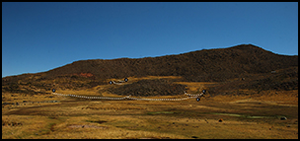
Northern Britain is one of a few areas in Western Europe over which the Roman Empire did not establish full control. In order to reassess the impact of Rome in this northernmost frontier, the new Leverhulme-funded project Beyond Walls is analysing the long-term transformation of settlement patterns in an area extending from south of Hadrian's Wall to north of the Antonine Wall. The results of a pilot study around Burnswark hillfort demonstrate the potential of such a landscape-based approach.
Coastal shell midden deposits are a quintessential component of the archaeological record on the Pacific Northwest Coast. Despite their importance in informing the cultural and environmental histories of Indigenous peoples, research on shell middens has largely not sought to address the physical extent of these cultural deposits, which requires estimating shape, depth, and volume. Here, we present a new scalable geospatial model, designed to work with legacy survey data, for estimating midden volumes based on applying a regular geometric solid to sites with known extent and depth. We evaluate the accuracy of this technique using percussion core, total station, and lidar data from eight sites in Tseshaht territory on western Vancouver Island and three sites on the north coast of British Columbia (Canada). As part of the evaluation process of our results, we calculate uncertainty using subsurface core depth data and then compare generalized and modeled midden volume estimates. We demonstrate an accurate general model applied at the regional scale across a systematically surveyed landscape. This work presents the first landscape-scale measure of midden extents and volume within our study area, with relevance to historical ecology and settlement patterns.
In this article, the authors examine radiocarbon, histo-taphonomic, and contextual evidence for the deliberate curation, manipulation, and redeposition of human bone in British Bronze Age mortuary contexts. New radiocarbon dates and histological analyses are combined with existing data to explore the processes and practices that resulted in the incorporation of ‘relic’ fragments of bone in later graves, including evidence for the deliberate re-opening of previous burials and for funerary treatments such as excarnation and mummification. In some cases, fragments of human bone were curated outside the mortuary context. The authors consider what the treatment of human remains reveals about mortuary complexity in the Bronze Age, about relations between the living and the dead, and about attitudes to the body and concepts of the self.
Yue gong qi shi 越公其事 is a recently published manuscript from the Tsinghua University collection. The manuscript provides a new version of the well-known story of King Goujian of Yue 越王句踐 (r. 496–464 b.c.e.), who turned defeat into victory and overcame Yue's formidable rival, the state of Wu 吳. My exploration of this text focuses on its two most notable aspects. First, the story about the policy of self-strengthening allegedly adopted by Goujian offers new insights into the evolution of political thought in the Warring States period. Second, the text allows deeper insight into the genre of didactic historical narratives that became prominent at a certain point of time between the Springs-and-Autumns (Chunqiu 春秋, 770–453 b.c.e.) and the Warring States (Zhanguo 戰國, 453–221 b.c.e.) periods.