To save content items to your account,
please confirm that you agree to abide by our usage policies.
If this is the first time you use this feature, you will be asked to authorise Cambridge Core to connect with your account.
Find out more about saving content to .
To save content items to your Kindle, first ensure no-reply@cambridge.org
is added to your Approved Personal Document E-mail List under your Personal Document Settings
on the Manage Your Content and Devices page of your Amazon account. Then enter the ‘name’ part
of your Kindle email address below.
Find out more about saving to your Kindle.
Note you can select to save to either the @free.kindle.com or @kindle.com variations.
‘@free.kindle.com’ emails are free but can only be saved to your device when it is connected to wi-fi.
‘@kindle.com’ emails can be delivered even when you are not connected to wi-fi, but note that service fees apply.
While a clear human presence may be recognised in the Andes by 12 000–11 000 cal BP, most archaeological research has focused on occupation of the Andean highlands. To understand the initial occupation of inland areas of South America, the authors consider regional connections and spatial exploitation strategies of hunter-gatherers highlighted in a recent survey of Andean sites. Focusing on north-central Chile, artefacts and radiocarbon dates from three rock shelters suggest sporadic and brief occupation during the Terminal Pleistocene–Early Holocene. Co-occurrence of marine and montane resources, the authors argue, demonstrates a strategy of high mobility and local adaptation in early Andean occupation, using rock shelters as landmarks to navigate and learn new landscapes.
Debate surrounds the early peopling of the Arabian Peninsula. The first evidence of the Levallois lithic technology in the Huqf area of south-eastern Arabia now extends the Middle Palaeolithic record of hominin activity into central Oman and helps to diversify the picture of Arabian prehistory.
Cuneiform tablets indicate the importance of textile manufacturing in the Bronze Age Old Assyrian Colony Period and Hittite Empire, yet the organic traces of this industry rarely survive. Two burnt textile fragments found at Beycesultan offer an unexpected insight into the Bronze Age textile industry in Anatolia. Here, the authors present the results of chromatographic and microscopic analyses that indicate one fragment was made from hemp using the nålbinding, or single-needle knitting, technique and was dyed with the woad or indigo plant, while the other was a natural tabby weave. Both add to our understanding of the diversity of textile production in the Bronze Age.
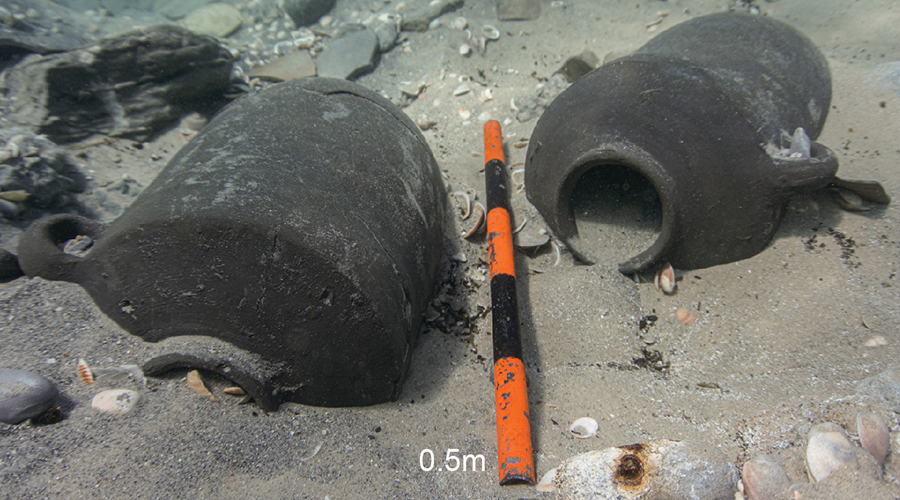
Cyprus, an island nation situated in the Eastern Mediterranean Sea, counts among the states that elected not to adopt the 2001 UNESCO Convention on the Protection of Underwater Cultural Heritage (henceforth: the 2001 UNESCO Convention), although recognizing its merits. With a coastline of 648 km, Cyprus’ seafloor holds an abundance of underwater cultural heritage. Despite that wealth, one searches in vain for a comprehensive study on the legal protection of its underwater cultural heritage. Instead, sporadic references to some of its provisions can be traced throughout the scholarly research surrounding the legal protection of underwater cultural heritage1 and maritime archaeology.2 Against this background, this article stands as the first thorough effort to reflect on Cyprus’ legal protection of its underwater cultural heritage.
Provincial coinage gives us a unique insight into the Roman world, reflecting the values and concerns of the elites of the many hundreds of cities in the Roman empire. Coins offer a very different perspective from written history, which usually represents the views of the senatorial class, and which was usually composed long after the events that are described. The coins, in contrast, provide evidence without hindsight, and uniquely allow a systematic examination across the whole Roman world. This volume makes it possible for instructors and students and scholars to deploy a complex set of material evidence on many historical topics. It includes over two hundred illustrations of coins with detailed captions, so providing a convenient sourcebook of the most important items, and covers topics such as the motivation for Roman conquest, the revolution of Augustus, the world of the Second Sophistic and the crisis of the third century.
This Element provides an overview of Aegeomania: the fascination, sometimes bordering on the obsession, with the Aegean Bronze Age, which manifests itself in the uses of Aegean Bronze Age material culture to create something new in literature, the visual and performing arts, and many other cultural practices. It discusses the role that Aegeomania can play in our understanding of the Aegean Bronze Age and illustrates this with examples from the 1870s to the present, which include, among many others, poems by Emma Lazarus, Salvatore Quasimodo, and Giorgos Seferis; novels by Kristmann Gudmundsson, Mary Renault, Don DeLillo, Zeruya Shalev, and Sally Rooney; Freudian psychoanalysis; sculptures by Henry Moore and Pablo Picasso; music by Harrison Birtwistle and the rock band Giant Squid; films by Robert Wise and Wolfang Petersen; elegant textiles and garments created by Josef Frank and Karl Lagerfeld. This title is also available as Open Access on Cambridge Core.
An exceptional Late Neolithic burial discovered at Puisserguier, southern France, contains a skeleton buried with its head deposited on its torso; the disposal of the rest of the body follows a standard pattern for individual burials of this period. The authors discuss the nature of this deposit in terms of its funerary status.
The provincial coinage was transformed during the new regime of Augustus and the adoption of his portrait. Roman interventions, however, were rare and localised, except for Nero.
The archaeological study of craft production investigates the role of household activities in broader social and political networks. In the Maya area, the production and distribution of ceramics, especially prestige ceramics including polychrome and fine ware pottery, relate to broader transformations in Maya society from the Classic to Terminal Classic periods. However, direct evidence for ceramic production in the form of kilns, workshops, or associated detritus can be elusive. We report the identification, excavation, and preliminary analysis of a large deposit of fine paste ceramics, including sherds representative of the Fine Orange and Fine Gray wares in the type-variety system of Maya ceramics, from a household group at the archaeological site of Benemérito de las Américas Primera Sección, located near the confluence of the Lacantún and Usumacinta Rivers. Discarded ceramics from this context exhibit several signs of overfiring consistent with pottery production. This deposit challenges notions of functional versus symbolic activity, as the members of this household used this deposit to dedicate a group of three burials accompanied by offerings including a figurine ensemble. We discuss the implications for this deposit in the context of economic shifts taking place across the Maya Lowlands during this period.
The diverse system of provincial city coinage saw the appearance of many personal names, including those of women, and the coinage was controlled mostly by the city elites.
Silver coinage developed accompanied by locally produced silver. Gold was introduced in the late first century bce. Both were reformed by Nero, and the system eventually collapsed.
The ideas of the Second Sophistic were reflected in Asia. A new method of production was introduced. Small denominations were discontinued. The cities struggled to recognise Hadrian’s lover Antinous.