To save content items to your account,
please confirm that you agree to abide by our usage policies.
If this is the first time you use this feature, you will be asked to authorise Cambridge Core to connect with your account.
Find out more about saving content to .
To save content items to your Kindle, first ensure no-reply@cambridge.org
is added to your Approved Personal Document E-mail List under your Personal Document Settings
on the Manage Your Content and Devices page of your Amazon account. Then enter the ‘name’ part
of your Kindle email address below.
Find out more about saving to your Kindle.
Note you can select to save to either the @free.kindle.com or @kindle.com variations.
‘@free.kindle.com’ emails are free but can only be saved to your device when it is connected to wi-fi.
‘@kindle.com’ emails can be delivered even when you are not connected to wi-fi, but note that service fees apply.
Archaeological research on pastoralism has mostly occurred within the silos of separate regionally specific traditions in the Middle East, Central Eurasia, North Africa, and East Africa. The common questions concerning pastoral ecologies and economies outlined in Chapter 6 and the social research agendas discussed in Chapter 7 open space for a more robust comparative archaeology of pastoralism across disparate regions and longer time spans.
Various biomolecular methods increasingly augment foundational methodologies for the study of pastoralism, including isotopic analyses, analyses of ancient human and animal DNA, identification of milk proteins, and residue analyses that identify animal carcass fat and milk fat. Although the results of biomolecular analyses can significantly expand the evidentiary basis for the archaeology of pastoralism and have in many ways revolutionized the field, they are not some sort of panacea that can easily solve all of the conceptual, interpretive, empirical, and disciplinary problems laid out in Chapter 1.
Twentieth-century scholars defined “pastoral nomadism” as an environmental adaptation inherently linked to specific political, social, and economic traits: long-distance mobility; tribalism, social egalitarianism, and dependence on sedentary agricultural communities; economic specialization in pastoralism; and “marginal” land. To resolve conceptual conflation and promote the writing of histories of pastoralism, archaeologists require a new framework that draws on anthropological ideas about mobility, political complexity, intensification of production, and pastoral landscapes.
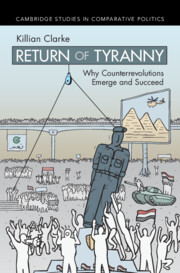
Why do some revolutions fail and succumb to counterrevolutions, whereas others go on to establish durable rule? Marshalling original data on counterrevolutions worldwide since 1900 and new evidence from the reversal of Egypt's 2011 revolution, Killian Clarke explains both why counterrevolutions emerge and when they are likely to succeed. He forwards a movement-centric argument that emphasizes the strategies revolutionary leaders embrace both during their opposition campaigns and after they seize power. Movements that wage violent resistance and espouse radical ideologies establish regimes that are very difficult to overthrow. By contrast, democratic revolutions like Egypt's are more vulnerable, though Clarke also identifies a path by which they too can avoid counterrevolution. By preserving their elite coalitions and broad popular support, these movements can return to mass mobilization to thwart counterrevolutionary threats. In an era of resurgent authoritarianism worldwide, Return of Tyranny sheds light on one particularly violent form of reactionary politics.
This article examines the recent transformation of marriage rituals in Turkey from the perspective of young brides. Based on ethnographic research conducted in Istanbul and Bursa in 2017–19, it discusses how young women construct their marital imaginaries through extravagant ceremonies and festivities such as proposals, photographs, henna nights, and weddings. Drawing from the theory of ritual economy, the article argues that their gendered desire for lavish spending does not position brides as victims of either traditional Turkish customs or the consumer market. Rather, the article emphasizes young women’s aspirations to romance and a sense of uniqueness, and their desire to feel as if they are “living a fairy tale.” These bridal imaginaries reflect the rise of neoliberal individualism, upward social mobility, and status-seeking in Bourdieu’s sense. The article’s findings contribute to the hitherto limited scholarship on changing marriage rituals and the wedding industry in Turkey.
Leaders abounded in the ancient world, from kings, pharaohs, emperors, tyrants, politicians, and orators to generals, minor officials and intellectuals. This book opens fresh perspectives on leadership by examining under-explored topics, posing new questions and revisiting old concepts. In particular, it seeks to shift attention from constitutional issues stricto sensu (such as kingship, monarchy, tyranny, etc.) or, more productively, to prompt a re-examination of these issues through the lens of leadership. The volume includes chapters on a range of cultures from across the ancient world in order to promote comparative reflection. Key questions include whether some models of good and bad leadership were universal among ancient cultures or exhibited differences? Why did a certain culture emphasise one leadership quality while another insisted on another? Why did only some cultures develop a theoretical discourse on leadership? How did each culture appropriate, define, redefine (or react) to existing concepts of leadership?
Palestinian doctors became a dynamic, vocal, influential, and fascinating professional community over the first half of the twentieth century, growing from roughly a dozen on the eve of World War I to 300 in 1948. This study examines the social history of this group during the late Ottoman and British Mandate periods, examining their social and geographic origins, their professional academic training outside Palestine, and their role and agency in the country's medical market. Yoni Furas and Liat Kozma examine doctors' interactions with the rural and urban society and their entangled relationship with the British colonial administration and Jewish doctors. This book also provides an in-depth description of how Palestinian doctors thought and wrote about themselves and their personal, professional, and collective ambitions, underlining the challenges they faced while attempting to unionize. Furas and Kozma tell Palestine's story through the acts and challenges of these doctors, writing them back into the local and regional history.
The Introduction begins with a description of the final days in the life of Sofia’s main thermal bath that in 1913 stood in the city’s historic center as the last representative of the Ottoman approach to place-making. I show how the decision to demolish one of the structures most characteristic of Sofia’s Ottoman experience cleared the path for the formulation of the national narrative of Sofia’s history. The narrative that still dominates both the scholarly and popular ideas of Sofia’s urbanistic identity is based on an ideologically biased interpretation of the Ottoman understanding of urban space, natural resource management, and public works. In the Introduction, I argue that Sofia’s key position within the Ottoman political and institutional landscapes as well as its role as a hub of cultural and technological exchange make the study of its history a good vantage point for overcoming the artificial spatial boundaries that still divide the research of the European, Asian, and African provinces of the Ottoman Empire. The Introduction shows how the environmental characteristics of Sofia and the Sofia plain make water the most natural and effective thematic pivot for the study of the construction and historical evolution of space and place.
This chapter continues the story of Sofia’s water supply, beginning with the political turmoil that marred urban fabrics and economies across the Ottoman Balkans from the 1790s to the 1820s and ending in 1912 when, after a long series of failed attempts, post-Ottoman Sofia received its first modern water supply system. I emphasize the similarity in the predicaments that shaped the Ottoman and Bulgarian policies in the fields of urban planning, underground infrastructures, and natural resource management. I explain how a series of extreme human-made and natural phenomena, including banditry, war, and intensified seismicity limited the capabilities of the Ottoman authorities to accomplish their modernizing intentions. In post-Ottoman Bulgaria, the modernization of urban fabrics was seen as a statement of the superiority of the nation-state over its former imperial master. However, in a series of attempts to meet the water needs of the national capital’s constantly expanding population, the post-Ottoman authorities found themselves continually unable to come up with solutions superior to the water supply practices of their predecessors. The chapter argues that throughout the long nineteenth century Sofia’s water supply functioned within the bounds of the system established by the Ottomans.
This paper examines Sadeq Hedayat's The Blind Owl through the lens of récit, focusing on the non-linear structure and elusive nature of the narrative. By analyzing the fluidity of time, space, and identity, the study argues that the seeming narrative flaws – including the instability of characters and shifting perspectives – are deliberate artistic strategies. Central to this reading is the concept of barzakh, the in-between state, which frames the narrator's ongoing struggle to navigate the boundaries between life and death, reality and imagination. The narrator's inability to fully express himself through art reflects this tension, as each attempt to articulate his vision reveals the inadequacy of language and the inherent impossibility of fully capturing the essence of life in art. The récit form reinforces this theme by immersing the reader in an unfinished, ever-shifting narrative, where meaning remains just beyond reach. This study highlights the importance of reading The Blind Owl as a récit to better understand its existential exploration and critique of the artist's role in grappling with the unknown.