Refine search
Actions for selected content:
7008 results in Algorithmics, Complexity, Computer Algebra, Computational Geometry
Revolutionaries and Spies on Random Graphs
-
- Journal:
- Combinatorics, Probability and Computing / Volume 22 / Issue 3 / May 2013
- Published online by Cambridge University Press:
- 08 March 2013, pp. 417-432
-
- Article
- Export citation
Distributions of Order Patterns of Interval Maps
-
- Journal:
- Combinatorics, Probability and Computing / Volume 22 / Issue 3 / May 2013
- Published online by Cambridge University Press:
- 05 March 2013, pp. 319-341
-
- Article
- Export citation
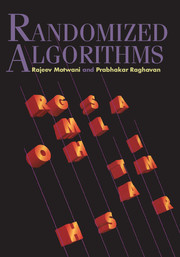
Randomized Algorithms
-
- Published online:
- 05 March 2013
- Print publication:
- 25 August 1995
Towards a Weighted Version of the Hajnal–Szemerédi Theorem
-
- Journal:
- Combinatorics, Probability and Computing / Volume 22 / Issue 3 / May 2013
- Published online by Cambridge University Press:
- 28 February 2013, pp. 346-350
-
- Article
- Export citation
-
For a positive integer r ≥ 2, a Kr-factor of a graph is a collection vertex-disjoint copies of Kr which covers all the vertices of the given graph. The celebrated theorem of Hajnal and Szemerédi asserts that every graph on n vertices with minimum degree at least
 $(1-\frac{1}{r})n contains a Kr-factor. In this note, we propose investigating the relation between minimum degree and existence of perfect Kr-packing for edge-weighted graphs. The main question we study is the following. Suppose that a positive integer r ≥ 2 and a real t ∈ [0, 1] is given. What is the minimum weighted degree of Kn that guarantees the existence of a Kr-factor such that every factor has total edge weight at least
  $$t\binom{r}{2}$?$ We provide some lower and upper bounds and make a conjecture on the asymptotics of the threshold as n goes to infinity.


The Size of the Largest Part of Random Weighted Partitions of Large Integers
-
- Journal:
- Combinatorics, Probability and Computing / Volume 22 / Issue 3 / May 2013
- Published online by Cambridge University Press:
- 21 February 2013, pp. 433-454
-
- Article
- Export citation
On the Independence Number of Steiner Systems
-
- Journal:
- Combinatorics, Probability and Computing / Volume 22 / Issue 2 / March 2013
- Published online by Cambridge University Press:
- 30 January 2013, pp. 241-252
-
- Article
- Export citation
-
A partial Steiner (n,r,l)-system is an r-uniform hypergraph on n vertices in which every set of l vertices is contained in at most one edge. A partial Steiner (n,r,l)-system is complete if every set of l vertices is contained in exactly one edge. In a hypergraph

 $$\alpha(\HH) \lesssim \biggl(\frac{l-1}{r-1}(r)_l\biggr)^{\frac{1}{r-1}}n^{\frac{r-l}{r-1}} (\log n)^{\frac{1}{r-1}} \quad \mbox{ as }n \rightarrow \infty.$$

CPC volume 22 issue 2 Cover and Front matter
-
- Journal:
- Combinatorics, Probability and Computing / Volume 22 / Issue 2 / March 2013
- Published online by Cambridge University Press:
- 30 January 2013, pp. f1-f2
-
- Article
-
- You have access
- Export citation
CPC volume 22 issue 2 Cover and Back matter
-
- Journal:
- Combinatorics, Probability and Computing / Volume 22 / Issue 2 / March 2013
- Published online by Cambridge University Press:
- 30 January 2013, pp. b1-b6
-
- Article
-
- You have access
- Export citation
The Maximum Displacement for Linear Probing Hashing
-
- Journal:
- Combinatorics, Probability and Computing / Volume 22 / Issue 3 / May 2013
- Published online by Cambridge University Press:
- 24 January 2013, pp. 455-476
-
- Article
- Export citation
A New Bound for the 2/3 Conjecture†
-
- Journal:
- Combinatorics, Probability and Computing / Volume 22 / Issue 3 / May 2013
- Published online by Cambridge University Press:
- 23 January 2013, pp. 384-393
-
- Article
- Export citation
The Compensation Approach for Walks With Small Steps in the Quarter Plane
-
- Journal:
- Combinatorics, Probability and Computing / Volume 22 / Issue 2 / March 2013
- Published online by Cambridge University Press:
- 11 January 2013, pp. 161-183
-
- Article
- Export citation
-
This paper is the first application of the compensation approach (a well-established theory in probability theory) to counting problems. We discuss how this method can be applied to a general class of walks in the quarter plane
 in the interior of
 \[ \{(-1,1),(-1,0),(-1,-1),(0,-1),(1,-1)\}\]

Tight Bounds on the Optimization Time of a Randomized Search Heuristic on Linear Functions†
-
- Journal:
- Combinatorics, Probability and Computing / Volume 22 / Issue 2 / March 2013
- Published online by Cambridge University Press:
- 09 January 2013, pp. 294-318
-
- Article
- Export citation
Expanders Are Universal for the Class of All Spanning Trees
-
- Journal:
- Combinatorics, Probability and Computing / Volume 22 / Issue 2 / March 2013
- Published online by Cambridge University Press:
- 03 January 2013, pp. 253-281
-
- Article
- Export citation
-
A graph is called universal for a given graph class


On characteristic formulae for Event-Recording Automata∗
-
- Journal:
- RAIRO - Theoretical Informatics and Applications / Volume 47 / Issue 1 / January 2013
- Published online by Cambridge University Press:
- 10 January 2013, pp. 69-96
- Print publication:
- January 2013
-
- Article
- Export citation
Some results on complexity of μ-calculusevaluation in the black-box model∗
-
- Journal:
- RAIRO - Theoretical Informatics and Applications / Volume 47 / Issue 1 / January 2013
- Published online by Cambridge University Press:
- 10 January 2013, pp. 97-109
- Print publication:
- January 2013
-
- Article
- Export citation
Strong functors and interleaving fixpoints in gamesemantics∗
-
- Journal:
- RAIRO - Theoretical Informatics and Applications / Volume 47 / Issue 1 / January 2013
- Published online by Cambridge University Press:
- 10 January 2013, pp. 25-68
- Print publication:
- January 2013
-
- Article
- Export citation
A non-uniform finitary relational semantics of systemT∗
-
- Journal:
- RAIRO - Theoretical Informatics and Applications / Volume 47 / Issue 1 / January 2013
- Published online by Cambridge University Press:
- 10 January 2013, pp. 111-132
- Print publication:
- January 2013
-
- Article
- Export citation
Avoiding Arrays of Odd Order by Latin Squares
-
- Journal:
- Combinatorics, Probability and Computing / Volume 22 / Issue 2 / March 2013
- Published online by Cambridge University Press:
- 21 December 2012, pp. 184-212
-
- Article
- Export citation
Asymptotic Normality Through Factorial Cumulants and Partition Identities
-
- Journal:
- Combinatorics, Probability and Computing / Volume 22 / Issue 2 / March 2013
- Published online by Cambridge University Press:
- 21 December 2012, pp. 213-240
-
- Article
- Export citation
Optimal Packings of Hamilton Cycles in Graphs of High Minimum Degree
-
- Journal:
- Combinatorics, Probability and Computing / Volume 22 / Issue 3 / May 2013
- Published online by Cambridge University Press:
- 20 December 2012, pp. 394-416
-
- Article
- Export citation
