Refine search
Actions for selected content:
178625 results in Earth and Environmental Sciences
Introduction
-
- Journal:
- Radiocarbon / Volume 66 / Issue 6 / December 2024
- Published online by Cambridge University Press:
- 22 January 2025, pp. 1469-1480
- Print publication:
- December 2024
-
- Article
-
- You have access
- HTML
- Export citation
RDC volume 66 issue 6 Cover and Back matter
-
- Journal:
- Radiocarbon / Volume 66 / Issue 6 / December 2024
- Published online by Cambridge University Press:
- 22 January 2025, pp. b1-b2
- Print publication:
- December 2024
-
- Article
-
- You have access
- Export citation
RDC volume 66 issue 6 Cover and Front matter
-
- Journal:
- Radiocarbon / Volume 66 / Issue 6 / December 2024
- Published online by Cambridge University Press:
- 22 January 2025, pp. f1-f6
- Print publication:
- December 2024
-
- Article
-
- You have access
- Export citation

Ethics and the Environment
- An Introduction
-
- Published online:
- 29 November 2024
- Print publication:
- 28 November 2024
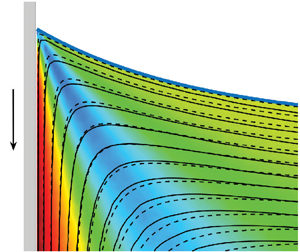
An experimental study of flow near an advancing contact line: a rigorous test of theoretical models
-
- Journal:
- Journal of Fluid Mechanics / Volume 1000 / 10 December 2024
- Published online by Cambridge University Press:
- 29 November 2024, A45
-
- Article
- Export citation
-
The flow near a moving contact line depends on the dynamic contact angle, viscosity ratio and capillary number. We report experiments involving immersing a plate into a liquid bath, concurrently measuring the interface shape, interfacial velocity and fluid flow using digital image processing and particle image velocimetry. All experiments were performed at low plate speeds to maintain small Reynolds and capillary numbers for comparison with viscous theories. The dynamic contact angle, measured in the viscous phase, was kept below $90^{\circ }$ and the viscosity ratio, $\lambda < 1$. This region of parameter space is largely unexplored for advancing contact lines. An important aim of the present study is to provide new experimental data against which new contact line models can be developed. The flow field is directly compared against the prediction from the viscous theory of Huh & Scriven (J. Colloid Interface Sci., vol. 35, issue 1, 1971, pp. 85–101) but with a slight modification involving the curved interface. Remarkable agreement is found between experiments and theory across a wide parameter range. The prediction for interfacial speed from Huh & Scriven is also in excellent agreement with experiments except in the vicinity of the contact line. Material points along the interface were found to rapidly slow down near the contact line, thus alleviating the singularity at the moving contact line. To the best of our knowledge, such a detailed test of theoretical models has not been performed before and we hope the present study will spur new modelling efforts in the field.


Detrital U-Pb ages for the first well-preserved vascular plant Cooksonia from the UK and Irish macrofossil record.
-
- Journal:
- Geological Magazine / Volume 161 / 2024
- Published online by Cambridge University Press:
- 29 November 2024, e19
-
- Article
-
- You have access
- Open access
- HTML
- Export citation
Fluvial-lacustrine interactions in the Marginal Triassic, Clevedon, Bristol Channel Basin, UK: deposition, dolomitization and silicification
-
- Journal:
- Geological Magazine / Volume 161 / 2024
- Published online by Cambridge University Press:
- 29 November 2024, e18
-
- Article
-
- You have access
- Open access
- HTML
- Export citation

A recursive neural-network-based subgrid-scale model for large eddy simulation: application to homogeneous isotropic turbulence
- Part of
-
- Journal:
- Journal of Fluid Mechanics / Volume 1000 / 10 December 2024
- Published online by Cambridge University Press:
- 29 November 2024, A76
-
- Article
-
- You have access
- Open access
- HTML
- Export citation

The Cambridge Handbook of Hydrogen and the Law
-
- Published online:
- 28 November 2024
- Print publication:
- 28 November 2024
-
- Book
-
- You have access
- Open access
- Export citation

General Post-Newtonian Orbital Effects
- From Earth's Satellites to the Galactic Centre
-
- Published online:
- 28 November 2024
- Print publication:
- 05 December 2024
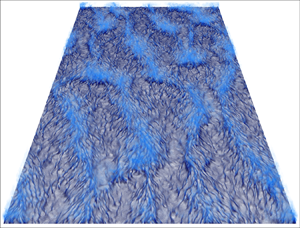
Scaling relations for heat and momentum transport in sheared Rayleigh–Bénard convection
- Part of
-
- Journal:
- Journal of Fluid Mechanics / Volume 1000 / 10 December 2024
- Published online by Cambridge University Press:
- 28 November 2024, A74
-
- Article
-
- You have access
- Open access
- HTML
- Export citation
-
We provide scaling relations for the Nusselt number $Nu$ and the friction coefficient $C_{S}$ in sheared Rayleigh–Bénard convection, i.e. in Rayleigh–Bénard flow with Couette- or Poiseuille-type shear forcing, by extending the Grossmann & Lohse (J. Fluid Mech., vol. 407, 2000, pp. 27–56, Phys. Rev. Lett., vol. 86, 2001, pp. 3316–3319, Phys. Rev. E, vol. 66, 2002, 016305, Phys. Fluids, vol. 16, 2004, pp. 4462–4472) theory to sheared thermal convection. The control parameters for these systems are the Rayleigh number $Ra$, the Prandtl number $Pr$ and the Reynolds number $Re_S$ that characterises the strength of the imposed shear. By direct numerical simulations and theoretical considerations, we show that, in turbulent Rayleigh–Bénard convection, the friction coefficients associated with the applied shear and the shear generated by the large-scale convection rolls are both well described by Prandtl's (Ergeb. Aerodyn. Vers. Gött., vol. 4, 1932, pp. 18–29) logarithmic friction law, suggesting some kind of universality between purely shear-driven flows and thermal convection. These scaling relations hold well for $10^6 \leq Ra \leq 10^8$, $0.5 \leq Pr \leq 5.0$, and $0 \leq Re_S \leq 10^4$.


Wake dynamics of wind turbines in unsteady streamwise flow conditions
-
- Journal:
- Journal of Fluid Mechanics / Volume 1000 / 10 December 2024
- Published online by Cambridge University Press:
- 28 November 2024, A66
-
- Article
-
- You have access
- Open access
- HTML
- Export citation
6 - Hydrogen Regulation in the Middle East and North Africa Region
- from Part I - Current Hydrogen Regulation on the Continents
-
-
- Book:
- The Cambridge Handbook of Hydrogen and the Law
- Published online:
- 28 November 2024
- Print publication:
- 28 November 2024, pp 84-97
-
- Chapter
-
- You have access
- Open access
- HTML
- Export citation
Index
-
- Book:
- The Cambridge Handbook of Hydrogen and the Law
- Published online:
- 28 November 2024
- Print publication:
- 28 November 2024, pp 313-316
-
- Chapter
-
- You have access
- Open access
- HTML
- Export citation
5 - Climate Networks to the Rescue? Exploring Stakeholder Perceptions of the Effectiveness of Collaborative Climate Governance
-
-
- Book:
- The Politics and Governance of Decarbonization
- Published online:
- 05 December 2024
- Print publication:
- 28 November 2024, pp 96-118
-
- Chapter
-
- You have access
- Open access
- HTML
- Export citation
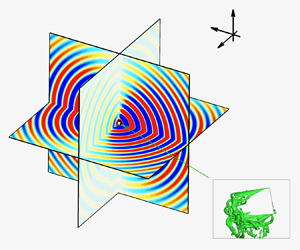
The evolution of vortices determines the aeroacoustics generated by a hovering wing
-
- Journal:
- Journal of Fluid Mechanics / Volume 1000 / 10 December 2024
- Published online by Cambridge University Press:
- 28 November 2024, A70
-
- Article
- Export citation
-
The effects of the evolution of vortices on the aeroacoustics generated by a hovering wing are numerically investigated by using a hybrid method of an immersed boundary–finite difference method for the three-dimensional incompressible flows and a simplified model based on the Ffowcs Williams-Hawkings acoustic analogy. A low-aspect-ratio ( $AR=1.5$) rectangular wing at low Reynolds ( $Re=1000$) and Mach ( $M=0.04$) numbers is investigated. Based on the simplified model, the far-field acoustics is shown to be dominated by the time derivative of the pressure on the wing surface. Results show that vortical structure evolution in the flow fields, which is described by the divergence of the convection term of the incompressible Navier–Stokes equations in a body-fixed reference frame, determines the time derivative of the surface pressure and effectively the far-field acoustics. It dominates over the centrifugal acceleration and Coriolis acceleration terms in determining the time derivative of the surface pressure. The position of the vortex is also found to affect the time derivative of the surface pressure. A scaling analysis reveals that the vortex acoustic source is scaled with the cube of the flapping frequency.


9 - California Conflicts
-
- Book:
- Ethics and the Environment
- Published online:
- 29 November 2024
- Print publication:
- 28 November 2024, pp 180-197
-
- Chapter
- Export citation
Contents
-
- Book:
- Ethics and the Environment
- Published online:
- 29 November 2024
- Print publication:
- 28 November 2024, pp vii-ix
-
- Chapter
- Export citation
19 - The Regulation of Hydrogen Storage as End Use
- from Part V - End Use of Hydrogen
-
-
- Book:
- The Cambridge Handbook of Hydrogen and the Law
- Published online:
- 28 November 2024
- Print publication:
- 28 November 2024, pp 277-290
-
- Chapter
-
- You have access
- Open access
- HTML
- Export citation
Copyright page
-
- Book:
- The Politics and Governance of Decarbonization
- Published online:
- 05 December 2024
- Print publication:
- 28 November 2024, pp iv-iv
-
- Chapter
-
- You have access
- Open access
- HTML
- Export citation
