Refine search
Actions for selected content:
178625 results in Earth and Environmental Sciences
7 - Hydrogen Regulation in Southeast Asia
- from Part I - Current Hydrogen Regulation on the Continents
-
-
- Book:
- The Cambridge Handbook of Hydrogen and the Law
- Published online:
- 28 November 2024
- Print publication:
- 28 November 2024, pp 98-112
-
- Chapter
-
- You have access
- Open access
- HTML
- Export citation
Part IV - Regulating Hydrogen Transport
-
- Book:
- The Cambridge Handbook of Hydrogen and the Law
- Published online:
- 28 November 2024
- Print publication:
- 28 November 2024, pp 215-260
-
- Chapter
-
- You have access
- Open access
- HTML
- Export citation
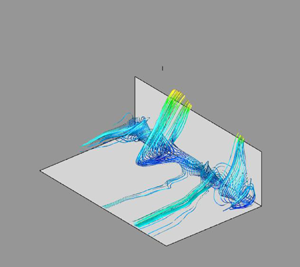
Low-dimensional analysis and modelling of the flow over a forward-facing step
-
- Journal:
- Journal of Fluid Mechanics / Volume 1000 / 10 December 2024
- Published online by Cambridge University Press:
- 28 November 2024, A69
-
- Article
- Export citation
13 - How to Build Your Own Electrolyser
- from Part III - Regulating Hydrogen Production
-
-
- Book:
- The Cambridge Handbook of Hydrogen and the Law
- Published online:
- 28 November 2024
- Print publication:
- 28 November 2024, pp 189-200
-
- Chapter
-
- You have access
- Open access
- HTML
- Export citation
Contributors
-
- Book:
- The Politics and Governance of Decarbonization
- Published online:
- 05 December 2024
- Print publication:
- 28 November 2024, pp x-x
-
- Chapter
-
- You have access
- Open access
- HTML
- Export citation
Tables
-
- Book:
- The Cambridge Handbook of Hydrogen and the Law
- Published online:
- 28 November 2024
- Print publication:
- 28 November 2024, pp xiii-xiv
-
- Chapter
-
- You have access
- Open access
- HTML
- Export citation
Copyright page
-
- Book:
- Ethics and the Environment
- Published online:
- 29 November 2024
- Print publication:
- 28 November 2024, pp iv-iv
-
- Chapter
- Export citation
Table
-
- Book:
- Ethics and the Environment
- Published online:
- 29 November 2024
- Print publication:
- 28 November 2024, pp xi-xii
-
- Chapter
- Export citation
Dedication
-
- Book:
- Ethics and the Environment
- Published online:
- 29 November 2024
- Print publication:
- 28 November 2024, pp v-v
-
- Chapter
- Export citation
4 - Politics and Governance of Sweden’s Transformation toward a Fossil-Free Welfare State
-
-
- Book:
- The Politics and Governance of Decarbonization
- Published online:
- 05 December 2024
- Print publication:
- 28 November 2024, pp 63-95
-
- Chapter
-
- You have access
- Open access
- HTML
- Export citation

Parameterized Ekman boundary layers on the tilted f-plane
-
- Journal:
- Journal of Fluid Mechanics / Volume 1000 / 10 December 2024
- Published online by Cambridge University Press:
- 28 November 2024, A61
-
- Article
-
- You have access
- Open access
- HTML
- Export citation
-
Rotating convection is considered on the tilted $f$-plane where gravity and rotation are not aligned. For sufficiently large rotation rates, $\Omega$, the Taylor–Proudman effect results in the gyroscopic alignment of anisotropic columnar structures with the rotation axis giving rise to rapidly varying radial length scales that vanishes as $\Omega ^{-1/3}$ for $\Omega \rightarrow \infty$. Compounding this phenomenon is the existence of viscous (Ekman) layers adjacent to the impenetrable bounding surfaces that scale as $\Omega ^{-1/2}$. In this investigation, these constraints are relaxed upon utilising a non-orthogonal coordinate representation of the fluid equations where the upright coordinate aligns with rotation axis. This exposes the problem to asymptotic perturbation methods that permit: (i) relaxation of the constraints of gyroscopic alignment; (ii) the filtering of Ekman layers through the uncovering of parameterised velocity pumping boundary conditions; and (iii) the development of reduced quasi-geostrophic systems valid in the limit $\Omega \rightarrow \infty$. Linear stability investigations reveal excellent quantitative agreement between results from parameterised or unapproximated mechanical boundary conditions. For no-slip boundaries, it is demonstrated that the associated Ekman pumping alters convective onset through an enhanced destabilisation of large spatial scales. The range of unstable modes at a fixed thermal forcing is thus significantly extended with a direct dependence on $\Omega$. This holds true even for geophysical and astrophysical regimes characterised by extreme values of the non-dimensional Ekman number $E$. The nonlinear regime is explored via the global heat and momentum transport of single-mode solutions to the quasi-geostrophic systems which indicate $O(1)$ changes which do not scale with the size of $E$.
$E$.


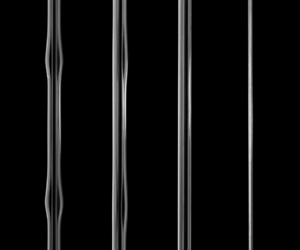
Suppressing capillary instability in falling liquid threads
-
- Journal:
- Journal of Fluid Mechanics / Volume 1000 / 10 December 2024
- Published online by Cambridge University Press:
- 28 November 2024, A77
-
- Article
-
- You have access
- Open access
- HTML
- Export citation
-
A cylindrical liquid thread readily destabilizes into a series of drops due to capillary instability, which is also responsible for undesirable bead-on-fibre structures observed when coating a thin fibre. In this experimental study, we show how a falling liquid thread can be stabilized by internally distorting the cross-sectional shape using two vertically hung fibres. Below a critical flow rate $Q_c$, the dual-fibre system deforms the falling thread into a smooth column with a non-circular cross-section, thereby suppressing instability. Above $Q_{{c}}$, the cylindrical thread is left undeformed by the fibres and destabilizes into beads connected by a stable, non-cylindrical film. An empirical stability threshold is identified showing that flow delays the onset of capillary instability when compared with a marginally stable quasi-static coating. When the flow is unstable $Q>Q_c$, the bead velocity $v$ obeys a simple scaling law that is well supported by our experiments over a large parameter range. This suppression technique can be extended to other slender geometries, such as a ribbon, which shows similar qualitative results but exhibits a different stability threshold due to spontaneous dewetting about its short edge.


18 - The Regulation of Hydrogen in the Transport Sector
- from Part V - End Use of Hydrogen
-
-
- Book:
- The Cambridge Handbook of Hydrogen and the Law
- Published online:
- 28 November 2024
- Print publication:
- 28 November 2024, pp 263-276
-
- Chapter
-
- You have access
- Open access
- HTML
- Export citation
14 - Giving Hydrogen the Green Light and Putting It on the Fast-Track?
- from Part III - Regulating Hydrogen Production
-
-
- Book:
- The Cambridge Handbook of Hydrogen and the Law
- Published online:
- 28 November 2024
- Print publication:
- 28 November 2024, pp 201-214
-
- Chapter
-
- You have access
- Open access
- HTML
- Export citation
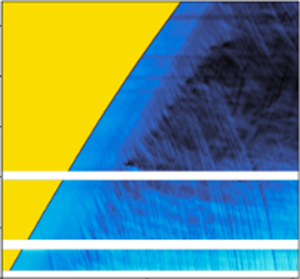
Exchange flows and plug cementing
-
- Journal:
- Journal of Fluid Mechanics / Volume 1000 / 10 December 2024
- Published online by Cambridge University Press:
- 28 November 2024, A67
-
- Article
-
- You have access
- Open access
- HTML
- Export citation
-
We present the results of an experimental study of buoyancy-driven exchange flows in a vertical pipe, where the lower fluid is Newtonian of low viscosity and the upper fluid has a yield stress. The fluids are initially separated by a gate valve, opened at time $\hat {t}=0$. The fluids are miscible, but away from the diffusive limit. For a sufficiently large ratio $Y$, of the yield stress to the buoyancy stress, no sustained fluid motions arise: the flow is stable. For smaller $Y$ numbers an exchange flow results. Commonly, the less dense fluid penetrates upwards in a central finger, displacing the upper fluid downwards around the walls of the pipe. Three regimes are classified: helical finger, disconnected finger and slug flow. The transition between regimes is governed by increasing relevance of inertial to viscous stresses, in balancing buoyancy. The disconnected finger and slug flow regimes are associated with yielded fluid at the interface and early growth of instabilities. Helical fingers are viscous dominated and evolve slowly until late in the experiments. The scenarios studied represent an idealised set-up for the industrial process of plug cementing. The regimes identified are helpful for industrial process design.


11 - Public Participation in the Hydrogen Economy
- from Part II - Regulating Hydrogen Markets
-
-
- Book:
- The Cambridge Handbook of Hydrogen and the Law
- Published online:
- 28 November 2024
- Print publication:
- 28 November 2024, pp 158-170
-
- Chapter
-
- You have access
- Open access
- HTML
- Export citation
5 - Hydrogen Regulation in Oceania
- from Part I - Current Hydrogen Regulation on the Continents
-
-
- Book:
- The Cambridge Handbook of Hydrogen and the Law
- Published online:
- 28 November 2024
- Print publication:
- 28 November 2024, pp 65-83
-
- Chapter
-
- You have access
- Open access
- HTML
- Export citation
1 - Introduction: State and Non-state Relations in Governing toward Decarbonization
-
-
- Book:
- The Politics and Governance of Decarbonization
- Published online:
- 05 December 2024
- Print publication:
- 28 November 2024, pp 1-17
-
- Chapter
-
- You have access
- Open access
- HTML
- Export citation
4 - Normative Ethics
-
- Book:
- Ethics and the Environment
- Published online:
- 29 November 2024
- Print publication:
- 28 November 2024, pp 66-86
-
- Chapter
- Export citation
Contents
-
- Book:
- The Cambridge Handbook of Hydrogen and the Law
- Published online:
- 28 November 2024
- Print publication:
- 28 November 2024, pp vii-x
-
- Chapter
-
- You have access
- Open access
- HTML
- Export citation
