Refine search
Actions for selected content:
178625 results in Earth and Environmental Sciences
Energetics of particle-size segregation
-
- Journal:
- Journal of Fluid Mechanics / Volume 1000 / 10 December 2024
- Published online by Cambridge University Press:
- 27 November 2024, A50
-
- Article
-
- You have access
- Open access
- HTML
- Export citation
-
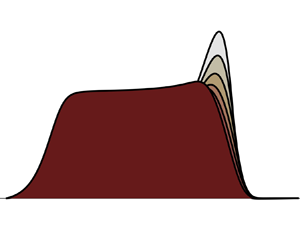
We introduce a continuum framework for the energetics of particle-size segregation in bidisperse granular flows. Building on continuum segregation equations and a recent segregation flux model, the proposed framework offers general analytical expressions to study the physics of granular flows from a mechanical energy perspective. We demonstrate the framework's applicability by examining the energetics of shear-driven granular flows. Numerical experiments with varying frictional coefficients and particle-size ratios reveal two distinct phases in the energetics, marked by the separate onset of particle segregation and diffusive remixing. Furthermore, our numerical simulations alongside previous experimental results show that the bulk Richardson number $Ri$, defined as the potential energy to kinetic energy ratio at steady state, follows the scaling relationship $Ri\equiv \hat {E}^{(s)}_{gp} / \hat {E}^{(s)}_{k} \propto Pe^{-1/2}_{sr}$ for $0.1 \leq Ri\leq ~10^{3}$ and $10^{-4} \leq Pe_{sr} \leq ~300$, the segregation–rheology Péclet number. Finally, we present a Péclet-number-dependent theoretical expression for the degree of mixing (or segregation), validated by the compiled numerical and experimental dataset. Our findings hint that the bulk segregation–mixing state can be predicted and controlled using the segregation Péclet number $Pe$ and $Pe_{sr}$, both determined from known system parameters, providing an instrumental tool for engineering and geophysical applications.


Turbulent flow of non-Newtonian fluid in rough channels
-
- Journal:
- Journal of Fluid Mechanics / Volume 1000 / 10 December 2024
- Published online by Cambridge University Press:
- 27 November 2024, A55
-
- Article
- Export citation
-
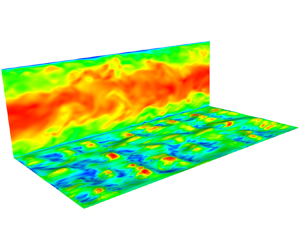
Direct numerical simulations of the turbulence of a Herschel–Bulkley (HB) fluid in a rough channel are performed at a shear Reynolds number $Re_{\tau } \approx 300$ and a Bingham number ${Bn} \approx 0.9$. For the type of rough surface used in this study, the results indicate that Townsend's wall similarity hypothesis also holds for HB fluids. However, there are notable differences compared with the effect of roughness on Newtonian fluids. More specifically, the effect of roughness appears to be slightly stronger for HB fluids, in the sense that the bulk Reynolds number, based on the viscosity at the wall, is reduced further due to the increase in viscosity in the troughs of the roughness surface induced by the low shear. At the same time, for the simulated rough surface, the contribution of form drag to the total pressure drop is reduced from 1/4 to about 1/5 due to the persistence of viscous shear in the boundary layer, reducing its shielding effect. As for the friction factor, due to the nonlinearity of the HB constitutive relation, its use with the wall shear rate from the mean wall shear stress underpredicts the minimum viscosity at the wall by up to 18 %. This inevitably leads to uncertainties in the prediction of the friction factor. Finally, it is observed that the rough surface is unable to break the peculiar near-wall flow structure of HB fluids, which consists of long persistent low-speed streaks occupying the entire domain. This means that the small-scale energy is significantly reduced for HB fluids, even in rough channels, with the energy more concentrated in the lower wavenumber range, implying an increase in the slope of the power spectrum to $-7/2$ in the inertial range, as shown by Mitishita et al. (J. Non-Newtonian Fluid Mech., vol. 293, 2021, 104570).


Path instabilities of freely falling oblong cylinders
-
- Journal:
- Journal of Fluid Mechanics / Volume 1000 / 10 December 2024
- Published online by Cambridge University Press:
- 27 November 2024, A54
-
- Article
- Export citation
-
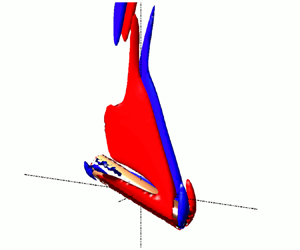
This paper presents numerical simulations of the free fall of homogenous cylinders of length-to-diameter ratios $2$,
$2$,  $3$ and 5 and solid-to-fluid-density ratios $\rho _s/\rho$ going from 0 to 10 in transitional regimes. The path instabilities are shown to be due to two types of transitional states. The well-known fluttering state is a solid mode, characterised by significant oscillations of the cylinder axis due to a strong interaction between the vortex shedding in the wake and the solid degrees of freedom. Weakly oscillating, mostly irregular trajectories, are fluid modes, associated with purely fluid instabilities in the wake. The interplay of solid and fluid modes leads to a varying scenario in which the length-to-diameter and density ratios play an important role. The description is accompanied by the presentation of the identified transitional states in terms of path characteristics and vorticity structure of the wakes and by bifurcation diagrams showing the evolution of asymptotic states with increasing Galileo numbers. There appears to be a strong difference between the behaviour of cylinders of aspect ratio $L/d=3$ and 5. A similar contrast is stated between light cylinders of density ratios $\rho _s/\rho \le 2$ and dense cylinders of density ratios 5 and 10. Finally, the question of the scatter of values of the drag coefficient and of the frequency of oscillations raised in the literature is addressed. It is shown, that in addition to external parameters (Galileo number, density and aspect ratio) the amplitude of oscillations characterising the instability development is to be taken into account to explain this scatter. Fits of the simulation results to simple correlations are proposed. Namely that of the drag coefficient proves to be accurate (better than 1 % of accuracy) but also that of the Strouhal number (a few per cent of accuracy) may be of practical use.


Evaluation of species-specificity in barnacle waterborne settlement pheromones
-
- Journal:
- Journal of the Marine Biological Association of the United Kingdom / Volume 104 / 2024
- Published online by Cambridge University Press:
- 27 November 2024, e106
-
- Article
- Export citation
On the role of eddy viscosity in resolvent analysis of turbulent jets
-
- Journal:
- Journal of Fluid Mechanics / Volume 1000 / 10 December 2024
- Published online by Cambridge University Press:
- 27 November 2024, A51
-
- Article
- Export citation
A possible new species of the Maculabatis gerrardi complex (Dasyatidae: Urogymninae) in the Indian Ocean coast off Southeastern Africa
-
- Journal:
- Journal of the Marine Biological Association of the United Kingdom / Volume 104 / 2024
- Published online by Cambridge University Press:
- 27 November 2024, e107
-
- Article
-
- You have access
- Open access
- HTML
- Export citation
Energetics of mode-1 internal waves interacting with topographic ridges of varying height and slope
-
- Journal:
- Journal of Fluid Mechanics / Volume 1000 / 10 December 2024
- Published online by Cambridge University Press:
- 27 November 2024, A53
-
- Article
-
- You have access
- Open access
- HTML
- Export citation
-
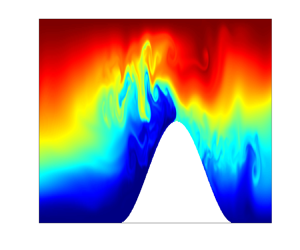
Energetics of mode-1 internal waves interacting with topographic ridges are investigated using high-resolution two-dimensional simulations at spatial scales of $O(100)$ m that span between classical laboratory-scale ( $O(10)$ m) and field-scale simulations ( $O(1000\unicode{x2013}10\,000)$ m). This paper focuses on the energetics of wave–topography interaction, with emphasis on systematically examining the partitioning of the incident wave energy as a function of wave forcing and topographic parameters. Partitioning of energy into the transmitted, reflected and dissipated components is quantified as a function of wave Froude number $Fr=U_0/c_{ph}$ ( $U_0=$ velocity amplitude of forcing and $c_{ph}=$ internal wave celerity), slope criticality $=\gamma /s$, where $\gamma =$ topographic slope and $s=$ wave characteristic slope, and the ratio of topographic height $h_t$ to water depth $d$. As $Fr$ increases, dense fluid from the base of the stratified water column surges upslope with significant vertical inertia, leading to the formation of internal boluses that plunge over and onto the downstream side of the ridge, resulting in elevated dissipation. Results show that non-hydrostatic contributions to the total energy flux are significant (up to 50 %). Analysis of the energy flux budget shows that transmitted energy flux decreases monotonically as $\gamma /s$ increases for any given $Fr$ and $h_t/d$. At critical slopes ( $\gamma /s=1$), the transmitted energy flux scales as a linear function of $h_t/d$, with a mild dependence on $Fr$, a key result that can be useful in energy flux parameterizations. Reflected energy flux exhibits a nonlinear dependence on the ridge height, increasing sharply when $h_t/d > 0.5$. Dissipation is enhanced at critical slopes, with a plateau evident for $\gamma /s \ge 1$ and $h_t/d = 0.5$ for all $Fr$.
$Fr$.


Keplerian turbulence in Taylor–Couette flow of dilute polymeric solutions
-
- Journal:
- Journal of Fluid Mechanics / Volume 1000 / 10 December 2024
- Published online by Cambridge University Press:
- 27 November 2024, R3
-
- Article
- Export citation
-
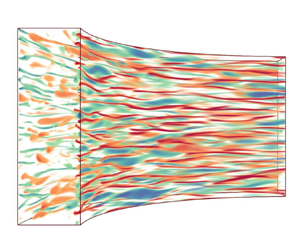
Turbulent flow induced by elastorotational instability in viscoelastic Taylor–Couette flow (TCF) with Keplerian rotation is analogous to a turbulent accretion disk destabilized by magnetorotational instability. We examine this novel viscoelastic Keplerian turbulence via direct numerical simulations (DNS) for the shear Reynolds number ( $Re$) ranging from $10^2$ to $10^4$. The observed characteristic flow structure consists of penetrating streamwise vortices with axial length scales much smaller than the gap width, distinct from the classic centrifugally induced Taylor vortices, which have axial lengths of the gap width. These intriguing vortices persist for the wide $Re$ range considered and give rise to intriguing scaling behaviour in key flow quantities. Specifically, the characteristic axial length of the penetrating vortices is shown to scale as $Re^{-0.22}$; the angular momentum transport scales as $Re^{0.42}$; the kinetic and elastic boundary-layer thicknesses based on angular velocity and hoop stress near the inner cylinder wall scale as $Re^{-0.48}$ and $Re^{-0.49}$, respectively. This implies that the viscoelastic Keplerian turbulence belongs to the classical turbulent regime of TCF with the Prandtl–Blasius-type boundary layer. Furthermore, we present an analytical relation between the viscous and elastic dissipation rates of kinetic energy and the angular momentum transport and in turn demonstrate its validity using our DNS data. This study has paved the way for future research to explore astrophysics-related Keplerian turbulence and angular momentum transport via the scaling relations of the analogous TCF of dilute polymeric solutions.


Pelagic Sargassum and some associated mobile fauna: new records for the archipelago of Madeira (subtropical eastern Atlantic)
-
- Journal:
- Journal of the Marine Biological Association of the United Kingdom / Volume 104 / 2024
- Published online by Cambridge University Press:
- 27 November 2024, e104
-
- Article
- Export citation
Modelling wind-induced changes to overturning wave shape
-
- Journal:
- Journal of Fluid Mechanics / Volume 1000 / 10 December 2024
- Published online by Cambridge University Press:
- 27 November 2024, A48
-
- Article
-
- You have access
- Open access
- HTML
- Export citation
AOG volume 64 issue 92 Cover and Back matter
-
- Journal:
- Annals of Glaciology / Volume 64 / Issue 92 / September 2023
- Published online by Cambridge University Press:
- 27 November 2024, p. b1
-
- Article
-
- You have access
- Open access
- Export citation
On the origin of circular rolls in rotor-stator flow
-
- Journal:
- Journal of Fluid Mechanics / Volume 1000 / 10 December 2024
- Published online by Cambridge University Press:
- 27 November 2024, A47
-
- Article
- Export citation
-
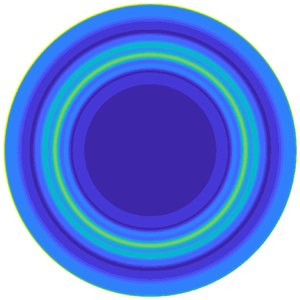
Rotor-stator flows are known to exhibit instabilities in the form of circular and spiral rolls. While the spirals are known to emanate from a supercritical Hopf bifurcation, the origin of the circular rolls is still unclear. In the present work we suggest a quantitative scenario for the circular rolls as a response of the system to external forcing. We consider two types of axisymmetric forcing: bulk forcing (based on the resolvent analysis) and boundary forcing using direct numerical simulation. Using the singular value decomposition of the resolvent operator the optimal response is shown to take the form of circular rolls. The linear gain curve shows strong amplification at non-zero frequencies following a pseudo-resonance mechanism. The optimal energy gain is found to scale exponentially with the Reynolds number $Re$ (for $Re$ based on the rotation rate and interdisc spacing $H$). The results for both types of forcing are compared with former experimental works and previous numerical studies. Our findings suggest that the circular rolls observed experimentally are the effect of the high forcing gain together with the roll-like form of the leading response of the linearised operator. For high enough Reynolds number it is possible to delineate between linear and nonlinear responses. For sufficiently strong forcing amplitudes, the nonlinear response is consistent with the self-sustained states found recently for the unforced problem. The onset of such non-trivial dynamics is shown to correspond in state space to a deterministic leaky attractor, as in other subcritical wall-bounded shear flows.


Annotated checklist and community composition of introduced, cryptogenic, and native polychaetes in floating dock communities of New England, USA
-
- Journal:
- Journal of the Marine Biological Association of the United Kingdom / Volume 104 / 2024
- Published online by Cambridge University Press:
- 27 November 2024, e103
-
- Article
- Export citation
AOG volume 64 issue 92 Cover and Front matter
-
- Journal:
- Annals of Glaciology / Volume 64 / Issue 92 / September 2023
- Published online by Cambridge University Press:
- 27 November 2024, pp. f1-f3
-
- Article
-
- You have access
- Open access
- Export citation
Linear stability analysis of a vertical liquid film over a moving substrate
-
- Journal:
- Journal of Fluid Mechanics / Volume 1000 / 10 December 2024
- Published online by Cambridge University Press:
- 27 November 2024, A57
-
- Article
- Export citation
-
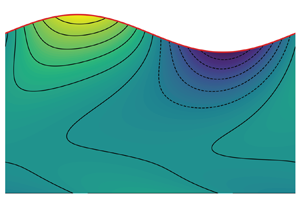
The stability of liquid-film flows is essential in many industrial applications. In the dip-coating process, a liquid film forms over a substrate extracted at a constant speed from a bath. We studied the linear stability of this film considering different thicknesses $\hat {h}$ for four liquids, spanning an extensive range of Kapitza numbers ( $Ka$). By solving the Orr–Sommerfeld eigenvalue problem with the Chebyshev–Tau spectral method, we calculated the threshold between growing and decaying perturbations, investigated the instability mechanism, and computed the absolute/convective threshold. The instability mechanism was studied by analysing the perturbations’ vorticity distribution and the kinetic energy balance. It was found that liquids with low $Ka$ (e.g. corn oil, $Ka = 4$) are stable for a smaller range of wavenumbers compared with liquid with high $Ka$ (e.g. liquid zinc, $Ka = 11\,525$). Surface tension has a stabilising and a destabilising effect. For long waves, it curves the vorticity lines near the substrate, reducing the flow under the crests. For short waves, it fosters vorticity production at the interface and creates a region of intense vorticity near the substrate. In addition, we discovered that the surface tension contributes to both the production and dissipation of perturbation's energy depending on the $Ka$ number. Regarding the absolute/convective threshold, we identified a window in the parameter space where unstable waves propagate throughout the entire domain (indicating absolute instability). Perturbations affecting Derjaguin's solution ( $\hat {h}=1$) for $Ka<17$ and the Landau–Levich–Derjaguin solution ( $\hat {h}=0.945 Re^{1/9}Ka^{-1/6}$), are advected by the flow (indicating convective instability).


The energetics and colour for linearised models of wall turbulence
-
- Journal:
- Journal of Fluid Mechanics / Volume 1000 / 10 December 2024
- Published online by Cambridge University Press:
- 26 November 2024, A42
-
- Article
-
- You have access
- Open access
- HTML
- Export citation
Transition to turbulence in rough plane Couette flow
-
- Journal:
- Journal of Fluid Mechanics / Volume 1000 / 10 December 2024
- Published online by Cambridge University Press:
- 26 November 2024, A40
-
- Article
-
- You have access
- Open access
- HTML
- Export citation
-
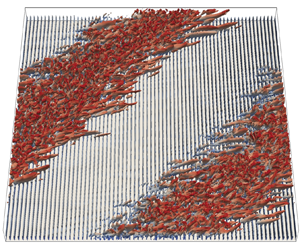
This DNS study considers transition to turbulence in plane Couette flow (pCf) with a rough stationary wall and a smooth moving wall. The roughness elements are square ribs of height $k=0.2h$ (where $h$ is the half-channel height). Two different pitch separations, $\lambda =2k$ and $10k$, are considered, i.e. d-type and k-type roughness, respectively. The transition in both rough pCf cases takes place through a stage of alternate laminar–turbulent bands aligned in an oblique fashion. However, roughness causes a shift in the transitional Reynolds number ( $Re$) range. In the k-type roughness, stable bands are observed in the range $Re \in [300, 325]$, which is a downwards shift from the transitional $Re$ range for the smooth pCf ( $Re \in [325,400]$). The d-type roughness, on the other hand, surprisingly shifts the transitional $Re$ range upwards to $Re \in [350,425]$. This peculiar behaviour is associated with the ability of the ribs to shed and regenerate vorticity. Large-scale components extracted using a filtering process relate to the transition bands and flow parallel to the oblique laminar–turbulent boundaries. Counter-rotating vortices are present in the turbulent regions of the flow field, which exist in tandem with the high- and low-velocity streaks. Another interesting observation is the secondary Reynolds shear stresses, $-\overline {v^{\prime }u^{\prime }}$ and $-\overline {w^{\prime }v^{\prime }}$, which are non-zero in the transitional regime, in contrast to the turbulent regime where they are negligible.


Ordinal pattern-based analysis of an opposition-controlled turbulent channel flow
-
- Journal:
- Journal of Fluid Mechanics / Volume 1000 / 10 December 2024
- Published online by Cambridge University Press:
- 26 November 2024, A43
-
- Article
- Export citation
-
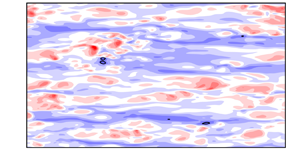
We conduct a numerical study on the drag-reduction mechanism of an opposition- controlled turbulent channel flow from the viewpoint of a symbolic dynamics approach. The effect of the virtual wall formed by the opposition control is maximised at the location of the detection plane $y_d^+ \approx 10$. At this wall-normal location, the local link strength of the self-loop of network nodes representing the negative correlation pattern between the streamwise and wall-normal velocity fluctuations is maximised in the uncontrolled flow. In the controlled case, the multiscale complexity–entropy causality plane and the spatial permutation entropy at $y_d^+ \approx 10$ indicate that the drag-reduction effect is attributed to the reduction of the region where streaks actively coalesce and separate and the suppression of the regeneration cycle in the region near the wall.


Gravity-driven motion of a highly viscous non-wetting drop on an inclined wall
-
- Journal:
- Journal of Fluid Mechanics / Volume 1000 / 10 December 2024
- Published online by Cambridge University Press:
- 26 November 2024, A16
-
- Article
-
- You have access
- Open access
- HTML
- Export citation
-
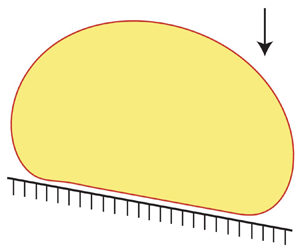
Extensive three-dimensional boundary-integral simulations are presented for the steady-state, low-Reynolds-number motion of a non-wetting deformable drop in another liquid on an inclined solid wall. The drop remains separated from the wall by a lubricating film. The boundary-integral formulation is based on the half-space Green function. The focus is on the challenging case of small tilt angles $\theta$ combined with high drop-to-medium viscosity ratios $\lambda$, when the drop travels with strong hydrodynamical interaction very close to the wall. Simulations to steady state have required ultrahigh drop surface resolutions (to $3\times 10^5$ boundary elements) achieved through multipole acceleration and combined with novel regularization to fully eliminate near-singular behaviour of the double-layer integrals due to small clearance. Non-dimensional drop speed $U$ is presented for $\theta \geq 7.5^\circ$, $\lambda \leq 300$ and in a broad range of Bond numbers $B$, covering from nearly spherical to strongly pancaked drops. The results are consistent with published experiments on liquid–liquid systems. At small $\theta$ and $\lambda \gg 1$, $U$ is a strong, decreasing function of $B$; the asymptotic regime $U\to 0$ at $B\to 0$ is not observed in the simulated range. For small $B$, the dimpled thin-film geometry is insensitive to $\lambda =1\unicode{x2013}300$. For pancaked drops, the lubrication film is much thicker for $\lambda =1$ than for $\lambda \gg 1$ drops. Approximate thin-film uniformity in the drop motion direction is confirmed for pancaked, but not for $B\ll 1$, drops. Kinematics of drop motion shows that neither perfect tank treading, nor perfect rolling can be approached for liquid–liquid systems in the purely hydrodynamical formulation. The methodology is applicable to other problems and can allow for direct inclusion of short-range colloidal forces in three-dimensional boundary-integral simulations.


Turbulence modulation in liquid–liquid two-phase Taylor–Couette turbulence
-
- Journal:
- Journal of Fluid Mechanics / Volume 999 / 25 November 2024
- Published online by Cambridge University Press:
- 26 November 2024, A98
-
- Article
- Export citation
-
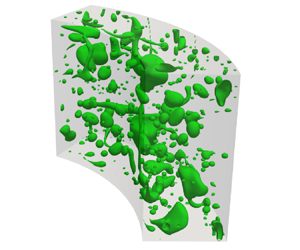
We investigate the coupling effects of the two-phase interface, viscosity ratio and density ratio of the dispersed phase to the continuous phase on the flow statistics in two-phase Taylor–Couette turbulence at a system Reynolds number of $6\times 10^3$ and a system Weber number of 10 using interface-resolved three-dimensional direct numerical simulations with the volume-of-fluid method. Our study focuses on four different scenarios: neutral droplets, low-viscosity droplets, light droplets and low-viscosity light droplets. We find that neutral droplets and low-viscosity droplets primarily contribute to drag enhancement through the two-phase interface, whereas light droplets reduce the system's drag by explicitly reducing Reynolds stress due to the density dependence of Reynolds stress. In addition, low-viscosity light droplets contribute to greater drag reduction by further reducing momentum transport near the inner cylinder and implicitly reducing Reynolds stress. While interfacial tension enhances turbulent kinetic energy (TKE) transport, drag enhancement is not strongly correlated with TKE transport for both neutral droplets and low-viscosity droplets. Light droplets primarily reduce the production term by diminishing Reynolds stress, whereas the density contrast between the phases boosts TKE transport near the inner wall. Therefore, the reduction in the dissipation rate is predominantly attributed to decreased turbulence production, causing drag reduction. For low-viscosity light droplets, the production term diminishes further, primarily due to their greater reduction in Reynolds stress, while reduced viscosity weakens the density difference's contribution to TKE transport near the inner cylinder, resulting in a more pronounced reduction in the dissipation rate and consequently stronger drag reduction. Our findings provide new insights into the physics of turbulence modulation by the dispersed phase in two-phase turbulence systems.

