Refine search
Actions for selected content:
178628 results in Earth and Environmental Sciences
Ordinal pattern-based analysis of an opposition-controlled turbulent channel flow
-
- Journal:
- Journal of Fluid Mechanics / Volume 1000 / 10 December 2024
- Published online by Cambridge University Press:
- 26 November 2024, A43
-
- Article
- Export citation
-
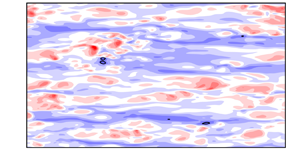
We conduct a numerical study on the drag-reduction mechanism of an opposition- controlled turbulent channel flow from the viewpoint of a symbolic dynamics approach. The effect of the virtual wall formed by the opposition control is maximised at the location of the detection plane $y_d^+ \approx 10$. At this wall-normal location, the local link strength of the self-loop of network nodes representing the negative correlation pattern between the streamwise and wall-normal velocity fluctuations is maximised in the uncontrolled flow. In the controlled case, the multiscale complexity–entropy causality plane and the spatial permutation entropy at $y_d^+ \approx 10$ indicate that the drag-reduction effect is attributed to the reduction of the region where streaks actively coalesce and separate and the suppression of the regeneration cycle in the region near the wall.


Gravity-driven motion of a highly viscous non-wetting drop on an inclined wall
-
- Journal:
- Journal of Fluid Mechanics / Volume 1000 / 10 December 2024
- Published online by Cambridge University Press:
- 26 November 2024, A16
-
- Article
-
- You have access
- Open access
- HTML
- Export citation
-
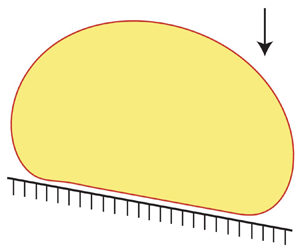
Extensive three-dimensional boundary-integral simulations are presented for the steady-state, low-Reynolds-number motion of a non-wetting deformable drop in another liquid on an inclined solid wall. The drop remains separated from the wall by a lubricating film. The boundary-integral formulation is based on the half-space Green function. The focus is on the challenging case of small tilt angles $\theta$ combined with high drop-to-medium viscosity ratios $\lambda$, when the drop travels with strong hydrodynamical interaction very close to the wall. Simulations to steady state have required ultrahigh drop surface resolutions (to $3\times 10^5$ boundary elements) achieved through multipole acceleration and combined with novel regularization to fully eliminate near-singular behaviour of the double-layer integrals due to small clearance. Non-dimensional drop speed $U$ is presented for $\theta \geq 7.5^\circ$, $\lambda \leq 300$ and in a broad range of Bond numbers $B$, covering from nearly spherical to strongly pancaked drops. The results are consistent with published experiments on liquid–liquid systems. At small $\theta$ and $\lambda \gg 1$, $U$ is a strong, decreasing function of $B$; the asymptotic regime $U\to 0$ at $B\to 0$ is not observed in the simulated range. For small $B$, the dimpled thin-film geometry is insensitive to $\lambda =1\unicode{x2013}300$. For pancaked drops, the lubrication film is much thicker for $\lambda =1$ than for $\lambda \gg 1$ drops. Approximate thin-film uniformity in the drop motion direction is confirmed for pancaked, but not for $B\ll 1$, drops. Kinematics of drop motion shows that neither perfect tank treading, nor perfect rolling can be approached for liquid–liquid systems in the purely hydrodynamical formulation. The methodology is applicable to other problems and can allow for direct inclusion of short-range colloidal forces in three-dimensional boundary-integral simulations.


Turbulence modulation in liquid–liquid two-phase Taylor–Couette turbulence
-
- Journal:
- Journal of Fluid Mechanics / Volume 999 / 25 November 2024
- Published online by Cambridge University Press:
- 26 November 2024, A98
-
- Article
- Export citation
-
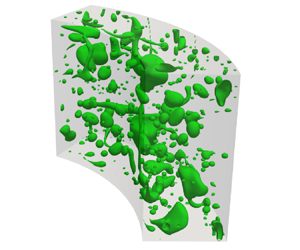
We investigate the coupling effects of the two-phase interface, viscosity ratio and density ratio of the dispersed phase to the continuous phase on the flow statistics in two-phase Taylor–Couette turbulence at a system Reynolds number of $6\times 10^3$ and a system Weber number of 10 using interface-resolved three-dimensional direct numerical simulations with the volume-of-fluid method. Our study focuses on four different scenarios: neutral droplets, low-viscosity droplets, light droplets and low-viscosity light droplets. We find that neutral droplets and low-viscosity droplets primarily contribute to drag enhancement through the two-phase interface, whereas light droplets reduce the system's drag by explicitly reducing Reynolds stress due to the density dependence of Reynolds stress. In addition, low-viscosity light droplets contribute to greater drag reduction by further reducing momentum transport near the inner cylinder and implicitly reducing Reynolds stress. While interfacial tension enhances turbulent kinetic energy (TKE) transport, drag enhancement is not strongly correlated with TKE transport for both neutral droplets and low-viscosity droplets. Light droplets primarily reduce the production term by diminishing Reynolds stress, whereas the density contrast between the phases boosts TKE transport near the inner wall. Therefore, the reduction in the dissipation rate is predominantly attributed to decreased turbulence production, causing drag reduction. For low-viscosity light droplets, the production term diminishes further, primarily due to their greater reduction in Reynolds stress, while reduced viscosity weakens the density difference's contribution to TKE transport near the inner cylinder, resulting in a more pronounced reduction in the dissipation rate and consequently stronger drag reduction. Our findings provide new insights into the physics of turbulence modulation by the dispersed phase in two-phase turbulence systems.

Turbulent spherical Rayleigh–Bénard convection: radius ratio dependence
-
- Journal:
- Journal of Fluid Mechanics / Volume 1000 / 10 December 2024
- Published online by Cambridge University Press:
- 26 November 2024, A41
-
- Article
-
- You have access
- Open access
- HTML
- Export citation
-
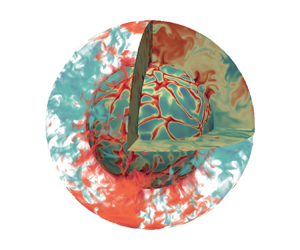
Direct numerical simulation (DNS) is performed to explore turbulent Rayleigh–Bénard convection in spherical shells. Our simulations cover six distinct values of radius ratio, $\eta = r_i/r_o = 0.2$, 0.3, 0.4, 0.5, 0.6 and 0.8, under the assumption of a centrally condensed mass with gravity profile $g \sim 1/r^{2}$; where $r_i$, $r_o$ and $r$ denote the inner shell radius, the outer shell radius and the local radial coordinate, respectively. The Prandtl number is kept constant at unity while the Rayleigh number ( $Ra$) is varied from $3 \times 10^{3}$ to $5 \times 10^8$. Our primary aim is to analyze how the radius ratio influences the global transport properties and flow physics. To gain insights into the scaling behaviour of the Nusselt number ( $Nu$) and the Reynolds number ( $Re$) with respect to $Ra$ and $\eta$, we apply the Grossmann–Lohse (GL) theory (Grossmann & Lohse, J. Fluid Mech., vol. 407, 2000, pp. 27–56) to the system. It is observed that the scaling exponents for $Nu$ and $Re$ in relation to $Ra$ are more significant for smaller $\eta$ values, suggesting that the simulations with smaller $\eta$ reach the classical $Nu\sim Ra^{1/3}$ regime at a relatively lower $Ra$. This observation could also imply the systems with smaller $\eta$ might transition to the ultimate regime earlier at a smaller $Ra$. Based on our extensive DNS data, we establish that the thickness of the inner thermal boundary, $\lambda _{\vartheta }^{i}$, follows a scaling relationship of $\lambda _{\vartheta }^{i} \sim \eta ^{1/2}$. This relationship, in turn, leads to a scaling law for $Nu$ in the form of $Nu \sim f(\eta ) Ra^{\gamma }$, where the function $f(\eta )$ is defined as $f(\eta ) = {\eta ^{1/2}}/{(1+\eta ^{4/3})}$, and the exponent $\gamma$ depends on both $Ra$ and $\eta$. Additionally, we characterize and explain the asymmetry in the velocity field by introducing the separate Reynolds numbers for the inner and outer shells. The asymmetry of the kinetic and thermal energy dissipation rates in the inner and outer boundary layers (BLs) is also quantified.


Breakage dynamics and scaling of wet aggregates of rigid particles
-
- Journal:
- Journal of Fluid Mechanics / Volume 1000 / 10 December 2024
- Published online by Cambridge University Press:
- 26 November 2024, A39
-
- Article
-
- You have access
- Open access
- HTML
- Export citation
-
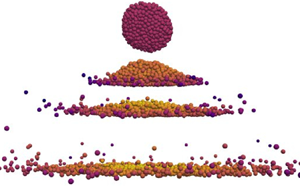
The mechanical behaviour of wet particle aggregates is crucial in many granular processes such as wet granulation and soil degradation. However, the interplay of capillary and viscous forces for aggregate stability and breakage have remained elusive due to the complexity of granular dynamics. We use particle dynamics simulations to analyse the deformation and breakage of wet aggregates colliding with a flat wall. The aggregates are composed of spherical particles and the effect of liquid bonds is modelled through capillary and lubrication forces acting between particles. We perform an extensive parametric study by varying surface tension, impact velocity and liquid viscosity in a broad range of values. We show that when lubrication force is neglected, aggregate breakage is fully controlled by the reduced kinetic energy $\xi$, defined as the ratio of incident kinetic energy to the initial capillary energy. At low values of $\xi$, the aggregate deforms without breakage due to inelastic energy loss induced by rearrangements and loss of capillary bonds, whereas above a critical value of $\xi$ it breaks into smaller aggregates due to the transfer of kinetic energy from aggregate to fragments. In the presence of lubrication forces, the crossover from capillary to viscous regime is controlled by the capillary number, defined as the ratio of viscous dissipation to capillary energy. We find that the critical value of $\xi$ for aggregate breakage in the viscous regime increases as a power law with capillary number while the effective restitution coefficient follows the same trend as in the capillary regime.


Quasi-steady transitions in confined convection
-
- Journal:
- Journal of Fluid Mechanics / Volume 1000 / 10 December 2024
- Published online by Cambridge University Press:
- 26 November 2024, A44
-
- Article
- Export citation
-
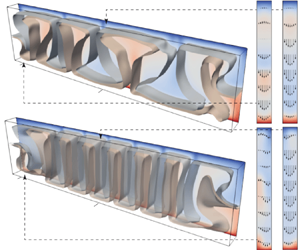
We study the effect of geometrical confinement on thermal convection by laboratory experiments and direct numerical simulations using Hele-Shaw geometries (typically the gap-to-height aspect ratio $0.12$) for the Prandtl number $Pr \geq 40$ and the Rayleigh number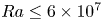 $Ra \leq 6 \times 10^7$. Under such strong unidirectional confinement, the convective flows are forced to squeeze within the narrow gap and exhibit unique spatiotemporal signatures, which contrast those in unconfined systems. With the increase of $Ra$, we identify that the system experiences five convective regimes that can be classified from two aspects, time dependency and flow dimensionality: (I) quasi-two-dimensional (quasi-2-D) steady flow; (II) quasi-2-D flow with oscillatory corner rolls; (III) three-dimensional (3-D) flow with oscillatory corner rolls; (IV) 3-D steady flow; and (V) 3-D time-dependent motion of plumes around sidewalls. Notably, unsteadiness does not emerge globally, but is localised near the sidewalls as oscillatory corner rolls, resulting in the regime transitions happening in a quasi-steady manner. We confirm that these regime transitions show less dependence on both $Pr$ and the other (wider) horizontal scale of the geometry. Moreover, we find that a recently proposed criterion ‘degree of confinement’ (Noto et al., Proc. Natl Acad. Sci. USA, vol. 121, issue 28, 2024, e2403699121) successfully explains the emergence of 3-D structures, expanding its applicable range to smaller $Ra$. This study deepens the comprehension of the thermal convection emerging in tight geometries, impacting across disciplines, such as Earth and planetary science, and thermal engineering.


Homogeneous turbophoresis of heavy inertial particles in turbulent flow
-
- Journal:
- Journal of Fluid Mechanics / Volume 999 / 25 November 2024
- Published online by Cambridge University Press:
- 26 November 2024, A83
-
- Article
- Export citation
-
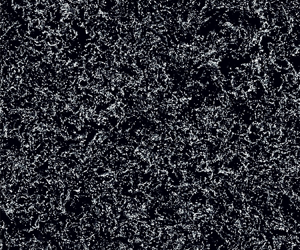
Heavy particles suspended in turbulent flow possess inertia and are ejected from violent vortical structures by centrifugal forces. Once piled up along particle paths, this small-scale mechanism leads to an effective large-scale drift. This phenomenon, known as ‘turbophoresis’, causes particles to leave highly turbulent regions and migrate towards calmer regions, explaining why particles transported by non-homogeneous flows tend to concentrate near the minima of turbulent kinetic energy. It is demonstrated here that turbophoretic effects are just as crucial in statistically homogeneous flows. Although the average turbulent activity is uniform, instantaneous spatial fluctuations are responsible for inertial-range inhomogeneities in the particle distribution. Direct numerical simulations are used to probe particle accelerations, specifically how they correlate to local turbulent activity, yielding an effective coarse-grained dynamics that accounts for particle detachment from the fluid and ejection from excited regions through a space- and time-dependent non-Fickian diffusion. This leads to cast fluctuations in particle distributions in terms of a scale-dependent Péclet number ${\textit {Pe}}_\ell$, which measures the importance of turbulent advection compared with inertial turbophoresis at a given scale $\ell$. Multifractal statistics of energy dissipation indicate that $ {\textit {Pe}}_\ell \sim \ell ^\delta /\tau _{p}$ with $\delta \approx 0.84$. Numerical simulations support this behaviour and emphasise the relevance of the turbophoretic Péclet number in characterising how particle distributions, including their radial distribution function, depends on $\ell$. This approach also explains the presence of voids with inertial-range sizes, and the fact that their volumes have a non-trivial distribution with a power-law tail $p(\mathcal {V}) \propto \mathcal {V}^{-\alpha }$, with an exponent $\alpha$ that tends to 2 as ${\textit {Pe}}_\ell \to 0$.


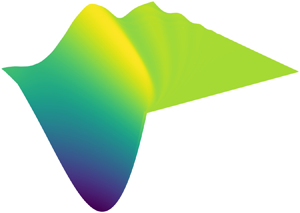
Lubrication-mediated rebounds off fluid baths
-
- Journal:
- Journal of Fluid Mechanics / Volume 1000 / 10 December 2024
- Published online by Cambridge University Press:
- 26 November 2024, R2
-
- Article
-
- You have access
- Open access
- HTML
- Export citation
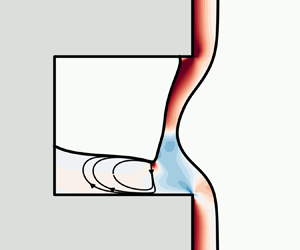
Flow of viscoelastic films over grooved surfaces with partial wetting
-
- Journal:
- Journal of Fluid Mechanics / Volume 1000 / 10 December 2024
- Published online by Cambridge University Press:
- 25 November 2024, A10
-
- Article
-
- You have access
- Open access
- HTML
- Export citation
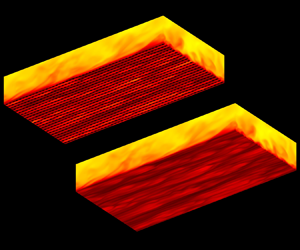
Resolving turbulence and drag over textured surfaces using texture-less simulations: the case of slip/no-slip textures
-
- Journal:
- Journal of Fluid Mechanics / Volume 1000 / 10 December 2024
- Published online by Cambridge University Press:
- 25 November 2024, A36
-
- Article
-
- You have access
- Open access
- HTML
- Export citation
-
We study the effect of surface texture on an overlying turbulent flow for the case of textures made of an alternating slip/no-slip pattern, a common model for superhydrophobic surfaces, but also a particularly simple form of texture. For texture sizes $L^+ \gtrsim 25$, we have previously reported that, even though the texture effectively imposes homogeneous slip boundary conditions on the overlying, background turbulence, this is not its sole effect. The effective conditions only produce an origin offset on the background turbulence, which remains otherwise smooth-wall-like. For actual textures, however, as their size increases from $L^+ \gtrsim 25$ the flow progressively departs from this smooth-wall-like regime, resulting in additional shear Reynolds stress and increased drag, in a non-homogeneous fashion that could not be reproduced by the effective boundary conditions. This paper focuses on the underlying physical mechanism of this phenomenon. We argue that it is caused by the nonlinear interaction of the texture-coherent flow, directly induced by the surface topology, and the background turbulence, as it acts directly on the latter and alters it. This does not occur at the boundary where effective conditions are imposed, but within the overlying flow itself, where the interaction acts as a forcing on the governing equations of the background turbulence, and takes the form of cross-advective terms between the latter and the texture-coherent flow. We show this by conducting simulations where we remove the texture and introduce additional, forcing terms in the Navier–Stokes equations, in addition to the equivalent homogeneous slip boundary conditions. The forcing terms capture the effect of the nonlinear interaction on the background turbulence without the need to resolve the surface texture. We show that, when the forcing terms are derived accounting for the amplitude modulation of the texture-coherent flow by the background turbulence, they quantitatively capture the changes in the flow up to texture sizes $L^+ \approx 70{-}100$. This includes not just the roughness function but also the changes in the flow statistics and structure.


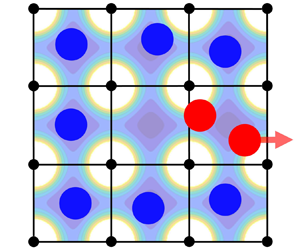
Slip due to kink propagation at the liquid–solid interface
-
- Journal:
- Journal of Fluid Mechanics / Volume 1000 / 10 December 2024
- Published online by Cambridge University Press:
- 25 November 2024, A19
-
- Article
-
- You have access
- Open access
- HTML
- Export citation
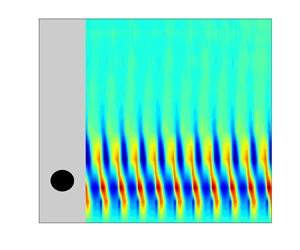
Experimental study on the effect of wall proximity on the flow around a cylinder under an axial magnetic field
-
- Journal:
- Journal of Fluid Mechanics / Volume 1000 / 10 December 2024
- Published online by Cambridge University Press:
- 25 November 2024, A23
-
- Article
- Export citation
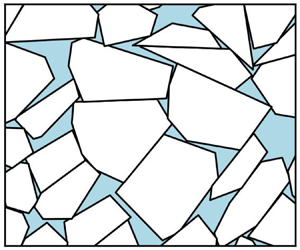
Modelling sea ice in the marginal ice zone as a dense granular flow with rheology inferred from discrete element model data
-
- Journal:
- Journal of Fluid Mechanics / Volume 1000 / 10 December 2024
- Published online by Cambridge University Press:
- 25 November 2024, A22
-
- Article
-
- You have access
- Open access
- HTML
- Export citation
-
The marginal ice zone represents the periphery of the sea ice cover. In this region, the macroscale behaviour of the sea ice results from collisions and enduring contact between ice floes. This configuration closely resembles that of dense granular flows, which have been modelled successfully with the $\mu (I)$ rheology. Here, we present a continuum model based on the $\mu (I)$ rheology that treats sea ice as a compressible fluid, with the local sea ice concentration given by a dilatancy function $\varPhi (I)$. We infer expressions for $\mu (I)$ and $\varPhi (I)$ by nonlinear regression using data produced with a discrete element method (DEM) that considers polygon-shaped ice floes. We do this by driving the sea ice with a one-dimensional shearing ocean current. The resulting continuum model is a nonlinear system of equations with the sea ice velocity, local concentration and pressure as unknowns. The rheology is given by the sum of a plastic term and a viscous term. In the context of a periodic patch of ocean, which is effectively a one-dimensional problem, and under steady conditions, we prove this system to be well-posed, present a numerical algorithm for solving it, and compare its solutions to those of the DEM. These comparisons demonstrate the continuum model's ability to capture most of the DEM results accurately. The continuum model is particularly accurate for ocean currents faster than 0.25 m s $^{-1}$; however, for low concentrations and slow ocean currents, the continuum model is less effective in capturing the DEM results. In the latter case, the lack of accuracy of the continuum model is found to be accompanied by the breakdown of a balance between the average shear stress and the integrated ocean drag extracted from the DEM. Since this balance is expected to hold independently of our choice of rheology, this finding indicates that continuum models might not be able to describe sea ice dynamics for low concentrations and slow ocean currents.


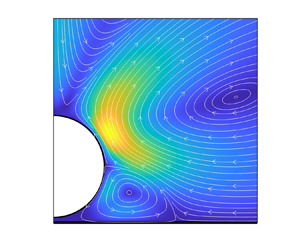
Electrohydrodynamic flow about a colloidal particle suspended in a non-polar fluid
-
- Journal:
- Journal of Fluid Mechanics / Volume 1000 / 10 December 2024
- Published online by Cambridge University Press:
- 25 November 2024, A15
-
- Article
-
- You have access
- Open access
- HTML
- Export citation
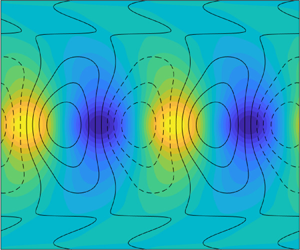
Localization of internal gravity waves in stratified channel flow
-
- Journal:
- Journal of Fluid Mechanics / Volume 1000 / 10 December 2024
- Published online by Cambridge University Press:
- 25 November 2024, A27
-
- Article
-
- You have access
- Open access
- HTML
- Export citation
Natural convection in a vertical channel. Part 1. Wavenumber interaction and Eckhaus instability in a narrow domain
-
- Journal:
- Journal of Fluid Mechanics / Volume 1000 / 10 December 2024
- Published online by Cambridge University Press:
- 25 November 2024, A28
-
- Article
-
- You have access
- Open access
- HTML
- Export citation
-
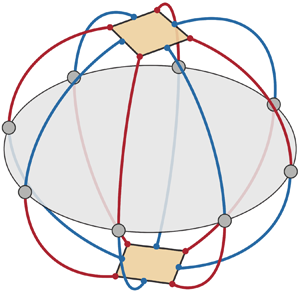
In a vertical channel driven by an imposed horizontal temperature gradient, numerical simulations (Gao et al., Phys. Rev. E, vol. 88, 2013, 023010; Phys. Rev. E, vol. 91, 2015, 013006; Phys. Rev. E, vol. 97, 2018, 053107) have previously shown steady, time-periodic and chaotic dynamics. We explore the observed dynamics by constructing invariant solutions of the three-dimensional Oberbeck–Boussinesq equations, characterizing the stability of these equilibria and periodic orbits, and following the bifurcation structure of the solution branches under parametric continuation in Rayleigh number. We find that in a narrow vertically periodic domain of aspect ratio 10, the flow is dominated by the competition between three and four co-rotating rolls. We demonstrate that branches of three- and four-roll equilibria are connected and can be understood in terms of their discrete symmetries. Specifically, the $D_4$ symmetry of the four-roll branch dictates the existence of qualitatively different intermediate branches that themselves connect to the three-roll branch in a transcritical bifurcation due to $D_3$ symmetry. The physical appearance, disappearance, merging and splitting of rolls along the connecting branch provide a physical and phenomenological illustration of the equivariant theory of $D_3$– $D_4$ mode interaction. We observe other manifestations of the competition between three and four rolls, in which the symmetry in time or in the transverse direction is broken, leading to limit cycles or wavy rolls, respectively. Our work highlights the interest of combining numerical simulations, bifurcation theory and group theory, in order to understand the transitions between and origin of flow patterns.


Richtmyer–Meshkov instability when a shock is reflected for fluids with arbitrary equation of state
-
- Journal:
- Journal of Fluid Mechanics / Volume 1000 / 10 December 2024
- Published online by Cambridge University Press:
- 25 November 2024, A18
-
- Article
-
- You have access
- Open access
- HTML
- Export citation
Direct numerical simulation of turbulent flow and structures in a circular pipe subjected to axial system rotation
-
- Journal:
- Journal of Fluid Mechanics / Volume 1000 / 10 December 2024
- Published online by Cambridge University Press:
- 25 November 2024, A1
-
- Article
-
- You have access
- Open access
- HTML
- Export citation
-
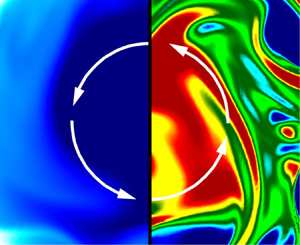
Turbulent circular pipe flows subjected to axial system rotation are studied using direct numerical simulations (DNS) for a wide range of rotation numbers of $Ro_b = 0\unicode{x2013}20$ at a fixed Reynolds number. To ensure that energetic turbulent eddy motions are captured at high rotation numbers, long pipes up to $L_z = 180{\rm \pi} R$ are used in DNS. Two types of energy-containing flow structures have been observed. The first type is hairpin structures that are characteristic of the turbulent boundary layer developing over the pipe wall for both non-rotating and axially rotating flows. The second type is Taylor columns forming at moderate and high rotation numbers. Based on the study of two-point autocorrelation coefficients, it is observed that Taylor columns exhibit quasi-periods in both axial and azimuthal directions. According to the premultiplied spectra, Taylor columns feature one single characteristic axial length scale at the moderate rotation numbers but two at high rotation numbers. It is discovered that the axial system rotation suppresses the sweep events systematically and impedes the formation of hairpin structures. As the rotation number is increased, the turbulence kinetic energy held by Taylor columns enhances rapidly associated with significant increases in their axial length scales.


Impact of vaporization on drop aerobreakup
-
- Journal:
- Journal of Fluid Mechanics / Volume 1000 / 10 December 2024
- Published online by Cambridge University Press:
- 25 November 2024, A33
-
- Article
-
- You have access
- Open access
- HTML
- Export citation
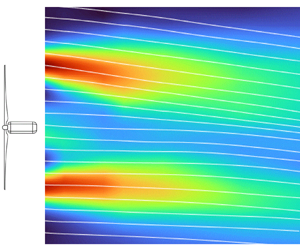
Modelling turbulence in axisymmetric wakes: an application to wind turbine wakes
-
- Journal:
- Journal of Fluid Mechanics / Volume 1000 / 10 December 2024
- Published online by Cambridge University Press:
- 25 November 2024, A2
-
- Article
-
- You have access
- Open access
- HTML
- Export citation
