Refine search
Actions for selected content:
178625 results in Earth and Environmental Sciences
References
-
- Book:
- Ethics and the Environment
- Published online:
- 29 November 2024
- Print publication:
- 28 November 2024, pp 249-264
-
- Chapter
- Export citation
2 - Human Morality
-
- Book:
- Ethics and the Environment
- Published online:
- 29 November 2024
- Print publication:
- 28 November 2024, pp 25-44
-
- Chapter
- Export citation
7 - Zeroing In on Cities: The Politics of Aspiration and Delay in Net-Zero Emission Targets of Swedish Municipalities
-
-
- Book:
- The Politics and Governance of Decarbonization
- Published online:
- 05 December 2024
- Print publication:
- 28 November 2024, pp 139-160
-
- Chapter
-
- You have access
- Open access
- HTML
- Export citation
Epigraph
-
- Book:
- Ethics and the Environment
- Published online:
- 29 November 2024
- Print publication:
- 28 November 2024, pp vi-vi
-
- Chapter
- Export citation
Figures
-
- Book:
- Ethics and the Environment
- Published online:
- 29 November 2024
- Print publication:
- 28 November 2024, pp x-x
-
- Chapter
- Export citation
Preface and Acknowledgments
-
- Book:
- The Politics and Governance of Decarbonization
- Published online:
- 05 December 2024
- Print publication:
- 28 November 2024, pp xi-xiii
-
- Chapter
-
- You have access
- Open access
- HTML
- Export citation
10 - Sustainability Criteria for Renewable Hydrogen
- from Part II - Regulating Hydrogen Markets
-
-
- Book:
- The Cambridge Handbook of Hydrogen and the Law
- Published online:
- 28 November 2024
- Print publication:
- 28 November 2024, pp 142-157
-
- Chapter
-
- You have access
- Open access
- HTML
- Export citation
Dedication
-
- Book:
- The Cambridge Handbook of Hydrogen and the Law
- Published online:
- 28 November 2024
- Print publication:
- 28 November 2024, pp v-vi
-
- Chapter
-
- You have access
- Open access
- HTML
- Export citation
7 - The Value of Nature
-
- Book:
- Ethics and the Environment
- Published online:
- 29 November 2024
- Print publication:
- 28 November 2024, pp 131-153
-
- Chapter
- Export citation
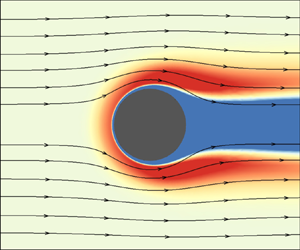
Nonlinear electrophoresis of a highly charged particle by incorporating electrostatic correlations and ion steric interactions for a finite Debye length
-
- Journal:
- Journal of Fluid Mechanics / Volume 1000 / 10 December 2024
- Published online by Cambridge University Press:
- 28 November 2024, A71
-
- Article
-
- You have access
- Open access
- HTML
- Export citation
Index
-
- Book:
- Ethics and the Environment
- Published online:
- 29 November 2024
- Print publication:
- 28 November 2024, pp 265-272
-
- Chapter
- Export citation
3 - Hydrogen Regulation in the United States
- from Part I - Current Hydrogen Regulation on the Continents
-
-
- Book:
- The Cambridge Handbook of Hydrogen and the Law
- Published online:
- 28 November 2024
- Print publication:
- 28 November 2024, pp 30-45
-
- Chapter
-
- You have access
- Open access
- HTML
- Export citation
8 - Economics of Regulating Hydrogen Markets
- from Part II - Regulating Hydrogen Markets
-
-
- Book:
- The Cambridge Handbook of Hydrogen and the Law
- Published online:
- 28 November 2024
- Print publication:
- 28 November 2024, pp 115-128
-
- Chapter
-
- You have access
- Open access
- HTML
- Export citation
Contributors
-
- Book:
- The Cambridge Handbook of Hydrogen and the Law
- Published online:
- 28 November 2024
- Print publication:
- 28 November 2024, pp xv-xx
-
- Chapter
-
- You have access
- Open access
- HTML
- Export citation
Contents
-
- Book:
- The Politics and Governance of Decarbonization
- Published online:
- 05 December 2024
- Print publication:
- 28 November 2024, pp v-ix
-
- Chapter
-
- You have access
- Open access
- HTML
- Export citation
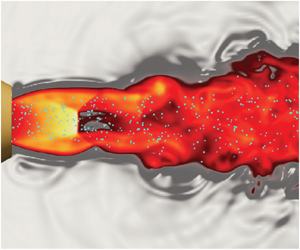
Experimental and numerical investigation of inertial particles in underexpanded jets
-
- Journal:
- Journal of Fluid Mechanics / Volume 1000 / 10 December 2024
- Published online by Cambridge University Press:
- 27 November 2024, A60
-
- Article
-
- You have access
- Open access
- HTML
- Export citation
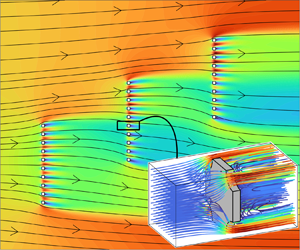
Quasi-linear homogenization for large-inertia laminar transport across permeable membranes
-
- Journal:
- Journal of Fluid Mechanics / Volume 1000 / 10 December 2024
- Published online by Cambridge University Press:
- 27 November 2024, A46
-
- Article
-
- You have access
- Open access
- HTML
- Export citation
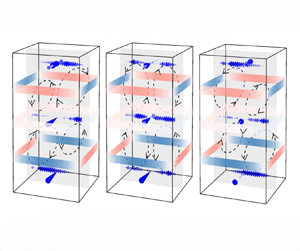
Effects of horizontal magnetic fields on flow morphologies and global transports in liquid metal thermal convection
-
- Journal:
- Journal of Fluid Mechanics / Volume 1000 / 10 December 2024
- Published online by Cambridge University Press:
- 27 November 2024, A59
-
- Article
- Export citation
-
We report an experimental study of Rayleigh–Bénard convection of liquid metal GaInSn in a cuboid cell with an aspect ratio of 0.5 under the effect of a horizontal magnetic field. The Rayleigh number spans a range of $3.8\times 10^5 \leqslant Ra \leqslant 1.1\times 10^7$, while the magnetic field strength reaches up to 0.5 T, corresponding to a maximum Hartmann number to 2041. By combining temperature and velocity measurements, we identify several flow morphologies, including a novel cellular pattern characterized by four stacked vortices that periodically squeeze and induce velocity reversals. Based on the identified flow morphologies, we partition the entire ( $Ra, Ha$) parameter space into five distinct flow regimes and systematically investigate the flow characteristics within each regime. The temperature gradient and oscillation frequency exhibit scaling relationships with the combined parameters $Ra$ and $Ha$. Notably, we observe a coupling between flow regime and global transport efficiencies, particularly in a regime dominated by the double-roll structure, which experiences a maximum 36 % decrease in heat transfer efficiency compared with the single-roll structure. The dependencies of heat and momentum transport on $Ra$ and $Ha$ follow scaling laws as $Nu \sim (Ha^{-2/3}RaPr^{-1})^{3/5}$ and $Re \sim (Ha^{-1}RaPr^{-1})^{4/3}$, respectively.


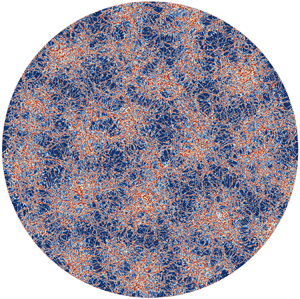
How wide must Rayleigh–Bénard cells be to prevent finite aspect ratio effects in turbulent flow?
-
- Journal:
- Journal of Fluid Mechanics / Volume 1000 / 10 December 2024
- Published online by Cambridge University Press:
- 27 November 2024, A58
-
- Article
-
- You have access
- Open access
- HTML
- Export citation
-
We employ direct numerical simulations to investigate the heat transfer and flow structures in turbulent Rayleigh–Bénard convection in both cylindrical cells and laterally periodic domains, spanning an unprecedentedly wide range of aspect ratios $0.075 \leqslant \varGamma \leqslant 32$. We focus on Prandtl number ${Pr}=1$ and Rayleigh numbers ${{Ra}}=2\times 10^7$ and ${{Ra}}=10^8$. In both cases, with increasing aspect ratio, the heat transfer first increases, then reaches a maximum (which is more pronounced for the cylindrical case due to confinement effects), and then slightly goes down again before it finally saturates at the large aspect ratio limit, which is achieved already at $\varGamma \approx 4$. Already for $\varGamma \gtrsim 0.75$, the heat transfers in both cylindrical and laterally periodic domains become identical. The large- $\varGamma$ limit for the volume-integrated Reynolds number and the boundary layer thicknesses are also reached at $\varGamma \approx 4$. However, while the integral flow properties converge at $\varGamma \approx 4$, the confinement of a cylindrical domain impacts the temperature and velocity variance distributions up to $\varGamma \approx 16$, as thermal superstructures cannot form close to the sidewall.


Second-order analysis of hypersonic boundary-layer stability
-
- Journal:
- Journal of Fluid Mechanics / Volume 1000 / 10 December 2024
- Published online by Cambridge University Press:
- 27 November 2024, A56
-
- Article
- Export citation
