To save content items to your account,
please confirm that you agree to abide by our usage policies.
If this is the first time you use this feature, you will be asked to authorise Cambridge Core to connect with your account.
Find out more about saving content to .
To save content items to your Kindle, first ensure no-reply@cambridge.org
is added to your Approved Personal Document E-mail List under your Personal Document Settings
on the Manage Your Content and Devices page of your Amazon account. Then enter the ‘name’ part
of your Kindle email address below.
Find out more about saving to your Kindle.
Note you can select to save to either the @free.kindle.com or @kindle.com variations.
‘@free.kindle.com’ emails are free but can only be saved to your device when it is connected to wi-fi.
‘@kindle.com’ emails can be delivered even when you are not connected to wi-fi, but note that service fees apply.
Silicification - the precipitation of silica within the remains of a buried organism - allows for the three-dimensional preservation of a fossil in minute cellular to subcellular detail and forms the basis for some of the most spectacular Lagerstätten for terrestrial ecosystems (e.g. Selden & Nudds 2004). Among these are the plant-bearing chert deposits of the Transantarctic Mountains, which were discovered by J.H. Mercer and J.D. Gunner during the 1969/1970 ‘Beardmore Expedition’ and sampled and first screened by J.M. Schopf soon thereafter (Schopf 1970). The collection, preparation and in-depth study of plant-bearing cherts from the Beardmore Glacier generated more than 125 publications, and systematic treatments of the permineralized biotas resulted in the description of 30 genera and almost 50 species of structurally preserved plants and fungi. The exquisite anatomical preservation enabled unusually detailed reconstruction of many of the preserved organisms, yielding the most completely known fossil members for several groups of gymnosperms (see Escapa et al.2011). Together with similar silicified peat deposits from the remote Prince Charles Mountains in East Antarctica (McLoughlin & Drinnan 1997), these conservation-Lagerstätten of the Transantarctic Mountains constitute an extraordinary window into the biology and ecology of late Palaeozoic and early Mesozoic high-latitude terrestrial ecosystems. Perhaps the single most important of these deposits is the silicified peat from the Triassic Fremouw Formation at Fremouw Peak in the Beardmore Glacier area. Triassic silicified peat also occurs elsewhere in the Transantarctic Mountains, including the Allan Hills in southern Victoria Land (Taylor & Taylor 1990) and Timber Peak in northern Victoria Land (Bomfleur et al.2011), but thus far the quality of preservation at other sites proved too poor to merit in-depth study.
This chapter analyzes the interconnections between energy policy and security and defense policies in Norway. It explains the background of energy and security regimes and analyzes policy interplay. Prior to 2022, Norway had barely considered the energy–security nexus due to substantial domestic energy supplies. Some interconnections were, however, visible via three cases: the economic security provided by oil and gas exports, security of hydropower infrastructure, and internal tensions around wind power. Repoliticization of the Norwegian energy policy took place in 2022, and questions of energy sovereignty and energy security also became a part of Norway’s energy policy vocabulary. In 2022, strong degree of securitization was not evident, but, lightly framed, there have been breaks from previous energy political practices – evidenced by new support for offshore wind power and visible military protection of critical energy infrastructure.
This chapter provides the tools to compute catastrophe (CAT) risk, which represents a compound measure of the likelihood and magnitude of adverse consequences affecting structures, individuals, and valuable assets. The process consists of first establishing an inventory of assets (here real or simulated) exposed to potential hazards (exposure module). Estimating the expected damage resulting from a given hazard load (according to Chapter 2) is the second crucial step in the assessment process (vulnerability module). The application of damage functions to exposure data forms the basis for calculating loss estimates (loss module). To ensure consistency across perils, the mean damage ratio is used as the main measure for damage footprints D(x,y), with the final loss footprints simply expressed as L(x,y) = D(x,y) × ν(x,y), where ν(x,y) represents the exposure footprint. Damage functions are provided for various hazard loads: blasts (explosions and asteroid impacts), earthquakes, floods, hail, landslides, volcanic eruptions, and wind.
This chapter goes beyond the description of individual events by covering extremes caused by a combination of multiple events. Two main types of interactions are covered: domino effects and compound events. Domino effects, which represent one-way chains of events, are quantified using Markov theory and graph theory. Compound events, which include complex feedback loops in the complex Earth system, are modelled with system dynamics (as in Chapter 4). Two such systems are provided, the ESCIMO climate model and the World2 model of world dynamics. The impact of global warming, pollution, and resource depletion on catastrophes is investigated, as far as ecosystem and societal collapse. The types of catastrophes considered in this chapter are as follows: storm clustering, earthquake clustering (with accelerated fatigue of structures), domino effects at refineries (explosions, fires, toxic spills), cascading failures in physical networks (more precisely blackouts in a power grid), rainforest dieback, lake eutrophication, and hypothetical human population collapse.
This study investigates the influence of surface wave characteristics, specifically wave steepness and directional spreading, on intermittency in deep-water gravity wave turbulence through long-term numerical simulations of three-dimensional potential fully nonlinear periodic gravity waves. We conducted this investigation by estimating the scaling exponent of the surface elevation under different sea state conditions. With our numerical methods, we were able to evaluate the scaling exponents of the structure-function up to 12th order. The observed increased intermittency in directionally narrower sea states and in higher steepness conditions aligns with known effects of quasi-resonant wave–wave interactions and wave breaking. Comparative analyses reveal that both the conventional She–Leveque model and the multifractal models, also used to represent intermittency in wave turbulence of a different nature, exhibit a strong correlation in this study. This observation underscores the universality of intermittency phenomena within wave turbulence.
This final chapter compares the country findings and brings together the conceptual and empirical insights presented. It also aims to answer the questions presented in the introductory chapter: What are the security implications of energy transitions? What elements of positive and negative security can be found? How should energy security and security of supply be redefined in the context of the energy transition? Is there a hidden side to policymaking in the energy–security nexus? It first discusses the interplay between energy, security, and defense policies, followed by securitization and politicization. Subsequently, focus is placed on the security implications of energy transitions, and on negative and positive security. The chapter ends by summarizing the key technological, actor-based, and institutional aspects of the country cases, perceptions of Russia as a landscape pressure, and final conclusions.
Large-scale atmospheric circulation patterns, so-called weather regimes, modulate the occurrence of extreme events such as heatwaves or extreme precipitation. In their role as mediators between long-range teleconnections and local impacts, weather regimes have demonstrated potential in improving long-term climate projections as well as sub-seasonal to seasonal forecasts. However, existing methods for identifying weather regimes are not specifically designed to capture the relevant physical processes responsible for variations in the impact variable in question. This paper introduces a novel probabilistic machine learning method, RMM-VAE, for identifying weather regimes targeted to a local-scale impact variable. Based on a variational autoencoder architecture, the method combines non-linear dimensionality reduction with a prediction task and probabilistic clustering in one coherent architecture. The new method is applied to identify circulation patterns over the Mediterranean region targeted to precipitation over Morocco and compared to three existing approaches: two established linear methods and another machine-learning approach. The RMM-VAE method identifies regimes that are more predictive of the target variable compared to the two linear methods, both in terms of terciles and extremes in precipitation, while also improving the reconstruction of the input space. Further, the regimes identified by the RMM-VAE method are also more robust and persistent compared to the alternative machine learning method. The results demonstrate the potential benefit of the new method for use in various climate applications such as sub-seasonal forecasting, and illustrate the trade-offs involved in targeted clustering.
In the context of the ongoing biodiversity crisis, understanding forest ecosystems, their tree species composition, and especially the successional stages of their development is crucial. They collectively shape the biodiversity within forests and thereby influence the ecosystem services that forests provide, yet this information is not readily available on a large scale. Remote sensing techniques offer promising solutions for obtaining area-wide information on tree species composition and their successional stages. While optical data are often freely available in appropriate quality over large scales, obtaining light detection and ranging (LiDAR) data, which provide valuable information about forest structure, is more challenging. LiDAR data are mostly acquired by public authorities across several years and therefore heterogeneous in quality. This study aims to assess if heterogeneous LiDAR data can support area-wide modeling of forest successional stages at the tree species group level. Different combinations of spectral satellite data (Sentinel-2) and heterogeneous airborne LiDAR data, collected by the federal government of Rhineland-Palatinate, Germany, were utilized to model up to three different successional stages of seven tree species groups. When incorporating heterogeneous LiDAR data into random forest models with spatial variable selection and spatial cross-validation, significant accuracy improvements of up to 0.23 were observed. This study shows the potential of not dismissing initially seemingly unusable heterogeneous LiDAR data for ecological studies. We advocate for a thorough examination to determine its usefulness for model enhancement. A practical application of this approach is demonstrated, in the context of mapping successional stages of tree species groups at a regional level.
This final chapter demonstrates how the catastrophe (CAT) models described in previous chapters can be used as inputs for CAT risk management. CAT model outputs, which can translate into actionable strategies, are risk metrics such as the average annual loss, exceedance probability curves, and values at risk (as defined in Chapter 3). Practical applications include risk transfer via insurance and CAT bonds, as well as risk reduction, consisting of reducing exposure, hazard, or vulnerability. The forecasting of perils (such as tropical cyclones and earthquakes) is explored, as well as strategies of decision-making under uncertainty. The overarching concept of risk governance, which includes risk assessment, management, and communication between various stakeholders, is illustrated with the case study of seismic risk at geothermal plants. This scenario exemplifies how CAT modelling is central in the trade-off between energy security and public safety and how large uncertainties impact risk perceptions and decisions.
This chapter analyzes the interconnections between energy, security, and defense policies from a transition perspective in Finland. It explains the key characteristics of Finland’s energy and security regimes, and then examines administrative interaction and policy interplay. The interconnections are visible via three cases: expansion of wind power and the operation of air surveillance radars, framing of peat as a security question, and how the Finnish government addressed the Nord Stream 2 pipeline. Policy coherence between energy and security was limited before 2022, mainly focusing on stockpiling fuels and mitigating direct risks to the electricity network, for example, collaboration via the “Power Pool.” Geopolitical discussion pertaining to Russia was avoided in energy policy discussions. Energy policy integration into security and defense policy has occurred on a general level, for example, energy is now seen as a critical infrastructure and the energy efficiency of defense premises has been improved. Recent events show the need for improved coherence and collaboration.
When Catherine Flowers in her memoir, Waste (2020), records how Lowndes County, Alabama, ‘inhabited largely by poor Black people who, like me, are descendants of slaves’, has a serious problem of waste accumulation in people's 1homes, she points to not just the present and future defined by sewage but to a certain past, a racialized history of land- and people-use. Flowers writes:
You can't understand how rural Alabama wound up with raw sewage in people's yards without first learning about how African Americans were brought here as slaves to work the soil. (4)
Flowers's advocacy-text-cum-memoir documents the acute distress of environmental injustice in areas populated mainly by coloured people and highlights the links between histories of transnational slavery, race, capitalism and contemporary American culture, especially government funding, policies and welfare measures. Environmental harm stems from a history of other kinds of harm suffered by the African Americans, argues Flowers.
The events in Lowndes originate elsewhere, and Flowers’ memoir is not merely an exercise in toxichorography – a portmanteau term for chorographic accounts that have toxified ecosystems and communities as their key theme – but presents us with planetary histories of environmental and social injustices, with the two forms of injustice being interlinked.
From a different context, Chen Qiufan in his novel Waste Tide (2019) giving us the backstory of Scott Brandle, a researcher for TerraGreen Recycling Co., Ltd., writes of the research group that wished to study ‘the impact of illegal logging on the environment and native tribes [in Papua New Guinea] with the goal of forcing the local government to crack down on illegal logging’ (unpaginated). This study was not, Brandle recognizes, for either environmental (the forests) or social or civic (the tribes) reasons, but to ensure that the ‘Rimbunan Hijau Group could be given a monopoly on the lumber supplies of Papua New Guinea’. Qiufan, through the thoughts of Brandle, calls the bluff when he writes: ‘[T]he so-called sustainable development was … just another name for legalized looting’ (unpaginated). Qiufan's toxichorography of Papua New Guinea reveals the toxic economy that inflects even the environmentalisms in our time where the environmental harm for the natives emerges from the calculation of environmental benefits that will accrue for the Rimbunan Hijau Group.
In Namwali Serpell's The Old Drift (2019), the mosquito chorus (called ‘Moskeetoze’) sings ‘the story of a place is the story of its water, and the Kariba Dam is no exception’ (78). The ‘story of a place’ and the ‘story of its water’ can be about either excess or scarcity, and the novels under consideration in this chapter deal with both effects of water. These novels are categorizable, after Sarah Nuttall, as ‘pluvial novels’ that are concerned with ‘heavy rainfall and flooding, but also with the pluvial flows, ubiquitous wetnesses and manifold waters that pool, stagnate, drift and roil’ (2022: 324). However, many novels dealing with water speak about the scarcity of water. I take this extended semantic scope of ‘pluvial’ from Nuttall herself, when she argues in her earlier work that
[c]onceptually, the term [pluvial time] implies a material condition and a relation to time, and thus to geology and history, that we can refer to as ‘pluvial time’. The pluvial lies at the centre of an accelerating climate change that exacerbates both drought and heavy rain. (2022: 324)
The fiction in this chapter, from literary novels to graphic texts, focuses on a crisis over or about water, a crisis often originating in and exacerbated by colonial history, postcolonial greed and models of development, human callousness and climate change. The novels are interested in not a single, cataclysmic event as much as a series of events and processes that lead to the crisis. These are not novels about the end of the world as much as an end-ing of the world some time in the future, and which is anticipated in the present, making them catachronistic in character and in their message.
Paolo Bacigalupi's The Water Knife (2015), structured as a climate thriller, is set in the near future where acute droughts brought on by climate change have rendered water an expensive resource. Water rights have been erased, and all water corporatized and guarded by militia hired by companies like the Southern Nevada Water Authority. The major agricultural areas, such as Imperial Valley, are becoming ‘dust bowls’, as one character puts it, due to the corporatization of water and protracted drought (70).
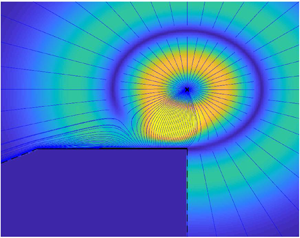
We study the effect of gas rarefaction on the interaction of small thermodynamic non-uniformities with a finite body. Considering a two-dimensional set-up, the initial system state is modelled as slight perturbations over its uniform density and temperature fields, prescribed in the vicinity of a thin plate. The problem is analysed in the collisionless limit and complemented by direct simulation Monte Carlo computations to cover the entire range of gas rarefaction rates. The high-Knudsen ‘sink-like’ and ‘source-like’ propagation patterns observed in the density- and temperature-driven set-ups, respectively, are discussed, together with the impact of specular (smooth) and diffuse (isothermal) wall reflections. At highly rarefied conditions, the solid body obstructs part of the gas domain, preventing the propagation of acoustic disturbances therein. With decreasing gas rarefaction, the acoustic field penetrates the obscured area via the effect of molecular collisions. Inspecting the near-field description, the propagation of flow disturbances along the plate surface is examined, and the acoustic force on the body is computed. In the thermally excited case, both normal- and shear-force components change sign at late times, attracting the plate towards the initial perturbation location. With reducing gas rarefaction, the shear force diminishes while the normal force sharply increases due to the decrease in signal decay. Finally, we apply the analysis to study the impact of gas rarefaction on acoustic reciprocity. Notably, acoustic reciprocity does not hold at non-continuum conditions over non-specular surfaces, where boundary reflections propagate in the presence of few molecular collisions, insufficient to retain reciprocal symmetry.