Refine search
Actions for selected content:
178636 results in Earth and Environmental Sciences

Abiotic crust formation in fallow agricultural desert soils through carbonate cementation reduces fugitive dust
-
- Journal:
- Cambridge Prisms: Drylands / Volume 2 / 2025
- Published online by Cambridge University Press:
- 21 November 2024, e3
-
- Article
-
- You have access
- Open access
- HTML
- Export citation
Contents
-
- Book:
- Vulnerable Earth
- Published online:
- 30 April 2024
- Print publication:
- 21 November 2024, pp v-vi
-
- Chapter
- Export citation
Foreword
-
-
- Book:
- Vulnerable Earth
- Published online:
- 30 April 2024
- Print publication:
- 21 November 2024, pp vii-viii
-
- Chapter
- Export citation
2 - Probabilistic Hazard Assessment
- from Part I - Basics of CAT Modelling
-
- Book:
- Introduction to Catastrophe Risk Modelling
- Published online:
- 08 November 2024
- Print publication:
- 21 November 2024, pp 60-117
-
- Chapter
- Export citation
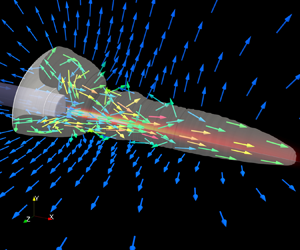
Vapour bubbles produced by long-pulsed laser: a race between advection and phase transition
-
- Journal:
- Journal of Fluid Mechanics / Volume 999 / 25 November 2024
- Published online by Cambridge University Press:
- 21 November 2024, A103
-
- Article
-
- You have access
- Open access
- HTML
- Export citation
-
Vapour bubbles produced by long-pulsed laser often have complex non-spherical shapes that reflect some characteristics of the laser beam. The transition between two commonly observed shapes, namely, a rounded pear-like shape and an elongated conical shape, is studied using a new computational model that combines compressible multiphase fluid dynamics with laser radiation and phase transition. Two laboratory experiments are simulated, in which a holmium:YAG or thulium fibre laser is used to generate bubbles of different shapes. In both cases, the predicted bubble nucleation and morphology agree reasonably well with the experimental observation. The full-field results of laser irradiance, temperature, velocity and pressure are analysed to explain bubble dynamics and energy transmission. It is found that due to the lasting energy input, the vapour bubble's dynamics is driven not only by advection, but also by the continued vaporisation at its surface. Vaporisation lasts less than $1~{\rm \mu}$s in the case of the pear-shaped bubble, compared with over $50~{\rm \mu}$s for the elongated bubble. It is thus hypothesised that the bubble's morphology is determined by competition. When the speed of advection is higher than that of vaporisation, the bubble tends to grow spherically. Otherwise, it elongates along the laser beam direction. To test this hypothesis, the two speeds are defined analytically using a model problem, then estimated for the experiments using simulation results. The results support the hypothesis. They also suggest that when the laser's power is fixed, a higher laser absorption coefficient and a narrower beam facilitate bubble elongation.


Photophysiology of the first reported bleached crustose coralline alga, Clathromorphum sp. (Hapalidiales, Rhodophyta), from Antarctica
-
- Journal:
- Antarctic Science / Volume 37 / Issue 1 / February 2025
- Published online by Cambridge University Press:
- 20 November 2024, pp. 5-12
-
- Article
-
- You have access
- Open access
- HTML
- Export citation
Effect of layer bending on montmorillonite hydration and structure from molecular simulation
-
- Journal:
- Clays and Clay Minerals / Volume 72 / 2024
- Published online by Cambridge University Press:
- 20 November 2024, e24
-
- Article
- Export citation
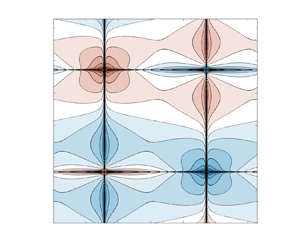
On the inviscid instability of the 2-D Taylor–Green vortex
-
- Journal:
- Journal of Fluid Mechanics / Volume 999 / 25 November 2024
- Published online by Cambridge University Press:
- 20 November 2024, A64
-
- Article
-
- You have access
- Open access
- HTML
- Export citation
Determining the stoichiometric composition of Wyoming montmorillonite using improved transmission electron microscopy-energy dispersive X-ray (TEM-EDX) techniques
-
- Journal:
- Clays and Clay Minerals / Volume 72 / 2024
- Published online by Cambridge University Press:
- 20 November 2024, e25
-
- Article
-
- You have access
- Open access
- HTML
- Export citation
Pore size distribution and water retention in colonized Antarctic Beacon sandstone
-
- Journal:
- Antarctic Science / Volume 36 / Issue 5 / October 2024
- Published online by Cambridge University Press:
- 20 November 2024, pp. 319-325
-
- Article
-
- You have access
- Open access
- HTML
- Export citation
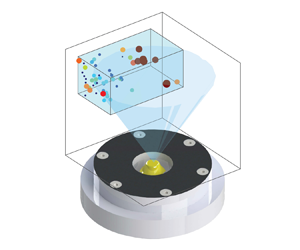
Three-dimensional clustering characteristics of large-Stokes-number dilute sprays interacting with turbulent swirling co-flows
-
- Journal:
- Journal of Fluid Mechanics / Volume 999 / 25 November 2024
- Published online by Cambridge University Press:
- 20 November 2024, A73
-
- Article
-
- You have access
- Open access
- HTML
- Export citation
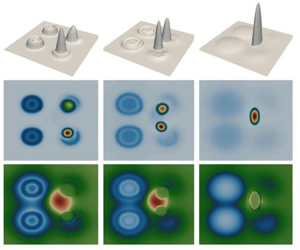
Mean field control of droplet dynamics with high-order finite-element computations
-
- Journal:
- Journal of Fluid Mechanics / Volume 999 / 25 November 2024
- Published online by Cambridge University Press:
- 20 November 2024, A76
-
- Article
- Export citation
New 2-D horizontal free-surface-flow models with applications for water waves
-
- Journal:
- Journal of Fluid Mechanics / Volume 999 / 25 November 2024
- Published online by Cambridge University Press:
- 20 November 2024, A32
-
- Article
-
- You have access
- Open access
- HTML
- Export citation
Graph convolutional network as a fast statistical emulator for numerical ice sheet modeling
-
- Journal:
- Journal of Glaciology / Volume 71 / 2025
- Published online by Cambridge University Press:
- 20 November 2024, e15
-
- Article
-
- You have access
- Open access
- HTML
- Export citation
The minimal flow unit and origin of two-dimensional elasto-inertial turbulence
-
- Journal:
- Journal of Fluid Mechanics / Volume 999 / 25 November 2024
- Published online by Cambridge University Press:
- 20 November 2024, A82
-
- Article
- Export citation
-
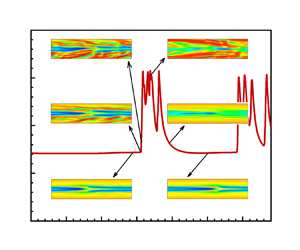
The research on elasto-inertial turbulence (EIT), a new type of turbulent flow, has reached the stage of identifying the minimal flow unit (MFU). On this issue, direct numerical simulations of FENE-P fluid flow in two-dimensional channels with variable sizes are conducted in this study. We demonstrate with the increase of channel length that the simulated flow experiences several different flow patterns, and there exists an MFU for EIT to be self-sustained. At Weissenberg number ( $Wi$) higher than the one required to excite EIT, when the channel length is relatively small, a steady arrowhead regime (SAR) flow structure and a laminar-like friction coefficient is achieved. However, as the channel length increases, the flow can fully develop into EIT characterized with high flow drag. Close to the size of the MFU, the simulated flow behaves intermittently between the SAR state with low drag and EIT state with high drag. The flow falling back to ‘laminar flow’ is caused by the insufficient channel size below the MFU. Furthermore, we give the relationship between the value of the MFU and the effective $Wi$, and explain its physical reasons. Moreover, the intermittent flow regime obtained based on the MFU gives us an opportunity to look into the origin and exciting process of EIT. Through capturing the onset process of EIT, we observed that EIT originates from the sheet-like extension structure located near the wall, which is maybe related to the wall mode rather than the centre mode. The fracture and regeneration of this sheet-like structure is the key mechanism for the self-sustaining of EIT.


Factors governing Fe2+-catalyzed transformation of ferrihydrite associated with kaolinite under anoxic conditions
-
- Journal:
- Clays and Clay Minerals / Volume 72 / 2024
- Published online by Cambridge University Press:
- 20 November 2024, e26
-
- Article
- Export citation
High-bandwidth pressure field imaging of fin-generated shock wave–boundary layer interactions
-
- Journal:
- Journal of Fluid Mechanics / Volume 999 / 25 November 2024
- Published online by Cambridge University Press:
- 19 November 2024, A80
-
- Article
-
- You have access
- Open access
- HTML
- Export citation
-
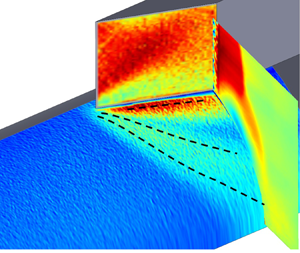
The dynamics of a shock-induced separation unit generated by a 20 $^\circ$ sharp fin placed on a cylindrical surface in a Mach 2.5 flow was investigated. Specifically, the present work investigated the mechanisms that govern the mid-frequency range of separation shock unsteadiness in the fin shock wave–boundary layer interaction (SBLI) unit. Two-dimensional pressure fields were obtained over the cylinder surface spanning the entire fin SBLI unit using high-bandwidth pressure-sensitive paint at 40 kHz imaging rate that allowed probing the low- through mid-frequency ranges of the separation shock unsteadiness. The mean pressure field showed a progressive weakening of the separation shock with downstream distance, which is an artifact of the three-dimensional relief offered by the curved mounting surface. The root-mean-square (r.m.s.) pressure field exhibited a banded structure with elevated $p_{r.m.s.}$ levels beneath the intermittent region, separation vortex and adjacent to the fin root. The power spectral density (PSD) of the surface pressure fluctuations obtained beneath the intermittent region revealed that the separation shock oscillations exhibited the mid-frequency content over the majority of its length. Interestingly, neither the PSD nor the length of the intermittent region varied noticeably with downstream distance, revealing a constant separation shock foot velocity along the entire SBLI. The pressure fluctuation PSD beneath the separation vortex also exhibited the broadband peak at the mid-frequency range of the separation shock motions over the majority of its length within the measurement domain. By contrast, the region adjacent to the fin root exhibited pressure oscillations at a substantially lower frequency compared with the separation shock and the separation vortex. Two-point coherence and cross-correlation analysis provided unique insights into the critical sources and mechanisms that drive the separation shock unsteadiness. The separation vortex and separation shock dynamics were found to be driven by a combination of convecting perturbations that originated from the vicinity of the fin leading edge and the local interactions of the separated flow with the incoming boundary layer. The boundary layer locally strengthened or weakened the convecting pressure perturbations depending on the local momentum fluctuations within the boundary layer.


Automated ablation stakes to constrain temperature-index melt models
-
- Journal:
- Annals of Glaciology / Volume 64 / Issue 92 / September 2023
- Published online by Cambridge University Press:
- 19 November 2024, pp. 425-438
-
- Article
-
- You have access
- Open access
- HTML
- Export citation
-
We developed automated ablation stakes to measure colocated in situ changes in relative glacier-surface elevation and climatological drivers of ablation. The designs, refined over 10 years of development and deployments, implement open-source hardware and common building materials. The ablation stakes record distance to the snow/ice surface, air temperature and relative humidity every 1–15 min. Using these high-frequency data, we demonstrate that melt factors calculated using standard melt-rate vs temperature regressions converge over averaging windows of approximately 12 h or greater. Furthermore, we evaluate an integral approach to estimating temperature-index melt factors for ablation. In a test case on Glaciar Perito Moreno, Argentina, this integral approach reveals an overall positive-degree-day melt factor of 7.5 mm w.e. $^\circ$
 C−1 d−1. We describe four deployments with iteratively improved designs and provide a list of materials required to construct an automated ablation stake.

Rough surfaces in underexplored surface morphology space and their implications on roughness modelling
-
- Journal:
- Journal of Fluid Mechanics / Volume 999 / 25 November 2024
- Published online by Cambridge University Press:
- 19 November 2024, A78
-
- Article
-
- You have access
- Open access
- HTML
- Export citation
-
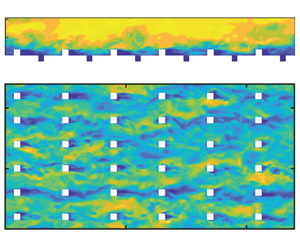
We report direct numerical simulations results of the rough-wall channel, focusing on roughness with high $k_{rms}/k_a$ statistics but small to negative $Sk$ statistics, and we study the implications of this new dataset on rough-wall modelling. Here, $k_{rms}$ is the root mean square, $k_a$ is the first-order moment of roughness height, and $Sk$ is the skewness. The effects of packing density, skewness and arrangement of roughness elements on mean streamwise velocity, equivalent roughness height ( $z_0$) and Reynolds and dispersive stresses have been studied. We demonstrate that two-point correlation lengths of roughness height statistics play an important role in characterizing rough surfaces with identical moments of roughness height but different arrangements of roughness elements. Analysis of the present as well as historical data suggests that the task of rough-wall modelling is to identify geometric parameters that distinguish the rough surfaces within the calibration dataset. We demonstrate a novel feature selection procedure to determine these parameters. Further, since there is no finite set of roughness statistics that distinguish between all rough surfaces, we argue that obtaining a universal rough-wall model for making equivalent sand-grain roughness ( $k_s$) predictions would be challenging, and that each rough-wall model would have its applicable range. This motivates the development of group-based rough-wall models. The applicability of multi-variate polynomial regression and feedforward neural networks for building such group-based rough-wall models using the selected features has been shown.


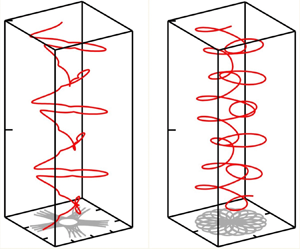
U-shaped disks in Stokes flow: chiral sedimentation of a non-chiral particle
-
- Journal:
- Journal of Fluid Mechanics / Volume 999 / 25 November 2024
- Published online by Cambridge University Press:
- 19 November 2024, A71
-
- Article
-
- You have access
- Open access
- HTML
- Export citation
