Refine search
Actions for selected content:
178636 results in Earth and Environmental Sciences
Analysing policy gaps in protecting avian species from electrocution and power-line collision in Kenya
-
- Journal:
- Environmental Conservation / Volume 51 / Issue 4 / December 2024
- Published online by Cambridge University Press:
- 19 November 2024, pp. 290-294
-
- Article
-
- You have access
- Open access
- HTML
- Export citation
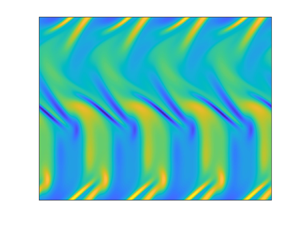
On statistical zonostrophic instability and the effect of magnetic fields
-
- Journal:
- Journal of Fluid Mechanics / Volume 999 / 25 November 2024
- Published online by Cambridge University Press:
- 19 November 2024, A77
-
- Article
-
- You have access
- Open access
- HTML
- Export citation
A multidimensional approach to knowledge coproduction in glaciology
-
- Journal:
- Journal of Glaciology / Volume 70 / 2024
- Published online by Cambridge University Press:
- 19 November 2024, e35
-
- Article
-
- You have access
- Open access
- HTML
- Export citation
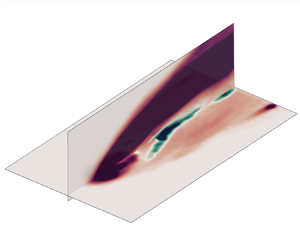
On the origin of counter-gradient transport in turbulent scalar flux: physics interpretation and adjoint data assimilation
-
- Journal:
- Journal of Fluid Mechanics / Volume 999 / 25 November 2024
- Published online by Cambridge University Press:
- 19 November 2024, A81
-
- Article
- Export citation
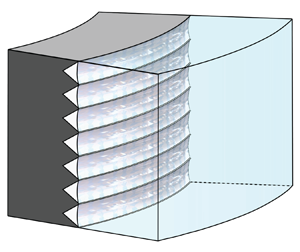
Friction drag reduction of Taylor–Couette flow over air-filled microgrooves
-
- Journal:
- Journal of Fluid Mechanics / Volume 999 / 25 November 2024
- Published online by Cambridge University Press:
- 19 November 2024, A63
-
- Article
- Export citation
-
Reducing drag under high turbulence is a critical but challenging issue that has engendered great concern. This study utilizes hydrophilic tips in superhydrophobic (SHP) grooves to enhance the stability of plastron, which results in a considerable drag reduction ( $DR$) up to 62 %, at Reynolds number ( $Re$) reaching $2.79 \times 10^{4}$. The effect of the spacing width $w$ of the microgrooves on both $DR$ and flow structures is investigated. Experimental results demonstrate that $DR$ increases as either microgroove spacing $w$ or $Re$ increases. The velocity fields obtained using particle image velocimetry indicate that the air-filled SHP grooves induce a considerable wall slip. This slip significantly weakens the intensity of Taylor rolls, reduces local momentum transport, and consequently lowers drag. This phenomenon becomes more pronounced with increasing $w$. Furthermore, to quantify the multiscale relationship between global response and geometrical as well as driving parameters, $DR\sim (w, \phi _s, Re)$, a theoretical model is established based on angular momentum defect theory and magnitude estimate. It is demonstrated that a decrease in the surface solid fraction can reduce wall shear, and an increase in the groove width can weaken turbulence kinetic energy production, rendering enhanced slip and drag reduction. This research has implications for designing and optimizing turbulent-drag-reducing surfaces in various engineering applications, such as transportation and marine engineering.


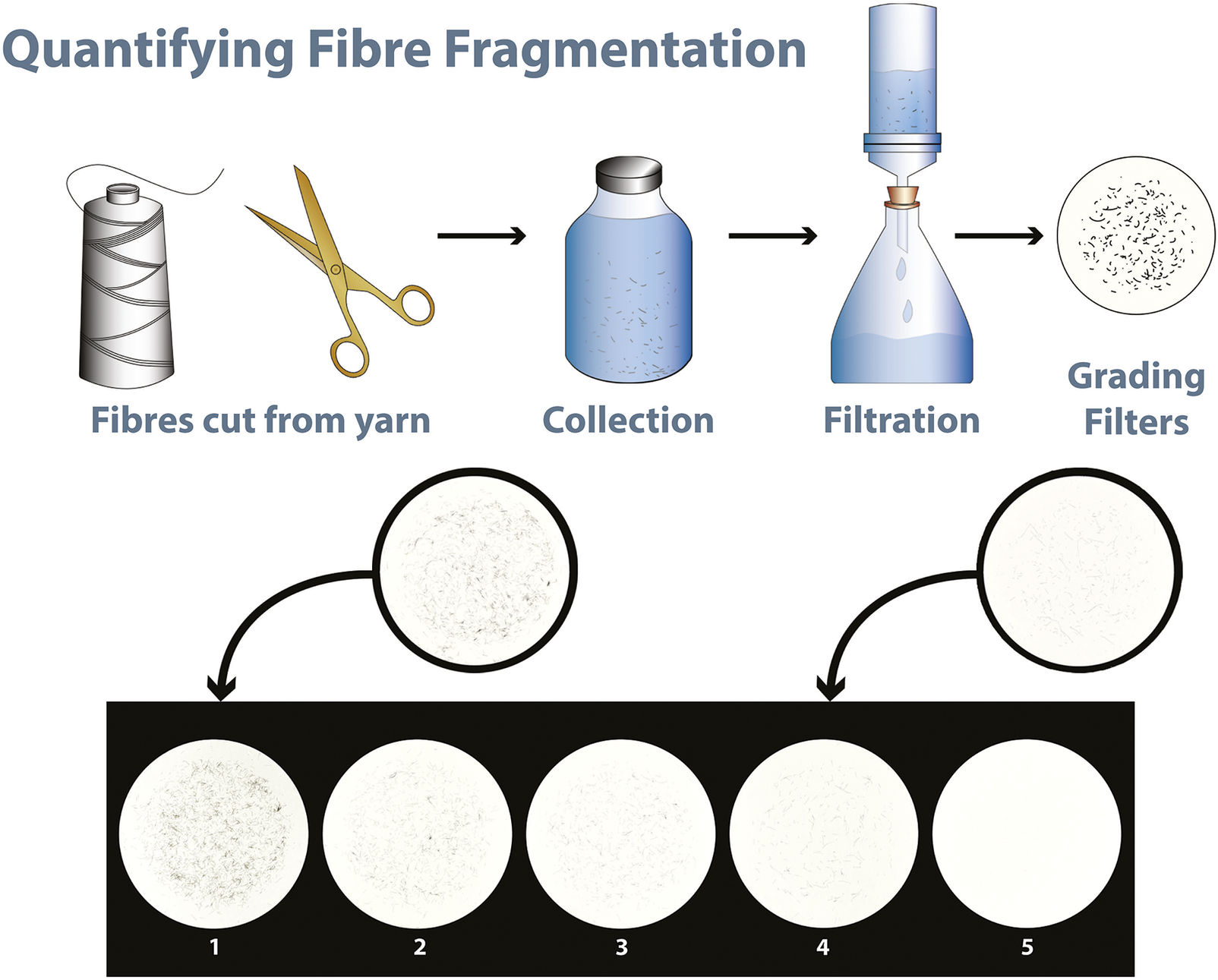
Low-cost, high-throughput quantification of microplastics released from textile wash tests: Introducing the fibre fragmentation scale
- Part of
-
- Journal:
- Cambridge Prisms: Plastics / Volume 2 / 2024
- Published online by Cambridge University Press:
- 19 November 2024, e30
-
- Article
-
- You have access
- Open access
- HTML
- Export citation
Trade of legally protected orchids in Indonesian e-commerce markets
-
- Journal:
- Environmental Conservation / Volume 51 / Issue 4 / December 2024
- Published online by Cambridge University Press:
- 19 November 2024, pp. 295-301
-
- Article
- Export citation
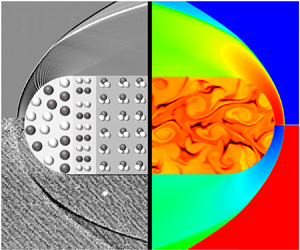
Curved detonation equations with analysis and its applications
-
- Journal:
- Journal of Fluid Mechanics / Volume 999 / 25 November 2024
- Published online by Cambridge University Press:
- 19 November 2024, A79
-
- Article
- Export citation
Negotiating extirpation: On the political implications of declaring dugongs extinct in Okinawan waters
-
- Journal:
- Cambridge Prisms: Extinction / Volume 2 / 2024
- Published online by Cambridge University Press:
- 19 November 2024, e16
-
- Article
-
- You have access
- Open access
- HTML
- Export citation
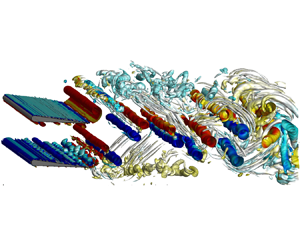
The effect of foil proximity on shear-layer instability around oscillating foils
-
- Journal:
- Journal of Fluid Mechanics / Volume 999 / 25 November 2024
- Published online by Cambridge University Press:
- 19 November 2024, A70
-
- Article
-
- You have access
- Open access
- HTML
- Export citation
-
Three-dimensional vortex dynamics around two pitching foils arranged in side-by-side (parallel) configurations is numerically examined at a range of separation (gap) distances ( $0.5c \leqslant y^* \leqslant 1.5c$). In-phase ( $\phi =0$) and out-of-phase ( $\phi ={\rm \pi}$) motions are considered for Strouhal numbers of $0.3$ and $0.5$ at a Reynolds number of $8000$. In this work, we show that the foil proximity effect, defined as the influence of one foil on the flow characteristics around the other, induces a spanwise instability in the braids of trailing-edge vortices (TEVs) during their roll-up. This is a newly identified instability that manifests itself in the form of secondary vortical structures with opposite circulation compared with the TEVs formed on the foils, which leads to the formation of double necking on the braids of the TEVs. We provide quantitative evidence linking the formation of these secondary structures to the braid instability. The first neck merges with the TEV, while the second neck detaches from the braid region and moves downstream independently. As the foil proximity effect intensifies (spacing between the foils decreases), secondary vortical structures, as well as the necks, become more prominent, leading to the emergence of three-dimensional wake features. Lastly, the influence of kinematics of the foils on three-dimensionality of the wake is investigated. At higher Strouhal numbers, broader regions of high strain are developed near the trailing edge, associated with the detachment of stronger structures from the braids of TEVs. The characterized instability demonstrates consistent properties for in-phase and out-of-phase motions, albeit with specific differences in dynamics of leading-edge vortices.


A one-day experiment quantifying subaqueous bleaching of K-feldspar luminescence signals in the Wadden Sea, the Netherlands
-
- Journal:
- Netherlands Journal of Geosciences / Volume 103 / 2024
- Published online by Cambridge University Press:
- 19 November 2024, e22
-
- Article
-
- You have access
- Open access
- HTML
- Export citation
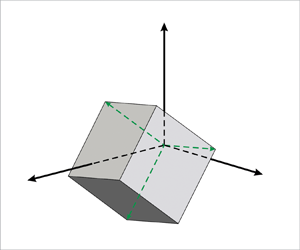
Effect of filter type on the topology of the eigenframe of the subfilter stress tensor and interscale energy transfer
-
- Journal:
- Journal of Fluid Mechanics / Volume 999 / 25 November 2024
- Published online by Cambridge University Press:
- 18 November 2024, A67
-
- Article
- Export citation
-
Effects of different filter kernels, namely, spectral cutoff ( $\mathcal {S}$-filter) and Gaussian ( $\mathcal {G}$-filter), on the geometrical properties of the subfilter stress (SFS) tensor and the filtered strain-rate (FSR) tensor are analysed in a forced homogeneous isotropic turbulence. Utilizing the Euler angle–axis methodology, it is observed that despite similar mean behaviour, the eigenframe alignment between SFS and FSR exhibits a non-trivially different statistical distribution for two different filters. Besides the eigenframe alignment, the eigenstructure of these tensors is also investigated. It is found that in contrast to the eigenstructure of the FSR which does not show sensitive dependence on the filter kernel type, the eigenstructure of the SFS tensor is significantly influenced by the filter type. Subsequently, the impact of different filter kernels on the subfilter energy flux (SFEF) is investigated. It is observed that energy transfer in $\mathcal {G}$-filtering is preferably distributed over the forward region, whereas for the $\mathcal {S}$-filter, the SFEF is more evenly distributed over both forward–backward regions, leading to a heavy energy transfer cancellation. Additionally, by decomposing the SFEF into different partial energy fluxes, it is found that the impact of the $\mathcal {S}$-filtering on the eigenstructure of the SFS leads to the amplification of the backward energy transfer. Conversely, the $\mathcal {G}$-filtering amplifies the forward energy transfer by producing a more pronounced alignment between the contractive–extensive eigenvectors.


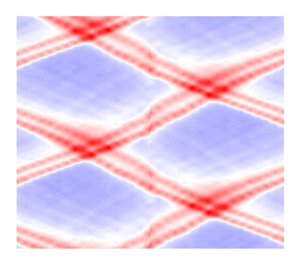
Resonant surface waves in an oscillating periodic tank with a submerged hill
-
- Journal:
- Journal of Fluid Mechanics / Volume 999 / 25 November 2024
- Published online by Cambridge University Press:
- 18 November 2024, A69
-
- Article
-
- You have access
- Open access
- HTML
- Export citation
-
Experimental studies on the sloshing of fluid layers are usually performed in rectangular tanks with fixed boundaries. In contrast, the present study uses a 4.76-m-long circular channel, a geometry with open periodic boundaries. Surface waves are excited by means of a submerged hill that, together with the tank, performs a harmonic oscillation. Laboratory measurements are made using 18 ultrasonic probes, evenly distributed over the channel to track the wave propagation. It is shown that a two-dimensional long-wave numerical model derived via the Kármán–Pohlhausen approach reproduces the experimental data as long as the forcing is monochromatic. The sloshing experiments imply a highly complex surface wave field. Different wave types such as solitary waves, undular bores and antisolitary waves are observed. For order one $\delta _{hill} = h_{hill}/h_0$, where $h_0$ is the mean water level and $h_{hill}$ the obstacle's height, the resonant reflections of solitary waves by the submerged obstacle give rise to an amplitude spectrum for which the main resonance peaks can be explained by linear theory. For smaller $\delta _{hill}$, wave transmissions lead to major differences with respect to the more common cases of sloshing with closed ducts having fully reflective ends for which wave transmission through the end walls is not possible. This ultimately results in more complex resonance diagrams and a pattern formation that changes rather abruptly with the frequency. The experiments are of interest not only for engineering applications but also for tidal flows over bottom topography.


A stable isotope (S, C and O) study of metamorphosed polymetallic sulphide deposits in the Bergslagen district, Sweden: The Stollberg example
-
- Journal:
- Geological Magazine / Volume 161 / 2024
- Published online by Cambridge University Press:
- 18 November 2024, e16
-
- Article
-
- You have access
- Open access
- HTML
- Export citation
The influence of the shock-to-reshock time on the Richtmyer–Meshkov instability in reshock
-
- Journal:
- Journal of Fluid Mechanics / Volume 999 / 25 November 2024
- Published online by Cambridge University Press:
- 18 November 2024, A68
-
- Article
-
- You have access
- Open access
- HTML
- Export citation
-
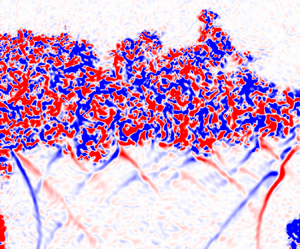
Experiments on the Richtmyer–Meshkov instability (RMI) in a dual driver vertical shock tube (DDVST) are described. An initially planar, stably stratified membraneless interface is formed by flowing air from above and sulfur hexafluoride from below the interface location using the method of Jones & Jacobs (Phys. Fluids, vol. 9, issue 1997, 1997, pp. 3078–3085). A random three-dimensional, multi-modal initial perturbation is imposed by vertically oscillating the gas column to produce Faraday waves. The DDVST design generates two shock waves, one originating above and one below the interface, with these shocks having independently controllable strengths and interface arrival times. The shock waves have nominal strengths of $M_L=1.17$ and $M_H=1.18$ for the shock wave originating in the light and heavy gas, respectively, with these strengths chosen to result in arrested bulk interface motion following reshock. The influence of the length of the shock-to-reshock time, as well as the order of shock arrival, on the post-reshock RMI is examined. The mixing layer width grows according to $h\propto t^\theta$, where $\theta _H=0.36\pm 0.018$ (95 %) and $\theta _L=0.38\pm 0.02$ (95 %) for heavy and light shock first experiments, respectively, indicating no strong dependence on the order of shock wave arrival. Volume integrated specific turbulent kinetic energy (TKE) in the mixing layer versus time is found to decay according to $E_{tot}/\bar {\rho }\propto t^p$ with $p_H=-0.823\pm 0.06$ (95 %) and $p_L=-1.061\pm 0.032$ (95 %) for heavy and light shock first experiments, respectively. Notably, the 95 % confidence intervals do not overlap. Analysis on the influence of the shock-to-reshock time on turbulent length scales, transition criteria, spectra and mixing layer anisotropy are also presented.


Numerical simulation of glacier terminus evolution using the dual action principle for momentum balance
-
- Journal:
- Journal of Glaciology / Volume 71 / 2025
- Published online by Cambridge University Press:
- 18 November 2024, e14
-
- Article
-
- You have access
- Open access
- HTML
- Export citation
Calving dynamics at Jakobshavn Isbrae (Sermeq Kujalleq) controlled by local geometry: insights from a 3D Stokes calving model
-
- Journal:
- Journal of Glaciology / Volume 70 / 2024
- Published online by Cambridge University Press:
- 18 November 2024, e7
-
- Article
-
- You have access
- Open access
- HTML
- Export citation
Aerodynamic heating in hypersonic shock wave and turbulent boundary layer interaction
-
- Journal:
- Journal of Fluid Mechanics / Volume 999 / 25 November 2024
- Published online by Cambridge University Press:
- 18 November 2024, A66
-
- Article
- Export citation
-
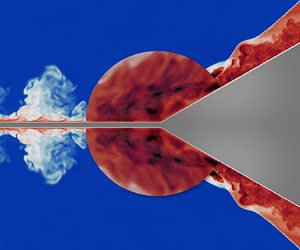
In hypersonic flight the shock wave and turbulent boundary layer interaction (STBLI) sharply increases wall heat transfer that intensifies the aerodynamic heating problems. In this work the STBLI is modelled by compression ramp flow with a Mach number of 5, a Reynolds number based on momentum thickness of 4652 and a wall to recovery temperature ratio of 0.5. The aerodynamic heat generation and transport mechanisms are investigated in the interaction based on theoretical analysis and direct numerical simulation (DNS) that agrees with previous studies. A prediction correlation of wall heat flux in STBLI is deduced theoretically and validated by some representative data including the present DNS, which improves the prediction accuracy and can be applied to a wider $Ma$ range compared with the canonical Q-P theory. The correlation indicates that the sharp increase of wall heat transfer in the STBLI can be explained by the boundary layer compression and the convection transport enhancement. Based on the DNS results, the aerodynamic heat generation and transport mechanisms are revealed in the separation, recirculation and reattachment zones in the STBLI. From this perspective, the peak heat flux can be further explained by the enhancement of near-wall turbulent energy dissipation, compression aerodynamic heat generation and the near-wall turbulent transport. The generation and transport of compression aerodynamic heat reveal the underlying mechanism of the strong correlation between the peak heat flux ratios and the pressure ratios in STBLIs.

Effect of an incoming Gaussian wave packet on underlying turbulence
-
- Journal:
- Journal of Fluid Mechanics / Volume 999 / 25 November 2024
- Published online by Cambridge University Press:
- 18 November 2024, A45
-
- Article
-
- You have access
- Open access
- HTML
- Export citation

On the boundary-layer asymmetry in two-dimensional annular Rayleigh–Bénard convection subject to radial gravity
-
- Journal:
- Journal of Fluid Mechanics / Volume 999 / 25 November 2024
- Published online by Cambridge University Press:
- 18 November 2024, R1
-
- Article
-
- You have access
- Open access
- HTML
- Export citation
-
Radial unstable stratification is a potential source of turbulence in the cold regions of accretion disks. To investigate this thermal effect, here we focus on two-dimensional Rayleigh–Bénard convection in an annulus subject to radially dependent gravitational acceleration $g \propto 1/r$. Next to the Rayleigh number $Ra$ and Prandtl number $Pr$, the radius ratio $\eta$, defined as the ratio of inner and outer cylinder radii, is a crucial parameter governing the flow dynamics. Using direct numerical simulations for $Pr=1$ and $Ra$ in the range from $10^7$ to $10^{10}$, we explore how variations in $\eta$ influence the asymmetry in the flow field, particularly in the boundary layers. Our results show that in the studied parameter range, the flow is dominated by convective rolls and that the thermal boundary-layer (TBL) thickness ratio between the inner and outer boundaries varies as $\eta ^{1/2}$. This scaling is attributed to the equality of velocity scales in the inner ( $u_i$) and outer ( $u_o$) regions. We further derive that the temperature drops in the inner and outer TBLs scale as $1/(1+\eta ^{1/2})$ and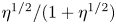 $\eta ^{1/2}/(1+\eta ^{1/2})$, respectively. The scalings and the temperature drops are in perfect agreement with the numerical data.


