To save content items to your account,
please confirm that you agree to abide by our usage policies.
If this is the first time you use this feature, you will be asked to authorise Cambridge Core to connect with your account.
Find out more about saving content to .
To save content items to your Kindle, first ensure no-reply@cambridge.org
is added to your Approved Personal Document E-mail List under your Personal Document Settings
on the Manage Your Content and Devices page of your Amazon account. Then enter the ‘name’ part
of your Kindle email address below.
Find out more about saving to your Kindle.
Note you can select to save to either the @free.kindle.com or @kindle.com variations.
‘@free.kindle.com’ emails are free but can only be saved to your device when it is connected to wi-fi.
‘@kindle.com’ emails can be delivered even when you are not connected to wi-fi, but note that service fees apply.
Stray light from the sun is one of the most significant factors affecting image quality for the optical system of a spacecraft. This paper proposes a method to design a deployable supporting mechanism for the sunshield based on origami. Firstly, a new type of space mechanism with single-closed loop was proposed according to thick-panel origami, and its mobility was analysed by using the screw theory. In order to design a deployable structure with high controllability, the tetrahedral constraint was introduced to reduce the degree of freedom (DOF), and a corresponding deployable unit named tetrahedral deployable unit (TDU) was obtained. Secondly, the process to constructing a large space deployable mechanism with infinite number of units was explained based on the characteristics of motion and planar mosaic array, and kinematics analysis and folding ratio of supporting mechanism were conducted. A physical prototype was constructed to demonstrate the mobility and deployment of the supporting mechanism. Finally, based on the Lagrange method, a dynamic model of supporting mechanism was established, and the influence of the torsion spring parameters on the deployment process was analysed.
Robotic systems, and in particular mobile robotic systems, are the embodiment of a set of complex computational processes, mechanical systems, sensors, user interface, and communications infrastructure. The problems inherent in integrating these components into a working robot can be very challenging. Overall system control requires an approach that can properly handle the complexity of the system goals while dealing with poorly defined tasks and the existence of unplanned and unexpected events. This task is complicated by the non-standard nature of much robotic equipment. Often the hardware seems to have been built following a philosophy of “ease of design” rather that with an eye toward assisting with later system integration.
Some think a green future is the start of world government with distant administrators telling us what to do and think. But such thinking couldn’t be more wrong. Today, most of our energy is already controlled by distant powers, whether renewable or not, either in uncaring corporate boardrooms or by autocratic state players. If we want more control of our daily lives, smaller-sized, scalable renewable energy allows us to become self-sufficient, letting us make our own decisions about our own needs. With an off-grid power setup, no one can tell me what to do.
Most importantly, no one has to go to war again in my name to secure my energy. Conservation, the circular economy, and the concept of “negawatts” are explained using everyday examples in the house, on the road, and in modern industry. Each watt not consumed is a watt saved. Ways to save energy and money through increased efficiency and changed consumer habits are discussed as is the sharing economy that sees fewer cars needed for personal use. Modern fixes to decrease the rise of greenhouse gases are discussed and the failure of government policy to limit global warming.
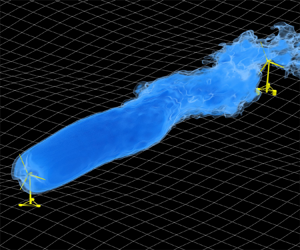
We propose a linearized deterministic model for predicting coherent structures in the wake of a floating offshore wind turbine subject to platform motions. The model's motion-to-wake predictive capability is achieved through two building blocks: a motion-to-forcing (M2F) part and a forcing-to-wake (F2W) part. The M2F model provides a unified framework to parameterize the effects of arbitrary floating wind turbine motions as unsteady loads of a fixed actuator disk, requiring only the radial distribution of the aerodynamics force coefficient on the blade as input. The F2W model is derived based on a bi-global resolvent model obtained from the linearized Navier–Stokes equations, using the time-averaged wake of a fixed wind turbine as input. In addition to its capability of predicting sensitive frequency ranges, the model excels linear stability analysis by providing spatial modes of the wake response in a motion-specific and phase-resolved manner. The model successfully predicts the wake pulsing mode induced by surge, as well as the similarity and difference of the wake meandering modes caused by sway and yaw. Large-eddy simulations under different inflow turbulence intensities (TIs) and length scales are further conducted to analyse the wake meandering triggered by the simultaneous excitation of free-stream turbulence and sway motion. The results show distinct frequency signatures for the wake dynamics induced by ambient turbulence and sway motion. The inflow TI is found to have a stabilizing effect on the wake, reducing the motion-induced wake responses. Such a stabilizing effect is captured satisfactorily with the proposed model, provided that the effective viscosity is calibrated properly using the data from the fixed turbine wake under the corresponding turbulent inflow.
The fundamentals of analog and digital modulation techniques are presented in Chapter 6. The theoretical underpinnings of the world's most popular amplitude modulations, frequency modulations, and phase modulations are presented. The impact of pulse shape and filtering on bit error rate of a mobile communication system is demonstrated, where Doppler spread creates an irreducible bit error rate no matter how good the signal-to-noise ratio, yet is below the noise created by other aspects of the radio system. This led Europe to select GMSK for the pan-European 2G digital cellular standard, whereas the US selected a pi/4 PSK modulation method originated in Japan that allows both coherent and non-coherent demodulation and a graceful upgrade path for existing operators to adopt the new digital modulation with gradual base station changeouts over time.Capacity and Shannon's limit are defined and explained through numerous examples.
The dynamic charge density of KZnB3O6, which contains edge-sharing BO4 units, has been characterized using laboratory and synchrotron X-ray diffraction techniques. The experimental electron density distribution (EDD) was constructed using the maximum-entropy method (MEM) from single crystal diffraction data obtained at 81 and 298 K. Additionally, MEM-based pattern fitting (MPF) method was employed to refine the synchrotron powder diffraction data obtained at 100 K. Both the room-temperature single crystal diffraction data and the cryogenic synchrotron powder diffraction data reveal an intriguing phenomenon: the edge-shared B2O2 ring exhibits a significant charge density accumulation between the O atoms. Further analysis of high-quality single crystal diffraction data collected at 81 K, with both high resolution and large signal-to-noise ratio, reveals no direct O–O bonding within the B2O2 ring. The experimental EDD of KZnB3O6 obtained aligns with the results obtained from ab-initio calculations. Our work underscores the importance of obtaining high-quality experimental data to accurately determine EDDs.
The great discoveries of the past two and a half centuries – the steam engine, electromagnetic induction, the electric power grid, the internal combustion engine, the transistor, personal computers, the internet – change not just the way we live, but an entire global economy. Nothing, however, created more change or made more millionaires than one discovery. By the early 1900s, the iron carriage had made its appearance on the streets of our booming cities, but a new kind of engine and a new kind of fuel would be needed to make a “gasmobile” run. Oil.
Despite the many advances, however, since the start of the petroleum era, ecosystems are failing because of increased industrialization, combustion pollution, and greenhouse gases. Are we seeing the beginning of the end, the twilight of our most gleaming idol? Is the next great global energy transition being forced upon us? In the words of Ahmed Zaki Yamani, Saudi oil minister from 1962 to 1986, “the Stone Age did not end for lack of stone and the Oil Age will end long before the world runs out of oil.” Alas, short-term profits and share price is still being valued over environmental degradation and global warming.
The ability to navigate purposefully through its environment is fundamental to most animals and to every intelligent organism. In this book we examine the computational issues specific to the creation of machines that move intelligently in their environment. From the earliest modern speculation regarding the creation of autonomous robots, it was recognized that regardless of the mechanisms used to move the robot around or the methods used to sense the environment, the computational principles that govern the robot are of paramount importance. As Powell and Donovan discovered in Isaac Asimov’s story “Runaround,” subtle definitions within the programs that control a robot can lead to significant changes in the robot’s overall behavior or action. Moreover, interactions among multiple complex components can lead to large-scale emergent behaviors that may be hard to predict.