Refine search
Actions for selected content:
212953 results in Engineering
Interfaces of high- and low-speed large-scale structures in compressible turbulent mixing layers: compressibility effects and structures
-
- Journal:
- Journal of Fluid Mechanics / Volume 981 / 25 February 2024
- Published online by Cambridge University Press:
- 15 February 2024, A6
-
- Article
- Export citation
-
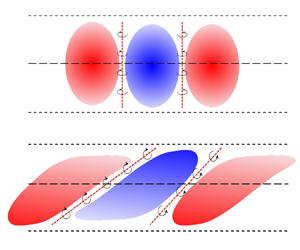
Direct numerical simulations of temporally developing mixing layers have been performed to investigate the effects of compressibility on statistics and structures near the interfaces of high- and low-speed large-scale structures (LSSs), covering a range of convective Mach numbers from $M_c=0.2$ to $1.8$ and Taylor Reynolds numbers up to 290. The interfaces of LSSs are directly defined by the isosurface of zero fluctuating streamwise velocity. The characteristic velocity jump at the interfaces grows rapidly in the transition stage and then decreases until reaching a gradual self-similar stage. The evolution of velocity jump is evidently delayed as the convective Mach number increases. The interface layer is formed by the shearing motion of neighbouring LSSs. A small vortical motion characterized by the Kolmogorov scale is induced in the interface layer by shear-dominated outer regions. The strengths of outer shearing motion and central vortical motion are greater at the leading edge, but smaller at the trailing edge, which is also reflected in a larger velocity jump at the leading edge. As the convective Mach number increases, the small-scale vortical structure is obviously suppressed by compressibility. At high convective Mach number $M_c=1.8$, the compressive shear-dominated outer regions are linked with a sheet-like structure passing through the centre of the expansion region corresponding to a small-scale vortical structure. The compressibility and shearing strength near the interface are highly dependent on the interface orientation.


Effects of dilatation and turbulence on tangential strain rates in premixed hydrogen and iso-octane flames
-
- Journal:
- Journal of Fluid Mechanics / Volume 981 / 25 February 2024
- Published online by Cambridge University Press:
- 15 February 2024, A5
-
- Article
-
- You have access
- Open access
- HTML
- Export citation
Dancing ejecta
-
- Journal:
- Journal of Fluid Mechanics / Volume 981 / 25 February 2024
- Published online by Cambridge University Press:
- 15 February 2024, A4
-
- Article
-
- You have access
- Open access
- HTML
- Export citation
-
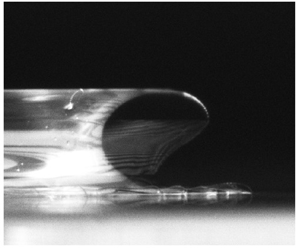
Splashing of impacting drops produces a myriad of secondary spray droplets, which generate aerosols during rain on the ocean and can cause health hazards during the spraying of pesticides or enhance the droplet transmission of disease. Determining the size and number of the finest splashed droplets is therefore of practical interest. Herein, we use a novel experimental facility with a 26 m tall vacuum tube, to study well-controlled drop impacts at velocities as high as 22 m s $^{-1}$, where we reach parameter regimes not studied before using freely falling drops. Using extreme video frame rates, we pinpoint the primary source of the finest spray, coming from the catastrophic bending and rupture of the sub-micron-thick ejecta sheet, which emerges at a high speed from the neck connecting the drop and pool. The axisymmetric bending and convoluted ejecta shapes are driven primarily by resistance from the surrounding air, but also depend on the viscosity difference between drop and pool, which influences the initial ejection angle of the sheet. These extreme impact conditions provide new insights into general spray formation, through a sequence of bucklings of the rising ejecta, which dances next to the drop surface and can also form an enclosed air torus.

Design of dual-band tunable bandpass filter with constant absolute bandwidth based on triple transmission path
-
- Journal:
- International Journal of Microwave and Wireless Technologies / Volume 16 / Issue 4 / May 2024
- Published online by Cambridge University Press:
- 14 February 2024, pp. 670-680
-
- Article
- Export citation
The influence of turbulence and inertia in radial fracture flow
-
- Journal:
- Journal of Fluid Mechanics / Volume 981 / 25 February 2024
- Published online by Cambridge University Press:
- 14 February 2024, A1
-
- Article
-
- You have access
- Open access
- HTML
- Export citation
-
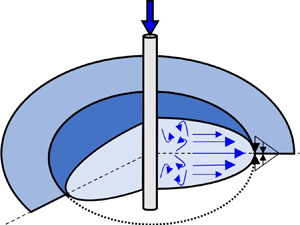
Industrial applications of flow through fractures such as geothermal energy or hydraulic stimulation involve forcing large flow rates through small fractures, thereby inducing inertial fluid behaviours and turbulence. The most common fracture flow model, Poiseuille flow (the cubic law), is incapable of capturing these phenomena and thus the impact of inertial and turbulent forces in fracture flow has remained relatively unexplored. The GG22 flow model is a newly derived fracture flow model that is capable of capturing inertial, transient and turbulent forces. In this article, we apply the GG22 flow model to hydraulic stimulation of radial fractures for the first time to determine how these phenomena manifest. We show that inertia and turbulence only manifest near the wellbore (within 30 radii) and lead to changes in fracture shape and injection pressure but have little impact on tip behaviour. Turbulence increases wellbore pressure and aperture while inertia decreases wellbore pressure and aperture. The majority of the pressure loss along the fracture occurs near the wellbore and is captured by turbulence where entrance correction factors would otherwise be needed. Using water, turbulence is the dominant mechanism that causes departures from Poiseuille flow at high $Re$. The solution departs immediately upon the manifestation of turbulence (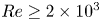 $Re\geq 2\times 10^3$), while inertial effects manifest at higher flow rates ( $Re\geq 2\times 10^4$). Using slickwater, the opposite trend is observed: inertial effects manifest first (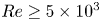 $Re\geq 5\times 10^3$), while turbulent effects are delayed ( $Re\geq 10^4$). In both cases, the threshold for departures from the Poiseuille flow solution are low and the differences are large.


FLM volume 980 Cover and Front matter
-
- Journal:
- Journal of Fluid Mechanics / Volume 980 / 10 February 2024
- Published online by Cambridge University Press:
- 14 February 2024, p. f1
-
- Article
-
- You have access
- Export citation
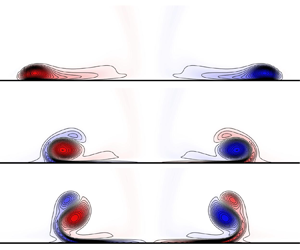
Vorticity dynamics at partial-slip boundaries
-
- Journal:
- Journal of Fluid Mechanics / Volume 980 / 10 February 2024
- Published online by Cambridge University Press:
- 13 February 2024, A58
-
- Article
-
- You have access
- Open access
- HTML
- Export citation
Wideband filtering power amplifier based on terminated coupled line structure
-
- Journal:
- International Journal of Microwave and Wireless Technologies / Volume 16 / Issue 3 / April 2024
- Published online by Cambridge University Press:
- 13 February 2024, pp. 418-423
-
- Article
- Export citation
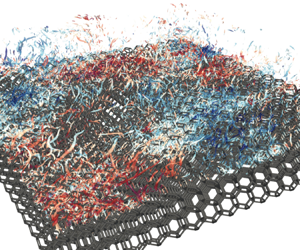
Reynolds number dependence of turbulent flows over a highly permeable wall
-
- Journal:
- Journal of Fluid Mechanics / Volume 981 / 25 February 2024
- Published online by Cambridge University Press:
- 13 February 2024, A3
-
- Article
- Export citation
-
Direct numerical simulations of turbulent flows over highly permeable porous walls were performed at various Reynolds numbers to examine the effects of the Reynolds number on permeable wall turbulence. The porous medium consisted of Kelvin cell arrays with porosity $0.95$, and the permeability Reynolds number $Re_K$ ranged from approximately 7 to 50. Simulations with thin and thick porous walls were performed to investigate the effects of spanwise roller vortices associated with the Kelvin–Helmholtz instability. The results show that the effect of the Kelvin–Helmholtz instability becomes more significant with increasing the permeability Reynolds number, and spanwise rollers, for which length scale is an order of channel height, dominate turbulence when $Re_K \gtrsim 30$. Spanwise rollers reinforce the negative correlation between the wall-normal and streamwise velocity fluctuations close to the porous/fluid interface, and intensify the turbulent velocity fluctuations away from the porous walls, leading to increased frictional resistance. An investigation of the Reynolds number dependence of the modified logarithmic law indicates that the zero-plane displacement and equivalent roughness height are proportional to the square root of permeability, whereas the von Kármán constant increases with the permeability Reynolds number because of the increased mixing length resulting from the relatively large-scale velocity fluctuations induced by spanwise rollers. We developed a model for the modified log law for permeable wall turbulence based on permeability, and confirmed that the skin friction coefficient obtained from the model reasonably predicts the skin friction coefficient for several types of high-porosity porous media. Hence, permeability is a key parameter that characterizes the logarithmic mean velocity profiles over a variety of porous media with high porosity.


Inertial enhancement of the polymer diffusive instability
-
- Journal:
- Journal of Fluid Mechanics / Volume 981 / 25 February 2024
- Published online by Cambridge University Press:
- 13 February 2024, A2
-
- Article
-
- You have access
- Open access
- HTML
- Export citation
-
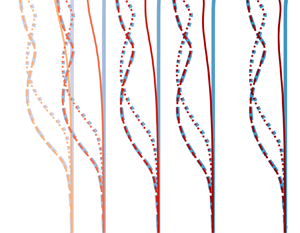
Beneitez et al. (Phys. Rev. Fluids, vol. 8, 2023, L101901) have recently discovered a new linear ‘polymer diffusive instability’ (PDI) in inertialess rectilinear viscoelastic shear flow using the finitely extensible nonlinear elastic constitutive model of Peterlin (FENE-P) when polymer stress diffusion is present. Here, we examine the impact of inertia on the PDI for both plane Couette and plane Poiseuille flows under varying Weissenberg number ${W}$, polymer stress diffusivity $\varepsilon$, solvent-to-total viscosity ratio $\beta$ and Reynolds number ${Re}$, considering the FENE-P and simpler Oldroyd-B constitutive relations. Both the prevalence of the instability in parameter space and the associated growth rates are found to significantly increase with ${Re}$. For instance, as $Re$ increases with $\beta$ fixed, the instability emerges at progressively lower values of $W$ and $\varepsilon$ than in the inertialess limit, and the associated growth rates increase linearly with $Re$ when all other parameters are fixed. For finite $Re$, it is also demonstrated that the Schmidt number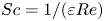 $Sc=1/(\varepsilon Re)$ collapses curves of neutral stability obtained across various $Re$ and $\varepsilon$. The observed strengthening of PDI with inertia and the fact that stress diffusion is always present in time-stepping algorithms, either implicitly as part of the scheme or explicitly as a stabilizer, implies that the instability is likely operative in computational work using the popular Oldroyd-B and FENE-P constitutive models. The fundamental question now is whether PDI is physical and observable in experiments, or is instead an artifact of the constitutive models that must be suppressed.


Versatile and non-versatile occupational back-support exoskeletons: A comparison in laboratory and field studies – ADDENDUM
-
- Journal:
- Wearable Technologies / Volume 5 / 2024
- Published online by Cambridge University Press:
- 12 February 2024, e5
-
- Article
-
- You have access
- Open access
- HTML
- Export citation
Swirling electrolyte. Part 1. Hierarchy of catastrophic transitions in steady annular flows
-
- Journal:
- Journal of Fluid Mechanics / Volume 980 / 10 February 2024
- Published online by Cambridge University Press:
- 12 February 2024, A59
-
- Article
-
- You have access
- Open access
- HTML
- Export citation
Turbulence ingestion noise generation in rotating blades
-
- Journal:
- Journal of Fluid Mechanics / Volume 980 / 10 February 2024
- Published online by Cambridge University Press:
- 12 February 2024, A53
-
- Article
-
- You have access
- Open access
- HTML
- Export citation
Boundary layer transition of hypersonic flow over a delta wing
-
- Journal:
- Journal of Fluid Mechanics / Volume 980 / 10 February 2024
- Published online by Cambridge University Press:
- 12 February 2024, A57
-
- Article
-
- You have access
- Open access
- HTML
- Export citation
-
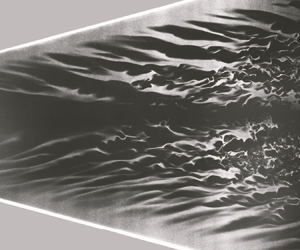
Cross-flow transition over a delta wing is systematically studied in a Mach 6.5 hypersonic wind tunnel, employing the Rayleigh scattering flow visualisation, high-speed schlieren and fast-response pressure sensors. Direct numerical simulations and analysis based on linear stability theory under the same flow conditions are applied to analyse the transition mechanism. Three unstable modes are identified: the travelling cross-flow instabilities, the second mode and the low-frequency waves. It is shown that the travelling cross-flow vortices first appear in the cross-flow region near the leading edge of the model. These vortices can modulate the mean profile of the flow, which benefits the growth of second mode. A phase-locked interaction mechanism transfers energy from the cross-flow instabilities to the high-frequency second mode, leading to amplification at the expense of the cross-flow instability. As the second mode grows to a critical amplitude, it triggers a $z$-type secondary instability within a similar frequency range, which introduces secondary finger-like structures connecting to the cross-flow vortex. It is further found that the generation of these finger-like structures is related to the expansion and compression of the second mode. These finger vortices further evolve along the streamwise direction into low-frequency waves and corresponding hairpin-like structures that finally trigger turbulence. An interaction mechanism likely exists between the secondary instability and the low-frequency waves, since their phase speeds are approaching each other. These observations of the interaction mechanism are consistent with those of previous studies on hypersonic boundary layers (Zhang et al., Phys. Fluids, vol. 32 (7), 2020, 071702; Li et al., Phys. Fluids, vol. 32 (5), 2020, 051701).

Jet-induced vortices of a row of distributed engines at vertical take-off condition
-
- Journal:
- The Aeronautical Journal / Volume 128 / Issue 1326 / August 2024
- Published online by Cambridge University Press:
- 12 February 2024, pp. 1706-1728
-
- Article
- Export citation
-
The aerodynamic performance of a wing model with a row of distributed engines are investigated at the vertical take-off condition. The engines are installed near the trailing edge of the wing. During vertical take-off, the jets exit from the engines and impinge perpendicularly to the ground, providing a thrust for the aircraft. Due to the ground effects, complex vortex structures are induced by the jets. The vortices are categorised into the spanwise vortices and the chordwise vortices. The underwing vortices can lead to low-pressure regions on the lower surface of the wing, resulting in an undesirable downward force. The underwing vortex structures are affected by the ratio of the engine distance to the engine diameter ( $S/D$). At a small $S/D$ = 1.10, the flow field is dominated by the spanwise vortices; at a large $S/D$ = 2.78, the flow field is dominated by the chordwise vortices. The range and strength of the spanwise vortices are affected by the vortices interaction. Competition mechanism exists between the range and strength effects, which results in the non-linear variation of the wing lift coefficient with engine spacing. The details of the flow physics underneath the wing and its mechanism on the lift of the wing during take-off are investigated.



Can we accurately bridge neurobiology to brain-inspired AGI to effectively emulate the human brain?
-
- Journal:
- Research Directions: Bioelectronics / Volume 2 / 2024
- Published online by Cambridge University Press:
- 12 February 2024, e1
-
- Article
-
- You have access
- Open access
- HTML
- Export citation
Design of a wearable shoulder exoskeleton robot with dual-purpose gravity compensation and a compliant misalignment compensation mechanism
-
- Journal:
- Wearable Technologies / Volume 5 / 2024
- Published online by Cambridge University Press:
- 12 February 2024, e4
-
- Article
-
- You have access
- Open access
- HTML
- Export citation
-
This paper presents the design and validation of a wearable shoulder exoskeleton robot intended to serve as a platform for assistive controllers that can mitigate the risk of musculoskeletal disorders seen in workers. The design features a four-bar mechanism that moves the exoskeleton’s center of mass from the upper shoulders to the user’s torso, dual-purpose gravity compensation mechanism located inside the four-bar’s linkages that supports the full gravitational loading from the exoskeleton with partial user’s arm weight compensation, and a novel 6 degree-of-freedom (DoF) compliant misalignment compensation mechanism located between the end effector and the user’s arm to allow shoulder translation while maintaining control of the arm’s direction. Simulations show the four-bar design lowers the center of mass by $ 11 $ cm and the kinematic chain can follow the motion of common upper arm trajectories. Experimental tests show the gravity compensation mechanism compensates gravitational loading within $ \pm 0.5 $ Nm over the range of shoulder motion and the misalignment compensation mechanism has the desired 6 DoF stiffness characteristics and range of motion to adjust for shoulder center translation. Finally, a workspace admittance controller was implemented and evaluated showing the system is capable of accurately reproducing simulated impedance behavior with transparent low-impedance human operation.


An enhanced wideband tracking method for characteristic modes
-
- Journal:
- International Journal of Microwave and Wireless Technologies / Volume 16 / Issue 7 / September 2024
- Published online by Cambridge University Press:
- 12 February 2024, pp. 1144-1154
-
- Article
- Export citation
A continuous-wave Nd:YVO4-KGW intracavity Raman laser with over 34% diode-to-Stokes optical efficiency
-
- Journal:
- High Power Laser Science and Engineering / Volume 12 / 2024
- Published online by Cambridge University Press:
- 12 February 2024, e19
-
- Article
-
- You have access
- Open access
- HTML
- Export citation
Wideband nonuniform metasurface antenna with stable gain
-
- Journal:
- International Journal of Microwave and Wireless Technologies / Volume 16 / Issue 2 / March 2024
- Published online by Cambridge University Press:
- 09 February 2024, pp. 268-275
-
- Article
- Export citation
