Refine search
Actions for selected content:
212964 results in Engineering
PDJ volume 38 issue 4 Cover and Back matter
-
- Journal:
- Powder Diffraction / Volume 38 / Issue 4 / December 2023
- Published online by Cambridge University Press:
- 08 February 2024, p. b1
-
- Article
-
- You have access
- Export citation
Optimal pattern synthesis of circular antenna arrays with improved effective aperture and beam area
-
- Journal:
- International Journal of Microwave and Wireless Technologies / Volume 16 / Issue 5 / June 2024
- Published online by Cambridge University Press:
- 08 February 2024, pp. 871-884
-
- Article
- Export citation
Appendix I - References
-
- Book:
- Wireless Communications
- Published online:
- 22 March 2024
- Print publication:
- 08 February 2024, pp 675-692
-
- Chapter
- Export citation
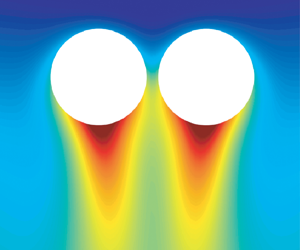
Buoyancy-driven attraction of active droplets
-
- Journal:
- Journal of Fluid Mechanics / Volume 980 / 10 February 2024
- Published online by Cambridge University Press:
- 08 February 2024, A54
-
- Article
-
- You have access
- Open access
- HTML
- Export citation
-
For dissolving active oil droplets in an ambient liquid, it is generally assumed that the Marangoni effect results in repulsive interactions, while the buoyancy effects caused by the density difference between the droplets, diffusing product and the ambient fluid are usually neglected. However, it has been observed in recent experiments that active droplets can form clusters due to buoyancy-driven convection (Krüger et al., Eur. Phys. J. E, vol. 39, 2016, pp. 1–9). In this study we numerically analyse the buoyancy effect, in addition to the propulsion caused by Marangoni flow (with its strength characterized by the Péclet number $Pe$). The buoyancy effects have their origin in (i) the density difference between the droplet and the ambient liquid, which is characterized by the Galileo number $Ga$; and (ii) the density difference between the diffusing product (i.e. filled micelles) and the ambient liquid, which can be quantified by a solutal Rayleigh number $Ra$. We analyse how the attracting and repulsing behaviour of neighbouring droplets depends on the control parameters $Pe$,
$Pe$,  $Ga$ and $Ra$. We find that while the Marangoni effect leads to the well-known repulsion between the interacting droplets, the buoyancy effect of the reaction product leads to buoyancy-driven attraction. At sufficiently large $Ra$, even collisions between the droplets can take place. Our study on the effect of $Ga$ further shows that with increasing $Ga$, the collision becomes delayed. Moreover, we derive that the attracting velocity of the droplets, which is characterized by a Reynolds number $Re_d$, is proportional to $Ra^{1/4}/( \ell /R)$, where $\ell /R$ is the distance between the neighbouring droplets normalized by the droplet radius. Finally, we numerically obtain the repulsive velocity of the droplets, characterized by a Reynolds number $Re_{rep}$, which is proportional to $PeRa^{-0.38}$. The balance of attractive and repulsive effect leads to $Pe\sim Ra^{0.63}$, which agrees well with the transition curve between the regimes with and without collision.


Afterword
-
- Book:
- The Truth About Energy
- Published online:
- 01 February 2024
- Print publication:
- 08 February 2024, pp 594-595
-
- Chapter
- Export citation
5 - The Old Becomes New Again: More Sustainable Energy
- from Part II - In with the New
-
- Book:
- The Truth About Energy
- Published online:
- 01 February 2024
- Print publication:
- 08 February 2024, pp 380-455
-
- Chapter
- Export citation
Appendix E - Gaussian Approximations for Spread Spectrum CDMA
-
- Book:
- Wireless Communications
- Published online:
- 22 March 2024
- Print publication:
- 08 February 2024, pp 621-644
-
- Chapter
- Export citation
Chapter 11 - Wireless Systems and Standards
-
- Book:
- Wireless Communications
- Published online:
- 22 March 2024
- Print publication:
- 08 February 2024, pp 533-600
-
- Chapter
- Export citation
Part II - In with the New
-
- Book:
- The Truth About Energy
- Published online:
- 01 February 2024
- Print publication:
- 08 February 2024, pp 297-548
-
- Chapter
- Export citation
Enhancing ASEAN’s Role in Critical Mineral Supply Chains
-
-
- Book:
- Enhancing ASEAN's Role in Critical Mineral Supply Chains
- Published by:
- ISEAS–Yusof Ishak Institute
- Published online:
- 17 April 2024
- Print publication:
- 08 February 2024, pp 1-30
-
- Chapter
- Export citation
Appendix D - Approximate Spatial Autocovariance Function for Shape Factor Theory
-
- Book:
- Wireless Communications
- Published online:
- 22 March 2024
- Print publication:
- 08 February 2024, pp 619-620
-
- Chapter
- Export citation
3 - The Nuclear World: Atoms for Peace
- from Part I - Out with the Old
-
- Book:
- The Truth About Energy
- Published online:
- 01 February 2024
- Print publication:
- 08 February 2024, pp 193-296
-
- Chapter
- Export citation
Appendix C - Useful Acronyms
-
- Book:
- The Truth About Energy
- Published online:
- 01 February 2024
- Print publication:
- 08 February 2024, pp 598-601
-
- Chapter
- Export citation
Machine learning algorithm to extract properties of ATE phantoms from microwave measurements
-
- Journal:
- International Journal of Microwave and Wireless Technologies / Volume 16 / Issue 10 / December 2024
- Published online by Cambridge University Press:
- 08 February 2024, pp. 1624-1631
-
- Article
-
- You have access
- Open access
- HTML
- Export citation
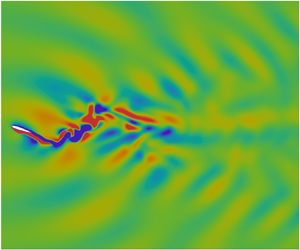
High propulsive performance by an oscillating foil in a stratified fluid
-
- Journal:
- Journal of Fluid Mechanics / Volume 980 / 10 February 2024
- Published online by Cambridge University Press:
- 08 February 2024, A55
-
- Article
- Export citation
-
We investigate numerically the propulsion characteristics of an oscillating foil undergoing coupled heave and pitch motion in a linearly density-stratified flow. A parameter space defined by the internal Froude number ( $1 \le Fr \le 10$) and the maximum angle of attack ( $5^\circ \le {\alpha _0} \le 30^\circ$) is considered in our study. The results demonstrate a significant enhancement in both thrust production and propulsive efficiency due to the stratification influence. Notably, the highest efficiency exceeding $80\,\%$ is achieved under moderate stratification conditions, surpassing the performance observed in a homogeneous fluid. We attribute this optimum performance to the proper match between the stratification effect and foil kinematics, which gives rise to intense vortex interactions and sufficient wave–mean flow interactions in the near wake of the oscillating foil. Consequently, the energy is transferred towards wake structures to form a high-intensity momentum jet in close proximity to the foil's trailing edge, indicating efficient propulsion. Furthermore, we find that the stratifications within the moderate-to-strong transitional regime display a reduced dependence of propulsive efficiency on the maximum angle of attack, primarily due to the delaying and alleviating effects on dynamic-stall events. Such a mechanism enables the oscillating foil to maintain a satisfactory performance by sufficiently high angles of attack without the penalty of stall events. Based on our findings, we propose that animals or artificial vehicles utilising oscillatory propulsion can benefit from the presence of density stratification in the surrounding fluid.


Chapter 7 - Equalization, Diversity, and Channel Coding
-
- Book:
- Wireless Communications
- Published online:
- 22 March 2024
- Print publication:
- 08 February 2024, pp 355-414
-
- Chapter
- Export citation
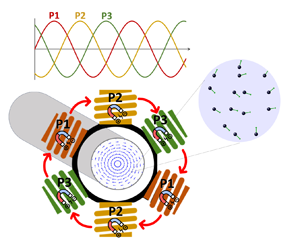
Two-phase volume-averaged predictive theory of dilute ferrofluid spin-up flow in a rotating magnetic field
-
- Journal:
- Journal of Fluid Mechanics / Volume 980 / 10 February 2024
- Published online by Cambridge University Press:
- 08 February 2024, A37
-
- Article
-
- You have access
- Open access
- HTML
- Export citation
Bibliography
-
- Book:
- Computational Principles of Mobile Robotics
- Published online:
- 19 March 2024
- Print publication:
- 08 February 2024, pp 387-420
-
- Chapter
- Export citation
4 - Non-Visual Sensors and Algorithms
- from Part one - Locomotion and Perception
-
- Book:
- Computational Principles of Mobile Robotics
- Published online:
- 19 March 2024
- Print publication:
- 08 February 2024, pp 82-119
-
- Chapter
- Export citation
Notes
-
- Book:
- The Truth About Energy
- Published online:
- 01 February 2024
- Print publication:
- 08 February 2024, pp 602-670
-
- Chapter
- Export citation
