Refine search
Actions for selected content:
212951 results in Engineering
Design of miniaturized single and dual-band bandpass filters using diamond-shaped coupled line resonator for next-generation wireless systems – ERRATUM
-
- Journal:
- International Journal of Microwave and Wireless Technologies / Volume 15 / Issue 10 / December 2023
- Published online by Cambridge University Press:
- 20 February 2024, p. 1809
-
- Article
-
- You have access
- HTML
- Export citation
Field-induced macroscopic flow of a dilute self-assembling magnetic colloid under rotating magnetic fields
-
- Journal:
- Journal of Fluid Mechanics / Volume 981 / 25 February 2024
- Published online by Cambridge University Press:
- 19 February 2024, A11
-
- Article
- Export citation
-
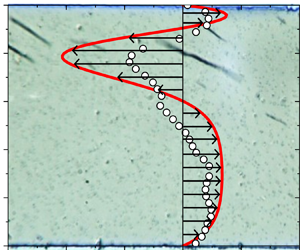
Flow generation by colloidal motors activated by external stimuli is an important issue for active matter physics and several nanotechnological or biomedical applications. For instance, flow recirculation generated by rotating magnetic self-assemblies allows effective ‘pumping’ of a thrombolytic drug towards a blood clot along a blocked vessel. However, the physics of the flow generation in this case remains still poorly explored. This study is focused on the generation of a recirculation flow of a magnetic colloid (aqueous suspension of iron oxide nanoparticles with partially screened electrostatic repulsion) within a closed microfluidic channel via application of an external rotating magnetic field. The colloid undergoes reversible phase separation manifested through the appearance of micron-sized elongated aggregates. They synchronously rotate with the magnetic field and can generate macroscopic flows only in the presence of gradients of the aggregate concentration across the channel induced by superposition of a weak magnetic field gradient to the homogeneous rotating field. We achieve recirculation flows with a characteristic speed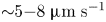 ${\sim} 5{-}8\;{\rm \mu}\textrm{m}\;{\textrm{s}^{ - \textrm{1}}}$ at low magnetic field amplitude and frequency ( ${H_0} \approx 3{-}10\;\textrm{kA}\;{\textrm{m}^{ - 1}}$, ${f = 5{-}15\ \textrm{Hz}}$) at low nanoparticle volume fraction ${\varphi _p} = (1.6{-}3.2) \times {10^{ - 3}}$. The concentration and velocity profiles have been assessed experimentally through particle tracking and particle image velocimetry, and have also been computed using the hydrodynamic diffusion approach coupled with the momentum balance equation with a magnetic torque term. The model correctly reproduces the shape of the experimental concentration and velocity fields and explains complex behaviours of the average recirculation speed as a function of governing parameters ( ${H_0}$, f, ${\varphi _p}$, channel size).


Global dynamics and topology of two-phase mixing layer flow through simultaneous gas and liquid velocity measurements
-
- Journal:
- Journal of Fluid Mechanics / Volume 981 / 25 February 2024
- Published online by Cambridge University Press:
- 19 February 2024, A13
-
- Article
-
- You have access
- Open access
- HTML
- Export citation
-
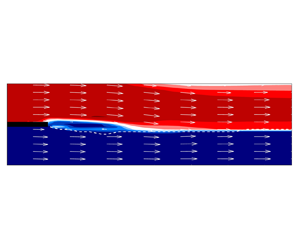
This study reports the first time-resolved particle image velocimetry characterization of a planar two-phase mixing layer flow, whose velocity field is measured simultaneously in gas and liquid streams. Two parallel air and water flows meet downstream of a splitter plate, giving rise to an initially spanwise invariant configuration. The aim is to elucidate further the mechanisms leading to the flow breakup in gas-assisted atomization. The complete experimental characterization of the velocity field represents a database that could be used in data-driven reduced-order models to investigate the global behaviour of the flow system. After the analysis of a selected reference case, a parametric study of the flow behaviour is performed by varying the liquid ( $Re_l$) and gas ( $Re_g$) Reynolds numbers, and as a consequence also the gas-to-liquid dynamic pressure ratio ( $M$), shedding light on both time-averaged (mean) and unsteady velocity fields. In the reference case, it is shown that the mean flow exhibits a wake region just downstream of the splitter plate, followed by the development of a mixing layer. By increasing both $Re_l$ and $Re_g$, the streamwise extent of the wake decreases and eventually vanishes, the flow resulting in a pure mixing layer regime. The spectral analysis of the normal-to-flow velocity fluctuations outlines different flow regimes by variation of the governing parameters, giving more insights into the global characteristics of the flow field. As a major result, it is found that at high $Re_g$ and $M$ values, the velocity fluctuations are characterized by low-frequency temporal oscillations synchronized in several locations within the flow field, which suggest the presence of a global mode of instability. The proper orthogonal decomposition of velocity fluctuations, performed in both gas and liquid phases, reveals finally that the synchronized oscillations are associated with a low-frequency dominant flapping mode of the gas–liquid interface. Higher-order modes correspond to interfacial wave structures travelling with the so-called Dimotakis velocity. For lower gas Reynolds numbers, the leading modes describe higher frequency fingers shedding at the interface.


Nonlinear travelling periodic waves for the Euler equations in three-layer flows
-
- Journal:
- Journal of Fluid Mechanics / Volume 981 / 25 February 2024
- Published online by Cambridge University Press:
- 19 February 2024, A12
-
- Article
-
- You have access
- Open access
- HTML
- Export citation
-
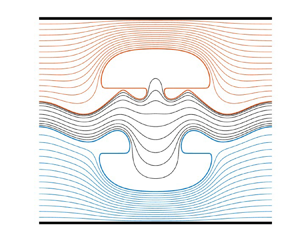
In this paper, we investigate periodic travelling waves in a three-layer system with the rigid-lid assumption. Solutions are recovered numerically using a boundary integral method. We consider the case where the density difference between the layers is small (i.e. a weakly stratified fluid). We consider the system both with and without the Boussinesq assumption to explore the effect the assumption has on the solution space. Periodic solutions of both mode-1 and mode-2 are found, and their bifurcation structure and limiting configurations are described in detail. Similarities are found with the two-layer case, where large-amplitude solutions are found to overhang with an internal angle of $120^{\circ }$. However, the addition of a second interface results in a richer bifurcation space, in part due to the existence of mode-2 waves and their resonance with mode-1 waves. New limiting profiles are found.

Crystal structure of anthraquinone-2-carboxylic acid, C15H8O4
-
- Journal:
- Powder Diffraction / Volume 39 / Issue 1 / March 2024
- Published online by Cambridge University Press:
- 19 February 2024, pp. 29-35
-
- Article
-
- You have access
- Open access
- HTML
- Export citation
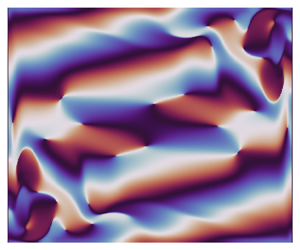
Vertical convection regimes in a two-dimensional rectangular cavity: Prandtl and aspect ratio dependence
-
- Journal:
- Journal of Fluid Mechanics / Volume 981 / 25 February 2024
- Published online by Cambridge University Press:
- 16 February 2024, A10
-
- Article
- Export citation
-
Vertical convection is the fluid motion that is induced by the heating and cooling of two opposed vertical boundaries of a rectangular cavity (see e.g. Wang et al., J. Fluid Mech., vol. 917, 2021, A6). We consider the linear stability of the steady two-dimensional flow reached at Rayleigh numbers of O( $10^8$). As a function of the Prandtl number, $Pr$, and the height-to-width aspect ratio of the domain, $A$, the base flow of each case is computed numerically and linear simulations are used to obtain the properties of the leading linear instability mode. Flow regimes depend on the presence of a circulation in the entire cavity, detachment of the thermal layer from the boundary or the corner regions and on the oscillation frequency relative to the natural frequency of oscillation in the stably temperature-stratified interior, allowing for the presence of internal waves or not. Accordingly, the regime is called slow or fast, respectively. Either the global circulation or internal waves in the interior may couple the top and bottom buoyancy currents, while their absence implies asymmetry in their perturbation amplitude. Six flow regimes are found in the range of $0.1 \leq Pr \leq 4$ and $0.5 \leq A \leq 2$. For $Pr \lessapprox 0.4$ and $A>1$, the base flow is driven by a large circulation in the entire cavity. For $Pr \gtrapprox 0.7$, the thermal boundary layers are thin and the instability is driven by the motion along the wall and the detached boundary layer. A transition between these regimes is marked by a dramatic change in oscillation frequency at $Pr = 0.55 \pm 0.15$ and $A <2$.


A novel neck brace to characterize neck mobility impairments following neck dissection in head and neck cancer patients – ADDENDUM
-
- Journal:
- Wearable Technologies / Volume 5 / 2024
- Published online by Cambridge University Press:
- 16 February 2024, e7
-
- Article
-
- You have access
- Open access
- HTML
- Export citation
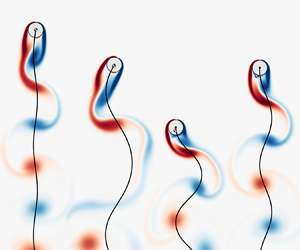
Rising and settling 2-D cylinders with centre-of-mass offset
-
- Journal:
- Journal of Fluid Mechanics / Volume 981 / 25 February 2024
- Published online by Cambridge University Press:
- 16 February 2024, A7
-
- Article
-
- You have access
- Open access
- HTML
- Export citation
Optimization and control of synchrotron emission in ultraintense laser–solid interactions using machine learning – CORRIGENDUM
-
- Journal:
- High Power Laser Science and Engineering / Volume 12 / 2024
- Published online by Cambridge University Press:
- 16 February 2024, e12
-
- Article
-
- You have access
- Open access
- HTML
- Export citation
Learning-based surface deformation recovery for large radio telescope antennas
-
- Journal:
- International Journal of Microwave and Wireless Technologies / Volume 16 / Issue 6 / July 2024
- Published online by Cambridge University Press:
- 16 February 2024, pp. 935-945
-
- Article
- Export citation
Puzzle-shaped cells and the mechanical response of tobacco (Nicotiana tabacum L.) seed coats
- Part of
-
- Journal:
- Programmable Materials / Volume 2 / 2024
- Published online by Cambridge University Press:
- 16 February 2024, e1
-
- Article
-
- You have access
- Open access
- HTML
- Export citation
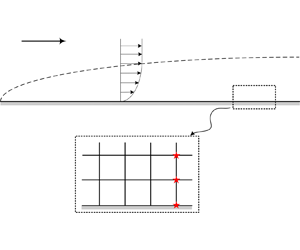
A new wall function method for hypersonic laminar boundary layers
-
- Journal:
- Journal of Fluid Mechanics / Volume 981 / 25 February 2024
- Published online by Cambridge University Press:
- 16 February 2024, A9
-
- Article
- Export citation
-
A new wall function method for hypersonic laminar boundary layers (HLBLs) is proposed to reduce the near-wall grid dependence of skin friction $c_f$ and wall heat flux $q_w$ in numerical simulations, aiming for fast and accurate predictions. First, an analytic laminar velocity law of the wall is derived, which achieves a universal scaling of the near-wall velocity of HLBLs. Then an accurate temperature–velocity relation is deduced by introducing the general recovery factor to address the invalidation of the Walz relation under the cold wall effect. Based on the laminar laws of the wall, a new wall function method for HLBLs is proposed. To avoid introducing the boundary layer edge quantities, the laminar laws of the wall are reformed by modifying the outer boundary conditions of the differential equation in deriving the temperature–velocity relation. Unlike the wall function method in turbulence, the new wall function obtains directly the accurate $c_f$ and $q_w$ by post-processing without being involved in the simulation iteration. The numerical experiments of a Mach 8 HLBL over the flat plate show that effectively, the new wall function can enlarge the distance of the first grid point off the wall $\Delta y_1$ from $10^{-6}$ m to $10^{-3}$ m, which brings a 50 times enhancement of the simulation efficiency. Meanwhile, the simulation errors of $c_f$ and $q_w$ of the mesh with $\Delta y_1=10^{-3}$ m are reduced significantly from 24.2 % and 18.5 % to 0.5 % and 0.1 %, respectively. Due to the new wall function removing the boundary layer edge quantities, success is also achieved under the curved walls.


A wideband, thin, dual-negative, and polarization-independent square-tooth circular ring resonator-based metamaterial absorber for Ku-band applications
-
- Journal:
- International Journal of Microwave and Wireless Technologies / Volume 16 / Issue 6 / July 2024
- Published online by Cambridge University Press:
- 16 February 2024, pp. 972-980
-
- Article
- Export citation
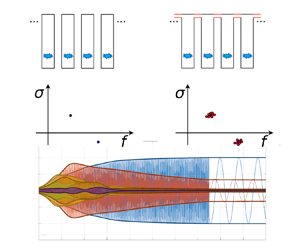
Weakly nonlinear analysis of thermoacoustic oscillations in can-annular combustors
-
- Journal:
- Journal of Fluid Mechanics / Volume 980 / 10 February 2024
- Published online by Cambridge University Press:
- 16 February 2024, A52
-
- Article
- Export citation
-
Can-annular combustors feature clusters of thermoacoustic eigenvalues, which originate from the weak acoustic coupling between $N$ identical cans at the downstream end. When instabilities occur, one needs to consider the nonlinear interaction between all $N$ modes in the unstable cluster in order to predict the steady-state behaviour. A nonlinear reduced-order model for the analysis of this phenomenon is developed, based on the balance equations for acoustic mass, momentum and energy. Its linearisation yields explicit expressions for the $N$ complex-valued eigenfrequencies that form a cluster. To treat the nonlinear equations semianalytically, a Galerkin projection is performed, resulting in a nonlinear system of $N$ coupled oscillators. Each oscillator represents the dynamics of a global mode that oscillates in the whole can-annular combustor. The analytical expressions of the equations reveal how the geometrical and thermofluid parameters affect the thermoacoustic response of the system. To gain further insights, the method of averaging is applied to obtain equations for the slow-time dynamics of the amplitude and phase of each mode. The averaged system, whose solutions compare very well with those of the full oscillator equations, is shown to be able to predict complex transient dynamics. A variety of dynamical states are identified in the steady-state oscillatory regime, including push–push (in-phase) and spinning oscillations. Notably, the averaged equations are able to predict the existence of synchronised states. These states occur when the frequencies of two (or more) unstable modes with nominally different frequencies lock onto a common frequency as a result of nonlinear interactions.


Wideband millimeter-wave reflectarray antenna with reduced cross-polarization
-
- Journal:
- International Journal of Microwave and Wireless Technologies / Volume 16 / Issue 4 / May 2024
- Published online by Cambridge University Press:
- 16 February 2024, pp. 636-644
-
- Article
- Export citation
-
A novel wideband reflectarray antenna (RA) is designed for 5G millimeter (mm) wave communications in the frequency range of 26.5–36 GHz. The proposed unit cell is constructed using a grid periodicity of 0.52 ${{\lambda }_0}{ }$ that offers 636° phase change through phase delay lines (PDLs) ( ${{\theta }_{\text{s}}}$). These PDLs are attached to the outer end of the unit cell comprising semi-circular rings. Bandwidth enhancement is achieved by incorporating a corrugated slot technique and a suitable air gap beneath the substrate. The proposed center-fed reflectarray is composed of 513 elements distributed in a circular aperture (13.46 ${{\lambda }_0}$). Using mirror-symmetrical distribution of the unit cells, a cross-polarization reduction as low as −50 dB is realized. At 30 GHz, RA has a measured peak gain of 28.2 dBi, a sidelobe level of −14.3 dB, and an aperture efficiency of 31.4%. The prototype antenna is fabricated, and the simulation results are experimentally validated. The measured 1-dB and 3-dB gain bandwidths of the proposed reflectarray antenna are 31.3% and 41.6%, respectively. The proposed broadband reflectarray can be a potential choice for inter-satellite services like inter-satellite networking/satellite positioning and control; fixed satellite services such as GPS satellite synchronization and data direct to home TV; and satellite position fixing.


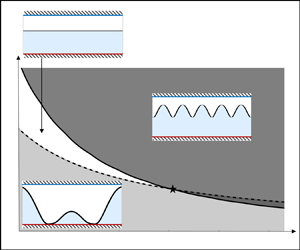
Influence of parametric forcing on Marangoni instability
-
- Journal:
- Journal of Fluid Mechanics / Volume 981 / 25 February 2024
- Published online by Cambridge University Press:
- 16 February 2024, A8
-
- Article
-
- You have access
- Open access
- HTML
- Export citation
Benchmarking commercially available soft and rigid passive back exoskeletons for an industrial workplace
-
- Journal:
- Wearable Technologies / Volume 5 / 2024
- Published online by Cambridge University Press:
- 15 February 2024, e6
-
- Article
-
- You have access
- Open access
- HTML
- Export citation
Extended correlation functions for spatial analysis of multiplex imaging data
-
- Journal:
- Biological Imaging / Volume 4 / 2024
- Published online by Cambridge University Press:
- 15 February 2024, e2
-
- Article
-
- You have access
- Open access
- HTML
- Export citation
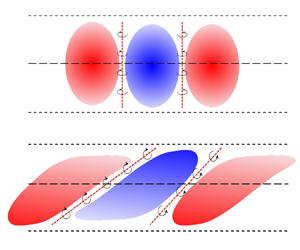
Interfaces of high- and low-speed large-scale structures in compressible turbulent mixing layers: compressibility effects and structures
-
- Journal:
- Journal of Fluid Mechanics / Volume 981 / 25 February 2024
- Published online by Cambridge University Press:
- 15 February 2024, A6
-
- Article
- Export citation
-
Direct numerical simulations of temporally developing mixing layers have been performed to investigate the effects of compressibility on statistics and structures near the interfaces of high- and low-speed large-scale structures (LSSs), covering a range of convective Mach numbers from $M_c=0.2$ to $1.8$ and Taylor Reynolds numbers up to 290. The interfaces of LSSs are directly defined by the isosurface of zero fluctuating streamwise velocity. The characteristic velocity jump at the interfaces grows rapidly in the transition stage and then decreases until reaching a gradual self-similar stage. The evolution of velocity jump is evidently delayed as the convective Mach number increases. The interface layer is formed by the shearing motion of neighbouring LSSs. A small vortical motion characterized by the Kolmogorov scale is induced in the interface layer by shear-dominated outer regions. The strengths of outer shearing motion and central vortical motion are greater at the leading edge, but smaller at the trailing edge, which is also reflected in a larger velocity jump at the leading edge. As the convective Mach number increases, the small-scale vortical structure is obviously suppressed by compressibility. At high convective Mach number $M_c=1.8$, the compressive shear-dominated outer regions are linked with a sheet-like structure passing through the centre of the expansion region corresponding to a small-scale vortical structure. The compressibility and shearing strength near the interface are highly dependent on the interface orientation.


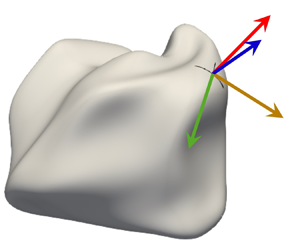
Effects of dilatation and turbulence on tangential strain rates in premixed hydrogen and iso-octane flames
-
- Journal:
- Journal of Fluid Mechanics / Volume 981 / 25 February 2024
- Published online by Cambridge University Press:
- 15 February 2024, A5
-
- Article
-
- You have access
- Open access
- HTML
- Export citation
