To save content items to your account,
please confirm that you agree to abide by our usage policies.
If this is the first time you use this feature, you will be asked to authorise Cambridge Core to connect with your account.
Find out more about saving content to .
To save content items to your Kindle, first ensure no-reply@cambridge.org
is added to your Approved Personal Document E-mail List under your Personal Document Settings
on the Manage Your Content and Devices page of your Amazon account. Then enter the ‘name’ part
of your Kindle email address below.
Find out more about saving to your Kindle.
Note you can select to save to either the @free.kindle.com or @kindle.com variations.
‘@free.kindle.com’ emails are free but can only be saved to your device when it is connected to wi-fi.
‘@kindle.com’ emails can be delivered even when you are not connected to wi-fi, but note that service fees apply.
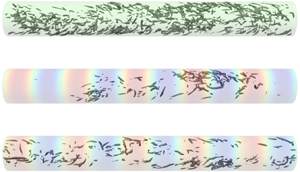
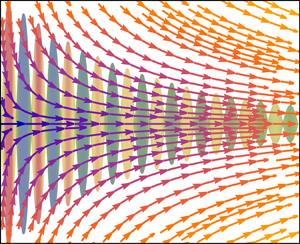
Wall-based spanwise forcing has been experimentally used with success by Auteri et al. (Phys. Fluids, vol. 22, 2010, 115103) to obtain large reductions of turbulent skin-friction drag and considerable energy savings in a pipe flow. The spatial distribution of the azimuthal wall velocity used in the experiment was not continuous, but piecewise constant. The present study is a numerical replica of the experiment, based on a set of direct numerical simulations (DNS); its goal is the identification of the effects of spatially discrete forcing, as opposed to the idealized sinusoidal forcing considered in the majority of numerical studies. Regardless of the discretization, with DNS the maximum drag reduction is found to be larger: the flow easily reaches complete relaminarization, whereas the experiment was capped at 33 % drag reduction. However, the key result stems from the observation that, for the piecewise-constant forcing, the apparent irregularities of the experimental data appear in the simulation data too. They derive from the rich harmonic content of the discontinuous travelling wave, which alters the drag reduction of the sinusoidal forcing. A detailed understanding of the contribution of each harmonic reveals that, whenever for example technological limitations constrain one to work far from the optimal forcing parameters, a discrete forcing may perform very differently from the corresponding ideal sinusoid, and in principle can outperform it. However, care should be exercised in comparison, as discrete and continuous forcing have different energy requirements.
The geostationary orbit (GEO) belt hosts a substantial number of high-value satellites, making the study of autonomous navigation within this area significant. Features of autonomous operations such as patrolling the GEO belt and frequent manoeuvres at a certain location make real-time positioning using the Global Navigation Satellite System (GNSS) valuable. This paper studies the performance of positioning with GNSS considering main lobe and side lobe signals at different longitudes in the GEO belt. The research delves into the visibility and Position Dilution of Precision (PDOP) across the GEO belt, analysing the performance of the Global Positioning System (GPS), GLObalnaya NAvigatsionnaya Sputnikovaya Sistema (GLONASS) in Russian, BeiDou Navigation Satellite System (BDS), Galileo Navigation Satellite System (Galileo) and multi-systems. In particular, this paper investigates the impact of asymmetric constellations of mixed GEO, Inclined Geosynchronous Orbit (IGSO) and Medium Earth Orbit (MEO) satellites. The study reveals that BDS hybrid constellation provides long-term stable signal coverage over the GEO space above North America and Atlantic Ocean, where GEO signals are more sustainable while IGSO signals have wider coverage. This advantage positions BDS favourably in terms of performance in these regions.
In previous research, several computational methods have been proposed to analyse the navigation, transportation safety and collision risks of maritime vessels. The objective of this study is to use Automatic Identification System (AIS) data to assess the collision risk between two vessels before an actual collision occurs. We introduce the concept of an angle interval in the model to enable real-time response to vessel collision risks. When predicting collision risks, we consider factors such as relative distance, relative velocity and phase between the vessels. Lastly, the collision risk is divided into different regions and represented by different colours. The green region represents a low-risk area, the yellow region serves as a cautionary zone and the red region indicates a high-alert zone. If a signal enters the red region, the vessel's control system will automatically intervene and initiate evasive manoeuvres. This reactive mechanism enhances the safety of vessel operations, ensuring the implementation of effective collision avoidance measures.
Indoor navigation for micro aerial vehicles (MAVs) is challenging in GPS signal-obstructed indoor corridor environments. Position and heading estimation for a MAV is required to navigate without colliding with obstacles. The connected components algorithm and k-means clustering algorithm have been integrated for line and vanishing point detection in the corridor image frames to estimate the position and heading of the MAV. The position of the vanishing point indicates the position of the MAV (centre, left or right) in the corridor. Furthermore, the Euclidean distance between the image centre and mid-pixel coordinates at the last row of the image and the detected vanishing point pixel coordinates in the successive corridor image frames are used to compute the heading of the MAV. When the MAV deviates from the corridor centre, the position and heading measurement can send a suitable control signal to the MAV and align the MAV at the centre of the corridor. When compared with a grid-based vanishing point detection method heading accuracy of ±1⋅5°, the k-means clustering-based vanishing point detection is suitable for real-time heading measurement for indoor MAVs with an accuracy of ±0⋅5°.
The title compound, 3-hydroxypropionitrile, was crystallized repeatedly in situ inside a quartz capillary using a liquid nitrogen cryostream. The X-ray powder diffraction patterns obtained indicated the presence of two distinct crystalline phases. The cleanest datasets for each of the phases were used to solve the crystal structures via simulated annealing, followed by refinement and optimization via dispersion-corrected density functional theory (DFT) calculations, with a final Rietveld refinement against the experimental data. The two structures appear to correspond to those proposed in a 1960s literature vibrational spectroscopy paper, one being the more stable with a gauche molecular conformation and the second metastable phase more complex with mixed conformations. Dispersion-corrected DFT computation using lattice parameters for both phases obtained from a single 84 K dataset with co-existing phases shows the stable and metastable phases to differ in energy by less than 0.5 kJ mol−1. A comparison of experimental far infrared spectra published in the 1960s with those calculated from the proposed crystal structures provides some independent supporting evidence for the proposed structures.
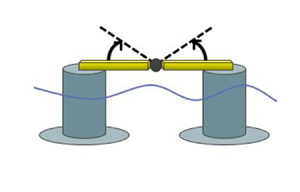
Due to the safety threats caused by icing, the de-icing system is essential in the aviation industry. As an effective method, the electromechanical de-icing system (EDS) is a new ice-protection system based on mechanical vibration principles. For the majority of the current research on system de-icing capability estimation, the effect of impedance-matching is not considered. Impedance matching plays a very important role in improving the performance of the electromechanical system, so we must also consider the impact of impedance matching when designing the EDS. In the present study, a de-icing capability prediction method considering the impact of an impedance-matching device is established based on experimental and numerical methods. The results indicate that the impedance-matching effect has no impact on the mechanical vibration of the structure for the same load power. Meanwhile, impedance-matching devices can significantly improve the power factor and increase the interface shear stress/strain for de-icing. Eight different vibrational modes were tested, and the experimental results showed that the actual interface shear strain after impedance matching is inversely proportional to the de-icing time. The verification experiments were conducted and the accuracy of the proposed prediction method was verified.
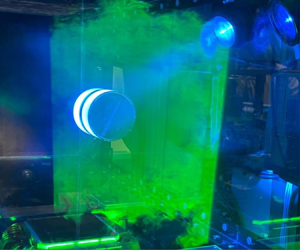
The relationships between characteristic large-scale wake structures appearing behind a free-stream-aligned circular cylinder are investigated and discussed from the velocity field obtained by wind tunnel tests. The tests were conducted under a supportless condition using a magnetic suspension and balance system and stereo PIV measurements at a Reynolds number of $3.46\times 10^4$. The velocity fields were analysed with a modal decomposition combining azimuthal Fourier decomposition and proper orthogonal decomposition. The wake behind the free-stream-aligned circular cylinder with three different fineness ratios of 1.0, 1.5 and 2.0 was investigated, and the wake structures in a non-reattaching flow formed by the cylinder at a fineness ratio of 1.0 are mainly discussed in the present study. Four characteristic large-scale wake structures of the recirculation bubble pumping, azimuthal shear mode, large-scale vortex shedding and streaks are identified and mainly focused on in the present study. The state of the vortex shedding is classified into three: anticlockwise/clockwise circular and flapping patterns. Each state has a relationship with the azimuthal shear mode and it tends to appear when the state is circular. Furthermore, from the analysis of the relationship between modes, the recirculation bubble pumping is found to be related to the vortex shedding position in the radial direction and the strength of the streaks. Particularly, analysis of causality shows that the recirculation bubble pumping is affected by them in the low-frequency range.
The development of small-scale self-focusing in a nonlinear Kerr medium after preliminary self-filtering of a laser beam propagating in free space is studied numerically. It is shown that, under definite conditions, due to self-filtering, filamentation instability (beam splitting into filaments) either occurs at significantly larger values of the B-integral, or does not occur at all. In the latter case, there develops the honeycomb instability revealed in this work. This instability is the formation of a random honeycomb structure in the beam cross-section. It is shown that self-filtering can significantly increase the permissible values of the B-integral, at which the beam quality remains acceptable.
Official interpretations of Doppler shifts from the final satellite communications of missing Malaysian Airlines MH370 were based on a motion-decoupled ‘Up-Down model’. That model predicted an uncontrolled high-speed gravitationally accelerated dive following fuel starvation. Here, I challenge that model using a more-realistic motion-coupled ‘Declination model’. Aerial, satellite and underwater searches failed to find the predicted official violent crash-site near the 7th arc. Meticulous re-examination of debris damage by air-crash investigator Larry Vance concluded that the aircraft glide-landed under power with extended wing-flaps. The trailing-edges were then damaged, broke off their mountings, flailing about and retracted along the guides to cause the observed wing-flap damage. Larry's conclusions complement interpretations from the ‘Declination model’ which we demonstrate here with three example flight tracks. Our revised Doppler-shift analyses support the hypothesis of a controlled eastward descent. We conclude that the official theory of fuel starvation and a high-speed dive are fundamentally flawed.
Vessel traffic services (VTS) is a marine information exchange system vital for the safety and efficiency of ship traffic within designated regions. The harmonisation, integration and exchange of marine information have emerged as significant components in promoting maritime safety, in line with the concept of e-navigation. This study aimed to analyse the flow of information between VTS areas employing social network analysis to ensure seamless marine information exchange across VTS areas. Information flow was analysed based on data obtained from ships navigating through coastal waters and ports in Korea, revealing that the sea area near Busan New Port exhibited the highest concentration of information flow, while the Tongyoung Coast VTS area represented a critical link in the flow of information. Given its history of marine accidents, the current Masan (Opko) VTS region emerged as a susceptible area. The study provides valuable foundational data for a comprehensive coastal surveillance system.
The dynamics and nonlinear wave forcing of a flexible floating structure are investigated experimentally and numerically. The floater was designed to match sub-harmonic rigid-body natural frequencies of typical floating wind turbine substructures, with the addition of a flexible bending mode. Experiments were carried out for three sea states with phase-shifted input signals to allow harmonic separation of the measured response. We find for the weakest sea states that sub-harmonic rigid-body motion is driven by even-harmonic difference frequency forcing, and by linear forcing for the strongest sea state. The flexible mode was tested in a soft, linearly forced layout, and a stiff layout, forced by second-, third- and fourth-harmonic frequency content, for increasing severity of the sea state. Further insight is gained by analysis of the amplitude scaling of the resonant response. A new simplified approach is proposed and compared with the recent method of Orszaghova et al. (J. Fluid Mech., vol. 929, 2021, A32). We find that resonant surge and pitch motions are dominated by even-harmonic potential-flow forcing and that odd-harmonic response is mainly potential-flow driven in surge and mainly drag driven in pitch. The measured responses are reproduced numerically with second-order forcing and quadratic drag loads, using a recent and computationally efficient calculation method, extended here for the heave, pitch and flexible motions. We are able to reproduce the response statistics and power spectra for the measurements, including the subharmonic pitch and heave modes and the flexible mode. Deeper analysis reveals that inaccuracies in the even-harmonic forcing content can be compensated by the odd-harmonic loads.
The crystal structure of ractopamine hydrochloride has been solved and refined using synchrotron X-ray powder diffraction data, and optimized using density functional theory techniques. Ractopamine hydrochloride crystallizes in space group Pbca (#61) with a = 38.5871(49), b = 10.7691(3), c = 8.4003(2) Å, V = 3490.75(41) Å3, and Z = 8. The ractopamine cation contains two chiral centers, and the sample consists of a mixture of the S,S/R,R/S,R and R,S forms. Models for the two diastereomers S,S and S,R were refined, and yielded equivalent residuals, but the S,R form is significantly lower in energy. The crystal structure consists of layers of molecules parallel to the bc-plane. In each structure one of the H atoms on the protonated N atom acts as a donor in a strong discrete N–H⋯Cl hydrogen bond. Hydroxyl groups act as donors in O–H⋯Cl and O–H⋯O hydrogen bonds. Both the classical and C–H⋯Cl and C–H⋯O hydrogen bonds differ between the forms, helping to explain the large microstrain observed for the sample. The powder pattern has been submitted to ICDD® for inclusion in the Powder Diffraction File™ (PDF®).
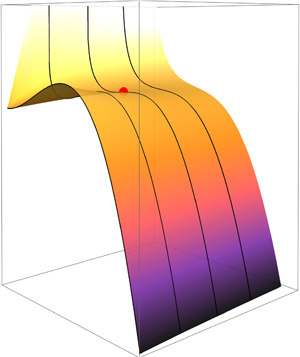
Cavitation inception originates from nuclei in a liquid. This paper proposes a Gibbs free energy approach that provides a smooth transition from homogeneous to heterogeneous nucleation when gas is present. The impact of gas content on nucleation is explored. It is found that the gas content stabilises nuclei, a phenomenon not present in pure liquid–vapour systems. This reduces the energy barrier over that required to nucleate a vapour bubble. Different gas saturation levels are studied. Gas content can significantly reduce the energy barrier required for nucleation, and under certain circumstances eliminate it. An analytic solution for the critical radius and activation energy is obtained that accounts for gas content. The classical Blake radius is recovered as a limiting case. The hysteresis between incipience and desinence is explained using the asymmetry observed in the critical radii. The solution is used to obtain the initial bubble radius, given a critical pressure condition in cavitation susceptibility meter experiments. The relationship between initial bubble diameter and critical pressure is described by an analytic solution that accounts for gas content. A model for the derivative of the cumulative nuclei histogram with respect to bubble diameter is proposed. An analytic expression is obtained that shows good agreement with decades worth of experimental data compiled by Khoo et al. (Exp. Fluids, vol. 61, issue 2, 2020, pp. 1–20) from ocean to water tunnels. The expression recovers the $-4$ power law that is observed experimentally.
Materials in a high radioactive environment undergo structural changes. X-ray diffraction (XRD) is commonly used to study the micro-structural changes of such materials. Therefore, a safe procedure is required for the preparation of specimens. In this paper, a simple methodology for the preparation of radioactive powder specimens to be analyzed in a non-nuclearized laboratory diffractometer is presented. The process is carried out inside a shielded glove box, where the milling of the radioactive sample and specimen preparation occurs. Minimum amount of sample is required (<20 mg), which is drop-casted on a polyether ether ketone (PEEK) foil and glue-sealed inside a disposable plastic holder for a safe handling of the specimen. One example using neutron-irradiated granite is shown, where unit-cell parameters and crystal density of the main phases were calculated. The developed methodology represents an easy and affordable way to study neutron irradiated materials with low activity at laboratory scale.
When a fluid system is subjected to an acoustic wave (or another periodic actuation), the response of the fluid is not purely periodic, but is rather characterized by the combination of a periodic flow and a steady Stokes drift component, where the former is, in many cases, an acoustic wave and the latter is commonly referred to as acoustic streaming. Classical theories of acoustic streaming have focused on slow acoustic streaming, where the periodic flow is the leading-order flow, and is insensitive to the steady flow component which appears as a small correction and is characterized by a small hydrodynamic Reynolds number. In contrast, Dubrovski et al. (J. Fluid Mech. vol. 975, 2023, A4) tackle the fast acoustic streaming regime – conceived by Zarembo (Acoustic streaming. In High-Intensity Ultrasonic Fields, 1971, pp. 135–199. Springer) approximately fifty years ago – where both the periodic and steady flow components are of a similar order of magnitude such that the periodic flow both supports and is simultaneously impacted by the steady flow. They present a novel theoretical framework that accounts for the convection of momentum both within and between the periodic and steady flow to extend slow-streaming equations to the case of steady flow with arbitrary hydrodynamic Reynolds number. They leverage a scaling analysis of the resulting system of equations and a case study to demonstrate the compatibility of their equations with slow streaming theories and highlight the distinctive features of fast streaming.
The traditional ground collision avoidance system (GCAS) makes avoidance decisions based on predicted collision time, without considering the impact of terrain environment and dynamic changes in load factor on avoidance decisions. This increases the risk of ground collisions for the aircraft. To solve the problem, a GCAS with multi-trajectory risk assessment and decision function is proposed. Firstly, a variety of predicted flight avoidance trajectories are established within the final manoeuvering capability of the aircraft. Secondly, for each predicted trajectory, the uncertain length between adjacent prediction points is used to construct a rectangular distance bin, and the terrain data below the avoided trajectory is extracted. Finally, the regret theory is used to establish a multi-attribute avoidance decision model to evaluate and prioritise the risk of collision avoidance trajectories, to provide effective collision avoidance decision for pilots. The algorithm is tested and verified with real digital elevation model and simulated flight data, and compared with traditional GCAS. Simulation results show that the proposed algorithm can comprehensively consider manoeuvering performance and threatening terrain, and provide safe and effective avoidance decisions for pilots.
The structure of Ni(3-amino-4,4′-bipyridine)[Ni(CN)4] (or known as Ni-BpyNH2) in powder form was determined using synchrotron X-ray diffraction and refined using the Rietveld refinement technique (R = 8.8%). The orthorhombic (Cmca) cell parameters were determined to be a = 14.7218(3) Å, b = 22.6615(3) Å, c = 12.3833(3) Å, V = 4131.29(9) Å3, and Z = 8. Ni-BpyNH2 forms a 3-D network, with a 2-D Ni(CN)4 net connecting to each other via the BpyNH2 ligands. There are two independent Ni sites on the net. The 2-D nets are connected to each other via the bonding of the pyridine “N” atom to Ni2. The Ni2 site is of six-fold coordination to N with relatively long Ni2–N distances (average of 2.118 Å) as compared to the four-fold coordinated Ni1–C distances (average of 1.850 Å). The Ni(CN)4 net is arranged in a wave-like fashion. The functional group, –NH2, is disordered and was found to be in the m-position relative to the N atom of the pyridine ring. Instead of having a unique position, N has ¼ site occupancy in each of the four m-positions. The powder reference diffraction pattern for Ni-BpyNH2 was prepared and submitted to the Powder Diffraction File (PDF) at the International Centre of Diffraction Data (ICDD).
A model for the crystal structure of carbadox has been generated and refined using synchrotron X-ray powder diffraction data and optimized using density functional theory techniques. Carbadox crystallizes in space group P21 (#4) with a = 13.8155(3), b = 21.4662(1), c = 16.3297(3) Å, β = 110.0931(7)°, V = 4548.10(3) Å3, and Z = 16. The crystal structure is characterized by approximately parallel stacking of the eight independent carbadox molecules parallel to the bc-plane. There are two different molecular configurations of the eight carbadox molecules; five are in the lower-energy configuration and three are in a ~10% higher-energy configuration. This arrangement likely achieves the lowest-energy crystalline packing via hydrogen bonding. Hydrogen bonds link the molecules both within and between the planes. Each of the amino groups forms a N–H⋯O hydrogen bond to an oxygen atom of the 1,4-dioxidoquinoxaline ring system of another molecule. The result is four pairs of hydrogen-bonded molecules, which form rings with graph set R2,2(14). Variation in specimen preparation can affect the preferred orientation of particles considerably. The powder pattern has been submitted to ICDD for inclusion in the Powder Diffraction File™ (PDF®).
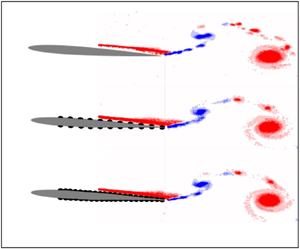
The hydrodynamic influence of surface texture on static surfaces ranges from large drag penalties (roughness) to potential performance benefits (shark-like skin). Although it is of wide-ranging research interest, the impact of roughness on flapping systems has received limited attention. In this work, we explore the effect of roughness on the unsteady performance of a harmonically pitching foil through experiments using foils with different surface roughness, at a fixed Strouhal number and within the Reynolds number ($Re$) range of $17\,000\unicode{x2013}33\,000$. The foils’ surface roughness is altered by changing the distribution of spherical-cap-shaped elements over the propulsor area. We find that the addition of surface roughness does not improve the performance compared with a smooth surface over the $Re$ range considered. The analysis of the flow fields shows near-identical wakes regardless of the foil's surface roughness. The performance reduction mainly occurs due to an increase in profile drag. However, we find that the drag penalty due to roughness is reduced from $76\,\%$ for a static foil to $16\,\%$ for a flapping foil at the same mean angle of attack, with the strongest decrease measured at the highest $Re$. Our findings highlight that the effect of roughness on dynamic systems is very different than that on static systems; thereby, it cannot be estimated by only using information obtained from static cases. This also indicates that the performance of unsteady, flapping systems is more robust to the changes in surface roughness.
This paper outlines an experimental demonstration of an envelope tracking (ET) technique applied to a kilowatt-level single-ended solid-state power amplifier (SSPA), aimed at enhancing the charging efficiency of superconducting radio frequency (SRF) cavities by reducing reflection power while maintaining a high degree of efficiency. The technique is particularly designed for the pulsed operation of the European Spallation Source (ESS) at a nominal frequency of 352 MHz, with a 5% duty cycle and a pulse width of 3.5 ms. The study introduces an optimal charging scheme using a solid-state-based amplifier to maintain high efficiency, allowing for power ramp-up while minimizing reflections from SRF cavities and optimizing SSPA efficiency. A fast envelope tracking power supply (ETPS) system is implemented for the approximately 300 ms charging time required by the SRF cavities at ESS. The ETPS system, demonstrated on a single module as a proof-of-concept with scalability potential to a 400 kW power station, indicates an overall average efficiency of 70% and a 24% energy saving over traditional vacuum-tube based amplifiers. This demonstrates the ET technique’s effectiveness at the kilowatt level for efficient SRF cavity charging with reduced reflection, offering significant efficiency and energy savings.