Refine search
Actions for selected content:
212951 results in Engineering
Proposed crystal structure of carbadox, C11H10N4O4
-
- Journal:
- Powder Diffraction / Volume 39 / Issue 2 / June 2024
- Published online by Cambridge University Press:
- 29 February 2024, pp. 82-93
-
- Article
-
- You have access
- Open access
- HTML
- Export citation
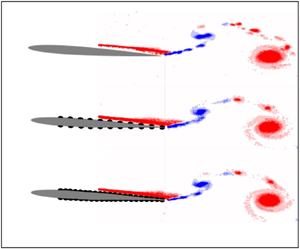
Effects of surface roughness on the propulsive performance of pitching foils
-
- Journal:
- Journal of Fluid Mechanics / Volume 982 / 10 March 2024
- Published online by Cambridge University Press:
- 29 February 2024, A1
-
- Article
-
- You have access
- Open access
- HTML
- Export citation
-
The hydrodynamic influence of surface texture on static surfaces ranges from large drag penalties (roughness) to potential performance benefits (shark-like skin). Although it is of wide-ranging research interest, the impact of roughness on flapping systems has received limited attention. In this work, we explore the effect of roughness on the unsteady performance of a harmonically pitching foil through experiments using foils with different surface roughness, at a fixed Strouhal number and within the Reynolds number ( $Re$) range of $17\,000\unicode{x2013}33\,000$. The foils’ surface roughness is altered by changing the distribution of spherical-cap-shaped elements over the propulsor area. We find that the addition of surface roughness does not improve the performance compared with a smooth surface over the $Re$ range considered. The analysis of the flow fields shows near-identical wakes regardless of the foil's surface roughness. The performance reduction mainly occurs due to an increase in profile drag. However, we find that the drag penalty due to roughness is reduced from $76\,\%$ for a static foil to $16\,\%$ for a flapping foil at the same mean angle of attack, with the strongest decrease measured at the highest $Re$. Our findings highlight that the effect of roughness on dynamic systems is very different than that on static systems; thereby, it cannot be estimated by only using information obtained from static cases. This also indicates that the performance of unsteady, flapping systems is more robust to the changes in surface roughness.


An advanced solid-state RF power source maximizing energy efficiency for optimal superconducting RF cavity charging
-
- Journal:
- International Journal of Microwave and Wireless Technologies / Volume 16 / Issue 10 / December 2024
- Published online by Cambridge University Press:
- 29 February 2024, pp. 1649-1658
-
- Article
-
- You have access
- Open access
- HTML
- Export citation
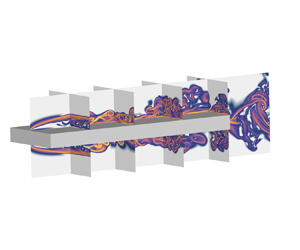
Vortex dynamics and boundary layer transition in flow around a rectangular cylinder with different aspect ratios at medium Reynolds number
-
- Journal:
- Journal of Fluid Mechanics / Volume 982 / 10 March 2024
- Published online by Cambridge University Press:
- 29 February 2024, A5
-
- Article
- Export citation
-
The numerical investigation focuses on the flow patterns around a rectangular cylinder with three aspect ratios ( $L/D=5$, $10$,
$10$,  $15$) at a Reynolds number of $1000$. The study delves into the dynamics of vortices, their associated frequencies, the evolution of the boundary layer and the decay of the wake. Kelvin–Helmholtz (KH) vortices originate from the leading edge (LE) shear layer and transform into hairpin vortices. Specifically, at $L/D=5$, three KH vortices merge into a single LE vortex. However, at $L/D=10$ and $15$, two KH vortices combine to form a LE vortex, with the rapid formation of hairpin vortex packets. A fractional harmonic arises due to feedback from the split LE shear layer moving upstream, triggering interaction with the reverse flow. Trailing edge (TE) vortices shed, creating a Kármán-like street in the wake. The intensity of wake oscillation at $L/D=5$ surpasses that in the other two cases. Boundary layer transition occurs after the saturation of disturbance energy for $L/D=10$ and $15$, but not for $L/D=5$. The low-frequency disturbances are selected to generate streaks inside the boundary layer. The TE vortex shedding induces the formation of a favourable pressure gradient, accelerating the flow and fostering boundary layer relaminarization. The self-similarity of the velocity defect is observed in all three wakes, accompanied by the decay of disturbance energy. Importantly, the decrease in the shedding frequency of LE (TE) vortices significantly contributes to the overall decay of disturbance energy. This comprehensive exploration provides insights into complex flow phenomena and their underlying dynamics.


Crystal structure of indacaterol hydrogen maleate (C24H29N2O3)(HC4H2O4)
-
- Journal:
- Powder Diffraction / Volume 39 / Issue 2 / June 2024
- Published online by Cambridge University Press:
- 29 February 2024, pp. 76-81
-
- Article
-
- You have access
- Open access
- HTML
- Export citation
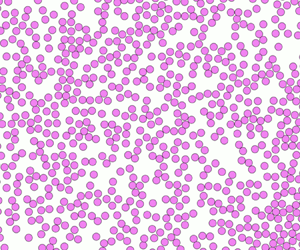
Investigation of near-wall particle statistics in CFD-DEM simulations of dense fluidised beds and derivation of an Eulerian particle dynamic wall boundary condition
-
- Journal:
- Journal of Fluid Mechanics / Volume 982 / 10 March 2024
- Published online by Cambridge University Press:
- 29 February 2024, A2
-
- Article
- Export citation
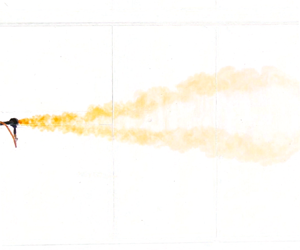
The dynamics of impinging plumes from a moving source
-
- Journal:
- Journal of Fluid Mechanics / Volume 982 / 10 March 2024
- Published online by Cambridge University Press:
- 29 February 2024, A6
-
- Article
-
- You have access
- Open access
- HTML
- Export citation
-
We present the results from a series of experiments investigating the dynamics of gravity currents which form when a dense saline or particle-laden plume issuing from a moving source interacts with a horizontal surface. We define the dimensionless parameter $P$ as the ratio of the source speed, $u_a$, to the buoyancy speed, $(B_0/z_0)^{1/3}$, where $B_0$ and $z_0$ are the source buoyancy flux and height above the horizontal surface, respectively. Using our experimental data, we determine that the limiting case in which $P=P_c$ the gravity current only spreads downstream of the initial impact point occurs when $P_c=0.83\pm 0.02$. For $P< P_c$, from our experiments we observe that the plume forms a gravity current that spreads out in all directions from the point of impact and the propagation of the gravity current is analogous to a classical constant-flux gravity current. For $P>P_c$, we observe that the descending plume is bent over and develops a pair of counter-rotating line vortices along the axis of the plume. The ensuing gravity current spreads out downstream of the source, normal to the motion of the source. Analogous processes occur with particle-laden plumes, but there is a second dimensionless parameter $S$, the ratio of the particle fall speed, $v_s$, to the vertical speed of a plume in a crossflow, $(B_0/u_a z_0)^{1/2}$. For $S\ll 1$, particles remain well mixed in the plume and a particle-driven gravity current develops. For $S\gg 1$, particles separate from the plume prior to impacting the boundary which leads to a fall deposit and no gravity current. We discuss these results in the context of deep-sea mining.


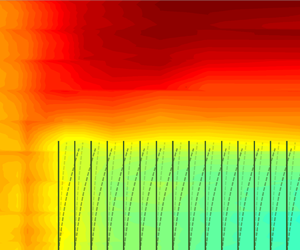
A simple prediction of time-mean and wave orbital velocities in submerged canopy
-
- Journal:
- Journal of Fluid Mechanics / Volume 982 / 10 March 2024
- Published online by Cambridge University Press:
- 29 February 2024, A3
-
- Article
- Export citation

How do we grow a Biodesigner?
-
- Journal:
- Research Directions: Biotechnology Design / Volume 2 / 2024
- Published online by Cambridge University Press:
- 28 February 2024, e2
-
- Article
-
- You have access
- Open access
- HTML
- Export citation
FLM volume 981 Cover and Front matter
-
- Journal:
- Journal of Fluid Mechanics / Volume 981 / 25 February 2024
- Published online by Cambridge University Press:
- 28 February 2024, p. f1
-
- Article
-
- You have access
- Export citation
Attitude modelling and real-time robust control of a 3-DoF quadcopter UAV test bench
-
- Journal:
- The Aeronautical Journal / Volume 128 / Issue 1326 / August 2024
- Published online by Cambridge University Press:
- 28 February 2024, pp. 1767-1788
-
- Article
- Export citation
Damage characteristics of fused silica under low-temporal coherence light
-
- Journal:
- High Power Laser Science and Engineering / Volume 12 / 2024
- Published online by Cambridge University Press:
- 27 February 2024, e30
-
- Article
-
- You have access
- Open access
- HTML
- Export citation
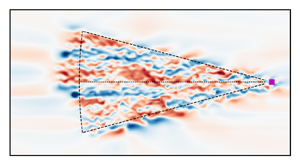
Large-eddy simulation-based reconstruction of turbulence in a neutral boundary layer using spectral-tensor regularization
-
- Journal:
- Journal of Fluid Mechanics / Volume 981 / 25 February 2024
- Published online by Cambridge University Press:
- 27 February 2024, A28
-
- Article
- Export citation
-
We propose an efficient method to reconstruct the turbulent flow field in a neutrally stratified atmospheric boundary layer using large-eddy simulation (LES) and a series of lidar measurements. The reconstruction is formulated as a strong four-dimensional variational data assimilation problem, which involves optimizing two competing terms that contribute in the objective functional. The first term is a likelihood term, while the second contains the initial background distribution of turbulent velocity fluctuations and works as a regularization term. However, computing and storing the full background covariance tensor in turbulent flows is time consuming and resource intensive. In the current work, we investigate the possibility of replacing the complex background tensor by simple analytical approximations based on spectral tensors such as the Hunt–Graham–Wilson (HGW) model (Boundary-Layer Meteorol., vol. 85, 1997, pp. 35–52) or the Mann model (J. Fluid Mech., vol. 273, 1994, pp. 141–168). Afterwards, the problem is solved using a quasi-Newton algorithm and preconditioned to enhance the convergence rate. We test the method using virtual lidar measurements collected on a fine reference LES. Results show a super-linear convergence rate of the optimization algorithm to a local minimum and very good agreement between virtual lidar measurements and reconstruction in the scanning region. Furthermore, we demonstrate that incorporating the Saffman energy spectrum ( $E(k) \sim k^2$ where E is the energy spectrum and k is the magnitude of the wavenumber vector) at low wavenumbers into the Mann spectral tensor yields a longer streamwise correlation length, resulting in reduced reconstruction error when compared with the Batchelor spectrum ( $E(k) \sim k^4$). Finally, we observe that using the HGW model or Mann model with a Saffman spectrum yields similar results.


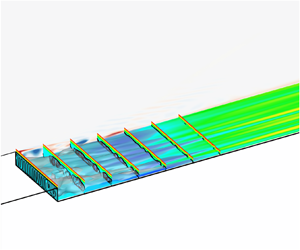
Bi-global stability of supersonic backward-facing step flow
-
- Journal:
- Journal of Fluid Mechanics / Volume 981 / 25 February 2024
- Published online by Cambridge University Press:
- 26 February 2024, A29
-
- Article
-
- You have access
- Open access
- HTML
- Export citation
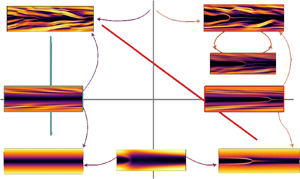
Multistability of elasto-inertial two-dimensional channel flow
-
- Journal:
- Journal of Fluid Mechanics / Volume 981 / 25 February 2024
- Published online by Cambridge University Press:
- 26 February 2024, A30
-
- Article
-
- You have access
- Open access
- HTML
- Export citation
The merger of co-rotating vortices in dusty flows
-
- Journal:
- Journal of Fluid Mechanics / Volume 981 / 25 February 2024
- Published online by Cambridge University Press:
- 26 February 2024, A27
-
- Article
-
- You have access
- Open access
- HTML
- Export citation
On the conditions for absolute minimum fuel burn for turbofan powered, civil transport aircraft and a simple model for wave drag
-
- Journal:
- The Aeronautical Journal / Volume 128 / Issue 1324 / June 2024
- Published online by Cambridge University Press:
- 26 February 2024, pp. 1071-1103
-
- Article
-
- You have access
- Open access
- HTML
- Export citation
New insights into experimental stratified flows obtained through physics-informed neural networks
-
- Journal:
- Journal of Fluid Mechanics / Volume 981 / 25 February 2024
- Published online by Cambridge University Press:
- 23 February 2024, R1
-
- Article
-
- You have access
- Open access
- HTML
- Export citation
-
We develop a physics-informed neural network (PINN) to significantly augment state-of-the-art experimental data of stratified flows. A fully connected deep neural network is trained using time-resolved experimental data in a salt-stratified inclined duct experiment, consisting of three-component velocity fields and density fields measured simultaneously in three dimensions at Reynolds number $= O(10^3)$ and at Prandtl or Schmidt number $=700$. The PINN enforces incompressibility, the governing equations for momentum and buoyancy, and the boundary conditions at the duct walls. These physics-constrained, augmented data are output at an increased spatio-temporal resolution and demonstrate five key results: (i) the elimination of measurement noise; (ii) the correction of distortion caused by the scanning measurement technique; (iii) the identification of weak but dynamically important three-dimensional vortices of Holmboe waves; (iv) the revision of turbulent energy budgets and mixing efficiency; and (v) the prediction of the latent pressure field and its role in the observed asymmetric Holmboe wave dynamics. These results mark a significant step forward in furthering the reach of experiments, especially in the context of stratified turbulence, where accurately computing three-dimensional gradients and resolving small scales remain enduring challenges.


Moment-based metrics for molecules computable from cryogenic electron microscopy images
-
- Journal:
- Biological Imaging / Volume 4 / 2024
- Published online by Cambridge University Press:
- 23 February 2024, e3
-
- Article
-
- You have access
- Open access
- HTML
- Export citation
Connecting transonic buffet with incompressible low-frequency oscillations on aerofoils
-
- Journal:
- Journal of Fluid Mechanics / Volume 981 / 25 February 2024
- Published online by Cambridge University Press:
- 23 February 2024, A23
-
- Article
-
- You have access
- Open access
- HTML
- Export citation
-
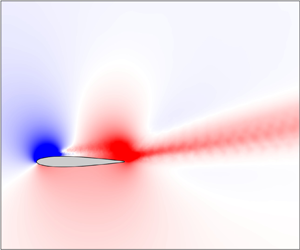
Self-sustained, low-frequency, coherent flow unsteadiness over rigid, stationary aerofoils in the transonic regime is referred to as transonic buffet. This study examines the role of shock waves in sustaining this transonic phenomenon and its relation to low-frequency oscillations (LFO) that occur in flow over aerofoils in the incompressible regime (Zaman et al., J. Fluid Mech., vol. 202, 1989, pp. 403–442). This is investigated by performing large-eddy simulations of the flow over a NACA0012 profile for a wide range of flow conditions under free-transition conditions. At low Reynolds numbers, zero incidence angle and sufficiently high free-stream Mach numbers, $M$, transonic buffet occurs with shock waves present in the flow. However, when $M$ alone is lowered, self-sustained, periodic oscillations at a low frequency are observed even though shock waves are absent and the entire flow field remains subsonic at all times. At higher incidence angles, the oscillations are sustained at progressively lower $M$ and are present even at $M=0.3$, where compressibility effects are low. A spectral proper orthogonal decomposition (SPOD) shows that the spatial structure of these oscillations is consistent for all cases. The SPOD modes are topologically similar, suggesting a connection between transonic buffet and LFO in the incompressible regime. Comparisons with other studies examining transonic buffet on various aerofoils, under forced-transition and fully turbulent conditions support this hypothesis. Future studies using tools of global linear stability analysis, especially at high free-stream Reynolds numbers are required to examine whether the underlying mechanisms of transonic buffet and incompressible LFO are the same.


