Refine search
Actions for selected content:
212948 results in Engineering
A comprehensive diagnostic system of ultra-thin liquid sheet targets
-
- Journal:
- High Power Laser Science and Engineering / Volume 12 / 2024
- Published online by Cambridge University Press:
- 05 March 2024, e26
-
- Article
-
- You have access
- Open access
- HTML
- Export citation
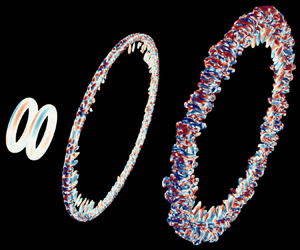
Velocity gradient analysis of a head-on vortex ring collision
-
- Journal:
- Journal of Fluid Mechanics / Volume 982 / 10 March 2024
- Published online by Cambridge University Press:
- 05 March 2024, A16
-
- Article
- Export citation
Metrology for sub-Rayleigh-length target positioning in ∼1022 W/cm2 laser–plasma experiments
-
- Journal:
- High Power Laser Science and Engineering / Volume 12 / 2024
- Published online by Cambridge University Press:
- 05 March 2024, e32
-
- Article
-
- You have access
- Open access
- HTML
- Export citation
-
Tight focusing with very small f-numbers is necessary to achieve the highest at-focus irradiances. However, tight focusing imposes strong demands on precise target positioning in-focus to achieve the highest on-target irradiance. We describe several near-infrared, visible, ultraviolet and soft and hard X-ray diagnostics employed in a ∼1022 W/cm2 laser–plasma experiment. We used nearly 10 J total energy femtosecond laser pulses focused into an approximately 1.3-μm focal spot on 5–20 μm thick stainless-steel targets. We discuss the applicability of these diagnostics to determine the best in-focus target position with approximately 5 μm accuracy (i.e., around half of the short Rayleigh length) and show that several diagnostics (in particular, 3 $\omega$ reflection and on-axis hard X-rays) can ensure this accuracy. We demonstrated target positioning within several micrometers from the focus, ensuring over 80% of the ideal peak laser intensity on-target. Our approach is relatively fast (it requires 10–20 laser shots) and does not rely on the coincidence of low-power and high-power focal planes.

Exploring slip effects of ferrofluid film flow over a slanted rough surface
-
- Journal:
- Journal of Fluid Mechanics / Volume 982 / 10 March 2024
- Published online by Cambridge University Press:
- 05 March 2024, A19
-
- Article
- Export citation
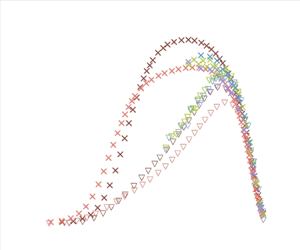
Consistent outer scaling and analysis of adverse pressure gradient turbulent boundary layers
-
- Journal:
- Journal of Fluid Mechanics / Volume 982 / 10 March 2024
- Published online by Cambridge University Press:
- 04 March 2024, A17
-
- Article
- Export citation
-
Under adverse pressure gradient (APG) conditions, the outer regions of turbulent boundary layers (TBLs) are characterized by an increased velocity defect $U_{e}-U$, an outwards shift of the peak value of the Reynolds shear stress $-\langle uv\rangle$ and an appearance of the outer peak value of the Reynolds normal stress $\langle uu\rangle$. Here $U_{e}$ is the TBL edge velocity. Scaling APG TBLs is challenging due to the non-equilibrium effects caused by changes in the APG. To address this, the response distance of TBLs to non-equilibrium conditions is utilized to extend the Zagarola–Smits scaling $U_{zs} = U_{e}({\delta ^{*} }/{\delta })$ and ensure that the original properties of the Zagarola–Smits scaling are maintained as $Re \to \infty$. Here $\delta ^{*}$ is the displacement thickness and $\delta$ is the boundary layer thickness. Based on the established correlation between $U_{e}-U$ and $-\langle uv\rangle$, the scaling is extended to $-\langle uv\rangle$. Furthermore, considering the coupling relationship between Reynolds stress components, the scaling is extended to encompass each Reynolds stress component. The proposed consistent scaling is verified using five non-equilibrium databases and five near-equilibrium databases, successfully collapsing the data of the TBL outer region. The pressure gradient parameter $\beta =({\delta ^{*} }/{\rho u_{\tau }^{2} }) ({\mathrm {d} P_{e} }/{\mathrm {d}\kern0.7pt x})$ of these databases spans two orders of magnitude. Here $P_{e}$ is the boundary layer edge pressure, $u_{\tau }$ is the friction velocity and $\rho$ is the density. Finally, the influence of the APG on the inner and outer regions of TBLs is analysed using the mean momentum balance equation. The analysis suggests that the shift of the $-\langle uv\rangle$ peak to the outer region under APG conditions is due to an insufficient inertia term near the inner region to balance the APG. It is observed that the APG promotes interaction between the inner and outer regions of TBLs, but the inner and outer regions still retain distinctive properties.



Regimes in rotating Rayleigh–Bénard convection over rough boundaries
-
- Journal:
- Journal of Fluid Mechanics / Volume 982 / 10 March 2024
- Published online by Cambridge University Press:
- 04 March 2024, A15
-
- Article
- Export citation
-
The present work focuses on the effect of rough horizontal boundaries on the heat transfer in rotating Rayleigh–Bénard convection. We measure the non-dimensional heat transfer, the Nusselt number $Nu$, for various strengths of the buoyancy forcing characterized by the Rayleigh number $Ra$ ( ${10^5}\mathrm{\ \mathbin{\lower.3ex\hbox{$\buildrel< \over {\smash{\scriptstyle\sim}\vphantom{_x}}$}}\ }Ra\mathrm{\ \mathbin{\lower.3ex\hbox{$\buildrel< \over {\smash{\scriptstyle\sim}\vphantom{_x}}$}}\ }5 \times {10^8}$), and rotation rates characterized by the Ekman number E ( $1.4 \times {10^{ - 5}}\mathrm{\ \mathbin{\lower.3ex\hbox{$\buildrel< \over {\smash{\scriptstyle\sim}\vphantom{_x}}$}}\ }E\mathrm{\ \mathbin{\lower.3ex\hbox{$\buildrel< \over {\smash{\scriptstyle\sim}\vphantom{_x}}$}}\ }7.6 \times {10^{ - 4}}$) for aspect ratios $\varGamma \approx 1$, $2.8$ and $6.7$. Similar to rotating convection with smooth horizontal boundaries, the so-called rotationally constrained (RC), rotation-affected (RA) and rotation-unaffected (RuA) regimes of heat transfer seem to persist for rough horizontal boundaries. However, the transition from the RC regime to RA regime occurs at a lower Rayleigh number for rough boundaries. For all experiments with rough boundaries in this study, the thermal and Ekman boundary layers are in a perturbed state, leading to a significant enhancement in the heat transfer as compared with that for smooth walls. However, the enhancement in heat transfer due to wall roughness is observed to attain a maximum in the RC regime. We perform companion direct numerical simulations of rotating convection over smooth walls to suggest a phenomenology explaining this observation. We propose that the heat transfer enhancement due to wall roughness reaches a maximum when the strength and coherence of the columnar structures are both significant, which enables efficient vertical transport of the additional thermal anomalies generated by the roughness at the top and bottom walls.


Frequency reconfigurable circular microstrip G-slotted antenna with DGS for various wireless applications
-
- Journal:
- International Journal of Microwave and Wireless Technologies / Volume 16 / Issue 3 / April 2024
- Published online by Cambridge University Press:
- 04 March 2024, pp. 505-514
-
- Article
- Export citation

Optimising subgrid-scale closures for spectral energy transfer in turbulent flows
-
- Journal:
- Journal of Fluid Mechanics / Volume 982 / 10 March 2024
- Published online by Cambridge University Press:
- 04 March 2024, A18
-
- Article
-
- You have access
- Open access
- HTML
- Export citation
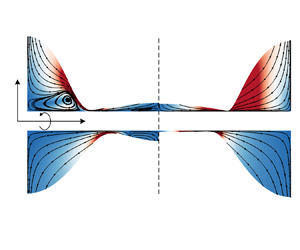
Inertia and slip effects on the instability of a liquid film coated on a fibre
-
- Journal:
- Journal of Fluid Mechanics / Volume 982 / 10 March 2024
- Published online by Cambridge University Press:
- 04 March 2024, A13
-
- Article
- Export citation

Neurocomputational Poetics
- How the Brain Processes Verbal Art
-
- Published by:
- Anthem Press
- Published online:
- 01 March 2024
- Print publication:
- 14 November 2023
NAV volume 77 issue 2 Cover and Back matter
-
- Journal:
- The Journal of Navigation / Volume 77 / Issue 2 / March 2024
- Published online by Cambridge University Press:
- 21 April 2025, pp. b1-b2
- Print publication:
- March 2024
-
- Article
-
- You have access
- Export citation
Missed detection probability evaluation for the RAIM based on worst-case fault magnitude searching
-
- Journal:
- The Journal of Navigation / Volume 77 / Issue 2 / March 2024
- Published online by Cambridge University Press:
- 25 October 2024, pp. 151-168
- Print publication:
- March 2024
-
- Article
- Export citation
Integrated orbit determination and time synchronization using inter-satellite observations for BDS-3 satellites with satellite clock drifts estimated simultaneously
-
- Journal:
- The Journal of Navigation / Volume 77 / Issue 2 / March 2024
- Published online by Cambridge University Press:
- 25 October 2024, pp. 169-181
- Print publication:
- March 2024
-
- Article
- Export citation
A controllable sliding law for thin-film flows over slippery fluid-saturated substrates: theory and experiments
-
- Journal:
- Journal of Fluid Mechanics / Volume 982 / 10 March 2024
- Published online by Cambridge University Press:
- 01 March 2024, A14
-
- Article
-
- You have access
- Open access
- HTML
- Export citation
Interface coupling effect and multi-mode Faraday instabilities in a three-layer fluid system
-
- Journal:
- Journal of Fluid Mechanics / Volume 982 / 10 March 2024
- Published online by Cambridge University Press:
- 01 March 2024, A8
-
- Article
- Export citation
-
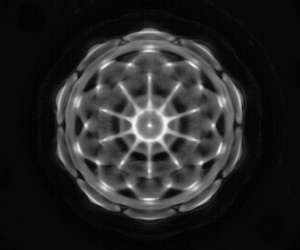
We investigate the Faraday instabilities of a three-layer fluid system in a cylindrical container containing low-viscosity liquid metal, sodium hydroxide solution and air by establishing the Mathieu equations with considering the viscous model derived by Labrador et al. (J. Phys.: Conf. Ser., vol. 2090, 2021, 012088). The Floquet analysis, asymptotic analysis, direct numerical simulation and experimental method are adopted in the present study. We obtain the dispersion relations and critical oscillation amplitudes of zigzag and varicose modes from the analysis of the Mathieu equations, which agree well with the experimental result. Furthermore, considering the coupling strength of two interfaces, besides zigzag and varicose modes, we find a beating instability mode that contains two primary frequencies, with its average frequency equalling half of the external excitation frequency in the strongly coupled system. In the weakly coupled system, the $A$-interface instability, $B$-interface instability and $A$&
$A$& $B$-interface instability are defined. Finally, we obtain a critical wavenumber $k_c$ that can determine the transition from zigzag or varicose modes to the corresponding $A$-interface or $B$-interface instability.


Vortex line entanglement in active Beltrami flows
- Part of
-
- Journal:
- Journal of Fluid Mechanics / Volume 982 / 10 March 2024
- Published online by Cambridge University Press:
- 01 March 2024, A12
-
- Article
-
- You have access
- HTML
- Export citation
Forced synchronization of self-excited chaotic thermoacoustic oscillations
-
- Journal:
- Journal of Fluid Mechanics / Volume 982 / 10 March 2024
- Published online by Cambridge University Press:
- 01 March 2024, A9
-
- Article
-
- You have access
- Open access
- HTML
- Export citation
-
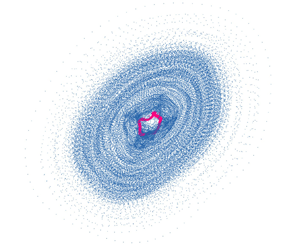
We experimentally investigate the forced synchronization of a self-excited chaotic thermoacoustic oscillator with two natural frequencies, $f_1$ and $f_2$. On increasing the forcing amplitude, $\epsilon _f$, at a fixed forcing frequency, $f_f$, we find two different types of synchronization: (i) $f_f/f_1 = 1:1$ or $2:1$ chaos-destroying synchronization (CDS), and (ii) phase synchronization of chaos (PSC). En route to $1:1$ CDS, the system transitions from an unforced chaotic state ( ${\rm {CH}}_{1,2}$) to a forced chaotic state ( ${\rm {CH}}_{1,2,f}$), then to a two-frequency quasiperiodic state where chaos is destroyed ( $\mathbb {T}^2_{2,f}$), and finally to a phase-locked period-1 state ( ${\rm {P1}}_f$). The route to $2:1$ CDS is similar, but the quasiperiodic state hosts a doubled torus $(2\mathbb {T}^2_{2,f})$ that transforms into a phase-locked period-2 orbit $({\rm {P2}}_f)$ when CDS occurs. En route to PSC, the system transitions to a forced chaotic state ( ${\rm {CH}}_{1,2,f}$) followed by a phase-locked chaotic state, where $f_1$, $f_2$ and $f_f$ still coexist but their phase difference remains bounded. We find that the maximum reduction in thermoacoustic amplitude occurs near the onset of CDS, and that the critical $\epsilon _f$ required for the onset of CDS does not vary significantly with $f_f$. We then use two unidirectionally coupled Anishchenko–Astakhov oscillators to phenomenologically model the experimental synchronization dynamics, including (i) the route to $1:1$ CDS, (ii) various phase dynamics, such as phase drifting, slipping and locking, and (iii) the thermoacoustic amplitude variations in the $f_f/f_1$– $\epsilon _f$ plane. This study extends the applicability of open-loop control further to a chaotic thermoacoustic system, demonstrating (i) the feasibility of using an existing actuation strategy to weaken aperiodic thermoacoustic oscillations, and (ii) the possibility of developing new active suppression strategies based on both established and emerging methods of chaos control.


NAV volume 77 issue 2 Cover and Front matter
-
- Journal:
- The Journal of Navigation / Volume 77 / Issue 2 / March 2024
- Published online by Cambridge University Press:
- 21 April 2025, pp. f1-f2
- Print publication:
- March 2024
-
- Article
-
- You have access
- Export citation
Exploring the MASS-DoA2 control-switching mechanism: Results from the autonomous ship guidelines review and expert survey
-
- Journal:
- The Journal of Navigation / Volume 77 / Issue 2 / March 2024
- Published online by Cambridge University Press:
- 13 January 2025, pp. 276-305
- Print publication:
- March 2024
-
- Article
- Export citation
The conceptual design of the high-efficiency 400 kW solid-state power station at 352 MHz for the European spallation source
-
- Journal:
- International Journal of Microwave and Wireless Technologies / Volume 16 / Issue 10 / December 2024
- Published online by Cambridge University Press:
- 01 March 2024, pp. 1678-1684
-
- Article
-
- You have access
- Open access
- HTML
- Export citation
