Refine search
Actions for selected content:
212937 results in Engineering
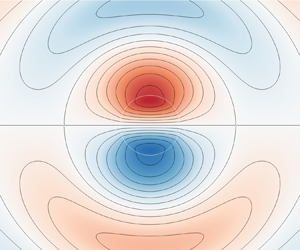
Wave scattering and radiation by a surface-piercing vertical truncated metamaterial cylinder
-
- Journal:
- Journal of Fluid Mechanics / Volume 983 / 25 March 2024
- Published online by Cambridge University Press:
- 12 March 2024, A7
-
- Article
-
- You have access
- Open access
- HTML
- Export citation
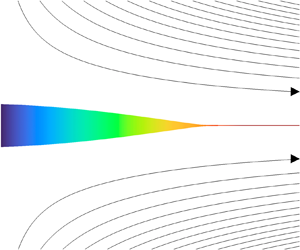
Stable production of fluid jets with vanishing diameters via tip streaming
-
- Journal:
- Journal of Fluid Mechanics / Volume 983 / 25 March 2024
- Published online by Cambridge University Press:
- 12 March 2024, A4
-
- Article
-
- You have access
- Open access
- HTML
- Export citation
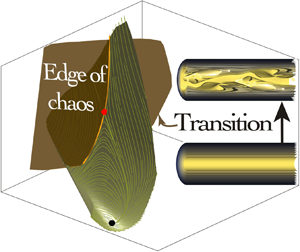
Life on the edge: subcritical pipe flow transition as a spectral submanifold
-
- Journal:
- Journal of Fluid Mechanics / Volume 983 / 25 March 2024
- Published online by Cambridge University Press:
- 12 March 2024, F1
-
- Article
-
- You have access
- HTML
- Export citation
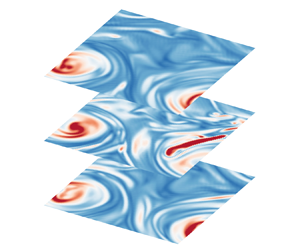
The conditional Lyapunov exponents and synchronisation of rotating turbulent flows
-
- Journal:
- Journal of Fluid Mechanics / Volume 983 / 25 March 2024
- Published online by Cambridge University Press:
- 12 March 2024, A1
-
- Article
-
- You have access
- Open access
- HTML
- Export citation
-
The synchronisation between rotating turbulent flows in periodic boxes is investigated numerically. The flows are coupled via a master–slave coupling, taking the Fourier modes with wavenumber below a given value $k_m$ as the master modes. It is found that synchronisation happens when $k_m$ exceeds a threshold value $k_c$, and $k_c$ depends strongly on the forcing scheme. In rotating Kolmogorov flows, $k_c\eta$ does not change with rotation in the range of rotation rates considered, $\eta$ being the Kolmogorov length scale. Even though the energy spectrum has a steeper slope, the value of $k_c\eta$ is the same as that found in isotropic turbulence. In flows driven by a forcing term maintaining constant energy injection rate, synchronisation becomes easier when rotation is stronger. Here, $k_c\eta$ decreases with rotation, and it is reduced significantly for strong rotations when the slope of the energy spectrum approaches $-3$. It is shown that the conditional Lyapunov exponent for a given $k_m$ is reduced by rotation in the flows driven by the second type of forcing, but it increases mildly with rotation for the Kolmogorov flows. The local conditional Lyapunov exponents fluctuate more strongly as rotation is increased, although synchronisation occurs as long as the average conditional Lyapunov exponents are negative. We also look for the relationship between $k_c$ and the energy spectra of the Lyapunov vectors. We find that the spectra always seem to peak at approximately $k_c$, and synchronisation fails when the energy spectra of the conditional Lyapunov vectors have a local maximum in the slaved modes.


Prandtl number effects on extreme mixing events in forced stratified turbulence
-
- Journal:
- Journal of Fluid Mechanics / Volume 983 / 25 March 2024
- Published online by Cambridge University Press:
- 12 March 2024, R1
-
- Article
-
- You have access
- Open access
- HTML
- Export citation
-
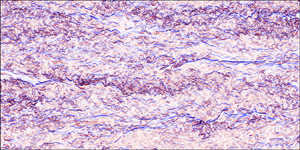
Relatively strongly stratified turbulent flows tend to self-organise into a ‘layered anisotropic stratified turbulence’ (LAST) regime, characterised by relatively deep and well-mixed density ‘layers’ separated by relatively thin ‘interfaces’ of enhanced density gradient. Understanding the associated mixing dynamics is a central problem in geophysical fluid dynamics. It is challenging to study LAST mixing, as it is associated with Reynolds numbers $Re := UL/\nu \gg 1$ and Froude numbers $Fr :=(2{\rm \pi} U)/(L N) \ll 1$ ( $U$ and $L$ being characteristic velocity and length scales, $\nu$ the kinematic viscosity and $N$ the buoyancy frequency). Since a sufficiently large dynamic range (largely) unaffected by stratification and viscosity is required, it is also necessary for the buoyancy Reynolds number $Re_{b} := \epsilon /(\nu N^{2}) \gg 1$, where $\epsilon$ is the (appropriately volume-averaged) turbulent kinetic energy dissipation rate. This requirement is exacerbated for oceanically relevant flows, as the Prandtl number $Pr := \nu /\kappa = {O}(10)$ in thermally stratified water (where $\kappa$ is the thermal diffusivity), thus leading (potentially) to even finer density field structures. We report here on four forced fully resolved direct numerical simulations of stratified turbulence at various Froude ( $Fr=0.5, 2$) and Prandtl ( $Pr=1, 7$) numbers forced so that $Re_{b}=50$, with resolutions up to $30\,240 \times 30\,240 \times 3780$. We find that, as $Pr$ increases, emergent ‘interfaces’ become finer and their contribution to bulk mixing characteristics decreases at the expense of the small-scale density structures populating the well-mixed ‘layers’. However, extreme mixing events (as quantified by significantly elevated local destruction rates of buoyancy variance $\chi _0$) are always preferentially found in the (statically stable) interfaces, irrespective of the value of $Pr$.
$Pr$.


Modelling the unsteady lift of a pitching NACA 0018 aerofoil using state-space neural networks
-
- Journal:
- Journal of Fluid Mechanics / Volume 983 / 25 March 2024
- Published online by Cambridge University Press:
- 12 March 2024, A8
-
- Article
-
- You have access
- Open access
- HTML
- Export citation
-
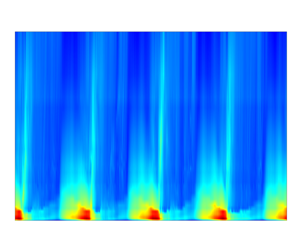
The development of simple, low-order and accurate unsteady aerodynamic models represents a crucial challenge for the design optimisation and control of fluid dynamical systems. In this work, wind tunnel experiments of a pitching NACA 0018 aerofoil conducted at a Reynolds number $Re = 2.8 \times 10^5$ and at different free-stream turbulence intensities are used to identify data-driven nonlinear state-space models relating the time-varying angle of attack of the aerofoil to the lift coefficient. The proposed state-space neural network (SS-NN) modelling technique explores an innovative methodology, which brings the flexibility of artificial neural networks into a classical state-space representation and offers new insights into the construction of reduced-order unsteady aerodynamic models. The work demonstrates that this technique provides accurate predictions of the nonlinear unsteady aerodynamic loads of a pitching aerofoil for a wide variety of angle-of-attack ranges and frequencies of oscillation. Results are compared with a modified version of the Goman–Khrabrov dynamic stall model. It is shown that the SS-NN methodology outperforms the classical semi-empirical dynamic stall models in terms of accuracy, while retaining a fast evaluation time. Additionally, the proposed models are robust to noisy measurements and do not require any pre-processing of the data, thus involving only a limited user interaction. Overall, these features make the SS-NN technique an excellent candidate for the construction of accurate data-driven models from experimental fluid dynamics data, and pave the way for their adoption in applications entailing design optimisation and real-time control of systems involving lift.
On the development and analysis of coupled surface–subsurface models of catchments. Part 3. Analytical solutions and scaling laws
-
- Journal:
- Journal of Fluid Mechanics / Volume 982 / 10 March 2024
- Published online by Cambridge University Press:
- 12 March 2024, A30
-
- Article
-
- You have access
- Open access
- HTML
- Export citation
On the development and analysis of coupled surface–subsurface models of catchments. Part 1. Analysis of dimensions and parameters for UK catchments
-
- Journal:
- Journal of Fluid Mechanics / Volume 982 / 10 March 2024
- Published online by Cambridge University Press:
- 11 March 2024, A28
-
- Article
-
- You have access
- Open access
- HTML
- Export citation
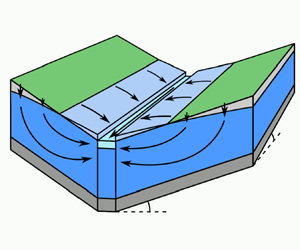
On the development and analysis of coupled surface–subsurface models of catchments. Part 2. A three-dimensional benchmark model and its properties
-
- Journal:
- Journal of Fluid Mechanics / Volume 982 / 10 March 2024
- Published online by Cambridge University Press:
- 11 March 2024, A29
-
- Article
-
- You have access
- Open access
- HTML
- Export citation
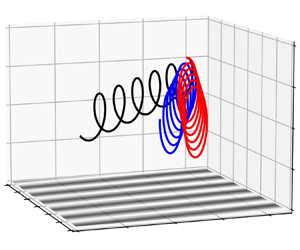
Surface corrugations induce helical near-surface flows and transport in microfluidic channels
-
- Journal:
- Journal of Fluid Mechanics / Volume 982 / 10 March 2024
- Published online by Cambridge University Press:
- 11 March 2024, A31
-
- Article
-
- You have access
- Open access
- HTML
- Export citation

Renewable Energy Engineering
-
- Published online:
- 08 March 2024
- Print publication:
- 28 March 2024
-
- Textbook
- Export citation

Essays on Coding Theory
-
- Published online:
- 08 March 2024
- Print publication:
- 14 March 2024
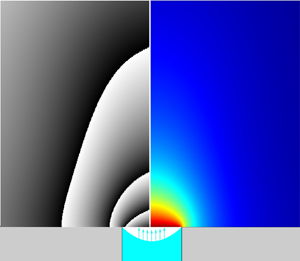
Evaporation from a cylindrical cavity: effect of gravity on the vapour cloud
-
- Journal:
- Journal of Fluid Mechanics / Volume 982 / 10 March 2024
- Published online by Cambridge University Press:
- 08 March 2024, A26
-
- Article
- Export citation
-
We examine the vapour cloud of a pure liquid evaporating from a millimetric cylindrical well/cavity/aperture. This is accomplished by injecting the liquid up a vertical pipe towards its outlet onto a horizontal substrate. The injection is halted before the liquid surpasses the substrate level. The resulting final state is a meniscus at or near the pipe's end. The analysis is realised by vapour interferometry (side view over the substrate) closely intertwined with simulations (including Stefan flow), which also help to fill up certain gaps in the measurements and provide computed evaporation rates. Comparison with experiment is facilitated by converting the computed vapour clouds into interferometric images, especially helpful when an inverse (Abel-type) conversion is difficult. Experiments are conducted in both microgravity (via parabolic flights) and ground conditions, thus enabling direct assessment of the role of gravity. The contrast is accentuated by a working liquid with heavy vapour (refrigerant HFE-7100), when instead of being flattened on ground the vapour cloud assumes a roughly hemispherical shape in microgravity. Furthermore, a non-trivial vapour-cloud response to the flight ${\rm g}$-jitter (residual gravity oscillations) is unveiled, ${\rm g}$-jitter vibrations posing a challenge for interferometry itself. A number of undesired but curious side issues are revealed. One concerns vapour formed deep inside the pipe during rapid injection and subsequently ejected into the field of view, which is detected experimentally and quantified in terms of vapour Taylor dispersion in the pipe. Others are an injection volume anomaly and parasitic postinjection specifically observed in microgravity conditions.


Developing a human rights compatible governance framework for quantum computing
-
- Journal:
- Research Directions: Quantum Technologies / Volume 2 / 2024
- Published online by Cambridge University Press:
- 08 March 2024, e1
-
- Article
-
- You have access
- Open access
- HTML
- Export citation
Brightness enhancement on random-distributed-feedback Raman fiber lasers pumped by multimode diodes
-
- Journal:
- High Power Laser Science and Engineering / Volume 12 / 2024
- Published online by Cambridge University Press:
- 08 March 2024, e29
-
- Article
-
- You have access
- Open access
- HTML
- Export citation
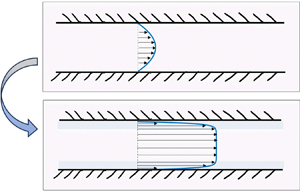
Electrolubrication in liquid mixtures between two parallel plates
-
- Journal:
- Journal of Fluid Mechanics / Volume 982 / 10 March 2024
- Published online by Cambridge University Press:
- 08 March 2024, A27
-
- Article
-
- You have access
- Open access
- HTML
- Export citation
-
We describe theoretically ‘electrolubrication’ in liquid mixtures: the phenomenon whereby an electric field applied transverse to the confining surfaces leads to concentration gradients that alter the flow profile significantly. When the more polar liquid is the less viscous one, the stress in the liquid falls on two electric-field-induced thin lubrication layers. The thickness of the lubrication layer depends on the Debye length and the mixture correlation length. For the simple case of two parallel and infinite plates, we calculate explicitly the liquid velocity profile and integrated flux. The maximum liquid velocity and flux can be increased by a factor $\alpha$, of order 10–100 or even more. For a binary mixture of water and a cosolvent, with viscosities $\eta _w$ and $\eta _{cs}$, respectively, $\alpha$ increases monotonically with inter-plate potential $V$ and average ion content, and is large if the ratio $\eta _{cs}/\eta _w$ is large.


Dual-port circularly polarized dielectric resonator–based antenna with reconfigurable integrated multifunctional filter for 5G cognitive radio applications
-
- Journal:
- International Journal of Microwave and Wireless Technologies / Volume 16 / Issue 7 / September 2024
- Published online by Cambridge University Press:
- 08 March 2024, pp. 1208-1217
-
- Article
- Export citation
Tunable microstrip bandpass filter with constant absolute bandwidth using BST varactors and digitally tunable capacitors
-
- Journal:
- International Journal of Microwave and Wireless Technologies / Volume 16 / Issue 7 / September 2024
- Published online by Cambridge University Press:
- 08 March 2024, pp. 1106-1112
-
- Article
- Export citation

Offshore Wind Energy
- Environmental Conditions and Dynamics of Fixed and Floating Turbines
-
- Published online:
- 07 March 2024
- Print publication:
- 14 March 2024
Multitask feature selection within structural datasets
-
- Journal:
- Data-Centric Engineering / Volume 5 / 2024
- Published online by Cambridge University Press:
- 07 March 2024, e4
-
- Article
-
- You have access
- Open access
- HTML
- Export citation
