Refine search
Actions for selected content:
213073 results in Engineering
Conditional analysis on extreme wall shear stress and heat flux events in compressible turbulent boundary layers
-
- Journal:
- Journal of Fluid Mechanics / Volume 974 / 10 November 2023
- Published online by Cambridge University Press:
- 03 November 2023, A38
-
- Article
- Export citation
-
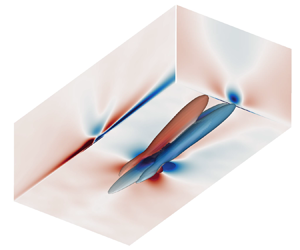
This study presents a comprehensive analysis on the extreme positive and negative events of wall shear stress and heat flux fluctuations in compressible turbulent boundary layers (TBLs) solved by direct numerical simulations. To examine the compressibility effects, we focus on the extreme events in two representative cases, i.e. a supersonic TBL of Mach number $M=2$ and a hypersonic TBL of $M=8$, by scrutinizing the coherent structures and their correlated dynamics based on conditional analysis. As characterized by the spatial distribution of wall shear stress and heat flux, the extreme events are indicated to be closely related to the structural organization of wall streaks, in addition to the occurrence of the alternating positive and negative structures (APNSs) in the hypersonic TBL. These two types of coherent structures are strikingly different, namely the nature of wall streaks and APNSs are shown to be related to the solenoidal and dilatational fluid motions, respectively. Quantitative analysis using a volumetric conditional average is performed to identify and extract the coherent structures that directly account for the extreme events. It is found that in the supersonic TBL, the essential ingredients of the conditional field are hairpin-like vortices, whose combinations can induce wall streaks, whereas in the hypersonic TBL, the essential ingredients become hairpin-like vortices as well as near-wall APNSs. To quantify the momentum and energy transport mechanisms underlying the extreme events, we proposed a novel decomposition method for extreme skin friction and heat flux, based on the integral identities of conditionally averaged governing equations. Taking advantage of this decomposition method, the dominant transport mechanisms of the hairpin-like vortices and APNSs are revealed. Specifically, the momentum and energy transports undertaken by the hairpin-like vortices are attributed to multiple comparable mechanisms, whereas those by the APNSs are convection dominated. In that, the dominant transport mechanisms in extreme events between the supersonic and hypersonic TBLs are indicated to be totally different.


Ensemble approaches for leveraging machine learning models in load estimation
- Part of
-
- Journal:
- The Aeronautical Journal / Volume 127 / Issue 1318 / December 2023
- Published online by Cambridge University Press:
- 03 November 2023, pp. 2082-2104
-
- Article
- Export citation
Dynamics of multilayer Rayleigh–Taylor instability at moderately high Atwood numbers
-
- Journal:
- Journal of Fluid Mechanics / Volume 974 / 10 November 2023
- Published online by Cambridge University Press:
- 03 November 2023, A35
-
- Article
-
- You have access
- Open access
- HTML
- Export citation
-
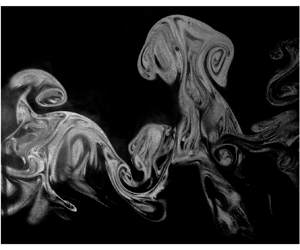
This paper investigates the multilayer Rayleigh–Taylor instability (RTI) using statistically stationary experiments conducted in a gas tunnel. Employing diagnostics such as particle image velocimetry (PIV) and planar laser induced fluorescence (PLIF), we make simultaneous velocity–density measurements to study how dynamics and mixing are linked in this variable density flow. Experiments are conducted in a newly built, blow-down three-layer gas tunnel facility. Mixing between three gas streams is studied, where the top and bottom streams are comprised of air, and the middle stream is an air–helium mixture. Shear is minimized between these streams by matching their inlet velocities. The four experimental conditions investigated here consist of two different density ratios (Atwood numbers 0.3 and 0.6), each investigated at two instability development times (or equivalently, two streamwise locations), and all experiments are with the same middle stream thickness of 3 cm. The growth of the middle layer is measured using laser-based planar Mie scattering visualization. The mixing width is found to grow linearly with time at late times. Various quantitative measures of molecular mixing indicate a very high degree of molecular mixing at late times in the multilayer RTI flow. The vertical turbulent mass flux $a_y$ is calculated. In addition to mostly negative values of $a_y$, typical of buoyancy-dominated flows due to negative correlation between velocity and density fluctuations, positive regions are also observed in profiles of $a_y$ due to entrainment and erosion at the lower edge of the mixing region. Global energy budgets are calculated for the multilayer RTI flow at late times and it is found that the majority of potential energy released has been dissipated due to viscous effects, and a large value of mixing efficiency ( $\sim$60 %) is observed.


Effect of passive shoulder exoskeleton support during working with arms over shoulder level
-
- Journal:
- Wearable Technologies / Volume 4 / 2023
- Published online by Cambridge University Press:
- 03 November 2023, e26
-
- Article
-
- You have access
- Open access
- HTML
- Export citation
Mean flow and turbulence in unsteady canopy layers
-
- Journal:
- Journal of Fluid Mechanics / Volume 974 / 10 November 2023
- Published online by Cambridge University Press:
- 03 November 2023, A33
-
- Article
-
- You have access
- Open access
- HTML
- Export citation
-
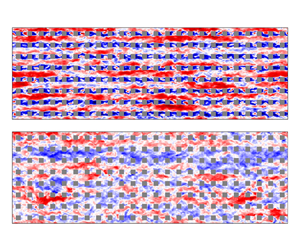
Non-stationarity is the rule in the atmospheric boundary layer (ABL). Under such conditions, the flow may experience departures from equilibrium with the underlying surface stress, misalignment of shear stresses and strain rates, and three-dimensionality in turbulence statistics. Existing ABL flow theories are primarily established for statistically stationary flow conditions and cannot predict such behaviours. Motivated by this knowledge gap, this study analyses the impact of time-varying pressure gradients on mean flow and turbulence over urban-like surfaces. A series of large-eddy simulations of pulsatile flow over cuboid arrays is performed, programmatically varying the oscillation amplitude $\alpha$ and forcing frequency $\omega$. The analysis focuses on both longtime-averaged and phase-dependent flow dynamics. Inspection of longtime-averaged velocity profiles reveals that the aerodynamic roughness length $z_0$ increases with $\alpha$ and $\omega$, whereas the displacement height $d$ appears to be insensitive to these parameters. In terms of oscillatory flow statistics, it is found that $\alpha$ primarily controls the oscillation amplitude of the streamwise velocity and Reynolds stresses, but has a negligible impact on their wall-normal structure. On the other hand, $\omega$ determines the size of the region affected by the unsteady forcing, which identifies the so-called Stokes layer thickness $\delta _s$. Within the Stokes layer, phase-averaged resolved Reynolds stress profiles feature substantial variations during the pulsatile cycle, and the turbulence is out of equilibrium with the mean flow. Two phenomenological models have been proposed that capture the influence of flow unsteadiness on $z_0$ and $\delta _s$, respectively.


Effect of oxygen shielding on the tensile and fatigue performance of 300M repaired through laser-directed energy deposition
- Part of
-
- Journal:
- The Aeronautical Journal / Volume 127 / Issue 1318 / December 2023
- Published online by Cambridge University Press:
- 03 November 2023, pp. 2118-2124
-
- Article
- Export citation
Embedding data science innovations in organizations: a new workflow approach
-
- Journal:
- Data-Centric Engineering / Volume 4 / 2023
- Published online by Cambridge University Press:
- 03 November 2023, e26
-
- Article
-
- You have access
- Open access
- HTML
- Export citation
Incomplete to complete multiphysics forecasting: a hybrid approach for learning unknown phenomena
-
- Journal:
- Data-Centric Engineering / Volume 4 / 2023
- Published online by Cambridge University Press:
- 03 November 2023, e27
-
- Article
-
- You have access
- Open access
- HTML
- Export citation
Structure of the streaming flow generated by a sphere in a fluid undergoing rectilinear oscillation
-
- Journal:
- Journal of Fluid Mechanics / Volume 974 / 10 November 2023
- Published online by Cambridge University Press:
- 03 November 2023, A37
-
- Article
- Export citation
-
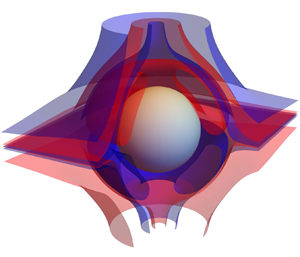
A solid body in a viscous fluid undergoing oscillatory motion naturally produces a steady secondary flow due to convective inertia. This phenomenon is embodied in the streaming flow generated by a sphere in an unbounded fluid executing rectilinear oscillations. We review the considerable literature on this canonical problem and summarise exact and asymptotic formulas in the small-amplitude limit. These analytical formulas are used to explore the characteristic flow structure of this problem and clarify previously unreported features. A single, toroidal-shaped vortex exists in each hemisphere regardless of the oscillation frequency, which can drive a counter-flow away from the sphere. The vortex centre moves monotonically away from the sphere with decreasing oscillation frequency, and engulfs the entire flow domain for $\beta \equiv \omega R^2/\nu < 16.317$, where $\omega$ is the angular oscillation frequency, $R$ the sphere radius, and $\nu$ the fluid kinematic viscosity. This seemingly abrupt change in flow structure at the critical frequency $\beta _{critical} =16.317$, and its quantification, appear to have not been reported previously. We perform a direct numerical simulation of the Navier–Stokes equations, to (1) confirm existence of this critical frequency at finite amplitude, and (2) examine its variation with amplitude. This reveals a universal relationship between the critical frequency and oscillation amplitude, clarifying previous reports on the structure of this streaming flow. The critical frequency is shown to be identical for the streaming flow and the cycle-averaged particle paths, establishing that the critical frequency is accessible directly using standard measurements.


Endmatter
-
- Book:
- Introduction to Electrodynamics
- Published online:
- 06 October 2023
- Print publication:
- 02 November 2023, pp 603-606
-
- Chapter
- Export citation
3 - UAVs Serving as Flying Infrastructures
- from Part II - UAV Communication Networks
-
- Book:
- Aerial Access Networks
- Published online:
- 19 October 2023
- Print publication:
- 02 November 2023, pp 21-54
-
- Chapter
- Export citation
Contents
-
- Book:
- Aerial Access Networks
- Published online:
- 19 October 2023
- Print publication:
- 02 November 2023, pp v-x
-
- Chapter
- Export citation
Preface
-
- Book:
- Aerial Access Networks
- Published online:
- 19 October 2023
- Print publication:
- 02 November 2023, pp xi-xii
-
- Chapter
- Export citation
2 - Bird’s–Eye View
-
- Book:
- Virtual Reality
- Published online:
- 12 October 2023
- Print publication:
- 02 November 2023, pp 31-54
-
- Chapter
- Export citation
3 - Potentials
-
- Book:
- Introduction to Electrodynamics
- Published online:
- 06 October 2023
- Print publication:
- 02 November 2023, pp 113-165
-
- Chapter
- Export citation
Copyright page
-
- Book:
- Introduction to Electrodynamics
- Published online:
- 06 October 2023
- Print publication:
- 02 November 2023, pp iv-iv
-
- Chapter
- Export citation
5 - Deployment for High Altitude Platform Systems with Perturbation
- from Part III - HAP Communication Networks
-
- Book:
- Aerial Access Networks
- Published online:
- 19 October 2023
- Print publication:
- 02 November 2023, pp 135-146
-
- Chapter
- Export citation
2 - Electrostatics
-
- Book:
- Introduction to Electrodynamics
- Published online:
- 06 October 2023
- Print publication:
- 02 November 2023, pp 57-112
-
- Chapter
- Export citation
-
Summary
The fundamental problem electrodynamics hopes to solve is this (Fig. 2.1): We have some electric charges,
(call them source charges); what force do they exert on another charge,
Advertisement
-
- Book:
- Introduction to Electrodynamics
- Published online:
- 06 October 2023
- Print publication:
- 02 November 2023, pp xiv-xx
-
- Chapter
- Export citation
5 - Magnetostatics
-
- Book:
- Introduction to Electrodynamics
- Published online:
- 06 October 2023
- Print publication:
- 02 November 2023, pp 209-267
-
- Chapter
- Export citation
-
Summary
Remember the basic problem of classical electrodynamics: we have a collection of charges
