Refine search
Actions for selected content:
213073 results in Engineering
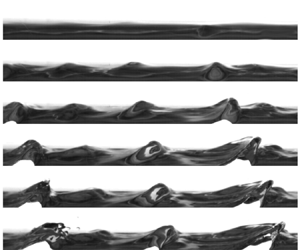
On the role of unsteadiness in impulsive-flow-driven shear instabilities: precursors of fragmentation
-
- Journal:
- Journal of Fluid Mechanics / Volume 973 / 25 October 2023
- Published online by Cambridge University Press:
- 23 October 2023, A28
-
- Article
- Export citation

Edge-driven collapse of fluid holes
-
- Journal:
- Journal of Fluid Mechanics / Volume 973 / 25 October 2023
- Published online by Cambridge University Press:
- 23 October 2023, A18
-
- Article
- Export citation
-
We study the stability and collapse of holes at the wall in liquid layers on circular bounded containers with various wettabilities. Three distinct wetting modes of the hole are observed, which are related to the wettability of the container: when the substrate and the inner wall of the container are superhydrophobic, a stable hole remains as the liquid volume is continuously increased until the liquid layer covers the entire substrate; when the substrate and the inner wall are hydrophobic, an eye-shaped hole remains stable as the projected area of the hole exceeds a critical value $A_c$, however, the hole collapses if the liquid volume is further increased; when the substrate is superhydrophobic but the wall is hydrophilic, on increasing the liquid volume, the hole suddenly transfers into a circular hole and is pushed against the wall, leaving the hole dwelling around the centre of the container. Theoretical analyses and numerical simulations are conducted to establish the phase diagram for different wetting modes. It is found that, in the second mode, $A_c$ increases with the size of the container but decreases with the contact angle of the substrate and the wall. Furthermore, we experimentally investigate the dynamics of the hole. The time evolution of the area of the hole obeys a scaling relationship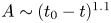 $A \sim (t_0 - t)^{1.1}$ after the hole collapses at time $t_0$.


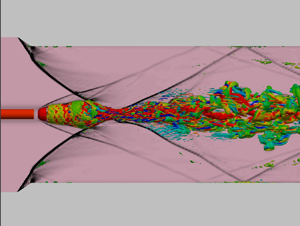
Streamwise vortex breakdown due to the interaction with crossed shock waves
-
- Journal:
- Journal of Fluid Mechanics / Volume 973 / 25 October 2023
- Published online by Cambridge University Press:
- 23 October 2023, A41
-
- Article
- Export citation
-
This paper presents a vortex breakdown study due to the interaction between a Batchelor vortex and the crossing of oblique shock waves with Mach numbers of 3.5 and 5.0, favourable for supersonic mixing and combustion, respectively. Numerical simulations were conducted to investigate the effects of the circulation intensity and shock angle on vortex breakdown. The results indicate that a breakdown occurs at the shock angle $\beta \geqslant 45^\circ$ or the vortex circulation $q = 0.32$, and the configuration is a bubble structure with a recirculation region; most of the breakdowns possess a stagnation point. Furthermore, the structure differs from that of a normal shock wave and vortex interaction because the bubble region is subsonic and does not comprise a normal shock wave on the inside. Additionally, this vortex breakdown shows that the momentum flux on the centreline decreases once at the tip of the bubble owing to a sudden drop in velocity in the subsonic region. In addition, the enstrophy production resulting from vortex stretching and tilting is found to have a significant advantage in the interaction region. Based on these results, the threshold required for a bubble vortex breakdown was theoretically derived as an inequality. The numerical simulation results support the theoretical criterion obtained from the proposed inequality. Therefore, a streamwise vortex breakdown resulting from the interaction between the vortex and intersecting oblique-shocks should be reasonably predicted.


An improved crack tip location algorithm using the principles of thermoelastic stress analysis
- Part of
-
- Journal:
- The Aeronautical Journal / Volume 127 / Issue 1318 / December 2023
- Published online by Cambridge University Press:
- 20 October 2023, pp. 2154-2168
-
- Article
-
- You have access
- Open access
- HTML
- Export citation
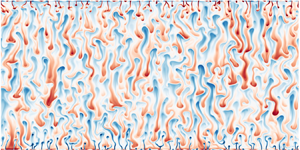
On the wall-bounded model of fingering double diffusive convection
-
- Journal:
- Journal of Fluid Mechanics / Volume 973 / 25 October 2023
- Published online by Cambridge University Press:
- 20 October 2023, A37
-
- Article
- Export citation
-
The present work aims at clarifying the effects of a solid boundary on the salt fingers in the wall-bounded double diffusive convection turbulence driven by the salinity and temperature differences between the top and bottom plates. The fluid properties are the same as the seawater, and two-dimensional direct numerical simulations are conducted over a wide range of the thermal and salinity Rayleigh numbers which measure the strength of driving salinity difference and stabilising temperature difference. We find that the bulk density ratio $\varLambda _b$, defined by the mean temperature and salinity gradients at the bulk, controls the flow morphology. As $\varLambda _b$ exceeds unity, the bulk flow shifts from wide convection rolls to slender salt fingers. Two different regimes are further identified for the cases of salt-finger type. One is the confined salt-finger regime where the characteristic height of salt fingers is comparable to the bulk height and the influences of the solid boundary are noticeable. The other is the free salt-finger regime where the salt fingers are much shorter than the bulk height. In this latter regime, the transport properties versus $\varLambda _b$ are in quantitative agreement with those obtained in the fully periodic domain (e.g. Traxler et al., J. Fluid Mech., vol. 677, 2011, pp. 530–553). For a limited range of density ratio at the highest salinity Rayleigh number considered here, multiple states can be obtained from different initial conditions. The large-scale secondary instability and spontaneous formation of staircase from finger layers are not observed in the current study.


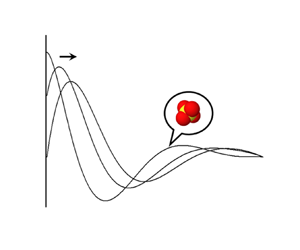
Sound wave propagation in rarefied molecular gases
-
- Journal:
- Journal of Fluid Mechanics / Volume 973 / 25 October 2023
- Published online by Cambridge University Press:
- 20 October 2023, A35
-
- Article
- Export citation
Prediction of aerodynamic characteristics of high-lift Common Research Model in ground effect
-
- Journal:
- The Aeronautical Journal / Volume 128 / Issue 1324 / June 2024
- Published online by Cambridge University Press:
- 20 October 2023, pp. 1245-1261
-
- Article
-
- You have access
- Open access
- HTML
- Export citation
-
Reynolds Averaged Navier-Stokes (RANS) simulations are performed to investigate the aerodynamic characteristics of the NASA Common Research Model (CRM) in its high-lift (HL) configuration in close proximity to the ground. The RANS simulations are conducted at a moderate Reynolds number of $Re = 5.49 \times {10^6}$ and $M = 0.2$ with the use of the Spalart-Allmaras (SA) turbulence model. out of ground effect (OGE) simulation results are validated against available wind tunnel data before proceeding to in ground effect (IGE) simulations. The obtained computational results in the immediate vicinity of the ground with asymmetric aircraft attitudes demonstrate significant changes in the longitudinal and lateral-directional aerodynamic characteristics, which should be taken into account in flight dynamics analysis of aircraft during take-off and landing in crosswind conditions.


The limits of β-plane turbulence
-
- Journal:
- Journal of Fluid Mechanics / Volume 973 / 25 October 2023
- Published online by Cambridge University Press:
- 20 October 2023, A33
-
- Article
-
- You have access
- Open access
- HTML
- Export citation
-
The quasigeostrophic shallow-water system on the mid-latitude $\beta$ plane with weak, small-scale turbulent forcing is explored in the limit of large energy. Forcing is weak in the sense that the energy input rate relative to the energy of the flow is very small, of the order of $10^{-5}$– $10^{-10}$, and the potential vorticity assumes an approximate staircase structure. The flow has large energy in the sense that the jet spacing is equal to the domain width so that no further jet mergers can occur. Quasi-stationary numerical experiments, in which the energy grows linearly, reveal late-time quasi-steady, translating solutions comprising a single jet and vortex dipole, with details of the jet-vortex configuration depending on the deformation radius. At a smaller deformation radius the jet may traverse the entire domain in the $y$ direction one or more times, giving a jet orientation that is predominantly north–south, rather than the usual east–west orientation characteristic of $\beta$-plane jets at lower energy. In these meandering cases, a mode number is proposed that quantifies the degree of meandering relative to the vortices. Besides the steadily translating solutions, topological changes in the jet-vortex structure are identified that occur via a transient interaction of a meandering jet with a vortex. At high energy, these give rise to apparently periodic solutions of the system; at low energy, before a single, domain-wide jet is established, they indicate that jet merger may occur through more complicated processes than the simple merging of neighbouring jets.


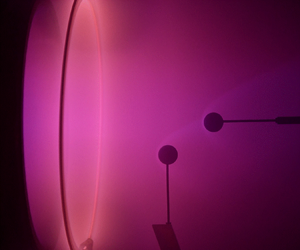
Investigation of shock/shock interferences on the aerodynamics of a fragment in the wake of debris in a rarefied regime/at high altitude
-
- Journal:
- Journal of Fluid Mechanics / Volume 973 / 25 October 2023
- Published online by Cambridge University Press:
- 20 October 2023, A26
-
- Article
- Export citation
Fixed-time control for free-floating space manipulators with prescribed constraints and input saturation
-
- Journal:
- The Aeronautical Journal / Volume 128 / Issue 1324 / June 2024
- Published online by Cambridge University Press:
- 20 October 2023, pp. 1219-1244
-
- Article
- Export citation
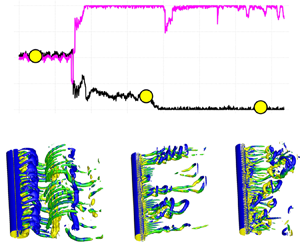
Deep reinforcement transfer learning of active control for bluff body flows at high Reynolds number
-
- Journal:
- Journal of Fluid Mechanics / Volume 973 / 25 October 2023
- Published online by Cambridge University Press:
- 20 October 2023, A32
-
- Article
- Export citation
-
We demonstrate how to accelerate the computationally taxing process of deep reinforcement learning (DRL) in numerical simulations for active control of bluff body flows at high Reynolds number ( $Re$) using transfer learning. We consider the canonical flow past a circular cylinder whose wake is controlled by two small rotating cylinders. We first pre-train the DRL agent using data from inexpensive simulations at low $Re$, and subsequently we train the agent with small data from the simulation at high $Re$ (up to $Re=1.4\times 10^5$). We apply transfer learning (TL) to three different tasks, the results of which show that TL can greatly reduce the training episodes, while the control method selected by TL is more stable compared with training DRL from scratch. We analyse for the first time the wake flow at $Re=1.4\times 10^5$ in detail and discover that the hydrodynamic forces on the two rotating control cylinders are not symmetric.


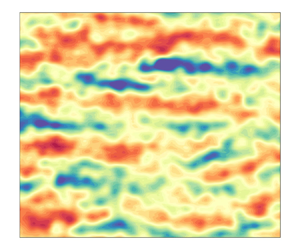
Study of the linear models in estimating coherent velocity and temperature structures for compressible turbulent channel flows
-
- Journal:
- Journal of Fluid Mechanics / Volume 973 / 25 October 2023
- Published online by Cambridge University Press:
- 20 October 2023, A36
-
- Article
-
- You have access
- Open access
- HTML
- Export citation

Resonances and instabilities in a tilted rotating annulus
-
- Journal:
- Journal of Fluid Mechanics / Volume 973 / 25 October 2023
- Published online by Cambridge University Press:
- 20 October 2023, A34
-
- Article
- Export citation
-
The flow inside a rotating annulus tilted with respect to gravity is characterized experimentally and theoretically. As in the case of a tilted rotating cylinder the flow is forced by the free surface, maintained flat by gravity. It leads to resonances of global inertial modes (Kelvin modes) when the height of fluid is a multiple of half the wavelength of the mode. The divergence of the mode is saturated by viscous effects at the resonance. The maximum amplitude scales as the Ekman number to the power $-1/2$ when surface Ekman pumping is dominant, and to the power $-1$ when volumic damping is dominant. An analytical prediction is given with no fitting parameter, in excellent agreement with experimental results. At lower Ekman numbers, the flow destabilizes with respect to a triadic resonance instability, as already observed by Xu & Harlander (Phys. Rev. Fluids, 2020). We provide here a linear stability analysis leading to the viscous threshold of the instability for small tilt angles. For large tilt angles, a centrifugal instability is observed due to the acceleration of the flow by the inner cylinder. Finally, the features of the turbulent flow and its mixing efficiency are characterized experimentally. We underline the potential interest of this configuration for bioreactors.


High-fidelity post-impact residual strength assessment for composite aircraft sustainment
- Part of
-
- Journal:
- The Aeronautical Journal / Volume 127 / Issue 1318 / December 2023
- Published online by Cambridge University Press:
- 20 October 2023, pp. 2169-2186
-
- Article
-
- You have access
- Open access
- HTML
- Export citation

Aerial Access Networks
- Integration of UAVs, HAPs, and Satellites
-
- Published online:
- 19 October 2023
- Print publication:
- 02 November 2023
8 - Hydrogen
-
- Book:
- Gas and Steam Turbine Power Plants
- Published online:
- 12 January 2024
- Print publication:
- 19 October 2023, pp 246-288
-
- Chapter
- Export citation
9 - Nuclear Power
-
- Book:
- Gas and Steam Turbine Power Plants
- Published online:
- 12 January 2024
- Print publication:
- 19 October 2023, pp 289-328
-
- Chapter
- Export citation
15 - Epilogue
-
- Book:
- Gas and Steam Turbine Power Plants
- Published online:
- 12 January 2024
- Print publication:
- 19 October 2023, pp 499-510
-
- Chapter
- Export citation
7 - Heat Conduction between Particles
-
- Book:
- Multiphase Flow with Solid Particles
- Published online:
- 05 October 2023
- Print publication:
- 19 October 2023, pp 170-176
-
- Chapter
- Export citation
5 - Computational Grains for Particulate Composites and Porous Materials
-
- Book:
- Computational Grains
- Published online:
- 05 October 2023
- Print publication:
- 19 October 2023, pp 72-109
-
- Chapter
- Export citation
