To save content items to your account,
please confirm that you agree to abide by our usage policies.
If this is the first time you use this feature, you will be asked to authorise Cambridge Core to connect with your account.
Find out more about saving content to .
To save content items to your Kindle, first ensure no-reply@cambridge.org
is added to your Approved Personal Document E-mail List under your Personal Document Settings
on the Manage Your Content and Devices page of your Amazon account. Then enter the ‘name’ part
of your Kindle email address below.
Find out more about saving to your Kindle.
Note you can select to save to either the @free.kindle.com or @kindle.com variations.
‘@free.kindle.com’ emails are free but can only be saved to your device when it is connected to wi-fi.
‘@kindle.com’ emails can be delivered even when you are not connected to wi-fi, but note that service fees apply.
This accessible and self-contained guide provides a comprehensive introduction to the popular programming language Python, with a focus on applications in chemistry and chemical physics. Ideally suited to students and researchers of chemistry learning to employ Python for problem-solving in their research, this fast-paced primer first builds a solid foundation in the programming language before progressing to advanced concepts and applications in chemistry. The required syntax and data structures are established, and then applied to solve problems computationally. Popular numerical packages are described in detail, including NumPy, SciPy, Matplotlib, SymPy, and pandas. End of chapter problems are included throughout, with worked solutions available within the book. Additional resources, datasets, and Jupyter Notebooks are provided on a companion website, allowing readers to reinforce their understanding and gain confidence applying their knowledge through a hands-on approach.
The free-piston driver is a powerful technique to increase both the driver gas sound speed and pressure. Therefore, it is capable of generating high-enthalpy flows and offering high performance among various gasdynamic shock drivers. So far, it has been implemented in a number of major reflected-shock as well as shock-expansion wind tunnels around the world. The free-piston driver has the advantage that a high driver gas pressure is automatically generated in the same process. On the other hand, the driver is far more complex mechanically and requires operation-tuning in order to operate effectively. Moreover, its test time is short and the test flow is not steady because the piston motion is difficult to control. In this chapter, the basic concepts of the free-piston driver are discussed. The analytical theory that describes the piston dynamics and the method for tuned piston operation are presented. Examples of major free-piston-driven test facilities as well as their applications in hypersonic testing are also summarized.
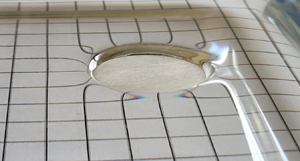
A coin always floats in stable equilibrium with its longitudinal axis normal to the air–liquid interface. In contrast, a long thin cylindrical pin floats with its longitudinal axis parallel to the air–liquid interface. In this context, we present a theoretical investigation of the stability of small-scale hydrophobic cylinders floating in vertical and horizontal orientations at various aspect ratios (length/diameter). The study is limited to cylinders denser than water floating at the air–water interface. Our analysis shows that, unlike large-scale vertically floating cylinders, the stability of vertically orientated small-scale cylinders increases with an increase in aspect ratio. A similar trend is observed in the stability of small-scale horizontal cylinders. We also explain the underlying mechanics that leads to a rise in the stability of floating cylinders with an increase in aspect ratio. Unlike large-scale floating cylinders with uniform density, we show that the effect of governing forces (weight, buoyancy and surface tension) in small-scale cylinders changes from a stabilising to a destabilising force with a change in the aspect ratio. For example, in the case of a vertically floating cylinder, the buoyancy force acts as a stabilising force at a small aspect ratio whereas, at large aspect ratios, the buoyancy force has a destabilising influence. Likewise, the body's weight has a destabilising influence at a small aspect ratio and stabilising effect at a large aspect ratio. The reason behind this transformation is that, above a particular aspect ratio, the centre of gravity of small-scale floating cylinders lies below the centre of buoyancy.
This accessible and self-contained guide provides a comprehensive introduction to the popular programming language Python, with a focus on applications in chemistry and chemical physics. Ideally suited to students and researchers of chemistry learning to employ Python for problem-solving in their research, this fast-paced primer first builds a solid foundation in the programming language before progressing to advanced concepts and applications in chemistry. The required syntax and data structures are established, and then applied to solve problems computationally. Popular numerical packages are described in detail, including NumPy, SciPy, Matplotlib, SymPy, and pandas. End of chapter problems are included throughout, with worked solutions available within the book. Additional resources, datasets, and Jupyter Notebooks are provided on a companion website, allowing readers to reinforce their understanding and gain confidence applying their knowledge through a hands-on approach.
Hypersonic and high-enthalpy wind tunnels have been a challenge in ground testing facilities in aerospace research for decades. In regard to performance requirements, theories and methods for designing hypersonic flow nozzles at high enthalpy conditions are quite difficult, but very interesting topics, especially when dissociation of air molecules take place in test-gas reservoirs. In this chapter, fundamental theories and important methods for nozzle design are reviewed with the emphasis on two-dimensional axisymmetric nozzles for hypersonic high-enthalpy wind tunnels, including the method of characteristics, the graphic design method, the Sivells method, the theory for boundary layer correction, and computational fluid dynamics (CFD)-based design optimization methods. They were proposed based on several physical issues covering the expansion wave generation and reflection, boundary layer development, and real-gas effects of hypersonic flows. Difficulties arising from applications of these methods in high-enthalpy nozzle design are discussed in detail and state-of-the-art of nozzle design technologies that have been reached over decades are summarized with some brief comments.
This accessible and self-contained guide provides a comprehensive introduction to the popular programming language Python, with a focus on applications in chemistry and chemical physics. Ideally suited to students and researchers of chemistry learning to employ Python for problem-solving in their research, this fast-paced primer first builds a solid foundation in the programming language before progressing to advanced concepts and applications in chemistry. The required syntax and data structures are established, and then applied to solve problems computationally. Popular numerical packages are described in detail, including NumPy, SciPy, Matplotlib, SymPy, and pandas. End of chapter problems are included throughout, with worked solutions available within the book. Additional resources, datasets, and Jupyter Notebooks are provided on a companion website, allowing readers to reinforce their understanding and gain confidence applying their knowledge through a hands-on approach.
Based on detonation-driven shock tunnels, key issues that play important roles in extending the test time are introduced in this chapter, and the corresponding solutions are proposed, evaluated, and discussed in detail, including the tailored-interface condition, the shock–boundary-layer interaction at the end of the driven section, and the precursor shock damping in the vacuum tank. The research work on these issues was carried out to find out the flow physics and application methods to improve the high-enthalpy shock tunnel for meeting the test time requirement for supersonic combustion and scramjet engine experiments. With application of the aforementioned theories and methods to the high-enthalpy shock tunnel, a large-scale detonation-driven hypersonic flight-duplicated shock tunnel (the JF-12 shock tunnel) was successfully developed, which can provide test times of more than 100 microseconds and is capable of duplicating hypersonic flight conditions for Mach numbers of 5–9 at altitudes of 25–50 km.
This accessible and self-contained guide provides a comprehensive introduction to the popular programming language Python, with a focus on applications in chemistry and chemical physics. Ideally suited to students and researchers of chemistry learning to employ Python for problem-solving in their research, this fast-paced primer first builds a solid foundation in the programming language before progressing to advanced concepts and applications in chemistry. The required syntax and data structures are established, and then applied to solve problems computationally. Popular numerical packages are described in detail, including NumPy, SciPy, Matplotlib, SymPy, and pandas. End of chapter problems are included throughout, with worked solutions available within the book. Additional resources, datasets, and Jupyter Notebooks are provided on a companion website, allowing readers to reinforce their understanding and gain confidence applying their knowledge through a hands-on approach.