To save content items to your account,
please confirm that you agree to abide by our usage policies.
If this is the first time you use this feature, you will be asked to authorise Cambridge Core to connect with your account.
Find out more about saving content to .
To save content items to your Kindle, first ensure no-reply@cambridge.org
is added to your Approved Personal Document E-mail List under your Personal Document Settings
on the Manage Your Content and Devices page of your Amazon account. Then enter the ‘name’ part
of your Kindle email address below.
Find out more about saving to your Kindle.
Note you can select to save to either the @free.kindle.com or @kindle.com variations.
‘@free.kindle.com’ emails are free but can only be saved to your device when it is connected to wi-fi.
‘@kindle.com’ emails can be delivered even when you are not connected to wi-fi, but note that service fees apply.
This accessible and self-contained guide provides a comprehensive introduction to the popular programming language Python, with a focus on applications in chemistry and chemical physics. Ideally suited to students and researchers of chemistry learning to employ Python for problem-solving in their research, this fast-paced primer first builds a solid foundation in the programming language before progressing to advanced concepts and applications in chemistry. The required syntax and data structures are established, and then applied to solve problems computationally. Popular numerical packages are described in detail, including NumPy, SciPy, Matplotlib, SymPy, and pandas. End of chapter problems are included throughout, with worked solutions available within the book. Additional resources, datasets, and Jupyter Notebooks are provided on a companion website, allowing readers to reinforce their understanding and gain confidence applying their knowledge through a hands-on approach.
The achievable total enthalpy and the pressure level in a shock tunnel depend on its capability to generate strong shock waves. To produce a strong shock wave, high pressure and high sound speed are two key parameters for driver gases. There are various techniques to increase the driver gas sound speed, which are essentially different approaches in the way to raise the driver gas temperature. The first technique to increase the driver gas sound speed is by the use of a light gas, and the second one is by heating the light gas to a high temperature with gas heaters. The light-gas-heated shock tunnel is introduced in this chapter, and the electrical heaters are discussed in detail, including the relatively simple electrical resistance heaters and electric-arc heaters. Strictly speaking, the electric-arc heating is not a gasdynamic technique and it is not capable of completing flight-condition duplication for hypervelocity testing. However, it is selected because it can generate extremely high total enthalpies and is useful in certain applications.
This accessible and self-contained guide provides a comprehensive introduction to the popular programming language Python, with a focus on applications in chemistry and chemical physics. Ideally suited to students and researchers of chemistry learning to employ Python for problem-solving in their research, this fast-paced primer first builds a solid foundation in the programming language before progressing to advanced concepts and applications in chemistry. The required syntax and data structures are established, and then applied to solve problems computationally. Popular numerical packages are described in detail, including NumPy, SciPy, Matplotlib, SymPy, and pandas. End of chapter problems are included throughout, with worked solutions available within the book. Additional resources, datasets, and Jupyter Notebooks are provided on a companion website, allowing readers to reinforce their understanding and gain confidence applying their knowledge through a hands-on approach.
In this chapter, the aerodynamic fundamentals for the working principles of shock tunnels are summarized. The moving waves, including expansion waves, shock waves, and contact surfaces, are introduced as the key issues and their theories are based on the unsteady one-dimensional flows in textbooks of aerodynamics. As unsteady one-dimensional moving waves are also critical for the design and operation of shock tunnels, their theories are also selected and summarized in this chapter for book completeness and readers’ convenience.
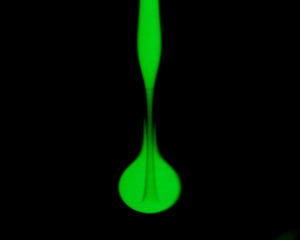
We study the coupled settling, deformation and mixing dynamics of a dense blob of fluid falling in an axially (vertically) linearly stratified Taylor–Couette cell (operated in a laminar stable regime). This configuration allows the independent analysis of stretching dynamics, driven by radial (horizontal) velocity variations, and settling dynamics, driven by buoyancy forces associated with vertical density variations. As the blob settles, it is stretched in the horizontal plane and forms an elongated lamella. Through the competing effects of transverse compression of the lamella due to this shear-induced stretching and broadening due to diffusion, the lamella irreversibly mixes with ambient fluid, thus progressively adjusting its own density towards that of the ambient fluid. Eventually, the lamella settling stops at a final equilibrium position that depends on the ambient vertical density gradient and the rate at which it has been deformed by the horizontal shear. We show how this final position is determined by stretching-enhanced diffusion, i.e. mixing. We demonstrate that a theoretical mixing model compares favourably with experiments with various Froude numbers (quantifying the relative strength of the horizontal shear and the vertical stratification) and construct a new criterion for the energetic ‘efficiency’ of this mixing process that explicitly captures its inherently diffusive character.
This accessible and self-contained guide provides a comprehensive introduction to the popular programming language Python, with a focus on applications in chemistry and chemical physics. Ideally suited to students and researchers of chemistry learning to employ Python for problem-solving in their research, this fast-paced primer first builds a solid foundation in the programming language before progressing to advanced concepts and applications in chemistry. The required syntax and data structures are established, and then applied to solve problems computationally. Popular numerical packages are described in detail, including NumPy, SciPy, Matplotlib, SymPy, and pandas. End of chapter problems are included throughout, with worked solutions available within the book. Additional resources, datasets, and Jupyter Notebooks are provided on a companion website, allowing readers to reinforce their understanding and gain confidence applying their knowledge through a hands-on approach.