To save content items to your account,
please confirm that you agree to abide by our usage policies.
If this is the first time you use this feature, you will be asked to authorise Cambridge Core to connect with your account.
Find out more about saving content to .
To save content items to your Kindle, first ensure no-reply@cambridge.org
is added to your Approved Personal Document E-mail List under your Personal Document Settings
on the Manage Your Content and Devices page of your Amazon account. Then enter the ‘name’ part
of your Kindle email address below.
Find out more about saving to your Kindle.
Note you can select to save to either the @free.kindle.com or @kindle.com variations.
‘@free.kindle.com’ emails are free but can only be saved to your device when it is connected to wi-fi.
‘@kindle.com’ emails can be delivered even when you are not connected to wi-fi, but note that service fees apply.
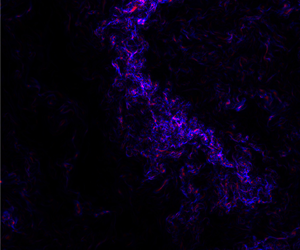
Direct numerical simulations up to Reλ = 1445 show that the scaling exponents for the enstrophy and the dissipation rate extrema are different and depend on the Reynolds number. A similar Reynolds number dependence of the scaling exponents is observed for the moments of the dissipation rate, but not for the moments of the enstrophy. Significant changes in the exponents occur at approximately Reλ ≈ 250, where Reλ is the Taylor based Reynolds number, which coincides with structural changes in the flow, in particular the development of large-scale shear layers. A model for the probability density functions (PDFs) of the enstrophy and dissipate rate is presented, which is an extension of our existing model (Proc. R. Soc. A, vol. 476, 2020, p. 20200591) and is based on the mentioned development of large-scale layer regions within the flow. This model is able to capture the observed Reynolds number dependencies of the scaling exponents, in contrast to the existing theories which yield constant exponents. Moreover, the model reconciles the scaling at finite Reynolds number with the theoretical limit, where the enstrophy and dissipation rate scale identically at infinite Reynolds number. It suggests that the large-scale shear layers are vital for understanding the scaling of the extrema. Furthermore, to reach the theoretical limit, the scaling exponents must remain Reynolds number dependent beyond the present Reλ range.
This accessible and self-contained guide provides a comprehensive introduction to the popular programming language Python, with a focus on applications in chemistry and chemical physics. Ideally suited to students and researchers of chemistry learning to employ Python for problem-solving in their research, this fast-paced primer first builds a solid foundation in the programming language before progressing to advanced concepts and applications in chemistry. The required syntax and data structures are established, and then applied to solve problems computationally. Popular numerical packages are described in detail, including NumPy, SciPy, Matplotlib, SymPy, and pandas. End of chapter problems are included throughout, with worked solutions available within the book. Additional resources, datasets, and Jupyter Notebooks are provided on a companion website, allowing readers to reinforce their understanding and gain confidence applying their knowledge through a hands-on approach.
The detonation-driven shock tunnel is one of three important classes of hypersonic and high-enthalpy ground testing facilities that are based on the shock-heated principle. The theory and methods for developing the detonation-driven shock tunnels aiming at hypervelocity flow generation are summarized in this chapter. At first, the primary concepts for detonation drivers are presented to demonstrate their unique advantages for aerodynamic ground-based testing. The difficult problems arising from the development of hypervelocity shock tunnels for simulating flight conditions are identified and discussed in detail to address critical issues underlying the high-enthalpy shock tunnel design. Then, three kinds of detonation-driven shock tunnels are introduced, and their key techniques and performances are reviewed and discussed in detail. Finally, some experiments are summarized to demonstrate the capability of the detonation-driven hypersonic shock tunnel and the importance of the measurement techniques for hypersonic and high-temperature flow experiments. Both are the frontiers of high-enthalpy flow research for developing hypersonic vehicles.
This accessible and self-contained guide provides a comprehensive introduction to the popular programming language Python, with a focus on applications in chemistry and chemical physics. Ideally suited to students and researchers of chemistry learning to employ Python for problem-solving in their research, this fast-paced primer first builds a solid foundation in the programming language before progressing to advanced concepts and applications in chemistry. The required syntax and data structures are established, and then applied to solve problems computationally. Popular numerical packages are described in detail, including NumPy, SciPy, Matplotlib, SymPy, and pandas. End of chapter problems are included throughout, with worked solutions available within the book. Additional resources, datasets, and Jupyter Notebooks are provided on a companion website, allowing readers to reinforce their understanding and gain confidence applying their knowledge through a hands-on approach.
In order to introduce hypersonic ground testing facilities, background information in hypersonics is presented to show to readers what we want to do, where we have been, and where we are going to go. These will provide with a good indication of the research needs that are called as hypersonic vehicle ground testing. It is of fundamental importance that a vehicle design must be carefully evaluated in ground test facilities before flight testing can proceed. Indeed, the development of hypersonic vehicles is related to the capability development of hypersonic ground testing facilities.
This accessible and self-contained guide provides a comprehensive introduction to the popular programming language Python, with a focus on applications in chemistry and chemical physics. Ideally suited to students and researchers of chemistry learning to employ Python for problem-solving in their research, this fast-paced primer first builds a solid foundation in the programming language before progressing to advanced concepts and applications in chemistry. The required syntax and data structures are established, and then applied to solve problems computationally. Popular numerical packages are described in detail, including NumPy, SciPy, Matplotlib, SymPy, and pandas. End of chapter problems are included throughout, with worked solutions available within the book. Additional resources, datasets, and Jupyter Notebooks are provided on a companion website, allowing readers to reinforce their understanding and gain confidence applying their knowledge through a hands-on approach.
From biological tissues to microactuators and absorption of solvents into layers of paint, macroscopically non-porous materials with the capacity to swell when in contact with a solvent are ubiquitous. In these systems, owing to strong solid–fluid interactions, chemically driven flows can yield large geometric changes. We study experimentally and theoretically the canonical problem of the swelling of a thin hydrogel layer by a single water drop. Using a bespoke experimental set-up, we observe fast absorption leading to a radially spreading axisymmetric blister. We use a fully three-dimensional linear poroelastic framework with nonlinear kinematic equations to obtain governing equations, which we then reduce with thin-layer scalings to a one-dimensional nonlinear diffusion equation for the evolution of the blister geometry. In the limits of large and small deformations, the evolution of the blister characteristic height and radius are self-similar, following power laws in time. Our experimental measurements show that the evolution of the blister is broadly within the theoretical predictions in the large and small deformation regimes. In the general intermediate deformation regime, the measurements are well captured by our reduced one-dimensional diffusion model, which does not require the sophisticated and computationally expensive numerical approaches necessary for the original two-dimensional nonlinear coupled transport problem. By adapting modelling techniques from the fluid dynamics of thin porous elastic layers to a polymer swelling problem, our modelling framework extends the range of polymer swelling problems that can be treated with semi-analytical methods. Moreover, our detailed experimental data can serve as a test case for future nonlinear poroelastic frameworks of swelling polymer materials.
In this article, different 2D and 3D mask styles for synthesizing large array pattern shaping to meet the requirements of modern applications are realized. The composition of the different beam pattern shaping is achieved by comparing the array factor with the proposed masks whose details (upper and lower borders) are predefined according to the designer. The generated pattern shapes are as follows: unscanned 2D single-pencil beam, scanned 2D pencil beam, 2D multi-beam scanning, 2D wide flat beam with little ripple, unscanned 3D single-pencil beam, 3D multi-beam scanning, and footprint (or contour) pattern for linear and planar arrays. The process of constructing these patterns is followed by predicting the amplitude-only weights (i.e., the phase weighting is considered zero in all computations) of the elements using the particle swarm optimization algorithm. In all proposed masks, different sidelobe levels are controlled, ranging from −20 to −100 dB. Also, the radiated beamwidth is controlled, ranging from 0.1334 rad (7.6 deg.) to 0.4 rad (23 deg.). The analysis and construction of linear and planar array arrangements depend on the formulation of antenna array theory through the implementation of the proposed (estimated) equations using MATLAB code. The simulation results showed the effectiveness of the proposed methods in controlling the pattern shape according to the required modern trends.
The microwave energy-harvesting (MEH) and microwave power transfer (MPT) technologies have become the most emerging areas of research nowadays. The microwave rectifier circuit is the bottleneck of both the MEH and MPT systems. The efficiency of the system depends on the power conversion efficiency (PCE) of the rectifier. Due to the recent advancement of the fifth-generation communication system, it is desirable to propose an efficient rectifier operating at sub-6 GHz 5G bands. A dual-band rectifier circuit is designed and demonstrated for MEH/MPT purposes, specifically at sub-6 GHz 5G frequency bands. The dual-band matching is achieved by using a stepped impedance transmission line. The rectifier covers N78 (3.3–3.6 GHz) and N79 (4.8–5.0 GHz) bands. Peak PCE of 67.6% @ 3.5 GHz and 56.8% @ 4.9 GHz are achieved. For validation purpose, the rectifier is fabricated and characterized and measured results show good agreement with simulated results.
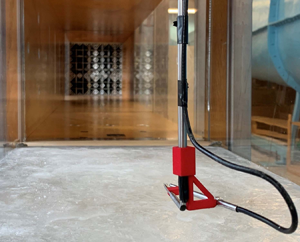
Accelerated glacier melt and the loss of perennial snowfields have been associated with increased warming in polar regions, at rates up to four times faster than the rest of the world, thereby reinforcing the critical need for improved models (and predictions) of glacier melt. An essential requirement for such models is an improved understanding of the sensible heat fluxes over glaciers. Since their complexity makes them difficult to model, and direct measurements of sensible turbulent heat fluxes over real glaciers are both rare and impractical, the present work involves simultaneous hot-wire anemometry and cold-wire thermometry measurements of two components of velocity and temperature above a melting glacier model in a series of wind-tunnel experiments. Both single- and multi-variable statistics were used to compare the turbulent velocity field measured over melting ice with that of a similar flow in the absence of ice. The results demonstrate that the ice's presence reduces the magnitude of the Reynolds stresses and vertical velocity variance, but also increases the streamwise velocity variance. The transient evolution of temperature statistics throughout the melt process was also investigated and found to be similar when suitably non-dimensionalized. The velocity and temperature fields were furthermore evaluated at an equivalent non-dimensional time during the melt process, in which statistics of the temperature field, and joint statistics of the vertical velocity and temperature, were studied. The present work lays the foundation for future laboratory-scale replications of the flow above melting glaciers, and provides additional insight into turbulent heat transfer over melting ice.
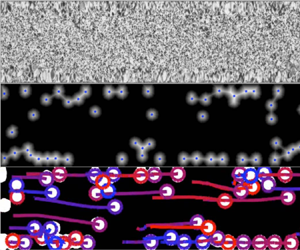
The irreversible behaviour of a highly confined non-Brownian suspension of spherical particles at low Reynolds number in a Newtonian fluid is studied experimentally and numerically. In the experiment, the suspension is confined in a thin rectangular channel that prevents complete particle overlap in the narrow dimension and is subjected to an oscillatory pressure-driven flow. In the small cross-sectional dimension, particles rapidly separate to the walls, whereas in the large dimension, features reminiscent of shear-induced migration in bulk suspensions are recovered. Furthermore, as a consequence of the channel geometry and the development and application of a single-camera particle tracking method, three-dimensional particle trajectories are obtained that allow us to directly associate relative particle proximity with the observed migration. Companion simulations of a steadily flowing suspension highly confined between parallel plates are conducted using the force coupling method, which also show rapid migration to the walls as well as other salient features observed in the experiment. While we consider relatively low volume fractions compared to most prior work in the area, we nevertheless observe significant and rapid migration, which we attribute to the high degree of confinement.
The effect of single perforations and their location on the drag and reconfiguration of flexible plates was explored through laboratory experiments and direct numerical simulations. The plates were subjected to uniform flows with negligible turbulence, and the perforations had a square cross-section resulting in a low porosity ratio of $\gamma \approx 0.028$. Rigid plates with and without perforations and flexible plates without perforations served as the baseline cases. The perforated plates exhibited distinct jets through the openings in the wake, significantly impacting the aerodynamic force and plate deformation. The velocity and position of the centre jet velocity in relation to downwind distance were influenced by both the incoming flow and the location of the perforations. The centre jet velocity profiles were normalized using an effective velocity and corrected perforation half-width, revealing their dependence on these factors. A simple first-order formulation was developed to predict the change in drag for various perforated plates under a wide range of incoming velocities. This formulation was supported by numerical simulations across a wider range of Cauchy number to confirm the proposed model and separate the effect of the Cauchy and Reynolds numbers. The results of this study may inform the design of flexible structures, define effective porosity and serve as an initial step towards modelling the complex interaction between flow and structures with low porosity.
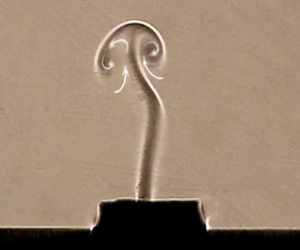
In this study, we performed a set of experiments of the thermal plume on an open cylinder heated from below and a simple scaling analysis. The flow structure of the plume was visualized using the shadowgraph technique, and the temperature at specific points was measured using a thermistor. Transient plumes in a developing stage, an equilibrating stage and a fully developed stage were described. The new scaling laws of the stem radius and the velocity of the rising plume were presented, which are different from those on a two-dimensional heated plate due to the cylindrical effect and agree with experimental results. In the fully developed stage, there is a transition route of the plume from a steady to chaotic state with an increase in the Rayleigh number, which involves a series of bifurcations. A reverse bifurcation from a periodic (Ra = 1.17 × 10⁶) back to a steady (Ra = 1.30 × 10⁶) state has been observed in the experiment, which is referred to as the period bubbling bifurcation. Thus, the present experimental results validate the previous numerical results presented by Zhang et al. (Phys. Fluids, vol. 33 (6), 2021, 064110). The bifurcation diagram, spectral analysis and attractor are used to characterize the transitional plume. In addition, the heat and mass transfer have also been quantified.
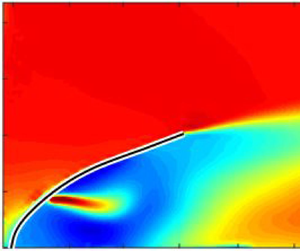
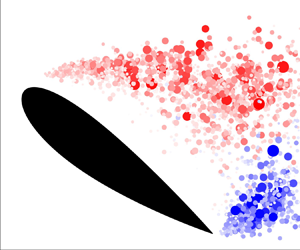
The effect of variations in the integral length scale of incoming free-stream turbulence on a NACA0012 wing is investigated with the use of force, moment and particle image velocimetry measurements. At a chord-based Reynolds number ($Re = U_\infty c/\nu$ where c is the chord length, $U_\infty$ is the free-stream velocity and $\nu$ is the kinematic viscosity) of $2\times 10^5$, an active grid generates turbulence intensities of 15 % at normalised integral length scales ranging from 0.5$c$ to 1$c$. The introduction of turbulence improves the time-averaged performance characteristics of the wing by delaying stall and increasing the peak lift coefficient. It is found that for half-chord integral length scales, the magnitude of the fluctuations in forces and moments is larger than that of full-chord integral length scales, as the former amplifies the naturally occurring unsteadiness in the flow (when there is no free-stream turbulence). The increase in magnitude is ascribed to a larger density of smaller-scale vortices within the separated flow and wake region of the wing.
The relevant growth of human-machine interaction (HMI) systems in recent years is leading to the necessity of being constantly aware of the cognitive workload level of an operator, especially in a safety-critical context such as aviation. Since the confusion in the definition of this concept, this paper clarifies this terminology and also highlights its relationship with stress. Thus, we analysed the state-of-the-art of cognitive workload evaluations, showing three up-to-date methodologies: subjective, behavioural and physiological. In particular, the physiological approach is increasingly gaining attention in the literature due to today’s exponential growth of biomedical sensors. Therefore, a review of the most adopted physiological signals in the workload evaluation is provided, focusing on the aeronautical field. We conclude by highlighting the necessity of a multimodal approach for mental workload assessment as a result of this analysis.