Refine search
Actions for selected content:
213073 results in Engineering
Bayesian system identification for structures considering spatial and temporal correlation
-
- Journal:
- Data-Centric Engineering / Volume 4 / 2023
- Published online by Cambridge University Press:
- 23 October 2023, e22
-
- Article
-
- You have access
- Open access
- HTML
- Export citation
Neural network ensembles and uncertainty estimation for predictions of inelastic mechanical deformation using a finite element method-neural network approach
- Part of
-
- Journal:
- Data-Centric Engineering / Volume 4 / 2023
- Published online by Cambridge University Press:
- 23 October 2023, e23
-
- Article
-
- You have access
- Open access
- HTML
- Export citation

Gravity-driven flow in a cross-bedded porous rock
-
- Journal:
- Journal of Fluid Mechanics / Volume 973 / 25 October 2023
- Published online by Cambridge University Press:
- 23 October 2023, R4
-
- Article
-
- You have access
- Open access
- HTML
- Export citation
-
Many geological layers include cross bedding, which leads to different values for permeability along and across the bedding planes. We explore how such cross bedding impacts buoyancy-driven flow through an inclined aquifer. For each bedding angle and ratio of the permeability along and across the bedding, a free buoyancy-driven plume rises at a particular angle to the horizontal. If the angle of inclination of the aquifer to the horizontal is smaller than this angle, then the plume rises along the upper boundary, otherwise, somewhat surprisingly, the buoyant plume rises along the lower boundary of the aquifer. We present new laboratory experiments to support these predictions. We also test a model for the effective permeabilities which control the speed and the rate of spread of the plume along one or other boundary of the aquifer. We consider the impact of our results for modelling geological storage of ${\rm CO}_2$ or aquifer thermal energy storage.


Flow and deformation due to periodic loading in a soft porous material
-
- Journal:
- Journal of Fluid Mechanics / Volume 974 / 10 November 2023
- Published online by Cambridge University Press:
- 23 October 2023, A2
-
- Article
-
- You have access
- Open access
- HTML
- Export citation
Dynamics of a data-driven low-dimensional model of turbulent minimal Couette flow
-
- Journal:
- Journal of Fluid Mechanics / Volume 973 / 25 October 2023
- Published online by Cambridge University Press:
- 23 October 2023, A42
-
- Article
-
- You have access
- Open access
- HTML
- Export citation
-
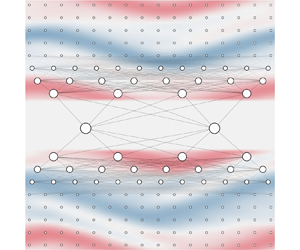
Because the Navier–Stokes equations are dissipative, the long-time dynamics of a flow in state space are expected to collapse onto a manifold whose dimension may be much lower than the dimension required for a resolved simulation. On this manifold, the state of the system can be exactly described in a coordinate system parameterising the manifold. Describing the system in this low-dimensional coordinate system allows for much faster simulations and analysis. We show, for turbulent Couette flow, that this description of the dynamics is possible using a data-driven manifold dynamics modelling method. This approach consists of an autoencoder to find a low-dimensional manifold coordinate system and a set of ordinary differential equations defined by a neural network. Specifically, we apply this method to minimal flow unit turbulent plane Couette flow at $Re=400$, where a fully resolved solutions requires ${O}(10^5)$ degrees of freedom. Using only data from this simulation we build models with fewer than $20$ degrees of freedom that quantitatively capture key characteristics of the flow, including the streak breakdown and regeneration cycle. At short times, the models track the true trajectory for multiple Lyapunov times and, at long times, the models capture the Reynolds stress and the energy balance. For comparison, we show that the models outperform POD-Galerkin models with $\sim$2000 degrees of freedom. Finally, we compute unstable periodic orbits from the models. Many of these closely resemble previously computed orbits for the full system; in addition, we find nine orbits that correspond to previously unknown solutions in the full system.


The role of soluble surfactant in the linear instability of a film coating inside a tube
-
- Journal:
- Journal of Fluid Mechanics / Volume 973 / 25 October 2023
- Published online by Cambridge University Press:
- 23 October 2023, A46
-
- Article
- Export citation
The effect of structural damping on flow-induced vibration of a thin elliptical cylinder
-
- Journal:
- Journal of Fluid Mechanics / Volume 974 / 10 November 2023
- Published online by Cambridge University Press:
- 23 October 2023, A5
-
- Article
-
- You have access
- Open access
- HTML
- Export citation
-
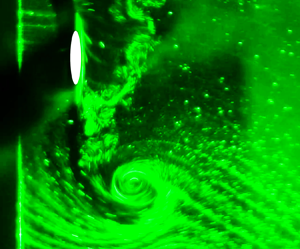
This study experimentally investigates the influence of structural damping on the transverse flow-induced vibration (FIV) of an elastically mounted thin elliptical cylinder. The cylinder tested has an elliptical ratio of $\varepsilon = b/a = 5$, where $a$ and $b$ are the streamwise and cross-flow dimensions, respectively, and a mass ratio (i.e. the total oscillating mass/the displaced fluid mass) of $17.4$. The FIV response was characterised over a reduced velocity range of $2.30 \leq U^* = U/(\,{{f_{{nw}}}} b) \leq 10.00$ (corresponding to a Reynolds number range of $300 \leq \textit {Re} =(U b)/\nu \leq 1300$) and a structural damping ratio range of $3.62\times 10^{-3}\leq \zeta \leq 1.87\times 10^{-1}$. Here, $U$ is the free stream velocity, ${{f_{{nw}}}}$ is the natural frequency of the system in quiescent fluid (water) and $\nu$ is the kinematic viscosity of the fluid. The FIV response was characterised by four wake–body synchronisation regimes (defined as the matching of the dominant fluid forcing and oscillation frequencies, and labelled regime I, regime II, regime III and the hyper branch) and a desynchronisation region, with the hyper branch representing a high amplitude regime not observed for a circular cylinder. Interestingly, the major vortex shedding mode was predominately two single opposite-signed vortices shed per body vibration cycle. Moreover, hydrogen-bubble-based flow visualisations revealed a secondary vortex street forming in the elongated shear layers associated with largest-scale vibration amplitudes ( $A^* = A/b$ up to $7.7$) in the hyper branch and regime II. As the structural damping ratio was increased beyond $1.92 \times 10^{-2}$, the hyper branch was found to be suppressed. The results have potential ramifications for the efficient extraction of energy from free-flowing water sources, which has become increasingly topical over the last decade.


On the non-self-adjoint and multiscale character of passive scalar mixing under laminar advection
-
- Journal:
- Journal of Fluid Mechanics / Volume 973 / 25 October 2023
- Published online by Cambridge University Press:
- 23 October 2023, A44
-
- Article
-
- You have access
- Open access
- HTML
- Export citation
-
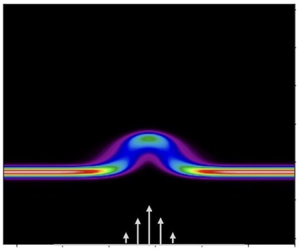
Except in the trivial case of spatially uniform flow, the advection–diffusion operator of a passive scalar tracer is linear and non-self-adjoint. In this study, we exploit the linearity of the governing equation and present an analytical eigenfunction approach for computing solutions to the advection–diffusion equation in two dimensions given arbitrary initial conditions, and when the advecting flow field at any given time is a plane parallel shear flow. Our analysis illuminates the specific role that the non-self-adjointness of the linear operator plays in the solution behaviour, and highlights the multiscale nature of the scalar mixing problem given the explicit dependence of the eigenvalue–eigenfunction pairs on a multiscale parameter $q=2{\rm i}k\,{\textit {Pe}}$, where $k$ is the non-dimensional wavenumber of the tracer in the streamwise direction, and ${\textit {Pe}}$ is the Péclet number. We complement our theoretical discussion on the spectra of the operator by computing solutions and analysing the effect of shear flow width on the scale-dependent scalar decay of tracer variance, and characterize the distinct self-similar dispersive processes that arise from the shear flow dispersion of an arbitrarily compact tracer concentration. Finally, we discuss limitations of the present approach and future directions.


Entropy and fluctuation relations in isotropic turbulence
- Part of
-
- Journal:
- Journal of Fluid Mechanics / Volume 973 / 25 October 2023
- Published online by Cambridge University Press:
- 23 October 2023, R6
-
- Article
-
- You have access
- Open access
- HTML
- Export citation
-
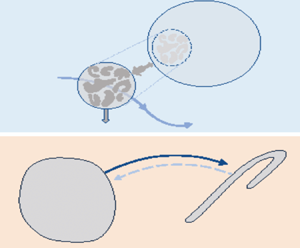
Based on a generalized local Kolmogorov–Hill equation expressing the evolution of kinetic energy integrated over spheres of size $\ell$ in the inertial range of fluid turbulence, we examine a possible definition of entropy and entropy generation for turbulence. Its measurement from direct numerical simulations in isotropic turbulence leads to confirmation of the validity of the fluctuation relation (FR) from non-equilibrium thermodynamics in the inertial range of turbulent flows. Specifically, the ratio of probability densities of forward and inverse cascade at scale $\ell$ is shown to follow exponential behaviour with the entropy generation rate if the latter is defined by including an appropriately defined notion of ‘temperature of turbulence’ proportional to the kinetic energy at scale $\ell$.


Internal shear layers in librating spherical shells: the case of attractors
-
- Journal:
- Journal of Fluid Mechanics / Volume 974 / 10 November 2023
- Published online by Cambridge University Press:
- 23 October 2023, A3
-
- Article
- Export citation
-
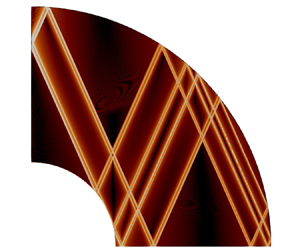
Following our previous work on periodic ray paths (He et al., J. Fluid Mech., vol. 939, 2022, A3), we study asymptotically and numerically the structure of internal shear layers for very small Ekman numbers in a three-dimensional spherical shell and in a two-dimensional cylindrical annulus when the rays converge towards an attractor. We first show that the asymptotic solution obtained by propagating the self-similar solution generated at the critical latitude on the librating inner core describes the main features of the numerical solution. The internal shear layer structure and the scaling for its width and velocity amplitude in $E^{1/3}$ and $E^{1/12}$, respectively, are recovered. The amplitude of the asymptotic solution is shown to decrease to $E^{1/6}$ when it reaches the attractor, as is also observed numerically. However, some discrepancies are observed close to the particular attractors along which the phase of the wave beam remains constant. Another asymptotic solution close to those attractors is then constructed using the model of Ogilvie (J. Fluid Mech., vol. 543, 2005, pp. 19–44). The solution obtained for the velocity has an $O(E^{1/6})$ amplitude, but a self-similar structure different from the critical-latitude solution. It also depends on the Ekman pumping at the contact points of the attractor with the boundaries. We demonstrate that it reproduces correctly the numerical solution. Surprisingly, the numerical solution close to an attractor with phase shift (that is, an attractor touching the axis in three or two dimensions with a symmetric forcing) is also found to be $O(E^{1/6})$, but its amplitude is much weaker. However, its asymptotic structure remains a mystery.


A novel (2+1)-dimensional nonlinear evolution equation for weakly stratified free-surface boundary layers
-
- Journal:
- Journal of Fluid Mechanics / Volume 973 / 25 October 2023
- Published online by Cambridge University Press:
- 23 October 2023, A40
-
- Article
-
- You have access
- Open access
- HTML
- Export citation
Heat transfer in a quasi-one-dimensional Rayleigh–Bénard convection cell
-
- Journal:
- Journal of Fluid Mechanics / Volume 973 / 25 October 2023
- Published online by Cambridge University Press:
- 23 October 2023, R5
-
- Article
-
- You have access
- HTML
- Export citation
-
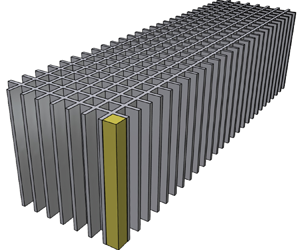
We report an experimental and numerical study on Rayleigh–Bénard convection in a slender rectangular geometry with the aspect ratio $\varGamma$ varying from 0.05 to 0.3 and a Rayleigh number range of $10^5\leqslant Ra\leqslant 3\times 10^9$. The Prandtl number is fixed at $Pr=4.38$. It is found that the onset of convection is postponed when the convection domain approaches the quasi-one-dimensional limit. The onset Rayleigh number shows a $Ra_c=328\varGamma ^{-4.18}$ scaling for the experiment and a $Ra_c=810\varGamma ^{-3.95}$ scaling for the simulation, both consistent with a theoretical prediction of $Ra_c\sim \varGamma ^{-4}$. Moreover, the effective Nusselt–Rayleigh scaling exponent $\beta =\partial (\log Nu)/\partial (\log Ra)$ near the onset of convection also shows a rapid increase with decreasing $\varGamma$. Power-law fits to the experimental and numerical data yield $\beta =0.290\varGamma ^{-0.90}$ and $\beta =0.564\varGamma ^{-0.92}$, respectively. Near onset, the flow shows a stretched cell structure. In this regime, the velocity and temperature variations in a horizontal cross-section are found to be almost invariant with height in the core region of a slender domain. As the Rayleigh number increases, the system evolves from the viscous dominant regime to a plume-controlled one, a feature of which is enhancement in the heat transport efficiency. Upon further increase of $Ra$, the flow comes back to the classical boundary-layer-controlled regime, in which the quasi-one-dimensional geometry has no apparent effect on the global heat transfer.


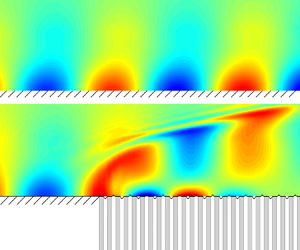
Impact of compliant coating on Mack-mode evolution in hypersonic boundary layers
-
- Journal:
- Journal of Fluid Mechanics / Volume 974 / 10 November 2023
- Published online by Cambridge University Press:
- 23 October 2023, A1
-
- Article
- Export citation
-
This paper focuses on the linear evolution of Mack instability modes in a hypersonic boundary layer over a flat plate that is partially coated by a compliant section. The compliant section is a thin, flexible membrane covering on a porous wall consisting of micro holes. The instability pressure could induce a vibration of the membrane, leading to a feedback to the boundary-layer fluids through the transverse velocity fluctuation. Such a process is formulated by an admittance boundary condition for the boundary-layer perturbation, which is dependent on the thickness and tension of the membrane, the properties of the porous wall, and the frequency of the Mack-mode perturbation. Using this admittance condition, the impact of the compliant coating on the Mack growth rate is studied systematically by solving the compressible Orr–Sommerfeld equations. It is found that the compliant coating could suppress the Mack instability with a frequency band in the neighbourhood of the most unstable frequency, and the stabilising frequency band widens as the membrane thickness and tension decrease, indicating a more favourable effect of a softer membrane. For a Mack mode with a specified dimensional frequency – since its dimensionless frequency, normalised by the local boundary-layer thickness and oncoming velocity, increases as it propagates downstream – the second-mode frequency band usually appears in downstream locations, and so does the stabilising effect of the membrane. Thus it is favourable to apply a compliant panel at a downstream region. In this situation, the solid–compliant junction could produce an additional scattering effect on the evolution of the Mack mode due to the sudden change of its boundary condition. The scattering effect is quantified by a transmission coefficient defined by the equivalent amplitude of the compliant-wall perturbation to the solid-wall perturbation, which can be obtained by the harmonic linearised Navier–Stokes (HLNS) approach. If the admittance is weak, then the transmission coefficient can also be predicted by an analytical solution based on the residue theorem. It is found that most of the second modes are suppressed by the scattering effect as long as the argument of the admittance is in the interval $[150^\circ, 210^\circ ]$, agreeing with most of the physical situation. The analytical predictions agree well with the HLNS calculations when the modulus of the admittance is less than $O(0.1)$.


Three-dimensional transition and force characteristics of low-Reynolds-number flows past a plunging airfoil
-
- Journal:
- Journal of Fluid Mechanics / Volume 973 / 25 October 2023
- Published online by Cambridge University Press:
- 23 October 2023, A43
-
- Article
- Export citation
-
The three-dimensional (3-D) transition of the leading-edge vortex (LEV) and the force characteristics of the plunging airfoil are investigated in the chord-based Strouhal number $St_c$ range of 0.10 to 1.0 by means of experimental measurements, numerical simulations and linear stability analysis in order to understand the spanwise instabilities and the effects on the force. We find that the interaction pattern of the LEV, the LEV from a previous cycle (pLEV) and the trailing-edge vortex (TEV) is the primary mechanism that affects the 3-D transition and associated force characteristics. For $St_c \leq 0.16$, the 3-D transition is dominated by the LEV–TEV interaction. For $0.16 < St_c \leq 0.44$, the TEV lies in the middle of the LEV and the pLEV and therefore vortex interaction between them is relatively weak; as a result, the LEV remains two-dimensional up to a relatively high Reynolds number of $Re = 4000$ at $St_c = 0.32$. For $0.44 < St_{c} \leq 0.54$, and at relatively low Reynolds numbers, the pLEV and the TEV tend to form a clockwise vortex pair, which is beneficial for the high lift and stability of the LEV. For $0.49 \leq St_c$, the pLEV and TEV tend to form an anticlockwise vortex pair, which is detrimental to the lift and flow stability. In the last $St_c$ range, vortex interaction involving the LEV, the TEV and the pLEV results in an unstable period-doubling mode which has a wavelength of about two chord-lengths and the 3-D transition enhances the lift.


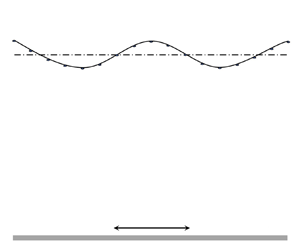
Instability of a viscoelastic film with insoluble surfactants on an oscillating plane
-
- Journal:
- Journal of Fluid Mechanics / Volume 973 / 25 October 2023
- Published online by Cambridge University Press:
- 23 October 2023, A39
-
- Article
- Export citation
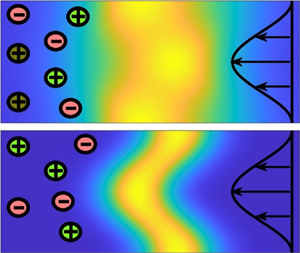
Dispersion with a pinch of salt
-
- Journal:
- Journal of Fluid Mechanics / Volume 974 / 10 November 2023
- Published online by Cambridge University Press:
- 23 October 2023, F1
-
- Article
-
- You have access
- HTML
- Export citation
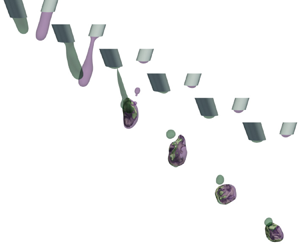
Analysis and optimisation of mixing in binary droplet collisions
-
- Journal:
- Journal of Fluid Mechanics / Volume 973 / 25 October 2023
- Published online by Cambridge University Press:
- 23 October 2023, A38
-
- Article
-
- You have access
- Open access
- HTML
- Export citation
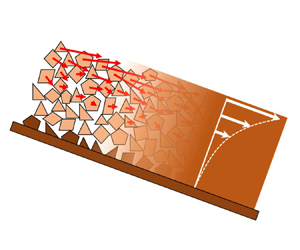
Analytic inclined flow rule for determining granular rheology under strong non-local effects
-
- Journal:
- Journal of Fluid Mechanics / Volume 973 / 25 October 2023
- Published online by Cambridge University Press:
- 23 October 2023, A47
-
- Article
- Export citation
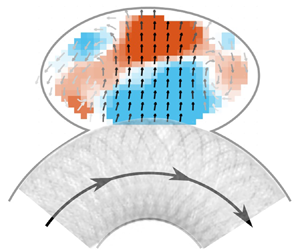
Fluid dynamics in intracranial aneurysms treated with flow-diverting stents: effect of multiple geometrical parameters
-
- Journal:
- Journal of Fluid Mechanics / Volume 973 / 25 October 2023
- Published online by Cambridge University Press:
- 23 October 2023, A45
-
- Article
- Export citation
-
Characterizing the haemodynamics in intracranial aneurysms is of high interest as it impacts aneurysm growth, rupture and treatment, especially with flow-diverting stents (FDS). Flow in these geometries is known to depend on the Dean, Reynolds and Womersley numbers, $De$,
$De$,  $Re$,
$Re$,  $Wo$, but is also influenced by geometrical parameters such as the sac shape or the size of the opening. Via particle image velocimetry, this parametric study aimed at evaluating the combined effects of $Re$,
$Re$,  $De$,
$De$,  $Wo$ and the geometry of the aneurysmal sac on the haemodynamics before and after treatment with FDS. Eight ellipsoidal idealized aneurysm models were created with two curvatures of the parent vessel, two aspect ratios of the sac and two neck sizes. Before treatment, a single counter-rotating vortex, whose strength increases with $Re$ and $De$, as well as with the neck size and the aspect ratio, was observed in the sac for all but one geometry. After treatment with FDS, four different flow topologies were observed, depending on the geometry: no separation, separation for part of the cycle, two opposing vortices or a single counter-rotating vortex. A linear model with interaction revealed the predominant effect of $De$ and the curvature of the parent vessel on the haemodynamics before and after treatment. This work once more demonstrated the primary role of haemodynamics in the treatment of intracranial aneurysms with FDS. Future work will consider the complexity of patient-specific geometries, and their effects on both the haemodynamics in the sac and the porosity of the FDS.


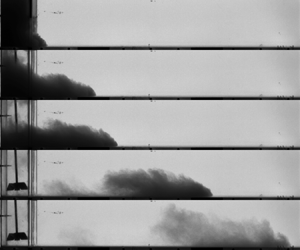
Slumping regime in lock-release turbidity currents
-
- Journal:
- Journal of Fluid Mechanics / Volume 974 / 10 November 2023
- Published online by Cambridge University Press:
- 23 October 2023, A4
-
- Article
- Export citation
-
Most gravitational currents occur on sloping topographies, often in the presence of particles that can settle during the current propagation. Yet an exhaustive exploration of associated parameters in experimental studies is still lacking. Here, we present an extensive experimental investigation of the slumping regime of turbidity (particle-laden) currents in two lock-release (dam-break) systems with inclined bottoms. We identify three regimes controlled by the ratio between settling and current inertia. (i) For negligible settling, the turbidity current morphodynamics corresponds to that of saline homogeneous gravity currents, in terms of velocity, slumping (constant-velocity) regime duration and current morphology. (ii) For intermediate settling, the slumping regime duration decreases to become fully controlled by a particle settling characteristic time. (iii) When settling overcomes the current initial inertia, the slumping (constant-velocity) regime is no longer detected. In the first two regimes, the current velocity increases with the bottom slope, of approximately $35\,\%$ between $0^\circ$ and $15^\circ$. Finally, our experiments show that the current propagates during the slumping regime with the same shape in the frame of the moving front. Strikingly, the current head is found to be independent of all experimental parameters covered in the present study. We also quantify water entrainment coefficients $E$ and compare them with previous literature, hence finding that $E$ increases rather linearly with the current Reynolds number.


