To save content items to your account,
please confirm that you agree to abide by our usage policies.
If this is the first time you use this feature, you will be asked to authorise Cambridge Core to connect with your account.
Find out more about saving content to .
To save content items to your Kindle, first ensure no-reply@cambridge.org
is added to your Approved Personal Document E-mail List under your Personal Document Settings
on the Manage Your Content and Devices page of your Amazon account. Then enter the ‘name’ part
of your Kindle email address below.
Find out more about saving to your Kindle.
Note you can select to save to either the @free.kindle.com or @kindle.com variations.
‘@free.kindle.com’ emails are free but can only be saved to your device when it is connected to wi-fi.
‘@kindle.com’ emails can be delivered even when you are not connected to wi-fi, but note that service fees apply.
On-demand urban air transportation gains popularity in recent years with the introduction of the electric VTOL (eVTOL) aircraft concept. There is an emerging interest in short/medium range eVTOL air taxi considering the critical advantages of electric propulsion (i.e. low noise and carbon emission). Using several electric propulsion systems (distributed electric propulsion (DEP)) has further advantages such as improved redundancy. However, flight controller design becomes more challenging due to highly over-actuated and coupled dynamics. This study defines and resolves flight control problems of a novel DEP eVTOL air taxi. The aircraft has a fixed-wing surface to have aerodynamically efficient cruise flight, and uses only tilting electric propulsion units to achieve full envelope flight control via pure thrust vector control. The aircraft does not have conventional control surfaces such as aileron, rudder or elevator. Using pure thrust vector control has some design benefits, but the control problem becomes more challenging due to the over-actuated and highly coupled dynamics (especially in transition flight). A preliminary flight dynamics model is obtained considering the dominant effects at hover and high-speed forward flight. Hover and forward flight models are blended to simulate the transition dynamics. Two central challenges regarding the flight control are significant nonlinearities in aircraft dynamics during the transition and proper allocation of the thrust vector control specifically in limited control authority (actuator saturation). The former challenge is resolved via designing a sensor-based incremental nonlinear dynamic inversion (INDI) controller to have a single/unified controller covering the wide flight envelope. For the latter one, an optimisation-based control allocation (CA) approach is integrated into the INDI controller. CA requires special attention due to the pure thrust vector control’s highly coupled dynamics. The controller shows satisfactory performance and disturbance rejection characteristics. Moreover, the CA plays a vital role in guaranteeing stable flight in case of severe actuator saturation.
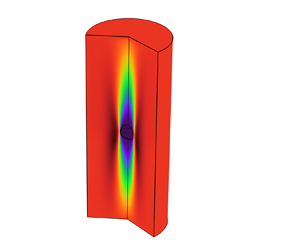
Odd viscous liquids are endowed with an intrinsic mechanism that tends to restore a displaced particle back to its original position. Since the odd viscous stress does not dissipate energy, inertial oscillations and inertial-like waves can become prominent in such a liquid. In this paper, we show that an odd viscous liquid in three dimensions may give rise to such axially symmetric waves and also to plane-polarized waves. We assume tacitly that an anisotropy axis giving rise to odd viscous effects has already been established, and proceed to investigate the effects of odd viscosity on fluid flow behaviour. Numerical simulations of the full Navier–Stokes equations show the existence of inertial-like waves downstream of a body that moves slowly along the axis of an odd viscous liquid filled cylinder. The wavelength of the numerically determined oscillations agrees well with the developed theoretical framework. When odd viscosity is the dominant effect in steady motions, a modified Taylor–Proudman theorem leads to the existence of Taylor columns inside such a liquid. Formation of the Taylor column can be understood as a consequence of helicity segregation and energy transfer along the cylinder axis at group velocity, by the accompanying inertial-like waves, whenever the reflection symmetry of the system is lost. A number of Taylor column characteristics known from rigidly rotating liquids are recovered here for a non-rotating odd viscous liquid. These include counter-rotating swirling liquid flow above and below a body moving slowly along the anisotropy axis. Thus in steady motions, odd viscosity acts to suppress variations of liquid velocity in a direction parallel to the anisotropy axis, inhibiting vortex stretching and vortex twisting. In unsteady and nonlinear motions, odd viscosity enhances the vorticity along the same axis, thus affecting both vortex stretching and vortex twisting.
The preprocessing of Computational Grains (CGs) is introduced in Chapter 3, and several types of CGs have been developed for the micromechanical modeling of different kinds of composites with particulates, fibers, and so on in Chapters 5–11. A multi-scale analysis framework of composite structures by using the CGs and the standard FEM is developed in this chapter, based on the homogenization of composite materials at the microlevel, and slender or shell structures at the meso- and macro-levels. The specific process of the multi-scale algorithm is illustrated with an example of a stiffened composite panel. The results show the multi-scale analysis method is an accurate and efficient tool for large composite structures, not only simulating the overall structural responses in a bottom-up fashion, but also obtaining the detailed stresses at multiple scales in the dehomogenization process.
This chapter covers the essential features of key equipment encountered in electric power generation systems, gas and steam turbines, heat exchange systems receiving into and discarding heat from those systems, and other lesser equipment.
A gas turbine engine is a device that is designed to convert the thermal energy of a fuel into some form of useful power, such as mechanical (or shaft) power or a high-speed thrust of a jet. The engine consists, basically, of a gas generator and a power conversion section, as shown in Figures 1.1 and 1.2.
The focus in this chapter is on the optimal integration of concentrated solar power (CSP) and the gas turbine combined cycle (GTCC) via the bottoming cycle of the latter in an integrated solar combined cycle (ISCC) framework, which can be considered as a currently available (if not truly mature) technology.
In this chapter, we will get familiar with a unique performance gauge, which is not process dependent, but is rather state dependent, by definition. In other words, the newly defined, so-called “polytropic” efficiency is independent of the size of a turbomachine (in terms of the total-to-total pressure ratio). In addition, we will have a means of computing the overall efficiency of several stages, sharing the same total-to-total magnitudes of pressure ratio and efficiency, without having to resort to the thermodynamics of each individual stage. The point is made that adding more stages to a multistage turbomachine will have drastic, but totally opposite, effects on turbines as contrasted to compressors. We will prove through this exercise that adding more turbine stages enhances the performance of the final turbine configuration. The effect in compressors, on the other hand, is that of performance deterioration.
In this chapter, a new type of Computational Grains is proposed to study the micro-electro-mechanical behavior of composite piezoelectric materials. This method is based on a new hybrid variational principle, and independently assumed displacements and electric potentials in each CG. Each CG can efficiently model a single physical grain of the composite material, thus saving a significant time of generating complex FEM mesh. Computational Grains can also model porous and composite piezoelectric materials even if the distribution of voids/inclusions is not symmetrical (which is assumption used with all unit cell models). Because the trial solutions are complete but do not satisfy the governing differential equations a priori, the formulation is very simple, and can accurately account for the local field concentrations efficiently and accurately. This is illustrated using different examples where the fields along the void/inclusion periphery are calculated, and the effective material properties of porous and composite materials are predicted, and compared with other analytical and computational models. The proposed CG in this chapter is expected to become a very powerful tool of direct numerical simulations of the micro/meso mechanics of composite piezoelectric materials, and can possibly lead to efficient multi-scale modeling of piezoelectric devices.
Consider the simplest nonafterburning, single-spool turbojet engine, which is schematically shown in Figure 12.1. Assuming a viable (i.e., stable compressor) operation mode, there are obvious constrains relating the gas-generator components to one another. These generally enforce the uniformity of shaft speed, as well as ensure the mass and energy conservation principles (Figure 12.2).
In this chapter, Computational Grains are developed for the direct micromechanical modeling of heterogeneous materials reinforced with coated particulate inclusions. Each CG is treated as a three-phase particle/coating/matrix grain, wherein the exact internal displacement field is assumed in terms of the P-N solutions that are further represented by the spherical harmonics. The Computational Grain program generates accurate homogenized moduli as well as exact local interphase stress distributions, with good agreement to the very fine-mesh FE technique and the CSA (Composite Sphere Assemblage) model. The effects of the material properties as well as the thickness of the coating system on the effective properties and localized stress concentrations are also examined for the CGs, where the former parameters play more important roles than the latter ones in altering the response of composite materials. Finally, a simpler implementation of periodic boundary conditions on the SERVEs is developed through the surface-to-surface constraints of the displacement field on the opposite faces. The developed CGs provide accurate and efficient computational tools in the direct modeling of the micromechanical behavior of the particulate composites reinforced with coatings/interphases, which cannot be easily accomplished by the off-the-shelf FE packages and classical models.
In this chapter, the focus is on post-combustion CO2 capture (PCC) from the heat recovery steam generator (HRSG) stack gas in a gas turbine combined cycle (GTCC) power plant. The reason for that is simple: GTCC with advanced class gas turbines and post-combustion capture represents the most cost-effective technology for carbon-free electric power generation from fossil fuels. The chapter includes detailed description of the PCC system, key equipment, and the operability of the system.
Utilization of axial-flow compressor stages (Figure 9.1) in gas turbine engines is a relatively recent development. The history of this compressor type began after an era when centrifugal compressors were dominant (Figure 9.2). It was later confirmed, on an experimental basis, that axial-flow compressors can run much more efficiently. Earlier attempts to build multistage axial-flow compressors entailed running multistage axial-flow turbines in the reverse direction. As presented in Chapter 4, a compressor-stage reaction, in this case, will be negative, a situation that has its own performance degradation effect. Today, carefully designed axial-flow compressor stages can very well have efficiencies in excess of 80%. A good part of this advancement is owing to the standardization of thoughtfully devised compressor-cascade blading rules.
This chapter covers the basic principles, concepts, and tools governing the operation of the equipment and systems described in Chapter 3. The operation of those systems in off-design conditions, steady as well as unsteady (transient), are described using basic formulae and charts.
This chapter provides a very brief summary of the types of heterogeneous materials considered in this monograph: fiber-reinforced composites, particulate composites, nanocomposites, porous composites, and so on. A succinct summary is given of analytical homogenization methods to determine the overall properties of particulate composites based on the upper and lower bounds of Hashin and Shtrikman; the Eshelby ellipsoidal inclusion theory and the Self-consistent Method of Eshelby; and the Mori-Tanaka Method and some other semi-analytical methods. Numerical methods such as the finite element method, the boundary element method, XFEM, and so on to model a representative volume element (RVE) of a heterogeneous material are reviewed, and thus the motivation for the Computational Grains method discussed in the rest of this book is presented.
This chapter discusses the role of a representative volume element (RVE) in the computational homogenization of heterogeneous materials. The use of the finite element method in modeling an RVE is discussed. The role of using the Hill-Mandel boundary conditions, and the use of periodic displacement and aperiodic traction boundary conditions on an RVE are discussed. The advantages of using the present Computational Grains method in modeling an RVE, not only to determine the macro properties of a heterogeneous material but also to determine the detailed interfacial stress states which are damage precursors at the micro level are discussed.