Refine search
Actions for selected content:
213073 results in Engineering
10 - Radial-Inflow Turbines
-
- Book:
- Principles of Turbomachinery in Air-Breathing Engines
- Published online:
- 18 November 2023
- Print publication:
- 19 October 2023, pp 467-547
-
- Chapter
- Export citation
Preface
-
- Book:
- Gas and Steam Turbine Power Plants
- Published online:
- 12 January 2024
- Print publication:
- 19 October 2023, pp ix-x
-
- Chapter
- Export citation
Index
-
- Book:
- Computational Grains
- Published online:
- 05 October 2023
- Print publication:
- 19 October 2023, pp 274-276
-
- Chapter
- Export citation
14 - A Technology Leap?
-
- Book:
- Gas and Steam Turbine Power Plants
- Published online:
- 12 January 2024
- Print publication:
- 19 October 2023, pp 467-498
-
- Chapter
- Export citation
Frontmatter
-
- Book:
- Multiphase Flow with Solid Particles
- Published online:
- 05 October 2023
- Print publication:
- 19 October 2023, pp i-iv
-
- Chapter
- Export citation
Preface
-
- Book:
- Computational Grains
- Published online:
- 05 October 2023
- Print publication:
- 19 October 2023, pp ix-xii
-
- Chapter
- Export citation
6 - Radial Equilibrium Theory
-
- Book:
- Principles of Turbomachinery in Air-Breathing Engines
- Published online:
- 18 November 2023
- Print publication:
- 19 October 2023, pp 269-297
-
- Chapter
- Export citation
Numerical modelling of Lamb wave propagation in 2D plate structures
- Part of
-
- Journal:
- The Aeronautical Journal / Volume 127 / Issue 1318 / December 2023
- Published online by Cambridge University Press:
- 18 October 2023, pp. 2187-2203
-
- Article
- Export citation
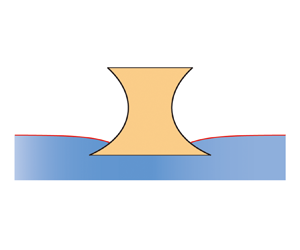
Exotic flotation theory with new method for floating stability analysis
-
- Journal:
- Journal of Fluid Mechanics / Volume 973 / 25 October 2023
- Published online by Cambridge University Press:
- 18 October 2023, A25
-
- Article
- Export citation
Experiments on fluid entrainment and slip in continuous bubble plumes
-
- Journal:
- Journal of Fluid Mechanics / Volume 973 / 25 October 2023
- Published online by Cambridge University Press:
- 18 October 2023, A22
-
- Article
-
- You have access
- Open access
- HTML
- Export citation
-
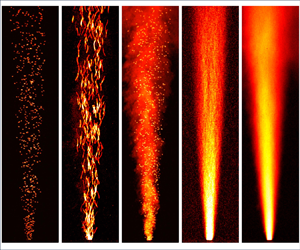
A series of laboratory experiments are reported in which a continuous stream of bubbles rise from a small source at the base of a tank of water. Using different nozzles, bubble sizes $d$ ranging from 1.2 to 11.6 mm were produced for a number of gas volume fluxes, $Q_b$, ranging between 1.1 and $21.1\times 10^{-6}\ {\rm m}^3\ {\rm s}^{-1}$. Within a small distance from the source, the slip speed of these bubbles exceeds the speed of the equivalent single-phase plume with the same buoyancy flux, leading to formation of what we refer to as the ‘slip plume’ regime. Through a combination of high-speed photography, coupled with flow visualisation in the plume and the ambient fluid using dye, we find that the bubble speed and the fluid speed remain nearly constant with height, with the maximum fluid speed being of order $0.30\pm 0.03$ of the bubble speed. Using the filling box method, we also find that the net fluid volume flux in the slip plume increases linearly with distance from the source at a rate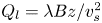 $Q_l = \lambda Bz/v_s^2$, where $B$ is the buoyancy flux of the gas, $v_s$ the rise speed of the gas bubbles, $z$ the distance above the source and $\lambda$ is a constant related to the dimensionless volume of fluid in the wake of each bubble. This slip-dominated flow regime can be understood in terms of kinetic energy imparted to the fluid as the bubbles rise and release potential energy. Further experiments with particle-laden plumes illustrate similar scalings for the volume flux in a particle-driven slip plume once the slip speed of the particles exceeds the bulk speed of the equivalent single-phase buoyant plume with the same buoyancy flux. Near the source the slip speed may be smaller than the plume speed, and the flow follows the classical model for a turbulent buoyant plume, with the transition to the slip regime occurring at a distance $z^*\approx (32\pm 5)\lambda ^{3/2} B/v_s^3$ from the source, where the dimensionless parameter $\lambda$ relates to the dimensionless volume of the fluid wake, which we find varies with the Reynolds number of the particles.


Thermocapillary dynamics of a surfactant-laden droplet with internal thermal singularity
-
- Journal:
- Journal of Fluid Mechanics / Volume 973 / 25 October 2023
- Published online by Cambridge University Press:
- 18 October 2023, A24
-
- Article
- Export citation
-
Thermocapillary droplets with internal thermal singularities have potential applications in drug delivery and cell analysis. Inspired by the work of Pak et al. (J. Fluid Mech., vol. 753, 2014, pp. 535–552), which was investigated for a surfactant-laden non-deformable droplet in an isothermal Poiseuille flow, we have explored the droplet dynamics by taking account of additional internal thermal singularities, namely monopole and dipole. A generalized mathematical model is developed, which is solved by using the solenoidal decomposition to describe the flow field in any arbitrary Stokes flow, and results are shown extensively for the case of a non-isothermal Poiseuille flow. Under small Péclet number ( $Pe_s$) limit, the droplet with an off-centred monopole or a dipole oriented along the flow direction shows cross-stream migration at $O(Pe_s^2)$. However, a dipole oriented perpendicular to the flow direction results in an $O(1)$ effect due to thermocapillarity, and from $O(Pe_s)$ onwards, we observe the combined impact of thermocapillary and surfactant-induced Marangoni stresses. As a surprise, we see cross-stream migration of the droplet from the Poiseuille flow centreline in a non-isothermal field, in contrast to existing findings which rule out any cross-stream migration. We show the trade-off between thermal Marangoni number ( $Ma_T$) and surfactant Marangoni number ( $Ma_\varGamma$). Our findings on droplet dynamics inspire new possibilities for microfluidics-based design.


Turbulent wall plumes with detrainment
-
- Journal:
- Journal of Fluid Mechanics / Volume 973 / 25 October 2023
- Published online by Cambridge University Press:
- 18 October 2023, R3
-
- Article
-
- You have access
- Open access
- HTML
- Export citation
-
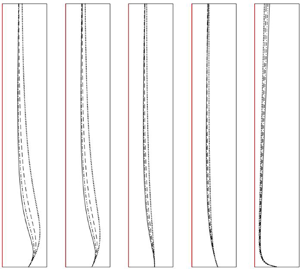
This article presents a theoretical modelling framework for the previously unconsidered case of turbulent wall plumes that detrain continually with height in stably stratified environments. Built upon the classic turbulent plume model, our approach incorporates turbulent detrainment with a variable coefficient of detrainment. Based on a linear constitutive relationship between the ratio of the detrainment to entrainment coefficients and the ambient buoyancy gradient, it is found that for linear ambient stratifications, a dynamic quasi-equilibrium region, characterised by a near invariant local plume Richardson number, is achieved, downstream of which this equilibrium rapidly breaks down. With increasing ambient buoyancy gradient, while the plume becomes increasingly slender with weaker vertical motions, the level at which the plume breaks down to form a horizontal intrusion first decreases and then increases. Moreover, distinct from classic purely entraining plumes, a detraining wall plume can swell within the pre-equilibrium adjustment stage provided the local Richardson number is sufficiently low $({Ri\ll 6})$, behaviour which is in accordance with observations made in filling-box experiments.

The cost of pediatric abdominal tuberculosis treatment in India: Evidence from a teaching hospital
-
- Journal:
- Experimental Results / Volume 4 / 2023
- Published online by Cambridge University Press:
- 18 October 2023, e18
-
- Article
-
- You have access
- Open access
- HTML
- Export citation
Role of pressure in the dynamics of intense velocity gradients in turbulent flows
-
- Journal:
- Journal of Fluid Mechanics / Volume 973 / 25 October 2023
- Published online by Cambridge University Press:
- 18 October 2023, A23
-
- Article
-
- You have access
- Open access
- HTML
- Export citation
-
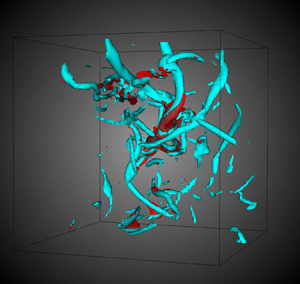
We investigate the role of pressure, via its Hessian tensor ${\boldsymbol {H}}$, on amplification of vorticity and strain-rate and contrast it with other inviscid nonlinear mechanisms. Results are obtained from direct numerical simulations of isotropic turbulence with Taylor-scale Reynolds number in the range 140–1300. Decomposing ${\boldsymbol {H}}$ into local isotropic ( ${\boldsymbol {H}}^{I}$) and non-local deviatoric ( ${\boldsymbol {H}}^{D}$) components reveals that ${\boldsymbol {H}}^{I}$ depletes vortex stretching, whereas ${\boldsymbol {H}}^{D}$ enables it, with the former slightly stronger. The resulting inhibition is significantly weaker than the nonlinear mechanism which always enables vortex stretching. However, in regions of intense vorticity, identified using conditional statistics, contribution from ${\boldsymbol {H}}$ prevails over nonlinearity, leading to overall depletion of vortex stretching. We also observe near-perfect alignment between vorticity and the eigenvector of ${\boldsymbol {H}}$ corresponding to the smallest eigenvalue, which conforms with well-known vortex-tubes. We discuss the connection between this depletion, essentially due to (local) ${\boldsymbol {H}}^{I}$, and recently identified self-attenuation mechanism (Buaria et al., Nat. Commun., vol. 11, 2020, p. 5852), whereby intense vorticity is locally attenuated through inviscid effects. In contrast, the influence of ${\boldsymbol {H}}$ on strain-amplification is weak. It opposes strain self-amplification, together with vortex stretching, but its effect is much weaker than vortex stretching. Correspondingly, the eigenvectors of strain and ${\boldsymbol {H}}$ do not exhibit any strong alignments. For all results, the dependence on Reynolds number is very weak. In addition to the fundamental insights, our work provides useful data and validation benchmarks for future modelling endeavours, for instance in Lagrangian modelling of velocity gradient dynamics, where conditional ${\boldsymbol {H}}$ is explicitly modelled.


Highly sensitive RF sensor based on microstrip meander line for measuring microfluidics dielectric properties of alcohol–alcohol mixtures
-
- Journal:
- International Journal of Microwave and Wireless Technologies / Volume 16 / Issue 4 / May 2024
- Published online by Cambridge University Press:
- 18 October 2023, pp. 704-710
-
- Article
- Export citation
General solutions of the plume equations: towards synthetic plumes and fountains
-
- Journal:
- Journal of Fluid Mechanics / Volume 973 / 25 October 2023
- Published online by Cambridge University Press:
- 17 October 2023, R2
-
- Article
-
- You have access
- Open access
- HTML
- Export citation
-
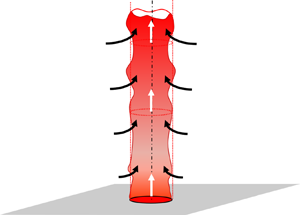
Previous mathematical models of quasi-steady turbulent plumes and fountains have described the flow that results from a prescribed input of buoyancy. We offer a new perspective by asking, what input of buoyancy would give rise to a plume, or fountain, with given properties? Addressing this question by means of an analytical framework, we take a first step toward enabling a plume with specific characteristics, i.e. a synthetic plume, to be designed. We develop analytical solutions to the conservation equations that describe four kinds of turbulent flow: axisymmetric plume, starting fountain, line plume and wall plume. Crucially, our solutions do not require the buoyancy distribution to be specified, whether this be the source or off-source distribution. Key to our approach, we specify a function for the volume flux, $Q=f(z)$, and take advantage of the weak coupling between the conservation equations to uniquely express general solutions in terms of $f$. We show that any analytic function $f$ can form the basis for a set of solutions for the fluxes, local variables and local Richardson number, though $f/({\rm d}f/{\rm d}z)>0$ is a necessary condition for physically realistic solutions. As an example of plume synthesis, we show that an axisymmetric plume can have an invariant radius if there is an exponentially increasing input of buoyancy to the plume centreline. We also consider how plume synthesis could be achieved practically.


The magnetic non-hydrostatic shallow-water model
-
- Journal:
- Journal of Fluid Mechanics / Volume 973 / 25 October 2023
- Published online by Cambridge University Press:
- 17 October 2023, A17
-
- Article
-
- You have access
- Open access
- HTML
- Export citation
-
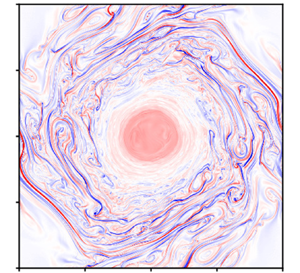
We consider the dynamics of a set of reduced equations describing the evolution of a magnetised, rotating stably stratified fluid layer, atop a stagnant dense, perfectly conducting layer. We consider two closely related models. In the first, the layer has, above it, relatively light fluid where the magnetic pressure is much larger than the gas pressure, and the magnetic field is largely force-free. In the second model, the magnetic field is constrained to lie within the dynamical layer by the implementation of a model diffusion operator for the magnetic field. The model derivation proceeds by assuming that the horizontal velocity and the horizontal magnetic field are independent of the vertical coordinate, whilst the vertical components in the layer have a linear dependence on height. The full system comprises evolution equations for the magnetic field, horizontal velocity and height field together with a linear elliptic equation for the vertically integrated non-hydrostatic pressure. In the magneto-hydrostatic limit, these equations simplify to equations of shallow-water type. Numerical solutions for both models are provided for the fiducial case of a Gaussian vortex interacting with a magnetic field. The solutions are shown to differ negligibly. We investigate how the interaction of the vortex changes in response to the magnetic Reynolds number ${Rm}$, the Rossby deformation radius $L_D$, and a Coriolis buoyancy frequency ratio $f/N$ measuring the significance of non-hydrostatic effects. The magneto-hydrostatic limit corresponds to $f/N\to 0$.


Attenuating surface gravity waves with an array of submerged resonators: an experimental study
-
- Journal:
- Journal of Fluid Mechanics / Volume 973 / 25 October 2023
- Published online by Cambridge University Press:
- 17 October 2023, A16
-
- Article
-
- You have access
- Open access
- HTML
- Export citation
Inertial wave attractors in librating cuboids
-
- Journal:
- Journal of Fluid Mechanics / Volume 973 / 25 October 2023
- Published online by Cambridge University Press:
- 17 October 2023, A20
-
- Article
-
- You have access
- Open access
- HTML
- Export citation
-
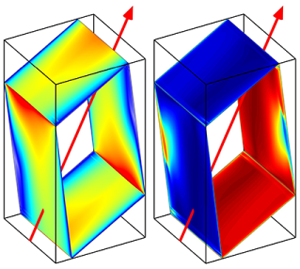
Perturbed rapidly rotating flows are dominated by inertial oscillations, with restricted group velocity directions, due to the restorative nature of the Coriolis force. In containers with some boundaries oblique to the rotation axis, the inertial oscillations may focus upon reflections, whereby their energy increases whilst their wavelength decreases and their trajectories focus onto attractor regions. In a linear inviscid setting, these attractors are Delta-like distributions. The linear inviscid setting is obtained formally by setting both Ekman number ${E}$ (ratio of inertial to viscous time scales) and Rossby number ${Ro}$ (non-dimensional amplitude of the forcing that drives the inertial oscillations) to zero. These settings raise fundamental questions, in particular concerning the nature of energy dissipation in the vanishing Ekman number regime. Here, we consider a simple container geometry, a rectangular cuboid, in which the direction of the rotation axis is oblique to four of its walls, subject to librational forcing (small-amplitude harmonic oscillations of the rotation rate). This geometry allows for accurate and efficient direct numerical simulations of the three-dimensional incompressible Navier–Stokes equations with no-slip boundary conditions using a spectral-Galerkin spatial discretisation along with a third-order temporal discretisation. Solutions with Ekman and Rossby numbers as small as ${E}={Ro}=10^{-8}$ reveal many details of how the inertial oscillations focus, at the libration frequency considered, onto attractors, and how the focusing leads to increased localised nonlinear and dissipative processes as ${E}$ and ${Ro}$ are reduced. Even for extremely small forcing amplitudes, nonlinear effects have important dynamic consequences for the attractors.


Flow over a circular cylinder with a flexible splitter plate
-
- Journal:
- Journal of Fluid Mechanics / Volume 973 / 25 October 2023
- Published online by Cambridge University Press:
- 17 October 2023, A19
-
- Article
-
- You have access
- Open access
- HTML
- Export citation
-
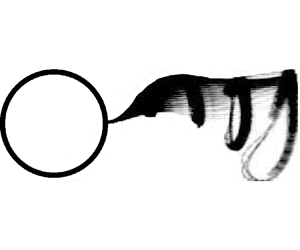
In the present work, we study the flow field around, and forces acting on, a circular cylinder with an attached flexible splitter plate/flap. Two cases of flap length ( $L/D$), namely, $L/D = 5$ and $L/D = 2$ have been investigated focusing on the effect of variations in flap flexural rigidity, $EI$. We find that for a range of $EI$ and Reynolds numbers $Re = UD/\nu$, a non-dimensional bending stiffness $K^{\ast }=EI/((1/2)\rho U^2 L^3)$ collapses flap motion and forces on the system well, as long as $Re>5000$. In the $L/D = 5$ flap case, two periodic flap deformation regimes in the form of travelling waves are identified (modes I and II), with mode I occurring at $K^{\ast } \approx 1.5\times 10^{-3}$ and mode II at lower $K^{\ast }$ values ( $K^{\ast }<3\times 10^{-5}$). In the $L/D = 2$ flap case, we find a richer set of flapping modes (modes A, B, C and D) that are differentiated by their flapping characteristics (symmetric/asymmetric and amplitude). Force measurements show that the largest drag reduction occurs in mode I ( $L/D = 5$) and mode C ( $L/D = 2$), which also correspond to the lowest lift and wake fluctuations, with the mode C wake fluctuations being lower than even the rigid splitter plate case. In contrast, the highest fluctuating lift, in both $L/D$ cases, occurs at higher $K^{\ast }$, when the wake frequency is close to the first structural bending mode frequency of the flap. The observed rich range of flap/splitter plate dynamics could be useful for applications such as drag reduction, vibration suppression, reduction of wake fluctuations and energy harvesting.


