Refine search
Actions for selected content:
213084 results in Engineering
4 - Deep Algorithm Unrolling for Biomedical Imaging
- from Part I - Theory of Deep Learning for Image Reconstruction
-
-
- Book:
- Deep Learning for Biomedical Image Reconstruction
- Published online:
- 15 September 2023
- Print publication:
- 12 October 2023, pp 53-86
-
- Chapter
- Export citation
12 - Image Synthesis in Multi-Contrast MRI with Generative Adversarial Networks
- from Part III - Generative Models for Biomedical Imaging
-
-
- Book:
- Deep Learning for Biomedical Image Reconstruction
- Published online:
- 15 September 2023
- Print publication:
- 12 October 2023, pp 279-298
-
- Chapter
- Export citation
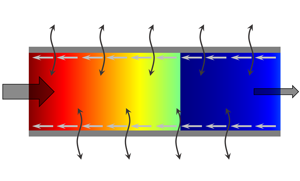
Analysis of the choking condition of one-dimensional diabatic flows with wall friction
-
- Journal:
- Journal of Fluid Mechanics / Volume 973 / 25 October 2023
- Published online by Cambridge University Press:
- 12 October 2023, A10
-
- Article
- Export citation
7 - Overview of the Deep-Learning Reconstruction of Accelerated MRI
- from Part II - Deep-Learning Architecture for Various Imaging Architectures
-
-
- Book:
- Deep Learning for Biomedical Image Reconstruction
- Published online:
- 15 September 2023
- Print publication:
- 12 October 2023, pp 166-176
-
- Chapter
- Export citation
5 - Deep Learning for CT Image Reconstruction
- from Part II - Deep-Learning Architecture for Various Imaging Architectures
-
-
- Book:
- Deep Learning for Biomedical Image Reconstruction
- Published online:
- 15 September 2023
- Print publication:
- 12 October 2023, pp 89-113
-
- Chapter
- Export citation
8 - Model-Based Deep-Learning Algorithms for Inverse Problems
- from Part II - Deep-Learning Architecture for Various Imaging Architectures
-
-
- Book:
- Deep Learning for Biomedical Image Reconstruction
- Published online:
- 15 September 2023
- Print publication:
- 12 October 2023, pp 177-199
-
- Chapter
- Export citation
10 - Deep Learning for Ultrasound Beamforming
- from Part II - Deep-Learning Architecture for Various Imaging Architectures
-
-
- Book:
- Deep Learning for Biomedical Image Reconstruction
- Published online:
- 15 September 2023
- Print publication:
- 12 October 2023, pp 223-251
-
- Chapter
- Export citation

The onset and saturation of the Faraday instability in miscible fluids in a rotating environment
-
- Journal:
- Journal of Fluid Mechanics / Volume 973 / 25 October 2023
- Published online by Cambridge University Press:
- 12 October 2023, A6
-
- Article
-
- You have access
- Open access
- HTML
- Export citation
-
We investigate the influence of rotation on the onset and saturation of the Faraday instability in a vertically oscillating two-layer miscible fluid using a theoretical model and direct numerical simulations (DNS). Our analytical approach utilizes Floquet analysis to solve a set of the Mathieu equations obtained from the linear stability analysis. The solution of the Mathieu equations comprises stable and harmonic, and subharmonic unstable regions in a three-dimensional stability diagram. We find that the Coriolis force delays the onset of the subharmonic instability responsible for the growth of the mixing zone size at lower forcing amplitudes. However, at higher forcing amplitudes, the flow is energetic enough to mitigate the instability delaying effect of rotation, and the evolution of the mixing zone size is similar in both rotating and non-rotating environments. These results are corroborated by DNS at different Coriolis frequencies and forcing amplitudes. We also observe that for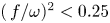 $(\,f/\omega )^2<0.25$, where $f$ is the Coriolis frequency, and $\omega$ is the forcing frequency, the instability and the turbulent mixing zone size- $L$ saturates. When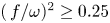 $(\,f/\omega )^2\geq 0.25$, the turbulent mixing zone size- $L$ never saturates and continues to grow.


Part I - Theory of Deep Learning for Image Reconstruction
-
- Book:
- Deep Learning for Biomedical Image Reconstruction
- Published online:
- 15 September 2023
- Print publication:
- 12 October 2023, pp 1-2
-
- Chapter
- Export citation
3 - Model-Based Reconstruction with Learning: From Unsupervised to Supervised and Beyond
- from Part I - Theory of Deep Learning for Image Reconstruction
-
-
- Book:
- Deep Learning for Biomedical Image Reconstruction
- Published online:
- 15 September 2023
- Print publication:
- 12 October 2023, pp 28-52
-
- Chapter
- Export citation
6 - Deep Learning in CT Reconstruction: Bringing the Measured Data to Tasks
- from Part II - Deep-Learning Architecture for Various Imaging Architectures
-
-
- Book:
- Deep Learning for Biomedical Image Reconstruction
- Published online:
- 15 September 2023
- Print publication:
- 12 October 2023, pp 114-165
-
- Chapter
- Export citation
Part III - Generative Models for Biomedical Imaging
-
- Book:
- Deep Learning for Biomedical Image Reconstruction
- Published online:
- 15 September 2023
- Print publication:
- 12 October 2023, pp 277-278
-
- Chapter
- Export citation
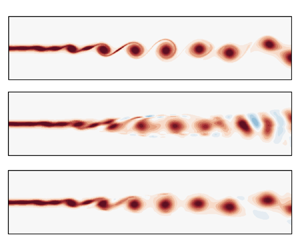
Multiscale model reduction for incompressible flows
-
- Journal:
- Journal of Fluid Mechanics / Volume 973 / 25 October 2023
- Published online by Cambridge University Press:
- 11 October 2023, A3
-
- Article
-
- You have access
- Open access
- HTML
- Export citation

Exact solutions for the initial stage of dam-break flow on a plane hillside or beach
-
- Journal:
- Journal of Fluid Mechanics / Volume 972 / 10 October 2023
- Published online by Cambridge University Press:
- 11 October 2023, R7
-
- Article
-
- You have access
- Open access
- HTML
- Export citation
-
Inviscid, incompressible liquid is released from rest by a sudden dam break, accelerating under gravity over a uniformly sloping impermeable plane bed. The liquid flows downhill or up a beach. A linearised model is derived from Euler's equations for the early stage of motion, of duration $2\sqrt {H/g}$, where H is the depth scale and $g$ is the acceleration due to gravity. Initial pressure and acceleration fields are calculated in closed form, first for an isosceles right-angled triangle on a slope of $45^{\circ }$. Second, the triangle belongs to a class of finite-domain solutions with a curved front face. Third, an unbounded domain is treated, with a curved face resembling a steep-fronted breaking water wave flowing up a beach. The fluid goes uphill due to a nearshore pressure gradient. In all cases the free-surface-bed contact point is the most accelerated particle, exceeding the acceleration due to gravity. Physical consequences are discussed, and the pressure approximation of shallow water theory is found poor during this early stage, near the steep free surface exposed by a dam break.


TrackAnalyzer: A Fiji/ImageJ toolbox for a holistic analysis of tracks
-
- Journal:
- Biological Imaging / Volume 3 / 2023
- Published online by Cambridge University Press:
- 11 October 2023, e18
-
- Article
-
- You have access
- Open access
- HTML
- Export citation

RETRACTED – Reynolds-number scaling and convergence time scale in two-dimensional Rayleigh–Bénard convection
-
- Journal:
- Journal of Fluid Mechanics / Volume 973 / 25 October 2023
- Published online by Cambridge University Press:
- 11 October 2023, A9
-
- Article
-
- You have access
- Open access
- HTML
- Export citation
-
An equation for the evolution of mean kinetic energy, $E$, in a two-dimensional (2-D) or 3-D Rayleigh–Bénard system with domain height $L$ is derived. Assuming classical Nusselt-number scaling, $Nu \sim Ra^{1/3}$, and that mean enstrophy, in the absence of a downscale energy cascade, scales as $\sim E/L^2$, we find that the Reynolds number scales as $Re \sim Pr^{-1}Ra^{2/3}$ in the 2-D system, where $Ra$ is the Rayleigh number and $Pr$ the Prandtl number. Using the evolution equation and the Reynolds-number scaling, it is shown that $\tilde {\tau } \gtrsim Pr^{-1/2}Ra^{1/2}$, where $\tilde {\tau }$ is the non-dimensional convergence time scale. For the 3-D system, we make the estimate $\tilde {\tau } \gtrsim Ra^{1/6}$ for $Pr = 1$. It is estimated that the total computational cost of reaching the high $Ra$ limit in a simulation is comparable between two and three dimensions. The predictions are compared with data from direct numerical simulations.


Nonlinear dynamics and acoustic radiation of coherent structures consisting of multiple ring–helical modes in the near-nozzle region of a subsonic turbulent circular jet
-
- Journal:
- Journal of Fluid Mechanics / Volume 973 / 25 October 2023
- Published online by Cambridge University Press:
- 11 October 2023, A8
-
- Article
- Export citation
Ka-band stacked and pseudo-differential orthogonal load-modulated balanced power amplifier in 22 nm CMOS FDSOI
-
- Journal:
- International Journal of Microwave and Wireless Technologies / Volume 16 / Issue 5 / June 2024
- Published online by Cambridge University Press:
- 11 October 2023, pp. 763-770
-
- Article
-
- You have access
- Open access
- HTML
- Export citation
-
This paper presents an integrated power amplifier (PA) following the orthogonal load-modulated balanced amplifier (OLMBA) topology. The fixed-phase prototype in this paper is implemented with 22 nm complementary metal oxide semiconductor (CMOS) fully depleted silicon-on-insulator (FDSOI) process. The proposed PA operates at 26 GHz frequency range, where it achieves 19.5 dBm output power, 16.6 dB gain, 15.7% power added efficiency, and 18.3 dBm output 1-dB compression point ( $P_{\rm 1\,dB}$). The PA is also tested with high dynamic range modulated signals, and it achieves, respectively, 11.4 dBm and 4.9 dBm average output power (Pavg) with 100 MHz and 400 MHz 64-QAM third-generation partnership project/new radio frequency range 2 signals, and 14 dBm Pavg with 0.6 Gb/s (120 MHz) single carrier 64-QAM signal, measured at 26 GHz and using −28 dBc adjacent channel leakage ratio and −21.9 dB (8%) error vector magnitude as threshold values. The proposed OLMBA is also compared to a stand-alone quadrature-balanced PA. Modulated measurements show that the stand-alone quadrature-balanced PA has better linearity in deep back-off, but the OLMBA has better efficiency.

FLM volume 972 Cover and Front matter
-
- Journal:
- Journal of Fluid Mechanics / Volume 972 / 10 October 2023
- Published online by Cambridge University Press:
- 10 October 2023, p. f1
-
- Article
-
- You have access
- Export citation
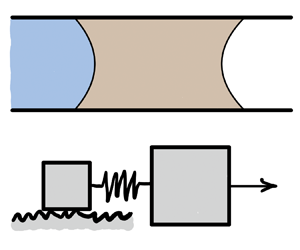
Motion of a viscous slug on heterogeneous surfaces: crossover from stick–slip to steady sliding
-
- Journal:
- Journal of Fluid Mechanics / Volume 973 / 25 October 2023
- Published online by Cambridge University Press:
- 10 October 2023, A2
-
- Article
- Export citation
