Refine search
Actions for selected content:
213092 results in Engineering
Annotation-free learning of a spatio-temporal manifold of the cell life cycle
-
- Journal:
- Biological Imaging / Volume 3 / 2023
- Published online by Cambridge University Press:
- 06 October 2023, e19
-
- Article
-
- You have access
- Open access
- HTML
- Export citation
Notes on Contributors
-
- Book:
- Gendering Green Criminology
- Published by:
- Bristol University Press
- Published online:
- 28 March 2024
- Print publication:
- 06 October 2023, pp vi-xi
-
- Chapter
- Export citation
2 - Eco-Feminism and the Gendering Green Criminology Project
-
-
- Book:
- Gendering Green Criminology
- Published by:
- Bristol University Press
- Published online:
- 28 March 2024
- Print publication:
- 06 October 2023, pp 17-33
-
- Chapter
- Export citation
PART I - Gendered Nature of Green Crimes and Environmental Harm
-
- Book:
- Gendering Green Criminology
- Published by:
- Bristol University Press
- Published online:
- 28 March 2024
- Print publication:
- 06 October 2023, pp 15-16
-
- Chapter
- Export citation
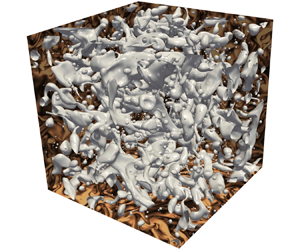
Intermittency in turbulent emulsions
-
- Journal:
- Journal of Fluid Mechanics / Volume 972 / 10 October 2023
- Published online by Cambridge University Press:
- 06 October 2023, A37
-
- Article
- Export citation

Sliding and merging of strongly sheared droplets
-
- Journal:
- Journal of Fluid Mechanics / Volume 972 / 10 October 2023
- Published online by Cambridge University Press:
- 06 October 2023, A40
-
- Article
- Export citation
PART III - Resistance
-
- Book:
- Gendering Green Criminology
- Published by:
- Bristol University Press
- Published online:
- 28 March 2024
- Print publication:
- 06 October 2023, pp 227-228
-
- Chapter
- Export citation

Computational Grains
- Micromechanical Genome for Heterogeneous Materials
-
- Published online:
- 05 October 2023
- Print publication:
- 19 October 2023

Multiphase Flow with Solid Particles
-
- Published online:
- 05 October 2023
- Print publication:
- 19 October 2023
Optimization of a wideband antipodal Vivaldi antenna with metalenses
-
- Journal:
- International Journal of Microwave and Wireless Technologies / Volume 16 / Issue 1 / February 2024
- Published online by Cambridge University Press:
- 05 October 2023, pp. 41-48
-
- Article
- Export citation
-
A wideband antipodal Vivaldi antenna has been designed and optimized. A slight improvement is obtained by employing multiple metalense based on circular split-ring resonators to maximize the antenna gain with the maximum bandwidth. The designed antennas have been fabricated and characterized, showing good agreement with simulations. The maximum measured gain is $G = 12\;{\textrm{dB}}$, and the −10 dB bandwidth is from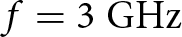 $f = 3\;{\textrm{GHz}}$ to $f = 13\;{\textrm{GHz}}$.
A compact bent microstrip-based wideband millimeter wave MIMO antenna for 5G applications
-
- Journal:
- International Journal of Microwave and Wireless Technologies / Volume 16 / Issue 3 / April 2024
- Published online by Cambridge University Press:
- 05 October 2023, pp. 424-439
-
- Article
- Export citation
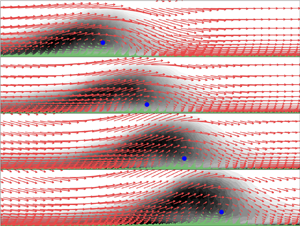
Characterisation of unsteady separation in a turbulent boundary layer: Reynolds stresses and flow dynamics
-
- Journal:
- Journal of Fluid Mechanics / Volume 972 / 10 October 2023
- Published online by Cambridge University Press:
- 05 October 2023, A36
-
- Article
-
- You have access
- Open access
- HTML
- Export citation
-
The large-eddy simulation technique was used to investigate the dynamics of unsteady flow separation on a flat-plate turbulent boundary layer. The unsteadiness was generated by imposing an oscillating, wall-normal velocity profile at the top of the computational domain, and a range of reduced frequencies ( $k$), from a very rapid flutter-like motion to a slow quasi-steady oscillation, was studied. Ambrogi et al. (J. Fluid Mech., vol. 945, 2022, A10) showed that the reduced frequency greatly affects the transient separation process, and at a frequency $k=1$, the separation region became unstable and was advected periodically out of the domain. In this paper, we discuss the causes of the observed advection process and the effects of the unsteadiness on the second moments. The time evolution of turbulent kinetic energy, for instance, reveals that an advection-like phenomenon is also present at a very low reduced frequency, but its dynamic behaviour is completely different from that of the intermediate frequency ( $k=1$). At the intermediate frequency the entire recirculation region is advected downstream, keeping its shape. The advected structure is rotational in nature, and moves at constant speed. In contrast, in the low-frequency case the advected fluid originates at the reattachment point, and the structure is shear-dominated. Particle pathlines reflect the fact that the flow at the low frequency is quasi-steady-state, but show peculiar differences at the intermediate frequency, in which the flow response to the freestream forcing depends on the particle positions in the wall-normal direction.


Analysis of high-speed drop impact onto deep liquid pool
-
- Journal:
- Journal of Fluid Mechanics / Volume 972 / 10 October 2023
- Published online by Cambridge University Press:
- 04 October 2023, A31
-
- Article
-
- You have access
- Open access
- HTML
- Export citation
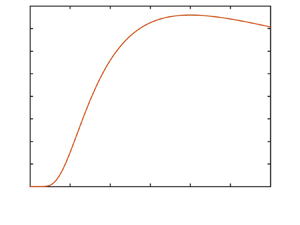
Spontaneous autophoretic motion of isotropic disks
-
- Journal:
- Journal of Fluid Mechanics / Volume 972 / 10 October 2023
- Published online by Cambridge University Press:
- 04 October 2023, R3
-
- Article
-
- You have access
- Open access
- HTML
- Export citation
-
It is theoretically known that an isotropic chemically active particle in an unbounded solution undergoes symmetry breaking when the intrinsic Péclet number ${{Pe}}$ exceeds a finite critical value (Michelin et al., Phys. Fluids, vol. 25, 2013, 061701). At that value, a transition takes place from a stationary state to spontaneous motion. In two dimensions, where no stationary state is possible in an unbounded domain, a linear stability analysis in a large bounded domain (Hu et al., Phys. Rev. Lett., vol. 123, 2019, 238004) reveals that the critical ${{Pe}}$ value slowly diminishes as the domain size increases. Motivated by these findings, we here consider an unbounded domain from the outset, addressing the two-dimensional problem of steady self-propulsion with a focus on the limit ${{Pe}}\ll 1$. This singular limit is handled using matched asymptotic expansions, conceptually decomposing the fluid domain into a particle-scale region, where the leading-order solute transport is diffusive, and a remote region, where diffusion and advection are comparable. The expansion parameter is provided by the product of ${{Pe}}$ and $U$, the unknown particle speed (normalised by the standard autophoretic scale). The problem is unconventional in that the scaling of $U$ with ${{Pe}}$ must be determined in the course of the perturbation analysis. The resulting approximation, $U=4\exp ({-2/{Pe}-\gamma _{E}-1})/{{Pe}}$ ( $\gamma _{E}$ being the Euler–Mascheroni constant), is in remarkable agreement with the numerical predictions of Hu et al. in the common interval of validity.


Reduced-order models of aeroacoustic sources for sound radiated in twin subsonic jets
-
- Journal:
- Journal of Fluid Mechanics / Volume 972 / 10 October 2023
- Published online by Cambridge University Press:
- 04 October 2023, A33
-
- Article
-
- You have access
- Open access
- HTML
- Export citation
-
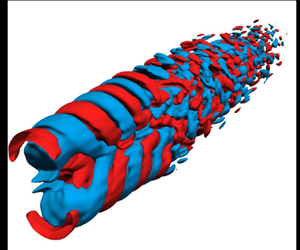
We construct reduced-order models of aeroacoustic sources for single and twin subsonic jets ( $M_j=0.9$, $Re=3600$), with the goal of accurately recovering the far-field sound over a wide band of frequencies $St=[0.07,1.0]$ and directivity angles $\phi = [30^{\circ },120^{\circ }]$ within a subdecibel level accuracy. These models are realized via combining spatio-temporally coherent spectral proper orthogonal decomposition (SPOD) modes extracted directly from Lighthill's stress tensor, itself calculated using large-eddy simulation (LES). We consider two sets of twin subsonic jets of diameter $D$ each, with spacings of $0.1D$ and $1D$, where the jets merge upstream and downstream of breakdown, respectively. The closely spaced twin jet decays the slowest due to reduced turbulent stresses which are, however, more broadband due to early merging. Such jets show strong shielding in the plane of jets, especially at shallow directivity angles where sound levels may drop below that of the single jet. The farther spaced twin jets have dynamics more akin to the constituent single jet with turbulent fluctuations peaking here at $St=0.34$, but showing very little shielding, with their overall sound pressure level (OASPL) mostly linked to the nature of extra flow structures created during merging. Three-dimensional, energy-ranked, coherent structures for twin jets exhibit rather poor low-rank behaviour, especially at the far-field spectral peak $St=0.14$. At $St \gtrsim 0.3$, the SPOD wavepackets show strong visual coherence, resembling Kelvin–Helmholtz instability modes upstream of breakdown, while at the lower frequencies, there is very little spatial coherence with wavepackets peaking downstream of breakdown. Although the leading SPOD modes radiate poorly, reduced-order models using a subset of them, up to $45$ SPOD modes per frequency, show a remarkable match (within $1$ dB) against the LES-predicted sound over $0.1 \lesssim St \lesssim 0.5$, at all angles investigated. At other frequencies, the closely spaced twin jet shows more error, due to its greater hierarchy of spatio-temporal structures, showing slower convergence at the shallower angles.


On the structure of parasitic gravity-capillary standing waves in the small surface tension limit
-
- Journal:
- Journal of Fluid Mechanics / Volume 972 / 10 October 2023
- Published online by Cambridge University Press:
- 04 October 2023, R6
-
- Article
-
- You have access
- Open access
- HTML
- Export citation
Compressibility effects in supersonic and hypersonic turbulent boundary layers subject to wall disturbances
-
- Journal:
- Journal of Fluid Mechanics / Volume 972 / 10 October 2023
- Published online by Cambridge University Press:
- 04 October 2023, A32
-
- Article
- Export citation
-
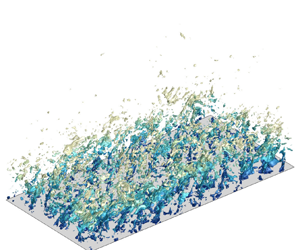
In the present study, we investigate the compressibility effects in supersonic and hypersonic turbulent boundary layers under the influence of wall disturbances by exploiting direct numerical simulation databases at Mach numbers up to 6. Such wall disturbances enforce extra Reynolds shear stress on the wall and induce mean streamline curvature in rough wall turbulence that leads to the intensification of turbulent motions in the outer region. The turbulent and fluctuating Mach numbers, the density and the velocity divergence fluctuation intensities suggest that the compressibility effects are enhanced by the increment of the free-stream Mach number and the implementation of the wall disturbances. The differences between the Reynolds and Favre average due to the density fluctuations constitute approximately $9\,\%$ of the mean velocity close to the wall and $30\,\%$ of the Reynolds stress near the edge of the boundary layer, indicating their non-negligibility in turbulent modelling strategies. The comparatively strong compressive events behaving as eddy shocklets are observed at the free-stream Mach number of $6$ only in the cases with wall disturbances. By further splitting the velocity into the solenoidal and dilatational components with the Helmholtz decomposition, we found that the dilatational motions are organized as travelling wave packets in the wall-parallel planes close to the wall and as forward inclined structures in the form of radiated waves in the vertical planes. Despite their increased magnitudes and higher portion in the Reynolds normal and shear stresses, the dilatational motions show no tendency of contributing significantly to the skin friction and the production of turbulent kinetic energy due to their mitigation by the cross-correlation between the solenoidal and dilatational velocity components.


Lift generation mechanism of the leading-edge vortex for an unsteady plate
-
- Journal:
- Journal of Fluid Mechanics / Volume 972 / 10 October 2023
- Published online by Cambridge University Press:
- 04 October 2023, A30
-
- Article
- Export citation
Modelling and scaling laws of the ion emission regime in Taylor cones
-
- Journal:
- Journal of Fluid Mechanics / Volume 972 / 10 October 2023
- Published online by Cambridge University Press:
- 04 October 2023, A34
-
- Article
-
- You have access
- Open access
- HTML
- Export citation
Apparent singularities of the finite-depth Zakharov equation
-
- Journal:
- Journal of Fluid Mechanics / Volume 972 / 10 October 2023
- Published online by Cambridge University Press:
- 04 October 2023, A35
-
- Article
-
- You have access
- Open access
- HTML
- Export citation
-
The description of weakly nonlinear water-wave evolution over a horizontal bottom by the integro-differential Zakharov equation, because of utilising the underlying Hamiltonian structure, has many advantages over direct use of the Euler equations. However, its application to finite-depth situations is not straightforward since, in contrast to the deep-water case, the kernels governing the four-wave interactions are singular, as well as the kernels in the canonical transformation that removes non-resonant interactions from the original equations of motion. At the singularities, these kernels are finite but not unique. The issue of how to use the Zakharov equation for finite depth and whether it is possible at all was debated intensely in the literature for decades but remains outstanding. Here we show that the absence of a limit of the kernels at the singularities is inconsequential, since in the equations of motion it is only the integral that matters. By applying the definition of the Dirac- $\delta$, we show that all the integrals involving a trivial manifold singularity are evaluated uniquely. Therefore, the Zakharov evolution equation and the nonlinear canonical transformation are only apparently singular. The findings are validated by application to examples where predictions based on the Zakharov equation are compared with known solutions obtained from the Euler equations.

