Refine search
Actions for selected content:
213092 results in Engineering

Large eddy simulations of bubbly flows and breaking waves with smoothed particle hydrodynamics
-
- Journal:
- Journal of Fluid Mechanics / Volume 972 / 10 October 2023
- Published online by Cambridge University Press:
- 03 October 2023, A24
-
- Article
-
- You have access
- Open access
- HTML
- Export citation
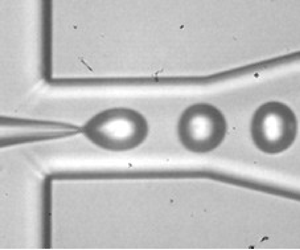
Microbubble formation by flow focusing: role of gas and liquid properties, and channel geometry
-
- Journal:
- Journal of Fluid Mechanics / Volume 972 / 10 October 2023
- Published online by Cambridge University Press:
- 03 October 2023, A27
-
- Article
-
- You have access
- Open access
- HTML
- Export citation
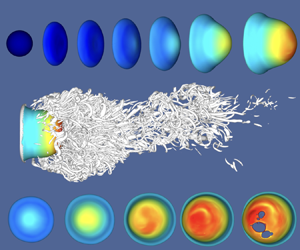
Detailed numerical investigation of the drop aerobreakup in the bag breakup regime
-
- Journal:
- Journal of Fluid Mechanics / Volume 972 / 10 October 2023
- Published online by Cambridge University Press:
- 03 October 2023, A28
-
- Article
- Export citation
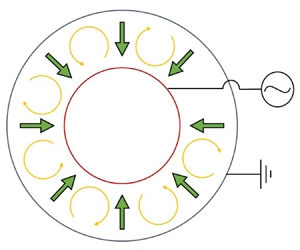
Thermo-electric convection in a cylindrical annulus during a sounding rocket flight
-
- Journal:
- Journal of Fluid Mechanics / Volume 972 / 10 October 2023
- Published online by Cambridge University Press:
- 03 October 2023, A26
-
- Article
-
- You have access
- Open access
- HTML
- Export citation
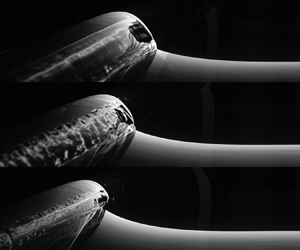
The effects of surfactants on plunging breakers
-
- Journal:
- Journal of Fluid Mechanics / Volume 972 / 10 October 2023
- Published online by Cambridge University Press:
- 03 October 2023, R5
-
- Article
-
- You have access
- Open access
- HTML
- Export citation
-
The effects of surfactants on a mechanically generated plunging breaker are studied experimentally in a laboratory wave tank. Waves are generated using a dispersively focused wave packet with a characteristic wavelength of $\lambda _0 = 1.18$ m. Experiments are performed with two sets of surfactant solutions. In the first set, increasing amounts of the soluble surfactant Triton X-100 are mixed into the tank water, while in the second set filtered tap water is left undisturbed in the tank for wait times ranging from 15 min to 21 h. Increasing Triton X-100 concentrations and longer wait times lead to surfactant-induced changes in the dynamic properties of the free surface in the tank. It is found that low surface concentrations of surfactants can dramatically change the wave breaking process by changing the shape of the jet and breaking up the entrained air cavity at the time of jet impact. Direct numerical simulations (DNS) of plunging breakers with constant surface tension are used to show that there is significant compression of the free surface near the plunging jet tip and dilatation elsewhere. To explore the effect of this compression/dilatation, the surface tension isotherm is measured in all experimental cases. The effects of surfactants on the plunging jet are shown to be primarily controlled by the surface tension gradient ( $\Delta \mathcal {E}$) while the ambient surface tension of the undisturbed wave tank ( $\sigma _0$) plays a secondary role.


Compressible turbulent convection in highly stratified adiabatic background
-
- Journal:
- Journal of Fluid Mechanics / Volume 972 / 10 October 2023
- Published online by Cambridge University Press:
- 03 October 2023, R4
-
- Article
-
- You have access
- Open access
- HTML
- Export citation
-
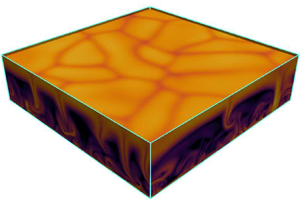
Buoyancy-driven turbulent convection leads to a fully compressible flow with a prominent top-down asymmetry of first- and second-order statistics when the adiabatic equilibrium profiles of temperature, density and pressure change very strongly across the convection layer. The growth of this asymmetry and the formation of an increasingly thicker stabilized sublayer with a slightly negative mean convective heat flux $J_c(z)$ at the top of the convection zone is reported here by a series of highly resolved three-dimensional direct numerical simulations beyond the Oberbeck–Boussinesq and anelastic limits for dimensionless dissipation numbers, $0.1 \le D\le 0.8$, at fixed Rayleigh number $Ra=10^6$ and superadiabaticity $\epsilon =0.1$. The highly stratified compressible convection regime appears for $D > D_{crit}\approx 0.65$, when density fluctuations collapse to those of pressure; it is characterized by an up to nearly 50 % reduced global turbulent heat transfer and a sparse network of focused thin and sheet-like thermal plumes falling through the top sublayer deep into the bulk.


New method based on genetic algorithm and Minkowski fractal for multiband antenna designs
-
- Journal:
- International Journal of Microwave and Wireless Technologies / Volume 16 / Issue 3 / April 2024
- Published online by Cambridge University Press:
- 03 October 2023, pp. 466-477
-
- Article
- Export citation
-
In this paper, a new method based on a genetic algorithm and Minkowski Island fractal is proposed for multiband antennas. Three-antenna configurations are chosen to validate the proposed optimization procedure. The first configuration is a wide-band antenna, operating in the WLAN (wireless local area network) UNII-2C band. The second configuration is a dual-band antenna, operating in the WLAN UNII-2 and UNII-2C bands. In contrast, the third is a tri-band antenna operating in the UNII-2, UNII-2C, and UNII-3 bands. The optimization process is accelerated by using the Computer Simulation Technology (CST) Application Programming Interface which allows all genetic operators to be performed in MATLAB while the numerical calculations are running in the internal CST Finite-Difference Time-Domain -solver using parallel computing with GPU acceleration. All three designed configurations are manufactured using a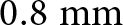 $\textstyle0.8\;\text{mm}$ thick FR4 epoxy substrate with a relative dielectric constant of $4.8$. The return loss and the radiation pattern’s measurements agree well with the simulation results. Further, the methodology presented can be very effective in terms of size reduction; the designed antennas are $24 \times 24 \times 0.8\;{\textrm{m}}{{\textrm{m}}^3}$ (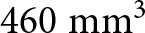 $460\;{\textrm{m}}{{\textrm{m}}^3}$).

Three-dimensional buoyant hydraulic fractures: finite-volume release
-
- Journal:
- Journal of Fluid Mechanics / Volume 972 / 10 October 2023
- Published online by Cambridge University Press:
- 02 October 2023, A20
-
- Article
-
- You have access
- Open access
- HTML
- Export citation
An interview with Gérard Mourou
- Part of
-
- Journal:
- High Power Laser Science and Engineering / Volume 11 / 2023
- Published online by Cambridge University Press:
- 02 October 2023, e74
-
- Article
-
- You have access
- Open access
- HTML
- Export citation
From sheared annular centrifugal Rayleigh–Bénard convection to radially heated Taylor–Couette flow: exploring the impact of buoyancy and shear on heat transfer and flow structure
-
- Journal:
- Journal of Fluid Mechanics / Volume 972 / 10 October 2023
- Published online by Cambridge University Press:
- 02 October 2023, A29
-
- Article
-
- You have access
- Open access
- HTML
- Export citation
-
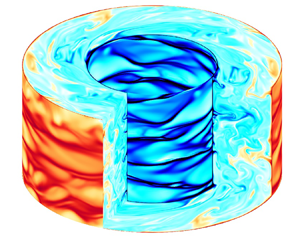
We investigate the coupling effect of buoyancy and shear based on an annular centrifugal Rayleigh–Bénard convection (ACRBC) system in which two cylinders rotate with an angular velocity difference. Direct numerical simulations are performed in a Rayleigh number range $10^6\leq Ra\leq 10^8$, at fixed Prandtl number $Pr=4.3$, inverse Rossby number $Ro^{-1}=20$, and radius ratio $\eta =0.5$. The shear, represented by the non-dimensional rotational speed difference $\varOmega$, varies from $0$ to $10$, corresponding to an ACRBC without shear and a radially heated Taylor–Couette flow with only the inner cylinder rotating, respectively. A stable regime is found in the middle part of the interval for $\varOmega$, and divides the whole parameter space into three regimes: buoyancy-dominated, stable and shear-dominated. Clear boundaries between the regimes are given by linear stability analysis, meaning the marginal state of the flow. In the buoyancy-dominated regime, the flow is a quasi-two-dimensional flow on the $r\varphi$ plane; as shear increases, both the growth rate of instability and the heat transfer are depressed. In the shear-dominated regime, the flow is mainly on the $rz$ plane. The shear is so strong that the temperature acts as a passive scalar, and the heat transfer is greatly enhanced. The study shows that shear can stabilize buoyancy-driven convection, makes a detailed analysis of the flow characteristics in different regimes, and reveals the complex coupling mechanism of shear and buoyancy, which may have implications for fundamental studies and industrial designs.


Effect of thermodynamic instability on viscous fingering of binary mixtures in a Hele-Shaw cell
-
- Journal:
- Journal of Fluid Mechanics / Volume 972 / 10 October 2023
- Published online by Cambridge University Press:
- 02 October 2023, A23
-
- Article
- Export citation
An accurate method for identifying hub dynamic loads by condition number of measured FRF matrix on helicopter fuselage
-
- Journal:
- The Aeronautical Journal / Volume 128 / Issue 1323 / May 2024
- Published online by Cambridge University Press:
- 02 October 2023, pp. 994-1010
-
- Article
- Export citation
Numerical simulation of the pressure characteristics of the pulsed jet actuator
-
- Journal:
- The Aeronautical Journal / Volume 128 / Issue 1323 / May 2024
- Published online by Cambridge University Press:
- 02 October 2023, pp. 896-910
-
- Article
- Export citation
-
A compressible large eddy simulation (LES) is performed to study a pulsed jet actuator that is used to control a turbulent axisymmetric bluff body wake. The actuator is driven at low-frequency ( $f = 200$Hz, $S{t_\theta } = 0.029$) and high amplitude ( ${C_\mu } = 0.034$). The numerical scheme and a suitable boundary condition for the pulsed jet are validated, showing good agreement with experimental results. A comparison of the velocity boundary condition and the moving boundary condition shows that, in the vicinity of the orifice/slot and in the downstream region, the results from these two methods are identical, while the fluid behaviour inside the cavity shows difference. An analysis of the pulsed jet actuator shows that the phase lag of the cavity pressure is determined by the integration of the diaphragm motion and the pulsed jet. The mean total pressure distribution shows that the total pressure loss is concentrated in the vicinity of the slot. Dynamic mode decomposition (DMD) on the pressure field is used to extract coherent structures which oscillate with the same frequency as that of the diaphragm motion. Some small-scale high-frequency structures are also apparent.


Ineffective diffusivity
-
- Journal:
- Journal of Fluid Mechanics / Volume 972 / 10 October 2023
- Published online by Cambridge University Press:
- 02 October 2023, F1
-
- Article
-
- You have access
- HTML
- Export citation
FLM volume 971 Cover and Front matter
-
- Journal:
- Journal of Fluid Mechanics / Volume 971 / 25 September 2023
- Published online by Cambridge University Press:
- 02 October 2023, p. f1
-
- Article
-
- You have access
- Export citation

Hydrodynamic permeability of circular-inclusion-doped Brinkman media
-
- Journal:
- Journal of Fluid Mechanics / Volume 972 / 10 October 2023
- Published online by Cambridge University Press:
- 02 October 2023, A25
-
- Article
-
- You have access
- Open access
- HTML
- Export citation
-
Theory and computations are applied to assess the hydrodynamic permeability of cavity- doped hydrogels, central to a variety range of contemporary technological applications. Direct volume-averaging is undertaken in a two-dimensional, Brinkman-hydrodynamic context to test an ensemble-averaging methodology recently proposed for the ion permeability of such media. In two dimensions, the ensemble-averaging integral furnishes a pre-factor $2$ linking the pressure dipole strength of a single inclusion in an unbounded continuum to the effective hydrodynamic permeability of a composite with small inclusion area fraction. The factor is verified by direct computations for dilute simple-square arrays of (cylindrical) inclusions. At area fractions up to the close-packing limit, computations address the hydrodynamic interactions. The theory is shown to accurately predict the effective hydrodynamic permeability of physically relevant composites (Brinkman length of the continuous phase $\ell$ smaller than the inclusion radius $a$) for area fractions $\phi \lesssim {\rm \pi}/ 9 \approx 0.3$. Computations for random ensembles demonstrate that the dilute theory may be extended to higher area fractions by drawing on Rayleigh's self-consistent approximation when the continuous-phase permeability places the continuous-phase flow well into the Darcy regime ( $a / \ell \gtrsim 10$). Computations also demonstrate, similarly to Rayleigh theories for scalar diffusion, that microstructural order has a very weak influence on the effective permeability when $\phi \lesssim {\rm \pi}/ 9$ with $\ell / a \lesssim 1$ (Darcy hydrodynamic interactions). Finally, a cursory examination is undertaken of the fluid velocity and its fluctuations arising from shear-viscosity heterogeneity in media with perfectly uniform permeability $\ell ^2$.


Robustness of energy landscape control to dephasing
-
- Journal:
- Research Directions: Quantum Technologies / Volume 1 / 2023
- Published online by Cambridge University Press:
- 02 October 2023, e13
-
- Article
-
- You have access
- Open access
- HTML
- Export citation
A new control scheme for an aerodynamic-surface-free tilt-rotor convertible UAV
-
- Journal:
- The Aeronautical Journal / Volume 128 / Issue 1324 / June 2024
- Published online by Cambridge University Press:
- 02 October 2023, pp. 1119-1144
-
- Article
- Export citation
E-band backhaul antenna for fine beam alignment
-
- Journal:
- International Journal of Microwave and Wireless Technologies / Volume 16 / Issue 1 / February 2024
- Published online by Cambridge University Press:
- 29 September 2023, pp. 30-40
-
- Article
- Export citation
Flow dynamics in sinusoidal channels at moderate Reynolds numbers
-
- Journal:
- Journal of Fluid Mechanics / Volume 972 / 10 October 2023
- Published online by Cambridge University Press:
- 29 September 2023, A22
-
- Article
-
- You have access
- Open access
- HTML
- Export citation
