Refine search
Actions for selected content:
213092 results in Engineering

A length scale for non-local multi-scale gradient interactions in isotropic turbulence
-
- Journal:
- Journal of Fluid Mechanics / Volume 971 / 25 September 2023
- Published online by Cambridge University Press:
- 22 September 2023, A40
-
- Article
-
- You have access
- Open access
- HTML
- Export citation
A systematic investigation into the effect of roughness on self-propelled swimming plates
-
- Journal:
- Journal of Fluid Mechanics / Volume 971 / 25 September 2023
- Published online by Cambridge University Press:
- 22 September 2023, A39
-
- Article
-
- You have access
- Open access
- HTML
- Export citation
-
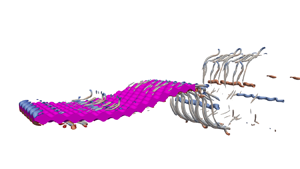
This study examines the effects of surface topography on the flow and performance of a self-propelled swimming (SPS) body. We consider a thin flat plate with an egg-carton roughness texture undergoing prescribed undulatory swimming kinematics at Strouhal number $0.3$ and tail amplitude to length ratio $0.1$; we use plate Reynolds numbers $Re=6$, 12 and $24\times 10^3$, and focus on $12\,000$. As the roughness wavelength is decreased, we find that the undulation wave speed must be increased to overcome the additional drag from the roughness and maintain SPS. Correspondingly, the extra wave speed raises the power required to maintain SPS, making the swimmer less efficient. To decouple the roughness and the kinematics, we compare the rough plates to equivalent smooth cases by matching the kinematic conditions. We find that all but the longest roughness wavelengths reduce the required swimming power and the unsteady amplitude of the forces when compared to a smooth plate undergoing identical kinematics. Additionally, roughness can enhance flow enstrophy by up to 116 % compared to the smooth cases without a corresponding spike in forces; this suggests that the increased mixing is not due to increased vorticity production at the wall. Instead, the enstrophy is found to peak strongly when the roughness wavelength is approximately twice the boundary layer thickness over the $Re$ range, indicating the roughness induces large-scale secondary flow structures that extend to the edge of the boundary layer. This study reveals the nonlinear interaction between roughness and kinematics beyond a simple increase or decrease in drag, illustrating that roughness studies on static shapes do not transfer directly to unsteady swimmers.


Numerical investigation of the dynamic stall reduction on the UAS-S45 aerofoil using the optimised aerofoil method
-
- Journal:
- The Aeronautical Journal / Volume 128 / Issue 1321 / March 2024
- Published online by Cambridge University Press:
- 22 September 2023, pp. 441-468
-
- Article
-
- You have access
- Open access
- HTML
- Export citation
-
This paper investigates the effect of the optimised morphing leading edge (MLE) and the morphing trailing edge (MTE) on dynamic stall vortices (DSV) for a pitching aerofoil through numerical simulations. In the first stage of the methodology, the optimisation of the UAS-S45 aerofoil was performed using a morphing optimisation framework. The mathematical model used Bezier-Parsec parametrisation, and the particle swarm optimisation algorithm was coupled with a pattern search with the aim of designing an aerodynamically efficient UAS-45 aerofoil. The $\gamma - R{e_\theta }$ transition turbulence model was firstly applied to predict the laminar to turbulent flow transition. The morphing aerofoil increased the overall aerodynamic performances while delaying boundary layer separation. Secondly, the unsteady analysis of the UAS-S45 aerofoil and its morphing configurations was carried out and the unsteady flow field and aerodynamic forces were analysed at the Reynolds number of 2.4 × 10⁶ and five different reduced frequencies of k = 0.05, 0.08, 1.2, 1.6 and 2.0. The lift ( ${C_L})$, drag ( ${C_D})$ and moment ( ${C_M})\;$coefficients variations with the angle-of-attack of the reference and morphing aerofoils were compared. It was found that a higher reduced frequencies of 1.2 to 2 stabilised the leading-edge vortex that provided its lift variation in the dynamic stall phase. The maximum lift $\left( {{C_{L,max}}} \right)$ and drag $\left( {{C_{D,max}}} \right)\;$coefficients and the stall angles of attack are evaluated for all studied reduced frequencies. The numerical results have shown that the new radius of curvature of the MLE aerofoil can minimise the streamwise adverse pressure gradient and prevent significant flow separation and suppress the formation of the DSV. Furthermore, it was shown that the morphing aerofoil delayed the stall angle-of-attack by 14.26% with respect to the reference aerofoil, and that the ${C_{L,max}}\;$of the aerofoil increased from 2.49 to 3.04. However, while the MTE aerofoil was found to increase the overall lift coefficient and the ${C_{L,max}}$, it did not control the dynamic stall. Vorticity behaviour during DSV generation and detachment has shown that the MTE can change the vortices’ evolution and increase vorticity flux from the leading-edge shear layer, thus increasing DSV circulation. The conclusion that can be drawn from this study is that the fixed drooped morphing leading edge aerofoils have the potential to control the dynamic stall. These findings contribute to a better understanding of the flow analysis of morphing aerofoils in an unsteady flow.


Finite Froude and Rossby numbers counter-rotating vortex pairs
-
- Journal:
- Journal of Fluid Mechanics / Volume 971 / 25 September 2023
- Published online by Cambridge University Press:
- 22 September 2023, A41
-
- Article
-
- You have access
- Open access
- HTML
- Export citation

Instability of the optimal edge trajectory in the Blasius boundary layer
-
- Journal:
- Journal of Fluid Mechanics / Volume 971 / 25 September 2023
- Published online by Cambridge University Press:
- 22 September 2023, A42
-
- Article
-
- You have access
- Open access
- HTML
- Export citation

Tomographic PIV investigation on near-wake structures of a hemisphere immersed in a laminar boundary layer
-
- Journal:
- Journal of Fluid Mechanics / Volume 971 / 25 September 2023
- Published online by Cambridge University Press:
- 22 September 2023, A36
-
- Article
- Export citation
-
The near wake of a hemisphere immersed in a laminar boundary layer is studied utilizing time-resolved tomographic particle image velocimetry (TPIV). Focus is placed on the three-dimensional vortical structures and the formation details of hairpin vortices before the onset of transition. The three-dimensional instantaneous pressure field of the hemisphere wake is reconstructed for better understanding the flow mechanism. Experiments are carried out with Reynolds number $Re_{r}=1370$, based on the hemisphere radius $R$. Features of periodicity of the near wake are analysed using proper orthogonal decomposition and Fourier transformation. The velocity fluctuation in the wall-normal direction is shown to be crucial to the formation of hairpin vortices in the near wake. By investigating the transport of mass and vorticity, and the correlation between pressure and hairpin vortex strength, the formation mechanism is revealed clearly. Specifically, the main hairpin vortices (MHVs) are formed within the reaction of outer high-speed flow and near-wall flow. The formation of the head portion is followed by the leg portion formation. The shedding of the MHVs is highly correlated with the pressure, as well as the pressure gradient in the wall-normal direction. For the side hairpin vortices (SHVs), the leg portion is formed first, followed by the generation of the head portion thanks to induction of the re-oriented standing vortices. The generation of the SHVs can be regarded as the downstream bridging of the standing vortices, similar to the generation of hairpin vortices due to the connection of streamwise vortices in turbulent boundary layers.


Part II - States and Organizations Driving Trends
-
- Book:
- Trending Islam
- Published by:
- ISEAS–Yusof Ishak Institute
- Published online:
- 26 March 2024
- Print publication:
- 21 September 2023, pp 63-64
-
- Chapter
- Export citation
Part II - Eigensystem
-
- Book:
- Graph Spectra for Complex Networks
- Published online:
- 07 September 2023
- Print publication:
- 21 September 2023, pp 305-306
-
- Chapter
- Export citation
Part I - Spectra of graphs
-
- Book:
- Graph Spectra for Complex Networks
- Published online:
- 07 September 2023
- Print publication:
- 21 September 2023, pp 13-14
-
- Chapter
- Export citation
9 - YouTube Islamic Web Series and the Mediatized Piety among Urban Muslims in Indonesia
-
-
- Book:
- Trending Islam
- Published by:
- ISEAS–Yusof Ishak Institute
- Published online:
- 26 March 2024
- Print publication:
- 21 September 2023, pp 183-197
-
- Chapter
- Export citation
Coalescence of immiscible sessile droplets on a partial wetting surface
-
- Journal:
- Journal of Fluid Mechanics / Volume 971 / 25 September 2023
- Published online by Cambridge University Press:
- 21 September 2023, A34
-
- Article
- Export citation
7 - Density function of the eigenvalues
- from Part I - Spectra of graphs
-
- Book:
- Graph Spectra for Complex Networks
- Published online:
- 07 September 2023
- Print publication:
- 21 September 2023, pp 247-270
-
- Chapter
- Export citation
About the Contributors
-
- Book:
- Trending Islam
- Published by:
- ISEAS–Yusof Ishak Institute
- Published online:
- 26 March 2024
- Print publication:
- 21 September 2023, pp xviii-xix
-
- Chapter
- Export citation
3 - The Salafi-Jihadi Identity and Malaysia’s Battle with Islamist Extremism
-
-
- Book:
- Trending Islam
- Published by:
- ISEAS–Yusof Ishak Institute
- Published online:
- 26 March 2024
- Print publication:
- 21 September 2023, pp 34-62
-
- Chapter
- Export citation
Part III - Influencers Driving Trends
-
- Book:
- Trending Islam
- Published by:
- ISEAS–Yusof Ishak Institute
- Published online:
- 26 March 2024
- Print publication:
- 21 September 2023, pp 153-154
-
- Chapter
- Export citation
Symbols
-
- Book:
- Graph Spectra for Complex Networks
- Published online:
- 07 September 2023
- Print publication:
- 21 September 2023, pp xvii-xx
-
- Chapter
- Export citation
Pattern formation in photo-controlled bioconvection
-
- Journal:
- Journal of Fluid Mechanics / Volume 971 / 25 September 2023
- Published online by Cambridge University Press:
- 21 September 2023, A29
-
- Article
- Export citation
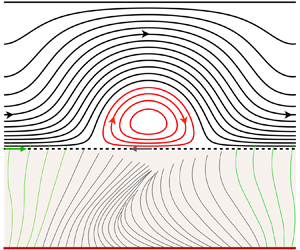
On the role of viscoelasticity in mucociliary clearance: a hydrodynamic continuum approach
-
- Journal:
- Journal of Fluid Mechanics / Volume 971 / 25 September 2023
- Published online by Cambridge University Press:
- 21 September 2023, A33
-
- Article
- Export citation
Mode selection in concentric jets: the steady–steady 1 : 2 resonant mode interaction with O(2) symmetry
-
- Journal:
- Journal of Fluid Mechanics / Volume 971 / 25 September 2023
- Published online by Cambridge University Press:
- 21 September 2023, A30
-
- Article
-
- You have access
- Open access
- HTML
- Export citation
-
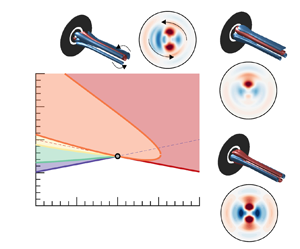
The linear and nonlinear stability of two concentric jets separated by a duct wall is analysed by means of global linear stability and weakly nonlinear analysis. Three governing parameters are considered, the Reynolds number based on the inner jet, the inner-to-outer jet velocity ratio ( $\delta _u$) and the length of the duct wall ( $L$) separating the jet streams. Global linear stability analysis demonstrates the existence of unsteady modes of inherent convective nature, and symmetry-breaking modes that lead to a new non-axisymmetric steady state with a single or double helix. Additionally, we highlight the existence of multiple steady states, as a result of a series of saddle-node bifurcations and its connection to the changes in the topology of the flow. The neutral lines of stability have been computed for inner-to-outer velocity ratios within the range $0 < \delta _u < 2$ and duct wall distances in the interval $0.5 < L < 4$. They reveal the existence of hysteresis, and mode switching between two symmetry-breaking modes with azimuthal wavenumbers $1:2$. Finally, the mode interaction is analysed, highlighting the presence of travelling waves emerging from the resonant interaction of the two steady states, and the existence of robust heteroclinic cycles that are asymptotically stable.


1 - Introduction
-
- Book:
- Graph Spectra for Complex Networks
- Published online:
- 07 September 2023
- Print publication:
- 21 September 2023, pp 1-12
-
- Chapter
- Export citation
