Refine search
Actions for selected content:
213073 results in Engineering

Frictional boundary condition for lattice Boltzmann modelling of dense granular flows
-
- Journal:
- Journal of Fluid Mechanics / Volume 973 / 25 October 2023
- Published online by Cambridge University Press:
- 17 October 2023, A21
-
- Article
- Export citation
Series-elastic actuator with two degree-of-freedom PID control improves torque control in a powered knee exoskeleton
-
- Journal:
- Wearable Technologies / Volume 4 / 2023
- Published online by Cambridge University Press:
- 16 October 2023, e25
-
- Article
-
- You have access
- Open access
- HTML
- Export citation
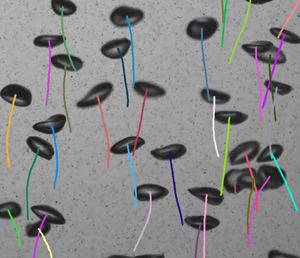
Fate of bubble clusters rising in a quiescent liquid
-
- Journal:
- Journal of Fluid Mechanics / Volume 973 / 25 October 2023
- Published online by Cambridge University Press:
- 16 October 2023, A15
-
- Article
-
- You have access
- Open access
- HTML
- Export citation
-
We use experiments to study the evolution of bubble clusters in a swarm of freely rising, deformable bubbles. A new machine learning-aided algorithm allows us to identify and track bubbles in clusters and measure the cluster lifetimes. The results indicate that contamination in the carrier liquid can enhance the formation of bubble clusters and prolong the cluster lifetimes. The mean bubble rise velocities conditioned on the bubble cluster size are also explored, and we find a positive correlation between the cluster size and the rise speed of the bubbles in the cluster, with clustered bubbles rising up to $20\,\%$ faster than unclustered bubbles.

Living artefacts for regenerative ecologies
-
- Journal:
- Research Directions: Biotechnology Design / Volume 1 / 2023
- Published online by Cambridge University Press:
- 16 October 2023, e16
-
- Article
-
- You have access
- Open access
- HTML
- Export citation
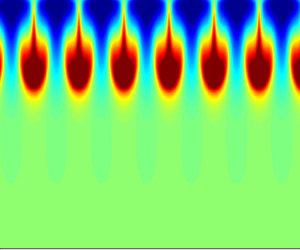
Characteristic scales during the onset of radiatively driven convection: linear analysis and simulations
-
- Journal:
- Journal of Fluid Mechanics / Volume 973 / 25 October 2023
- Published online by Cambridge University Press:
- 16 October 2023, A14
-
- Article
-
- You have access
- Open access
- HTML
- Export citation
-
This paper considers the initial stage of radiatively driven convection, when the perturbations from a quiescent but time-dependent background state are small. Radiation intensity is assumed to decay exponentially away from the surface, and we consider parameter regimes in which the depth of the water is greater than the decay scale of $e$ of the radiation intensity. Both time-independent and time-periodic radiation are considered. In both cases, the background temperature profile of the water column is time-dependent. A linear analysis of the system is performed based on these time-dependent profiles. We find that the perturbations grow in time according to $\exp [(\sigma (t) t)]$, where $\sigma (t)$ is a time-dependent growth rate. An appropriately defined Reynolds number is the primary dimensionless number characterising the system, determining the wavelength, vertical structure and growth rate of the perturbations. Simulations using a Boussinesq model (the Stratified Ocean Model with Adaptive Refinement) confirm the linear analysis.


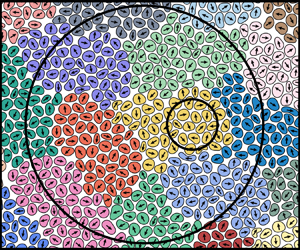
Emergence of long-range correlations and thermal spectra in forced turbulence
-
- Journal:
- Journal of Fluid Mechanics / Volume 973 / 25 October 2023
- Published online by Cambridge University Press:
- 16 October 2023, A13
-
- Article
-
- You have access
- Open access
- HTML
- Export citation
-
Recent numerical studies have shown that forced, statistically isotropic turbulence develops a ‘thermal-equilibrium’ spectrum, $\mathcal {E}(k) \propto k^2$, at large scales. This behaviour presents a puzzle, as it appears to imply the growth of a non-zero Saffman integral, which would require the longitudinal velocity correlation function, $\chi (r)$, to satisfy $\chi (r\to \infty )\propto r^{-3}$. As is well known, the Saffman integral is an invariant of decaying turbulence, precisely because non-local interactions (i.e. interactions via exchange of pressure waves) are too weak to generate such correlations. Subject to certain restrictions on the nature of the forcing, we argue that the same should be true for forced turbulence. We show that long-range correlations and a $k^2$ spectrum arise as a result of the turbulent diffusion of linear momentum, and extend only up to a maximum scale that grows slowly with time. This picture has a number of interesting consequences. First, if the forcing generates eddies with significant linear momentum (as in so-called Saffman turbulence), a thermal spectrum is not reached – instead, a shallower spectrum develops. Secondly, the energy of turbulence that is forced for a while and then allowed to decay obeys Saffman's decay laws for a period that is much longer than the duration of the forcing stage.


Synthesis, powder diffraction pattern, crystal structure determination of the pharmaceutical co-crystal of levetiracetam and 3,5-dinitrosalicylic acid
-
- Journal:
- Powder Diffraction / Volume 38 / Issue 4 / December 2023
- Published online by Cambridge University Press:
- 16 October 2023, pp. 244-252
-
- Article
- Export citation
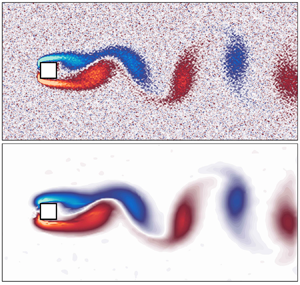
Physics-constrained deep reinforcement learning for flow field denoising
-
- Journal:
- Journal of Fluid Mechanics / Volume 973 / 25 October 2023
- Published online by Cambridge University Press:
- 13 October 2023, A12
-
- Article
-
- You have access
- Open access
- HTML
- Export citation
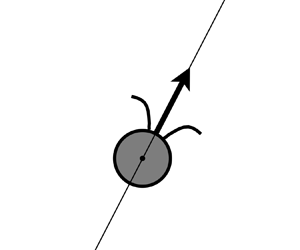
Hydrodynamic force on a small squirmer moving with a time-dependent velocity at small Reynolds numbers
-
- Journal:
- Journal of Fluid Mechanics / Volume 973 / 25 October 2023
- Published online by Cambridge University Press:
- 13 October 2023, A11
-
- Article
- Export citation
Design and analysis of an energy selective rasorber
-
- Journal:
- International Journal of Microwave and Wireless Technologies / Volume 16 / Issue 2 / March 2024
- Published online by Cambridge University Press:
- 13 October 2023, pp. 237-243
-
- Article
- Export citation
A low-profile SIW multi-beam antenna array fed by a compact two-layer 6 × 6 BFN
-
- Journal:
- International Journal of Microwave and Wireless Technologies / Volume 16 / Issue 4 / May 2024
- Published online by Cambridge University Press:
- 13 October 2023, pp. 559-566
-
- Article
- Export citation
Dual UWB bandpass filter with highly band-to-band rejection using stepped impedance stub-loaded resonators for WBAN health-care applications
-
- Journal:
- International Journal of Microwave and Wireless Technologies / Volume 16 / Issue 3 / April 2024
- Published online by Cambridge University Press:
- 13 October 2023, pp. 409-417
-
- Article
-
- You have access
- Open access
- HTML
- Export citation
-
With the rapid development of communication technology, the researches of multi-band filtering circuits have become more and more important. Multimode resonator (MMR) is one of the vital methods to provide multi-resonant modes within a single design. In this paper, a dual-band ultra-wideband bandpass filter (UWB-BPF) using stepped impedance stub-loaded resonators (SI-SLR) is presented. The main advantage of using SI-SLR is to have better performance with multimode behavior and more parameters to control resonant modes. SI-SLR combines the advantages of SIR and SLR structures, which gives a compact, high-performance multiband filter. The proposed filter design has compact size, sharp and flat response with low insertion loss (IL), low return loss (RL), and high band-to-band rejection. The filter is designed for UWB communication in wireless body area networks and fabricated on Arlon substrate with relative permittivity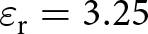 ${\varepsilon_{\textrm{r}}} = 3.25$, thickness $0.8\;{\textrm{mm}}$. The resulted dual-bands are centered at $4{\textrm{ GHz}}$ and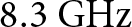 $8.3{\textrm{ GHz}}$ with fractional bandwidths $37{\textrm{% }}$ and $48{\textrm{%}}$. The simulation was carried out using CST Microwave Studio. The filter provides good passband performances, with IL 0.49 dB and 0.31 dB at the center frequency of lower and higher bands, respectively. The band-to-band 40 dB rejection is realized by adding circular spiral at the input/output of the filter.


Theories and Technologies of Hypervelocity Shock Tunnels
-
- Published online:
- 12 October 2023
- Print publication:
- 26 October 2023
Python for Chemists
-
- Published online:
- 12 October 2023
- Print publication:
- 26 October 2023

Virtual Reality
-
- Published online:
- 12 October 2023
- Print publication:
- 02 November 2023
Part II - Deep-Learning Architecture for Various Imaging Architectures
-
- Book:
- Deep Learning for Biomedical Image Reconstruction
- Published online:
- 15 September 2023
- Print publication:
- 12 October 2023, pp 87-88
-
- Chapter
- Export citation
Compact three-way planar power divider with a simple structure
-
- Journal:
- International Journal of Microwave and Wireless Technologies / Volume 16 / Issue 1 / February 2024
- Published online by Cambridge University Press:
- 12 October 2023, pp. 69-74
-
- Article
-
- You have access
- Open access
- HTML
- Export citation
1 - Formalizing Deep Neural Networks
- from Part I - Theory of Deep Learning for Image Reconstruction
-
-
- Book:
- Deep Learning for Biomedical Image Reconstruction
- Published online:
- 15 September 2023
- Print publication:
- 12 October 2023, pp 3-12
-
- Chapter
- Export citation
2 - Geometry of Deep Learning
- from Part I - Theory of Deep Learning for Image Reconstruction
-
-
- Book:
- Deep Learning for Biomedical Image Reconstruction
- Published online:
- 15 September 2023
- Print publication:
- 12 October 2023, pp 13-27
-
- Chapter
- Export citation
9 - k-Space Deep Learning for MR Reconstruction and Artifact Removal
- from Part II - Deep-Learning Architecture for Various Imaging Architectures
-
-
- Book:
- Deep Learning for Biomedical Image Reconstruction
- Published online:
- 15 September 2023
- Print publication:
- 12 October 2023, pp 200-222
-
- Chapter
- Export citation
