Refine search
Actions for selected content:
213073 results in Engineering
NAV volume 76 issue 6 Cover and Front matter
-
- Journal:
- The Journal of Navigation / Volume 76 / Issue 6 / November 2023
- Published online by Cambridge University Press:
- 26 February 2025, pp. f1-f2
- Print publication:
- November 2023
-
- Article
-
- You have access
- Export citation
Frontmatter
-
- Book:
- Sopwith Triplane
- Published by:
- Amsterdam University Press
- Published online:
- 27 March 2024
- Print publication:
- 01 November 2023, pp 1-1
-
- Chapter
- Export citation
Study of the applicability of radio signals emitted by lightning for long-range navigation
-
- Journal:
- The Journal of Navigation / Volume 76 / Issue 6 / November 2023
- Published online by Cambridge University Press:
- 25 January 2024, pp. 641-652
- Print publication:
- November 2023
-
- Article
- Export citation
Signal design and performance analysis for LEO high dynamic navigation application
-
- Journal:
- The Journal of Navigation / Volume 76 / Issue 6 / November 2023
- Published online by Cambridge University Press:
- 13 May 2024, pp. 675-684
- Print publication:
- November 2023
-
- Article
- Export citation
A conceptual model of autonomous ship remote operators' competency
-
- Journal:
- The Journal of Navigation / Volume 76 / Issue 6 / November 2023
- Published online by Cambridge University Press:
- 16 December 2024, pp. 653-674
- Print publication:
- November 2023
-
- Article
-
- You have access
- Open access
- HTML
- Export citation
Scientific basis for improving the efficiency of urban street and road network operation
-
- Journal:
- The Journal of Navigation / Volume 76 / Issue 6 / November 2023
- Published online by Cambridge University Press:
- 06 March 2024, pp. 685-708
- Print publication:
- November 2023
-
- Article
-
- You have access
- Open access
- HTML
- Export citation
Waylosing and wayfinding in the outdoors: a typology of wayfinding approaches to problem-solving when temporarily lost
-
- Journal:
- The Journal of Navigation / Volume 76 / Issue 6 / November 2023
- Published online by Cambridge University Press:
- 08 March 2024, pp. 603-626
- Print publication:
- November 2023
-
- Article
-
- You have access
- Open access
- HTML
- Export citation
A switched adaptive strategy for state estimation in MEMS-based inertial navigation systems with application for a flight test
-
- Journal:
- The Journal of Navigation / Volume 76 / Issue 6 / November 2023
- Published online by Cambridge University Press:
- 02 April 2024, pp. 709-730
- Print publication:
- November 2023
-
- Article
- Export citation
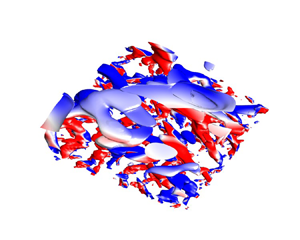
Vorticity cascade and turbulent drag in wall-bounded flows: plane Poiseuille flow
- Part of
-
- Journal:
- Journal of Fluid Mechanics / Volume 974 / 10 November 2023
- Published online by Cambridge University Press:
- 31 October 2023, A27
-
- Article
-
- You have access
- Open access
- HTML
- Export citation
-
Drag for wall-bounded flows is directly related to the spatial flux of spanwise vorticity outward from the wall. In turbulent flows a key contribution to this wall-normal flux arises from nonlinear advection and stretching of vorticity, interpretable as a cascade. We study this process using numerical simulation data of turbulent channel flow at friction Reynolds number $Re_\tau =1000$. The net transfer from the wall of spanwise vorticity created by downstream pressure drop is due to two large opposing fluxes, one which is ‘down-gradient’ or outward from the wall, where most vorticity concentrates, and the other which is ‘up-gradient’ or toward the wall and acting against strong viscous diffusion in the near-wall region. We present evidence that the up-gradient/down-gradient transport occurs by a mechanism of correlated inflow/outflow and spanwise vortex stretching/contraction that was proposed by Lighthill. This mechanism is essentially Lagrangian, but we explicate its relation to the Eulerian anti-symmetric vorticity flux tensor. As evidence for the mechanism, we study (i) statistical correlations of the wall-normal velocity and of wall-normal flux of spanwise vorticity, (ii) vorticity flux cospectra identifying eddies involved in nonlinear vorticity transport in the two opposing directions and (iii) visualizations of coherent vortex structures which contribute to the transport. The ‘D-type’ vortices contributing to down-gradient transport in the log layer are found to be attached, hairpin-type vortices. However, the ‘U-type’ vortices contributing to up-gradient transport are detached, wall-parallel, pancake-shaped vortices with strong spanwise vorticity, as expected by Lighthill's mechanism. We discuss modifications to the attached eddy model and implications for turbulent drag reduction.

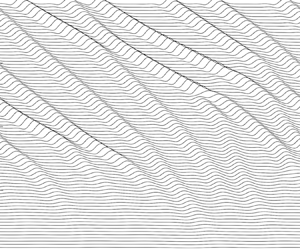
A long-wave model for film flow inside a tube with slip
-
- Journal:
- Journal of Fluid Mechanics / Volume 974 / 10 November 2023
- Published online by Cambridge University Press:
- 31 October 2023, A22
-
- Article
-
- You have access
- Open access
- HTML
- Export citation
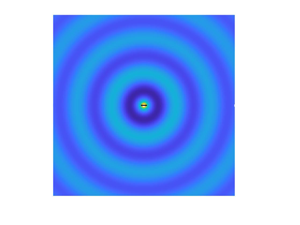
Non-continuum effects on the sound of a heated line source: from a monopole to non-isotropic radiation
-
- Journal:
- Journal of Fluid Mechanics / Volume 974 / 10 November 2023
- Published online by Cambridge University Press:
- 31 October 2023, A28
-
- Article
-
- You have access
- Open access
- HTML
- Export citation
Supersonic gas jet stabilization in laser–plasma acceleration
- Part of
-
- Journal:
- High Power Laser Science and Engineering / Volume 11 / 2023
- Published online by Cambridge University Press:
- 31 October 2023, e91
-
- Article
-
- You have access
- Open access
- HTML
- Export citation
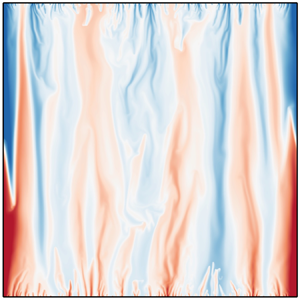
Flow structure transition in thermal vibrational convection
-
- Journal:
- Journal of Fluid Mechanics / Volume 974 / 10 November 2023
- Published online by Cambridge University Press:
- 31 October 2023, A29
-
- Article
-
- You have access
- Open access
- HTML
- Export citation
-
This study investigates the effect of vibration on the flow structure transitions in thermal vibrational convection (TVC) systems, which occur when a fluid layer with a temperature gradient is excited by vibration. Direct numerical simulation (DNS) of TVC in a two-dimensional enclosed square box is performed over a range of dimensionless vibration amplitudes $0.001 \le a \le 0.3$ and angular frequencies $10^{2} \le \omega \le 10^{7}$, with a fixed Prandtl number of 4.38. The flow visualisation shows the transition behaviour of flow structure upon the varying frequency, characterising three distinct regimes, which are the periodic-circulation regime, columnar regime and columnar-broken regime. Different statistical properties are distinguished from the temperature and velocity fluctuations at the boundary layer and mid-height. Upon transition into the columnar regime, columnar thermal coherent structures are formed, in contrast to the periodic oscillating circulation. These columns are contributed by the merging of thermal plumes near the boundary layer, and the resultant thermal updrafts remain at almost fixed lateral position, leading to a decrease in fluctuations. We further find that the critical point of this transition can be described nicely by the vibrational Rayleigh number ${{Ra}}_{vib}$. As the frequency continues to increase, entering the so-called columnar-broken regime, the columnar structures are broken, and eventually the flow state becomes a large-scale circulation (LSC), characterised by a sudden increase in fluctuations. Finally, a phase diagram is constructed to summarise the flow structure transition over a wide range of vibration amplitude and frequency parameters.


Interplay between Brownian and hydrodynamic tracer diffusion in suspensions of swimming microorganisms
-
- Journal:
- Journal of Fluid Mechanics / Volume 974 / 10 November 2023
- Published online by Cambridge University Press:
- 31 October 2023, A25
-
- Article
-
- You have access
- Open access
- HTML
- Export citation
-
The general problem of tracer diffusion in non-equilibrium baths is important in a wide range of systems, from the cellular level to geographical length scales. In this paper, we revisit the archetypical example of such a system: a collection of small passive particles immersed in a dilute suspension of non-interacting dipolar microswimmers, representing bacteria or algae. In particular, we consider the interplay between thermal (Brownian) diffusion and hydrodynamic (active) diffusion due to the persistent advection of tracers by microswimmer flow fields. Previously, it has been argued that even a moderate amount of Brownian diffusion is sufficient to significantly reduce the persistence time of tracer advection, leading to a significantly reduced value of the effective active diffusion coefficient $D_A$ compared to the non-Brownian case. Here, we show by large-scale simulations and kinetic theory that this effect is in fact practically relevant only for microswimmers that effectively remain stationary while still stirring up the surrounding fluid – so-called shakers. In contrast, for moderate and high values of the swimming speed, relevant for biological microswimmer suspensions, the effect of Brownian motion on $D_A$ is negligible, leading to the effects of advection by microswimmers and Brownian motion being additive. This conclusion contrasts with previous results from the literature, and encourages a reinterpretation of recent experimental measurements of $D_A$ for tracer particles of varying size in bacterial suspensions.


High-efficiency bismuth borate-based optical parametric chirped pulse amplifier with approximately 2.1 mJ, 38 fs output pulses at approximately 2150 nm – ERRATUM
-
- Journal:
- High Power Laser Science and Engineering / Volume 11 / 2023
- Published online by Cambridge University Press:
- 31 October 2023, e75
-
- Article
-
- You have access
- Open access
- HTML
- Export citation
Effect of Stokes number and particle-to-fluid density ratio on turbulence modification in channel flows
-
- Journal:
- Journal of Fluid Mechanics / Volume 974 / 10 November 2023
- Published online by Cambridge University Press:
- 31 October 2023, A26
-
- Article
-
- You have access
- Open access
- HTML
- Export citation
-
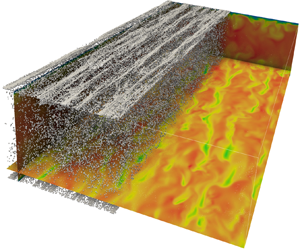
Two-way momentum-coupled direct numerical simulations of a particle-laden turbulent channel flow are addressed to investigate the effect of the particle Stokes number and of the particle-to-fluid density ratio on the turbulence modification. The exact regularised point-particle method is used to model the interphase momentum exchange in presence of solid boundaries, allowing the exploration of an extensive region of the parameter space. Results show that the particles increase the friction drag in the parameter space region considered, namely the Stokes number $St_+ \in [2,80]$, and the particle-to-fluid density ratio $\rho _p/\rho _f \in [90,5760]$ at a fixed mass loading $\phi =0.4$. It is noteworthy that the highest drag occurs for small Stokes number particles. A measurable drag increase occurs for all particle-to-fluid density ratios, the effect being reduced significantly only at the highest value of $\rho _p/\rho _f$. The modified stress budget and turbulent kinetic energy equation provide the rationale behind the observed behaviour. The particles’ extra stress causes an additional momentum flux towards the wall that modifies the structure of the buffer and of the viscous sublayer where the streamwise and wall-normal velocity fluctuations are increased. Indeed, in the viscous sublayer, additional turbulent kinetic energy is produced by the particles’ back-reaction, resulting in a strong augmentation of the spatial energy flux towards the wall where the energy is ultimately dissipated. This behaviour explains the increase of friction drag in particle-laden wall-bounded flows.



A multiple time scale approach for anisotropic inertial wave turbulence
-
- Journal:
- Journal of Fluid Mechanics / Volume 974 / 10 November 2023
- Published online by Cambridge University Press:
- 31 October 2023, A24
-
- Article
- Export citation
Universal law of skin-friction coefficient in a fully developed zero pressure gradient axisymmetric turbulent boundary layer flow
-
- Journal:
- Journal of Fluid Mechanics / Volume 974 / 10 November 2023
- Published online by Cambridge University Press:
- 31 October 2023, A31
-
- Article
- Export citation
-
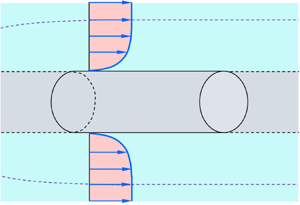
Understanding the skin friction in an axisymmetric turbulent boundary layer (ATBL) flow is a key to designing and optimising the flow past axisymmetric bodies, for example, a rocket engine nozzle and a submarine hull. In this study, we propose a universal law of the skin-friction coefficient in an ATBL flow. The flow is steady and fully developed with a zero pressure gradient. The governing equation for the ATBL flow is derived by methodically applying the boundary layer approximation. Subsequently, the scaling law of the Reynolds shear stress, caused by turbulent eddies, at the surface tangential to the wall roughness summits is derived by incorporating the role of transverse curvature. The skin-friction coefficient in a smooth ATBL flow is found to depend on two parameters, namely, the Reynolds number based on the cylinder radius, Rea, and the ratio of boundary layer thickness to cylinder radius, δ/a. The analysis predicts a simple form of the skin-friction coefficient as ${C_f} = 4.56 \times {10^{ - 2}}{[R{e_a}\ln (1 + \delta /a)]^{ - 1/4}}$, which agrees satisfactorily with the available experimental data and the numerical simulations in all the axisymmetric flow regimes. The proposed law, in the limit of infinite radius, is consistent with the classical law of the skin-friction coefficient in a plane turbulent boundary layer flow as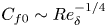 ${C_{f0}}\sim Re_\delta ^{ - 1/4}$, where Reδ is the Reynolds number based on the boundary layer thickness. This study reveals that, for δ/a < 1, the relative skin-friction coefficient, $({C_f} - {C_{f0}})/{C_{f0}}$, follows a linear law with δ $/$a.
$/$a.


Linear disturbance growth induced by viscous dissipation in Darcy–Bénard convection with throughflow
-
- Journal:
- Journal of Fluid Mechanics / Volume 974 / 10 November 2023
- Published online by Cambridge University Press:
- 31 October 2023, A15
-
- Article
- Export citation
Deployable optics for the Buccaneer Main Mission (BMM)
- Part of
-
- Journal:
- The Aeronautical Journal / Volume 127 / Issue 1318 / December 2023
- Published online by Cambridge University Press:
- 31 October 2023, pp. 2068-2081
-
- Article
-
- You have access
- Open access
- HTML
- Export citation
