To save content items to your account,
please confirm that you agree to abide by our usage policies.
If this is the first time you use this feature, you will be asked to authorise Cambridge Core to connect with your account.
Find out more about saving content to .
To save content items to your Kindle, first ensure no-reply@cambridge.org
is added to your Approved Personal Document E-mail List under your Personal Document Settings
on the Manage Your Content and Devices page of your Amazon account. Then enter the ‘name’ part
of your Kindle email address below.
Find out more about saving to your Kindle.
Note you can select to save to either the @free.kindle.com or @kindle.com variations.
‘@free.kindle.com’ emails are free but can only be saved to your device when it is connected to wi-fi.
‘@kindle.com’ emails can be delivered even when you are not connected to wi-fi, but note that service fees apply.
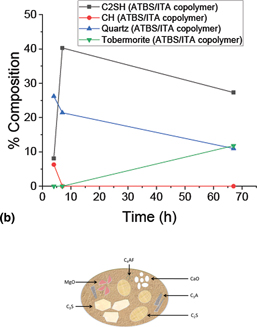
Powerful synergies between phosphonate, zinc oxide, and acrylamido-tert-butyl-sulfonate (ATBS) copolymer chemical additives render superior performance in a high-temperature retarder system for oil well grade Portland cement. The phosphonate retarder and ATBS-based retarders establish a two-tiered strength development where amorphous C-S-H converts to crystalline dicalcium silicate hydrate (C2SH) in the first (low compressive strength) tier prior to the reaction of Portlandite with quartz. The three additive retarder system can be tuned with nanosilica to eliminate the two-tiered strength development effect leading to a smooth transition from the cement in the slurry form directly to its highest compressive strength.
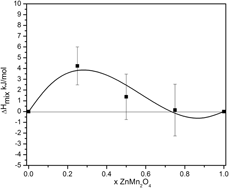
The thermodynamic properties of ZnxMn3−xO4 and Mg1−zCuzCr2O4 spinel solid solutions have been studied using high-temperature oxide melt solution calorimetry. Except for MgCr2O4 spinel, which possesses cubic structure, the other three end-members are tetragonal. The enthalpies of mixing are small endothermic and fit subregular solution behavior. The main contribution to the energetics of mixing of both spinel systems comes from the difference in the crystal structure between the end-members: a change in the tetragonal distortion for ZnxMn3−xO4 solid solutions and a transition from cubic to tetragonal for the Mg1−zCuzCr2O4 system. If all Mg1−zCuzCr2O4 spinels possessed the same structure, the mixing enthalpies would be close to zero. Because both series have normal cation distributions, the entropies of mixing are equal to the configurational entropies of mixing of Zn2+ and Mn2+ and of Mg2+ and Cu2+ on tetrahedral sites, and the activities would follow Raoult’s law. The calculated Gibbs energy of mixing confirms the absence of solvus at any temperature for both systems.
Learn from the experts about industrial crystallization in this third edition of a widely regarded classic that has been completely revised to reflect the latest developments in the field. New chapters on crystal nucleation, molecular modelling application, and precipitation and crystallization of pigments and dyes are included, as well as completely revised chapters on crystallization of proteins, crystallizer selection and design, control of crystallization processes, and process analytical technology. Richly illustrated with 150 new diagrams and photographs, and with dozens of practical hands-on examples, this is an ideal introduction for newcomers, and serves as an excellent reference for experienced professionals covering aspects of industrial crystallization in a single, complete volume.
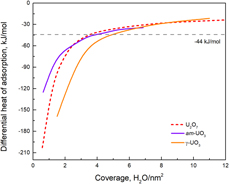
Enthalpies of water adsorption on amorphous and crystalline oxides and peroxides of uranium are reported. Despite substantial structural and computational research on reactions between actinides and water, understanding their surface interactions from the energetic perspective remains incomplete. Direct calorimetric measurements of hydration energetics of nano-sized, bulk-sized UO2, U3O8, anhydrous γ-UO3, amorphous UO3, and U2O7 were carried out, and their integral adsorption enthalpies were determined to be −67.0, −70.2, −73.0, −84.1, −61.6, and −83.6 kJ/mol water, with corresponding water coverages of 4.6, 4.5, 4.1, 5.2, 4.4, and 4.1 H2O per nm2, respectively. These energetic constraints are important for understanding the interfacial phenomena between water and U-containing phases. Additionally, this set of data also helps predict the absorption and desorption behavior of water from nuclear waste forms or used nuclear fuels under repository conditions. There are also underlying relations for water coverage among different U compounds. These experimentally determined data can be used as benchmark values for future computational investigations.
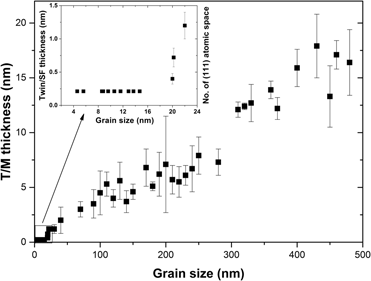
Grain size effect on twin thickness has been rarely investigated, especially when the grain size is less than 1000 nm. In our previous work (Mater. Sci. Eng.A527, 3942, 2010), different severe plastic deformation techniques were used to achieve a wide range of grain sizes from about 3 μm to 70 nm in a Cu–30% Zn alloy. Transmission electron microscopy (TEM) revealed a gradual decrease in the deformation twin thickness with decreasing grain size. In the present work, high-resolution TEM was used to further identify deformation twins and measure their thickness, especially for grain sizes below 70 nm. The twin thickness was found to gradually reduce with decreasing grain size, until a critical size (20 nm), below which only stacking faults were observed. Interestingly, the relationship between twin thickness and grain size in the ultrafine/nanocrystalline regime is found similar to that in the coarse-grained regime, despite the differences in their twinning mechanisms. This work provides a large set of data for setting up a model to predict the twin thickness in ultrafine-grained and nanocrystalline face-centered cubic materials.
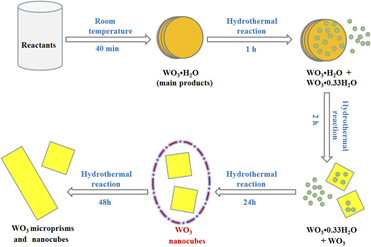
Regular WO3 nanocubes have been prepared on a large scale through a convenient hydrothermal route at the temperature of 200 °C. The products were characterized by powder X-ray diffraction (XRD), field-emission scanning electron microscopy, UV-vis diffuse reflectance spectroscopy (DRS), and photoluminescence (PL) spectroscopy. A crystal growth process for WO3 nanocubes was simply proposed based on the comparative experiments. The band gap energy (Eg) was determined to be 2.58 eV based on the UV-vis DRS analysis, and the PL spectrum exhibited a strong blue light emission band centered at 469 nm. The as-prepared WO3 nanocubes showed higher visible light photocatalytic performance for degrading rhodamine B compared with WO3·H2O and WO3·0.33H2O/WO3 which were obtained at 80 °C and 140 °C, respectively, suggesting potential application in the region of wastewater purification.
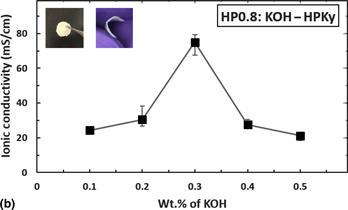
Polymeric electrolytes have attracted recent research interest because they offer the advantages of being safe and non-flammable, having no dendrite formation, and having no possibility of leakage. The incorporation of synthetic polymers to gel electrolytes has numerous disadvantages: for instance, the required preparation time for creating gel electrolytes from synthetic polymers is dubious and lengthy. Additionally, the conventional pristine polymer gel electrolyte layer has been reported to have low ionic conductivity. This work is focused on preparing a thin flexible gel electrolyte layer by using a naturally occurring wood-based nanofiber cellulose (NFC) hydrogel, to overcome the energy and time consumption of conventional processes. In addition, we use polyvinyl alcohol (PVA) as an additive to the NFC hydrogel in controlled amounts to fabricate a stable thin gel electrolyte layer. By using x-ray diffraction, optical microscopy, and Fourier transform infrared spectra studies, we were able to further our understanding of the microstructure of the films: i.e., the penetration and cross-linking (changes in the bonding structures) of semi-crystalline PVA and hydrogel to form a flexible gel electrolyte layer. The NFC hydrogel-PVA films resulted in much higher ionic conductivity values when compared to other existing pristine polymer electrolytes. The addition of KOH to the NFC hydrogel-PVA further enhanced the ionic conductivity. The best ionic conductivity recorded was 75 mS/cm for films with thickness in the range of 200–350 µm, which is comparable to the highest reported ionic conductivity values of gel electrolytes.
The growing application of data-driven analytics in materials science has led to the rise of materials informatics. Within the arena of data analytics, deep learning has emerged as a game-changing technique in the last few years, enabling numerous real-world applications, such as self-driving cars. In this paper, the authors present an overview of deep learning, its advantages, challenges, and recent applications on different types of materials data. The increasingly availability of materials databases and big data in general, along with groundbreaking advances in deep learning offers a lot of promise to accelerate the discovery, design, and deployment of next-generation materials.
Machine-learning (ML) approaches have proven to be of great utility in modern materials innovation pipelines. Generally, ML models are trained on predetermined past data and then used to make predictions for new test cases. Active-learning, however, is a paradigm in which ML models can direct the learning process itself through providing dynamic suggestions/queries for the “next-best experiment.” In this work, the authors demonstrate how an active-learning framework can aid in the discovery of polymers possessing high glass transition temperatures (Tg). Starting from an initial small dataset of polymer Tg measurements, the authors use Gaussian process regression in conjunction with an active-learning framework to iteratively add Tg measurements of candidate polymers to the training dataset. The active-learning framework employs one of three decision making strategies (exploitation, exploration, or balanced exploitation/exploration) for selection of the “next-best experiment.” The active-learning workflow terminates once 10 polymers possessing a Tg greater than a certain threshold temperature are selected. The authors statistically benchmark the performance of the aforementioned three strategies (against a random selection approach) with respect to the discovery of high-Tg polymers for this particular demonstrative materials design challenge.
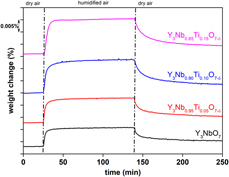
The defect fluorite titanium-doped yttrium niobate samples Y3Nb1−xTixO7−δ have been synthesized and investigated by the means of high-temperature X-ray diffraction, dilatometry, and thermogravimetry. Thermal expansion coefficients (TECs) as well as chemical expansion coefficients for material with 5, 10, and 15 mol% of titanium were determined. All investigated samples exhibit chemical contraction caused by Ti doping. The values of TECs obtained by two different methods show similar results, which suggests the isotropy of the polycrystalline ceramic. Thermogravimetric studies have shown that all of the compositions exhibit a mass increase upon being exposed to a humid air atmosphere. The total proton concentration calculated on the basis of these results was in the range of 0.1 mol%. Moreover, titanium content influences chemical expansion coefficient, water uptake, and protonic defects concentration, whereas it does not significantly affect the values of TECs.
In this contribution, we devoted ourselves to fabricating aggregation-induced emission (AIE) activity copolymers via one-pot combination of RAFT polymerization and Biginelli reaction for the first time. When the feeding ratio of TPB was 33.5%, the molar fraction of TPB was, respectively, about 14.2 and 22.5% in PEG-PTE1 copolymers by two-step strategy and PEG-PTE2 copolymers by one-pot strategy with the similar structure. The Mn of PEG-PTE1 increased to 59,300 from 52,800 of PEG-AE presoma with narrow PDI, which was more than Mn of PEG-PTE2 with 52,300. As compared with PEG-PTE2, when the feeding ratio of TPB was 48.6%, the molar fraction of TPB increased to 32.6% in PEG-PTE3. In aqueous solution, the as-obtained PEG-PTE2 copolymers can self-assemble into fluorescent organic nanoparticles (FONs) with 100–180 nm spherical morphology, the maximal emission peak of which presented at 460 nm with the obvious AIE phenomenon. Moreover, due to the low toxicity and excellent cell dyeing behavior, the as-prepared PEG-PTE2 copolymers displayed great potential for biomedical applications.
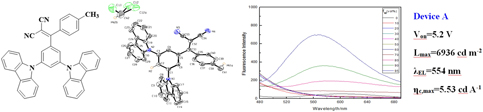
In this work, a new phenylethylene derivative, named 2-((3,5-di(9H-carbazol-9-yl)phenyl)(p-tolyl)methylene)malononitrile (DCPTMM), is synthesized and characterized by 1H NMR, 13C NMR spectroscopies, mass spectrum, and X-ray crystallography. Its photophysical properties are systematically studied and the result illustrates that DCPTMM shows aggregation-induced emission (AIE). The X-ray single crystal diffraction shows that the individual structure of crystals is monoclinic system with space group symbol P21/c and presents a twisted propeller-type structure as well as the packing structure of crystals has multiple types of hydrogen bonds (C–H⋯π and C–H⋯N) formed between adjacent molecules, and there is no π–π interaction between the aromatic rings, which is the main reason for the formation of AIE. Nondoped OLED fabricated with DCPTMM as light emitting layer emits greenish yellow light with a maximum emission peak of 554 nm and has relatively good performance with a maximum current efficiency of 5.53 cd/A and a maximum brightness of 6936 cd/m2.
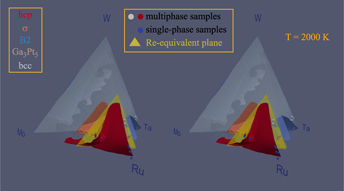
While rhenium has proven to be an ideal material in fast-cycling high-temperature applications such as rocket nozzles, its prohibitive cost limits its continued use and motivates a search for viable cost-effective substitutes. We show that a simple design principle that trades off average valence electron count and cost considerations proves helpful in identifying a promising pool of candidate substitute alloys: The Mo–Ru–Ta–W quaternary system. We demonstrate how this picture can be combined with a computational thermodynamic model of phase stability, based on high-throughput ab initio calculations, to further narrow down the search and deliver alloys that maintain rhenium’s desirable hcp crystal structure. This thermodynamic model is validated with comparisons to known binary phase diagram sections and corroborated by experimental synthesis and structural characterization demonstrating multiprinciple-element hcp solid-solution samples selected from a promising composition range.
This paper presents an example of comparing geochemical and mineralogical data by means of the statistical analysis of the X-ray diffraction patterns and the chemical compositions of bulk samples. The proposed methodology was tested on samples of metasomatic rocks from two geologically different objects. Its application allows us to mathematically identify all the main, secondary and some accessory minerals, to qualitatively estimate the contents of these minerals, as well as to assess their effect on the distribution of all petrogenic and investigated trace elements in a short period of time at the earliest stages of the research. We found that the interpretation of the results is significantly influenced by the number of samples studied and the quality of diffractograms.
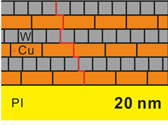
In order to reveal the quantitative relationship between fatigue crack deflection path and cross-sectional grain boundary (GB) arrangement of metallic nanolayered composites (NLCs), a stochastic model was established based on the interface-dominant fatigue damage for the ultrafine-scale NLCs. The model indicates that the crack deflection length decreases with decreasing GB arrangement deviation and grain size of constituent layers. The observation and quantitative analysis of fatigue cracking behavior of the Cu/W multilayers with a layer thickness of 5 and 20 nm was conducted to verify the model.
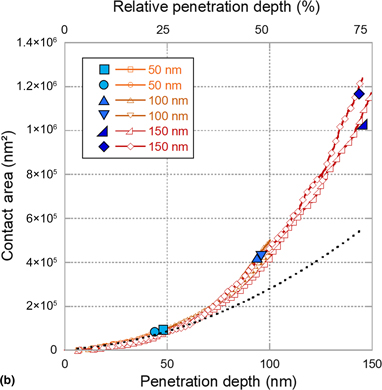
In the past decades, efforts have been made to couple nanoindentation with resistive measurements in order to monitor the real-time contact area, as an alternative to the use of traditional analytical models. In this work, a novel and efficient stand-alone method is proposed to compute the contact area using resistive-nanoindentation of noble metals (bulk or thin films). This method relies on three steps: tip shape measurement, set-up calibration, application to the sample to be characterized. The procedure is applied to nanoindentation tests on a sample with film-on-elastic-substrate rheology and is successfully validated against experimental measurements of the contact area.
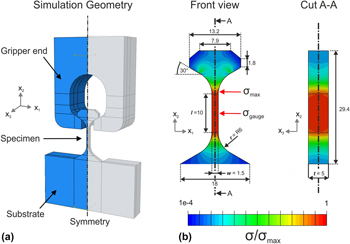
A novel microtensile setup was developed to overcome typical issues encountered in small-scale testing, particularly sample fabrication, sample handling, and misalignment. The system features a silicon (Si) gripper, which is able to self-align with the specimen main axis. Finite element simulations were employed to optimize the microtensile specimen geometry and to mechanically characterize the system. Specimens were prepared using focused ion beam milling, while reactive ion etching was employed to produce the grippers. The system was calibrated using single-crystal (100) Si specimens. The strength asymmetry of brittle crystals was investigated on the example of gallium arsenide (GaAs). Microtensile GaAs specimens and square micropillars sharing lowest dimensions of 1.70 ± 0.19 µm were tested along the [001] crystallographic orientation. Micropillars underwent plastic deformation via twinning in {111} planes and exhibited yield stress of 2.60 ± 0.14 GPa. The tensile experiment showed brittle failure at 1.86 ± 0.17 GPa associated with complex fracture surfaces and no measurable dislocation activity.