To save content items to your account,
please confirm that you agree to abide by our usage policies.
If this is the first time you use this feature, you will be asked to authorise Cambridge Core to connect with your account.
Find out more about saving content to .
To save content items to your Kindle, first ensure no-reply@cambridge.org
is added to your Approved Personal Document E-mail List under your Personal Document Settings
on the Manage Your Content and Devices page of your Amazon account. Then enter the ‘name’ part
of your Kindle email address below.
Find out more about saving to your Kindle.
Note you can select to save to either the @free.kindle.com or @kindle.com variations.
‘@free.kindle.com’ emails are free but can only be saved to your device when it is connected to wi-fi.
‘@kindle.com’ emails can be delivered even when you are not connected to wi-fi, but note that service fees apply.
Civic education and civic competencies have been repeatedly emphasized as key features of democratic societies.1 In 2001, the European Commission included active citizenship among four aims of education; a 2006 Recommendation included social and civic competencies as one of the eight key competencies for lifelong learning, recommending their development beginning in preschool through higher education, and a Declaration in 2015 again repeated the importance of education in raising youth as responsible, open, active, and tolerant citizens (European Commission, 2001, 2006; and the 2015 Paris Declaration2). The importance of including civic education courses in compulsory education curricula in order to achieve these aims has been repeatedly demonstrated (Kennedy, 2019). Fostering a democratic culture relies on instilling broader values of ‘democratic commitment, social inclusion, tolerance, and the need for more equitable societies’ (Holle, 2022, p 51) as well as developing skills such as analysis, critical thinking, consideration of alternatives, multi-perspectivity, ability to transcend own options, conflict resolution skills, and applying these concepts in practice (Bergan, 2013).
In Central and Eastern Europe (CEE) specifically, scholars have paid attention to the issue of civic education because of its potential in democratic consolidation and the democratic (re)socialization of citizens (Torney-Purta, 2002; see also Kolleck and Karolewski, Chapter 1, this volume). However, these countries are generally seen as lagging behind other European states in adequate policy responses (EECEA, 2017). To examine these issues, several strands of research have proliferated since the early 2000s.
Of all the many instruments that symbolized scientific endeavour in British India by the end of the nineteenth century, microscopes were among the most iconic, and yet, for both empirical and ideological reasons, their rise to scientific authority was slow and often contested. Moving from recreational use and marginal scientific status in the 1830s, by the 1870s microscopes were becoming integral to colonial education and governance and deployed across a wide scientific spectrum, their expanding use and heightened public presence facilitated by a rich and diverse visual culture. The eventual triumph of the microscope in India cannot be detached from its ongoing entanglement with local issues and agencies, its ascent to medical authority in particular constrained by scepticism about its utility. In this battle of instruments and imaginaries, microscopes – political emblems as well as material objects and scientific tools – pose critical questions about the visibility of science in a colonial context, about evolving techniques of seeing and representation, about the racialization of science and about the individual or collective authority of those who sought empowerment through the lens.
The central focus of political socialization and citizenship education is to form the bedrock of a functioning democracy, primarily taking root during adolescence and shaped by the experiences of youth within their sociopolitical contexts (Eckstein, 2019, p 417). Influences range from vast, intricate phenomena such as the climate crisis, the COVID-19 pandemic, and the war in Ukraine to more intimate socialization within peer groups, families, and schools. The COVID-19 pandemic has significantly curtailed these essential socialization channels, casting a shadow of uncertainty over the future in terms of environmental conservation, education, and economic stability. Notably, climate change and the COVID-19 pandemic rank among the primary concerns of German youth, signalling a significant shift in public opinion on these political issues (Schoen, 2006). These considerations emphasize the need to incorporate the political attitudes of Germany's youth into decision-making processes, bolster citizenship education, and counter the spread of extremist and conspiracy-linked beliefs. Especially in times of crisis, extreme or conspiratorial political positions often offer a seemingly simple solution to the complex challenges of the time and usually spread when people are confronted with surprising and frightening events (van Prooijen and Douglas, 2017). Conspiracy theories often act as catalysts for violence. For instance, right-wing groups in Germany have been at the forefront of promoting extremist and conspiracy theory-fuelled violence, with movements such as the anti-vaccination movement and PEGIDA representing vivid examples (Körner, 2020, p 388)
In this volume, we have carried out a multifaceted exploration of citizenship education and citizenship practices in Central and Eastern Europe focusing mainly on insights from Political Science and Education Studies. Our point of departure was the acknowledgement of a significant gap in research on citizenship, which has necessitated a more interdisciplinary discussion of the topic at hand. Each chapter of the volume has contributed a unique perspective, allowing for insights that, taken together, have deepened our understanding of citizenship practices in this dynamic region.
Key themes
Citizenship is not a monolithic concept but rather a multilayered phenomenon, shaped by historical legacies, sociopolitical contexts, and educational systems. The pluralist approach adopted throughout this volume has allowed us to spell out the diversity of citizenship practices – from the conventional to the avant-garde – and has unveiled the interplay between citizenship and democracy. In this context, education emerges as a cornerstone in shaping citizenship practices. The role of formal, non-formal, and informal educational settings in cultivating civic virtues and political engagement has thus been a recurrent theme throughout the volume. By scrutinizing these civic and educational landscapes, we have uncovered the transformative potential of education in fostering active and informed citizenship among the youth – the future generations of citizens. Moreover, our comparative lens has highlighted both convergences and divergences across countries in the region. The impact of historical legacies, societal structures, and geopolitical shifts on citizenship practices has been explored, contributing to a map of citizenship practices in this dynamic region.
Democracy in Europe currently faces multiple challenges stemming from strengthened neo-nationalist movements, the democratic deficit of the European Union (EU), and the effects of grand global issues including the changing climate, pandemics, migration, and, most recently, the Russian war within the east of Europe (Cambien et al, 2020). Especially in Central and Eastern Europe (CEE), processes of de-Europeanization and de-democratization as well as a strengthening of political authoritarianism have been observed (Szymański, 2017). Citizenship education has been ascribed an important role by policy makers, civil society, and academics alike. Citizenship education can be understood as a concept that encompasses all educational efforts to qualify citizens to responsibly participate in social and democratic life (Solhaug, 2013). It can thus serve as a response to the developments mentioned previously since it has the potential to prepare learners for the challenges of the 21st century by using the indicated issues as learning opportunities and contributing to the development of civic competences (Besand, 2020).
However, the concept and practice of citizenship education is itself the subject of broad discussions and changes, especially in times of crisis (Ben-Porath, 2006). As comparative studies indicate, the way that citizenship education is currently understood and practised across European states is diverging: ‘Given that there is not one type of ideal citizen, there is not a single type of citizenship education either’ (EACEA, 2017, p 20). Thus, it can be seen as a complex matter linking a multitude of actors and levels.
Regional conflicts in Central and Eastern Europe (CEE), including the Belarusian political crisis in 2020 and the full-scale Russian war in Ukraine in 2022, have exposed the new potential of digital technology use for the engagement of society in all forms of service production, resistance, and mobilization. Against the background of digitalization reforms and increased general digital literacy of the population, the West's support for civic education in the region has contributed to the formation of a new generation of activists familiar with digital tools and platforms and, in general, to the creation of a favourable environment for the development of civic initiatives using digital technologies. This can be seen in the emergence of online platforms and digital tools which facilitate civic engagement and allow a wider audience to participate in the democratic process. For example, online petitions, social media campaigns, and digital activism have become increasingly prevalent, particularly among young people, in Belarus (see Astapova et al, 2022; Titarenko, 2022) and in Ukraine (Diuk, 2012; Bohdanova, 2014). Specifically, as Pospieszna and Galus (2020) note, the evaluation of a long-term civic education programme for young people from post-Soviet countries suggests that training experiences can lead to changes in line with democratic values and practices. Investment in social and human capital by Western donors, particularly in Belarus and Ukraine (Pospieszna and Galus, 2020; Pospieszna et al, 2023), has been of particular importance for fostering a vibrant civil society as a key element in promoting democratic change (see Chapter 2, this volume)
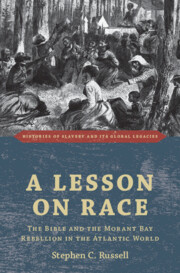
Stephen C. Russell tells the story of the Bible's role in Jamaica's 1865 Morant Bay rebellion and the international debates about race relations then occupying the Atlantic world. With the conclusion of the American Civil War and arguments about reconstruction underway, the Morant Bay rebellion seemed to serve as a cautionary tale about race relations. Through an interdisciplinary lens, the book demonstrates how those participating in the rebellion, and those who discussed it afterward, conceptualized events that transpired in a small town in rural Jamaica as a crucial instance that laid bare universal truths about race that could be applied to America. Russell argues that biblical slogans were used to encode competing claims about race relations. Letters, sermons, newspaper editorials, and legal depositions reveal a world in the grips of racial upheaval as everyone turned their attention to Jamaica. Intimately and accessibly told, the story draws readers into the private and public lives of the rebellion's heroes and villains.
Sidney Kark and H. Jack Geiger, superstars in the realm of social medicine, both got their start at a community health center in a remote, rural area of South Africa called Pholela. In Pholela, starting in 1940, Sidney Kark and his wife Emily developed what would become Community-Oriented Primary Care (COPC) with a team of Zulu-speaking nurses and community health workers and alongside area residents. In the 1950s, Geiger went to train in Pholela, bringing what he learned back to the United States. This chapter explores the development of COPC from the perspective of the people who lived in the health center’s catchment, uncovering the important role of Pholela’s residents in the creation of COPC and social medicine more generally. As COPC traveled out of Pholela, the efforts of Pholela’s African women were evident in places like Mississippi, USA, as COPC adapted to new realities and new needs. In focusing on Pholela’s residents and the health center’s Zulu-speaking team, this story of social medicine offers an important corrective to more common stories that focus on the doctors and pushes us to rethink how we understand medicine and who contributes to it.
Social medicine, as it was conceived of by left-wing medical doctors in Scandinavia from the 1930s became influential in the creation of a new role for medicine in the making of “the good society” and the political radicalism of social medicine was assimilated into the dominant, social democratic ideology. Several of the pioneers of the left-wing social medicine that had previously aimed for a disruption of the power balances in society, acquired hegemonic positions within the state medical bureaucracy. They constituted an expertise that, by and large, was responsible for the shaping of the national health policies in the “golden age” of the Scandinavian social democratic welfare states (1940s–70s). In this chapter, we discuss the coming into being and passing away of social medicine in the Scandinavian welfare states, exploring how it unfolded in the late twentieth century, in the clinic, in academia, and in health policy. We argue that in spite of its dominance within the central health bureaucracy, social medicine never managed to penetrate mainstream medicine and it left perhaps its strongest footprint abroad, in the field of international health.
The South Asian region consisting of India, Pakistan, Bangladesh, Nepal, and Sri Lanka share a common history of British colonial rule for nearly 200 years. Most of these countries gained independence during the 1940s. Western European ideas of social medicine found considerable resonance. However, through the process of anti-colonial struggle, new ideas on the relationship between society, medicine, and health were brought to light by actors such as practitioners of indigenous systems of medicine, leadership of the nationalist movement, the communist movement, and radical elements within the medical community and society. This chapter explores the engagement of diverse sets of actors from differing ideological positions that engaged in the relationship between society and health in the Indian subcontinent. It further seeks to explore how the Non-Aligned Movement created by postcolonial societies provided a platform for South–South networks in the economy and social sectors to define inclusive development. In medicine and health, there were efforts to redress inequalities through various reform initiatives that had local importance and influenced global health policies.
As a response to antisemitic stereotypes of Jews as weak and brainy, Zionism wanted Jews to develop their muscles instead. It was a useful call that coincided with the need to literally build the Jewish home in Palestine from the ground up. The agricultural development of land and the construction of villages and towns on it provided ample opportunities for Jews to become the kind of muscular Jews Zionism fantasized about. Later, when the Arab resistance to Jewish settlement grew, Jewish farmers developed into soldiers as well and completed the transformation of Jews.
In a world of growing health inequity and ecological injustice, how do we revitalize medicine and public health to tackle new problems? This groundbreaking collection draws together case studies of social medicine in the Global South, radically shifting our understanding of social science in healthcare. Looking beyond a narrative originating in nineteenth-century Europe, a team of expert contributors explores a far broader set of roots and branches, with nodes in Sub-Saharan Africa, South America, Oceania, the Middle East, and Asia. This plural approach reframes and decolonizes the study of social medicine, highlighting connections to social justice and health equity, social science and state formation, bottom-up community initiatives, grassroots movements, and an array of revolutionary sensibilities. As a truly global history, this book offers a more usable past to imagine a new politics of social medicine for medical professionals and healthcare workers worldwide. This title is also available as open access on Cambridge Core.
This paper examines Douglass North’s evolving recommendations for economic development policy. Using archival material, it traces how North’s historical analysis of economic growth shaped his policy prescriptions from the start of his career through the 1990s. In the 1950s and 1960s, North attributed US economic growth primarily to trade and productivity gains driven by the United States’s competitive market system and international trade, leading him to advocate market-oriented reforms. But from the 1970s onward, recognizing the critical role of institutions through his study of institutional history, he emphasized reducing transaction costs through extensive reforms in property rights and political systems. His archives reveal how his historical understanding of development made him increasingly skeptical of simplistic, market-oriented reforms, and underscore the originality of his policy proposals for Latin America and Eastern Europe in the 1980s and 1990s.
This article provides an overview of the main interpretations in contemporary historiography of the role of Italian political actors in the management of public debt during the First Republic, also in the context of European integration. In order to fill the gaps in historical research on this crucial issue, the conclusion proposes some questions and insights for future research.
The Berlin Conference (1884–85) is widely studied for its role in fuelling European imperialism and legitimising the scramble for Africa. However, its global impact beyond Europe and Africa has received little attention, with Latin America notably absent. This article examines how prominent diplomats from Argentina, Brazil, Colombia, and Mexico interpreted the proceedings. In their view, Europe’s renewed expansionism in Africa—combining private adventurism, colonisation enterprises, and imperial statecraft—resembled the great powers’ incursions into post-independence Latin America. They feared that new criteria for staking colonial claims would endanger their states’ sovereignty over vast, remote territories. Yet, while opposing intervention, these diplomats embraced civilisational thinking and state-building projects that echoed Eurocentric racial hierarchies. Their arguments reflected both resistance to imperialism and complicity in its logic. By tracing Berlin’s reverberations across multiple regions, this article highlights the broader repercussions of late nineteenth-century ‘high imperialism’ and reassesses the nature of Latin American anti-imperialism.