To save content items to your account,
please confirm that you agree to abide by our usage policies.
If this is the first time you use this feature, you will be asked to authorise Cambridge Core to connect with your account.
Find out more about saving content to .
To save content items to your Kindle, first ensure no-reply@cambridge.org
is added to your Approved Personal Document E-mail List under your Personal Document Settings
on the Manage Your Content and Devices page of your Amazon account. Then enter the ‘name’ part
of your Kindle email address below.
Find out more about saving to your Kindle.
Note you can select to save to either the @free.kindle.com or @kindle.com variations.
‘@free.kindle.com’ emails are free but can only be saved to your device when it is connected to wi-fi.
‘@kindle.com’ emails can be delivered even when you are not connected to wi-fi, but note that service fees apply.
In a world of growing health inequity and ecological injustice, how do we revitalize medicine and public health to tackle new problems? This groundbreaking collection draws together case studies of social medicine in the Global South, radically shifting our understanding of social science in healthcare. Looking beyond a narrative originating in nineteenth-century Europe, a team of expert contributors explores a far broader set of roots and branches, with nodes in Sub-Saharan Africa, South America, Oceania, the Middle East, and Asia. This plural approach reframes and decolonizes the study of social medicine, highlighting connections to social justice and health equity, social science and state formation, bottom-up community initiatives, grassroots movements, and an array of revolutionary sensibilities. As a truly global history, this book offers a more usable past to imagine a new politics of social medicine for medical professionals and healthcare workers worldwide. This title is also available as open access on Cambridge Core.
Despite the influence of key figures like Henry Sigerist and the Rockefeller Foundation, social medicine achieved a formal presence at only a handful of medical schools in the US, partly reflecting the political context in which “social medicine” was often heard as “socialized medicine.” Work that might otherwise have been called social medicine had to pass under other names. Does “social medicine” in the US only include those who self-identified with social medicine or does it include people who worked in the spirit of social medicine? Beginning with the recognized work of Sigerist and the Rockefeller, we then examine several Black social theorists whose work can now be recognized as social medicine. The Cold War context challenged would-be proponents of social medicine but different threads endured. The first, clinically oriented, focused on community health. The second, based in academic departments, applied the interpretive social sciences to explore the interspace between the clinical and the social. These threads converged in the 1990s and 2000s in new forms of social medicine considered as healthcare committed to social justice and health equity.
Brazil has a long tradition in the public health arena, with roots that can be traced to the colonial period, when the first medical schools were established in the country. The recent history of the field, however, became deeply intertwined with the struggle to re-democratize the country after the military coup of 1964. As part of a broad coalition, the movement for health reform was seeded by left-leaning public health physicians who were instrumental in designing what would become Brazil’s national healthcare system, the Sistema Único de Saúde (SUS), after the restoration of democracy. The creation of the Instituto de Medicina Social (Social Medicine Institute, IMS) at the Universidade do Estado do Rio de Janeiro (Rio de Janeiro State University) in 1970 was closely followed by the introduction of its Masters course in Social and Preventive Medicine in 1974, one of the pioneers in the field in Latin America, and is an important part of this development. The professors and researchers at the IMS were important actors both in the development of a theoretical body of work as well as in political at different levels of government. The account of this institution’s history, partially based on personal experience, is an important element of the general history of the field in Brazil.
In an international comparison, Sweden’s state higher education institutions are characterized by their form of association, as they are formally administrative authorities. An administrative authority under the government is subordinate to the government and is normally tasked with carrying out the tasks decided by the Riksdag and the government, which are communicated via regulations, instructions to authorities, letters of appropriation and specific assignments. It is easy to see that the stated relationship of obedience to the government does not sit well with the idea of universities being free from politics and the market. In this article the weak constitutional support of academic freedom in Sweden will be displayed and problematized, and a historic account of how Swedish universities have ended up with the same legal status as the state will be given. It is exposed how academic freedom is undermined not because of illiberal ambitions, which are often at the centre of this type of analysis, but rather due to a lack of understanding for the specificity of the university by the political and administrative sphere.
From Virchow to Allende, social medicine had been intertwined with left-wing or socialist political thought for over a century. While the prominence or significance of this connection ebbed and flowed in Western Europe and North America, the basic tenets underpinning social medicine gained new purchase in the “Global East” with the rise of state socialism and the emergence of a socialist world. Ideas around the role of social, environmental, and economic factors in health, coupled with revolutionary aims of new socialist regimes. What constituted “socialist medicine” and in what way did this, ideologically based concept prevalent in the East relate to ideas of “social medicine” in the West during the Cold War? Through and Eastern European lens, this chapter traces connections between socialist politics and health in emerging practices and ideas to map divergences and overlaps in what became a key issue in the Cold War that, at least in its rhetoric, set apart East and West.
Zionists wanted to develop a distinct Jewish national art. And although no one knew how to do it exactly, the hope was that the Zionist cultural revolution would eventually take on an aesthetic shape or sensibility as well. The first art academy that was established in Palestine in 1906, the Bezalel School of Arts and Crafts, emphasized the manufacture of crafts that would express the spirit of Jewish nationalism. The idea was to replace a Christian and European visual dictionary with references that would be more Jewish, that would reflect Palestine more closely, and would eventually become part of a uniquely Jewish visual subconscious. The success of the school was limited and it was eventually replaced by more conventional artistic schools in the spirit of European modernism. At the same time, the spirit of nationalism influenced almost all artists and designers, including painters, sculptors, illustrators, and graphic designers.
The Zionist revolution had a spatial and architectural dimension. Although the land Zionists bought in Palestine had been settled for centuries, they considered it virgin soil and wanted to reshape it in the spirit of Jewish nationalism. To take possession of this land, they spread small villages over it and introduced industrial farming. Most of the villages were agricultural cooperatives called kibbutz in Hebrew. Kibbutz cooperatives were developed to cope with the lack of infrastructure, means of production, lack of agricultural expertise and experience and expressed the national and socialist aspects of the Zionist movement. Land that could not be cultivated was covered by trees, small woods of pines and cypresses. Cities were less important for Zionists, with one exception, Tel Aviv, a low-density, green city that was inspired by anti-urban ideas imported from Europe.
Whereas the growing body of research into algorithmic memory technologies and the platformisation of memory has a media-centric approach, this article engages with the question of how users experience and make sense of such omnipresent technologies. By means of a questionnaire and follow-up qualitative interviews with young adults (born between 1997 and 2005) and a Grounded Theory approach, we empirically examine an object of study that has been mainly explored theoretically. Our study found four major experiences associated with algorithmic memory technologies: intrusive, dissonant, nostalgic, and practical. Connected to these experiences, we found four sets of practices and strategies of use: avoidance and non-use; curating and training; reminiscing; and cognitive offloading and managing identity through memory. Our results show that our participants’ use and awareness of algorithmic memory technologies are diverse and, at times, contradictory, and shape their attitudes towards their memories, whether they are mediated or not. Hence, our study offers nuances and new perspectives to extant research into algorithmic memory technologies, which often assumes particular users and uses.
The Intergovernmental Conference on Rural Hygiene held in Bandung, Dutch East Indies, in August 1937 is often discussed as a precursor to the 1978 Alma-Ata Declaration on Primary Health Care. In this chapter, we investigate the Bandung Conference’s antecedents rather than its legacy. We view “Bandung” as a synthetic formulation of various Southeast Asian initiatives, experiments, and experiences in rural hygiene and social medicine, most of which were designed and developed in areas under colonial rule. Primarily focusing on French Indochina and the Dutch East Indies, we explore the meanings of social medicine and rural hygiene in Southeast Asian contexts, where health measures were tied to (colonial) economic objectives, health budgets were limited, and populations mostly rural. However, the delegates at the Bandung Conference proposed highly idealistic programs that could not possibly be realized. Consequently, all lofty plans turned into a mirage that symbolically absolved colonial administrations from their responsibility to safeguard their subject’s health. Social medicine at Bandung was a tool for colonial governmentality at a time when colonial empires were contested and weakened.
Rudolf Virchow is regularly celebrated as one of the fathers of social medicine. This chapter explores the context in which Virchow wrote and published his famous statement that: “Medicine is a social science, and politics nothing but medicine at a larger scale.” I discuss Virchow’s epidemiological fact-finding mission to Upper Silesia and his involvement in the revolutionary events of 1848 and 1849. I also look at the ways in which Virchow’s achievements were framed during his lifetime and in the early twentieth century, when medicine in Germany was perceived, by many, to be undergoing a crisis, caused by materialism, specialization, and a growing dominance of laboratory medicine –developments then seen as in-line with Virchow’s aims. I argue that what we think of as social medicine is an American tradition which emerged at a particular point of time in the mid twentieth century and that the image of Virchow as the father of social medicine was created then, by scholars and activists such as George Rosen and Henry Sigerist, to provide this new tradition with a longer pedigree.
All human societies draw lines between disconnected events in their history and create illusions of continuity or topographies of the past. These traditions of remembering, which began in the Hebrew Bible, played an important part in the renewal of the Jewish festival calendar in the Yishuv. Festivals do this very well because their repetition year after year allows societies to emphasize historical connections and revise their stories of origin by creating unique emotional maps. The Zionist festival calendar did it especially well by revising old Jewish festivals and by inventing completely new ones as part of an updated program that emphasized the ancient Jewish agricultural past and the ancient Jewish military past, all in the spirit of Hebrew nationalism.
This chapter examines two Ghanaian health programs which embodied many ideas and practices of social medicine. The first is a system of village clinic-dispensaries which was built by chiefs and the communities whom they represented, providing treatment and advice to thousands of outpatients. The second is the Medical Field Units (MFUs), which arose from 1945, serving extensive rural areas that lay beyond the reach of both the colonial and early post-independence states. Their successes were recognized by the first government of independent Ghana and after independence in 1957, the MFU program was expanded countrywide and became central to the continued provision of basic health services when other parts of the national health system collapsed. However, ideologies of reduced welfare and severe austerity during Adjustment caused the closing-down of the program in the early 1990s. The chapter relates the evolution of the MFU program to social histories of individual advocacy, healthcare reforms from colonialism to independence, and shifts in internationally circulating economic beliefs regarding the role of welfare and the state.
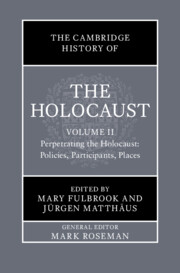
This ambitious pan-European overview explores the most significant causal factors, political developments, and societal forces that contributed to the perpetration of the Holocaust. Drawing on wide-ranging current scholarly expertise, this volume seeks to explain the genocidal scope and European dimensions of the crimes committed by Nazi Germany and its allies, collaborators, and facilitators across the continent during the war. It broadens the range of Holocaust research beyond the German initiators and organizers, however central these remain. Contributions look beyond simple or monocausal explanations in terms of, for example, Hitler's role or ideological antisemitism. Combining in-depth studies of specific locations and developments with overviews of thematic issues and wider questions, the second volume of the Cambridge History of the Holocaust offers concise analyses of the complex developments, varied interests, and interrelated events that were rooted in previous history and continue to influence the present within and beyond Europe. Cumulatively, this book presents a complex, multifaceted approach to understanding the uneven unfolding and escalation of the Holocaust.